Famous Londoners – Jim Jarvis…

An orphan who lived on London’s streets in the 1860s, Jim Jarvis is famous for having inspired Dr Thomas Barnardo to establish his first home for boys.

Barnardo had moved to London from Dublin in Ireland to train as a doctor and, after a cholera epidemic swept through the East End, leaving many children orphans, in 1867 he established the Hope Place Ragged School in Stepney where children could get a basic education for free.
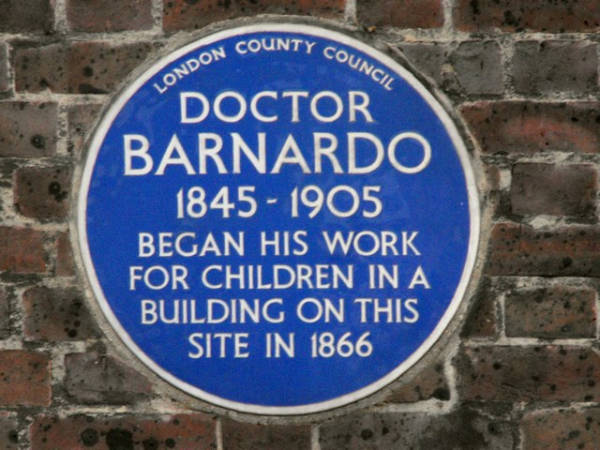
An English Heritage Blue Plaque marking the site of the school (now in Ben Jonson Road) where Barnardo says he met Jim Jarvis. PICTURE: © Peter Thwaite (licensed under CC BY-SA 2.0)

Jim Jarvis, who was 10-years-old at the time (although Barnardo later said he looked older but had the body of a boy of seven or eight), was one of the children who attended the school.

Barnardo’s account is that one night, after he was about to close the school, the boy had begged to be allowed to stay and, when pressed, had told his story.

Jarvis explained that had been living in a workhouse with his mother (he apparently never knew his father) but after she died, he ran away. Living on the streets of Stepney, he was initially helped by a woman who sold whelks and shrimp. He subsequently did some odd jobs for coal lighter but was treated very cruelly – this included the lighterman, ‘Swearin’ Dick’ setting his dog on him when he was drunk.

Jarvis was able to escape and lived on the streets for a time, including being briefly detained in a workhouse. Eventually he attended Barnardo’s newly opened ragged school and asked for help.

Jarvis explained that there were many other boys in a similar position to his own. Barnardo asked him to show him where some of these boys were staying, so Jim took him to a rooftop near a hayloft where 11 boys were sleeping in a huddle.

That encounter helped open Barnardo’s eyes to the hardships faced by the children in the East End – in his words, “I had seen enough, and I needed no fresh proof of the truth of his story or any new incentive to a life of active effort on behalf of destitute street lads”.

After the fateful night on which Jarvis told his story, Barnardo paid for Jarvis’ lodgings. It’s been suggested that, thanks to the aid of a charity, he later went to live on a Canadian farm.

Barnardo meanwhile, established his first home for boys in Stepney in 1870 – a place where they could live and learn skills such as carpentry, metalwork, and shoemaking to help them secure apprenticeships.

Barnardo went on to open further homes and by his death in 1905 the charity he and his wife Syrie Louise Elmslie founded had some 96 homes caring for more than 8,500 children.

Jarvis’ story is encapsulated in Berlie Doherty’s bestselling children’s novel, Street Child.
10 London ‘battlefields’ – 9. The Battle of Cable Street…

We hit the 20th century with this London ‘battle’, a confrontation in Stepney between police and a range of anti-fascist and fascist forces in the lead-up to World War II.

Battle-of-Cable-Street-red-plaqueThe ‘battle’ took place on a Sunday – 4th October, 1936 – following a summer of anti-Semitic violence and was sparked by a decision by the British Union of Fascists, led by Sir Oswald Mosley , to march through the East End, then the heartland of London’s Jewish community.

Incensed at the plans (and faced with government inaction despite calls for the march to be called off), anti-fascist protestors – which included large numbers of Jewish and Irish people as well as trade unionists, communists, socialists, anarchists and local residents – gathered initially at Gardiner’s Corner (named for a department store which once on the site at the junction of Whitechapel High Street and Commercial Road) to prevent the march.

The protestors were chanting and carrying banners which read “No Parasan” (“They shall not pass”, a slogan taken from anti-fascist forces who used it during the Spanish Civil War).

Estimates as to how many people turned out in protest vary widely – from 100,000 people up to as many as 250,000 or even 500,000 – but it’s clear that whatever the actual number, the crowd was huge and vastly outnumbered the up to 3,000 fascists – known as Blackshirts – who turned up to march and the 10,000 Metropolitan Police officers, some of whom were on horseback, sent to prevent the march from being disrupted.

With the path blocked despite police charges into the crowd, Mosley and his Blackshirts were advised by authorities to head south to Cable Street but there they encountered road-blocks made from furniture, paving stones and even apparently overturned lorries which appeared at the street’s west end, around the junction with Christian Street.

Police again attempted to clear the road but were blocked by the makeshift barricades and a wall of protestors while residents in houses lining the streets threw rubbish and even the contents of chamber pots at them. Police responded by sending in squads of men to snatch the ringleaders of the protests; protestors responded by ‘kidnapping’ some police officers.

Faced with continuing violence, Mosley was forced to abandon the march and the BUF were dispersed back through the City of London. The protestors meanwhile were said to have turned the event into a giant street party in celebration of their victory.

More than 100 people were said to have been injured in the violence and some 150 of the demonstrators were arrested. Most of the charges were of a minor nature but some of the ringleaders were given up to three year terms of imprisonment.

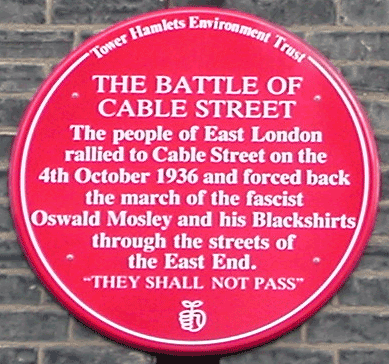
A large mural depicting the battle was painted on the side of St George’s Town Hall in Cable Street in the 1980s and there’s also a red plaque in nearby Dock Street (pictured) commemorating the incident.

Aside from a victory in itself, the battle was the catalyst for the passing of the Public Order Act of 1936 which meant the organisers of marches would henceforth have to seek permission of the police before holding them. It also banned demonstrators from marching in uniform.

PICTURED: A plaque commemorating the ‘battle’ in Dock Street which runs off the west end of Cable Street. Via Richard Allen/Wikipedia

What’s in a name?…Houndsditch…

This City of London thoroughfare runs between St Botolph and Outwich Streets and its name – first recorded in the 13th century – apparently relates to its location on the outer side of the wall, dating from the Roman era, which once encircled the city.

HoundsditchOn the outer side of the wall lay a ditch which, although filled and redug several times in its history, was eventually filled permanently in the 16th century (and became the street you can now walk upon).

Dogs were associated with this ditch – the skeletons of some dogs were found here in 1989 during an archaeological dig at the wall, possibly dating back to Roman times – although there’s a couple of theories on exactly how.

According to one version, the ditch, before it was finally filled, had become the repository of all sorts of rubbish but was particularly known as a site to deposit the corpses of dogs. An alternate theory, meantime, suggests that kennels which housed dogs used in hunting were once located here.

The name ‘houndsditch’ was apparently used for many sections of the ditch which lay outside the city wall before it came to be associated with this particular stretch of ditch.

The street (and the area in which it sits, also known as Houndsditch) has apparently been associated with several different trades over its history including bell founding, gunmaking and cannon founding and, later for the rag trade. In the 20th century, it was the site of department store, The Houndsditch Warehouse.

It was in Houndsditch that Dr Thomas Barnardo found 11 boys sleeping huddled together on the roof of the old rag market – a fact which helped push him to found the first of the Barnardo’s homes for the destitute in Stepney.

Famously, of course, it was also the scene of an attempted robbery and shoot-out in 1910 which led to the infamous Siege of Sidney Street (see our earlier post here).

For more on the Houndsditch murders, see Donald Rumbelow’s The Houndsditch Murders and the Siege of Sidney Street.

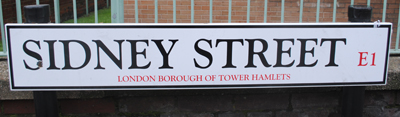
10 London sites associated with Sir Winston Churchill – 8. Sidney Street, Stepney…

Sidney-Street

Sir Winston Churchill will be forever associated with this now rather nondescript East London street, thanks to a series of events that occurred when he was Home Secretary.

Known as the Siege of Sidney Street or the Battle of Stepney, the event was sparked when, on 16th December, 1910, a gang of Russian and Latvian exiles attempted to break into a jewellers in Houndsditch by tunnelling from an adjacent property in Exchange Buildings.

Tipped off by a neighbour, the police arrived and in the series of events that followed, a number of officers were shot and three – Sergeant Charles Tucker, PC Walter Choate and Sergeant Robert Bentley – were killed (Sergeant Tucker died at the scene and the latter two later that day in hospital). The event became known as the Houndsditch Murders.

The gang members largely escaped – although one gang member, George Gardstein, was later found dead of wounds he had received during the gunfight – and an intensive manhunt commenced for the gang.

Some two weeks later, on 2nd January, 1911, police were informed that several members of the gang, including the alleged mastermind known as Peter the Painter (who may not have even existed or who may have been a Polish decorator Peter Piaktow), were hiding at a property at 100 Sidney Street.

Expecting fierce resistance, several hundred police officers moved in to surround the property the next day and, at dawn – after encountering heavy fire from the building, the siege began.

When the then 36-year-old Churchill received word of the siege (apparently while taking a bath), he made his way to the site, already attracting crowds of onlookers, to observe and apparently offer advice.

At the scene he authorised the use of the military – including a detachment of Scots Guards from the Tower of London and 13 pounder artillery pieces. These, drawn by the Royal Horse Artillery, had just arrived when a fire began to consume the building (it may have been sparked by a bullet hitting a gas pipe). The fire brigade attended but Churchill apparently refused them entry until the shooting stopped.

The gang members inside the building never attempted to escape the building and the remains of two of them – Latvians Fritz Svaars and William Sokolow – were subsequently found in its ruins.

Along with the thee policemen killed at the attempted burglary, a firefighter – Charles Pearson – was also killed, struck by falling debris. There is a memorial plaque to him at the former site of 100 Sidney Street.

Seven supposed members of the gang were eventually captured by police but all either had the charges dropped, were acquitted or had their convictions quashed.

Churchill’s role at the six hour siege was the matter of some controversy and former PM (and then Opposition Leader) Arthur Balfour was among those who accused him of acting improperly and risking lives.

There’s a famous photo of Churchill – who was recorded by one of his biographers saying the event had been “such fun” – peering around a corner at the scene (there’s a story that a bullet tore through his top hat, almost killing him, during the siege) while the event was also one of the first news stories to be captured on film (by Pathe News).