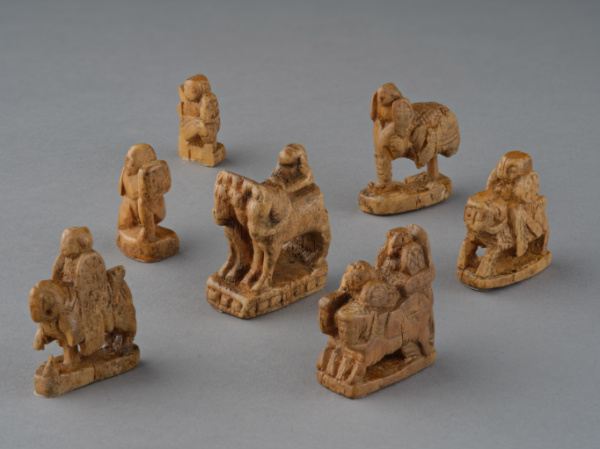
• The popular concept of the ‘Silk Road’ as a simple history of trade between East and West is challenged in a new exhibition which opens at the British Museum today. Silk Roads, which spans the period from about 500 AD to 1,000 AD, explores the overlapping networks which linked communities ranging from the UK to Japan and Scandinavia to Madagascar through a display organised into five geographic zones. The exhibition features more than 300 objects which include the oldest group of chess pieces ever found (pictured), a six metre long wall painting from the ‘Hall of the Ambassadors’ in what is now Samarkand in Uzbekistan, a glass drinking horn from Italy dating from between 550 and 600 AD, and, a map of the world from al-Idrisi’s Nuzhat al-mushtaq fi ikh0raq al-afaq (Pleasure of He who Longs to Cross the Horizons) from a 1533 manuscript which drew on a 1154 original. Visitors will also encounter the stories of people whose stories intertwined with the Silk Roads including Willibald, a balsam smuggler from England, and a legendary Chinese princess her shared the secrets of silk farming with her new kingdom. The display in the Sainsbury Exhibitions Gallery can be seen until 23rd February. Admission charge applies. For more, see britishmuseum.org/silkroads.
• The psychological dimensions of war are explored in a major new temporary exhibition at the Imperial War Museum in Lambeth. War and the Mind features more 150 objects spanning the period from World War I through to the War in Afghanistan. Among them are a letter from Winnie the Pooh author AA Milne which speaks of how dedicated pacifists have changed their mind in the face of direct threat, amphetamine tablets issued to Allied soldiers to help them overcome the psychological effects of fatigue, a newly-acquired mitten belonging to the baby son of an Avro Lancaster bomber rear gunner who carried it for comfort while carrying out operations during the World War II, and a Protect and Survive booklet issued in the UK in 1980 as part of the government’s response to the fear of nuclear weapons during the Cold War. The exhibition, which opens on Friday, is free to visit. For more, see iwm.org.uk/events/war-and-the-mind.
• The artwork of painter, illustrator and caricaturist Sidney Sime is the subject of a new exhibition at the Heath Robinson Museum in Pinner. Sime, who was born in Manchester in 1865, trained at the Liverpool school of art before heading to London where he worked for magazines including Pick-Me-Up, drawing theatrical caricatures and other humorous drawings. He later struck up a friendship with Lord Dunsany and illustrated his first book, The Gods of Pegana, in a collaboration which continued until the 1930s. He also formed friendships with Lord Howard de Walden and composer Joseph Holbrooke, making set and costume designs for their theatrical and operatic productions. After World War I, Sime made a number of large oil paintings, many of which are shown in the display. The Art of Sidney H Sime, Master of Fantasy, which opens on Saturday, can be seen until 5th January. For more, see www.heathrobinsonmuseum.org/whats-on/sidney-sime-artist-and-philosopher/.
Send all items for inclusion to exploringlondon@gmail.com.
 Exploring London