This Week in London – Michelangelo’s last decades; expressionists on show; and, Dinosaur rEvolution…

Michelangelo Buonarro (1475–1564) – study for the ‘Last Judgment’ (Black chalk on paper, about 1534–36); the fall of Phaeton (Black chalk, over stylus underdrawing, on paper, about 1533); and, Christ on the Cross between the Virgin and St John (Black chalk and white lead on paper, about 1555–64.) All images © The Trustees of the British Museum

A landmark exhibition exploring the final three decades of the life of Renaissance master Michelangelo has opened at the British Museum. Michelangelo: the last decades focuses on how his art and faith evolved and centres on the two metre high Epifania (about 1550–53), which is being displayed for the first time since conservation work on it began in 2018. Showing alongside it is a painting made from it by Michelangelo’s biographer, Ascanio Condivi, as well as preparatory drawings from the Last Judgment, which chart how Michelangelo invented a fresh vision of how the human form would be refashioned at the end of the world, and works created as part of his correspondence with his friends Tommaso de’ Cavalieri and the poet Vittoria Colonna. The latter include The Punishment of Tityus (about 1532) showing an eagle tearing out the liver of a bound naked man which was gifted to Tommaso as moral guidance for the young man. Other highlights include a group of drawings of Christ’s crucifixion which he made during the last 10 years of his life and through which he explored his feelings about mortality, sacrifice, faith, and the prospect of redemption. Runs until 28th July in the Joseph Hotung Great Court Gallery. Admission charge applies. For more, see www.britishmuseum.org/michelangelo.

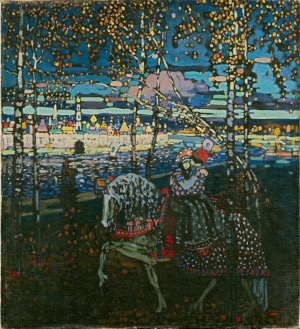
Wassily Kandinsky, ‘Riding Couple’, 1906-1907, Lenbachhaus Munich, Donation of Gabriele Münter, 1957

• A new exhibition has opened celebrating the expressionists’ radical experimentations with form, colour, sound and performance at the Tate Modern. Expressionists: Kandinsky, Münter and the Blue Rider features masterpieces from the Lenbachhaus in Munich and includes some works never previously seen in the UK. Among the artists whose work is on display are everyone from renowned artists like Wassily Kandinsky, Gabriele Münter, Franz Marc and Paul Klee, through to lesser known figures like Wladimir Burliuk and Maria Franck-Marc. Highlights include Marianne Werefkin’s Self-Portrait (c1910), Münter’s Listening (Portrait of Jawlensky) (1909), Erma Bossi’s Circus (1909), Kandinsky’s Impression III (Concert) (1911), Franz-Marc’s Deer in the Snow II (1911), Klee’s Legend of the Swamp (1919), and a selection of photographs from the Masterpieces of Muhammadan Art exhibition staged in Munich in 1910. Runs until 20th October. Admission charge applies. For more, see tate.org.uk.

On Now – Dinosaur rEvolution. This exhibition at the Horniman Museum in Forest Hill highlights discoveries from recent decades which have changed the way we envisage dinosaurs – not all as scaly green reptiles but many with an array of colours, feathers, quills and spikes. At the centre of the display are five large animatronic dinosaur models – including a seven metre-long Tyrannosaurus rex – as well as well as artworks by artist and exhibition curator Luis V Rey. The exhibition also features fossil casts including the horned skull of a Diabloceratops, the claw of a Therizinosaurus, and skeletons of Velociraptor and Compsognathus – a chicken-sized, feathered dinosaur. Runs until 3rd November. Admission charge applies. For more, see www.horniman.ac.uk.

Send all inclusions to exploringlondon@gmail.com.

This Week in London – Rosalind Franklin’s grave; American printmaking; and Disabled Access Day at royal residences….

Acclaimed biologist Rosalind Franklin’s grave in Willesden United Synagogue Cemetery has been given listed status, Historic England announced in marking International Women’s Day this week. Franklin’s tomb commemorates her life and achievements – they include X-ray observations she made of DNA which contributed to the discovery of its helical structure by Crick and Watson in 1953. Meanwhile, Historic England has teamed with The Royal Society to highlight the achievements of 28 remarkable women noted for their achievements in the fields of chemistry, biology, physics and astronomy. The women’s stories have been explored and key historic locations mapped. They include the Marianne North Gallery in Kew Gardens (named for 19th century botanist Marianne North), the Elizabeth Garrett Anderson Hospital – founded in 1872 as the New Hospital for Women in London by Anderson, a suffragette and the first English woman to qualify as a doctor, and the Royal Academy of Arts where natural history illustrator and painter Sarah Stone was an honorary exhibitor in the 1780s.

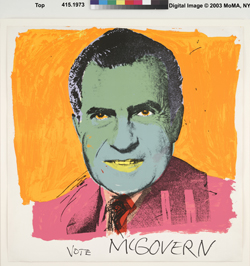
The first major exhibition focusing on contemporary American printmaking has opened in the Sainsbury Exhibitions Gallery of The British Museum. The American Dream: pop to the present features more than 200 works from 70 artists including Andy Warhol, Jasper Johns, Robert Rauschenberg, Ed Ruscha, Chuck Close, Louise Bourgeois and Kara Walker. Including loans from institutions such as The National Gallery of Art in Washington, DC, as well the museum’s own collection, the works span six decades – from the moment when pop art arrived in the New York and West Coast scene of the early 1960s, to the rise of minimalism, conceptual art and photorealism in the 1970s, and through to the practices of today’s artists. Among the works on show are Warhol’s Marilyn, Willie Cole’s Stowage and Claes Oldenburg’s sculpture of the Three-Way Plug. Admission charges apply. Runs until 18th June. For more, see www.americandreamexhibition.org. PICTURE: Andy Warhol (1928–1987), ‘Vote McGovern’, Colour screenprint/© 2016 The Andy Warhol Foundation for the Visual Arts, Inc./Artists Rights Society (ARS), New York and DACS, London.

Visitors with disabilities will be offered free admission to royal residences – including the Royal Mews and The Queen’s Gallery at Buckingham Palace – this weekend to mark Disabled Access Day. Visitors to the Queen’s Gallery can join verbal descriptive tours of the Portrait of the Artist exhibition on 12th March while the Royal Mews will offer free admission to disabled visitors on 10th and 11th March.  Standard access resources, including plain English tour scripts, induction loops, large-print and list access will be available across all venues. For more, see www.royalcollection.org.uk.

Send all items for inclusion to exploringlondon@gmail.com.

Around London – 250,000 British Library titles to be available online; summer in Bunhill Fields Burial Ground; funding for church and synagogue repairs; and, the British Museum takes a closer look at relics and reliquaries…

The British Library is to digitise 250,000 books and make them available on the internet under a deal with tech giant Google. The works, which are all out of copyright, date from between 1700 and 1870 and include printed books, pamphlets and periodicals. Among them are feminist pamphlets about the ill-fated French Queen Marie Antionette dating from 1791, blueprints of the first combustion engine-driven submarine dating from 1858, and a 1775 account which tells of a stuffed hippopotamus owned by the Prince of Orange. The works will all be available online via Google Books which has partnered with more than 40 libraries around the world. The project will include material published in a range of European languages and will focus on works not already freely available in digital form online. For more see www.bl.uk.

A series of events running under the banner of ‘Green Garden Lunchtimes’ will be held at the Bunhill Fields Burial Group (off City Road) in the City of London from next Monday until 1st July. The events include free yoga and tai chi classes, a bike repair workshop, a history tour from City Guides and a wildlife talk courtesy of the Natural History Museum. The Wren Clinic will also be providing free advice and treatments. Bunhill Fields is famous for its connections to the Nonconformists and contains the graves of writers William Blake, Daniel Defoe and John Bunyan. For dates and times, follow this link.

• Six churches and a synagogue in London have been granted £582,000 to carry out repair works under the Repair Grants for Places of Worship scheme. The grants, which are administered by English Heritage and funded by the Heritage Lottery Fund, include £199,000 for the Church of St Augustine in Honor Oak Park – an early example of the Gothic Revival in the Early English style, £122,000 for Christ Church in Christchurch Park, Sutton, and £111,000 for the Golders Green Synagogue in Barnet. The grants were part of £8 million worth of funding given to 67 of England’s most important Grade II listed churches, chapels and synagogues. For more, see www.hlf.org.uk.

On Now: Treasures of Heaven: saints, relics and devotion at the British Museum. The museum’s major summer exhibition looks at the spiritual and artistic significance of Christian relics and reliquaries in medieval Europe. Among the highlights are: an arm reliquary of St George, which was housed in the treasury of St Mark’s in Venice following its capture in the sack of Constantinople in 1204; the British Museum’s bejewelled Holy Thorn reliquary, dating from 1390-97 and said to contain a relic from the Crown of Thorns; and, a 12th century bust of St Baudime from France, which once contained a vial of the saint’s blood and is being seen for the first time in Britain. Other exhibits come from the Cleveland Museum of Art in Ohio and the Walters Art Museum in Baltimore as well as from the Vatican. Runs until 9th October. There is an admission charge. For more, see www.britishmuseum.org.