LondonLife – ‘Lady in Blue’ steps up to the Fourth Plinth…

The latest sculpture to grace Trafalgar Square’s Fourth Plinth, Lady in Blue, was unveiled last week.
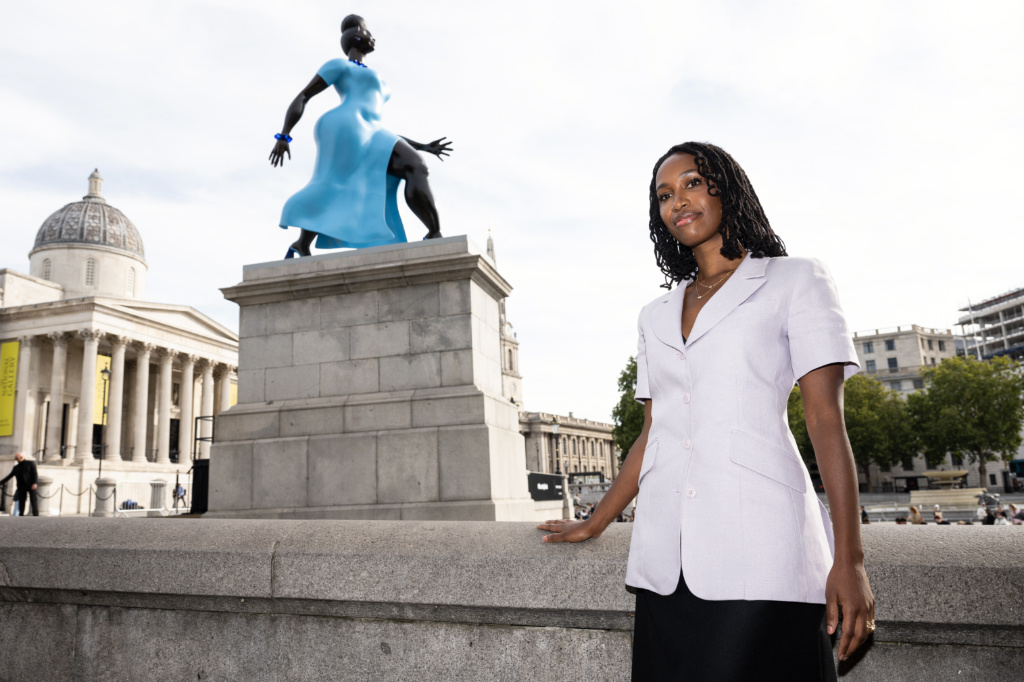
Artist Tschabalala Self unveils her artwork, ‘Lady in Blue’, on Trafalgar Square’s Fourth Plinth in London on 10th September, 2026. PICTURE: Jeff Spicer/PA Media Ass
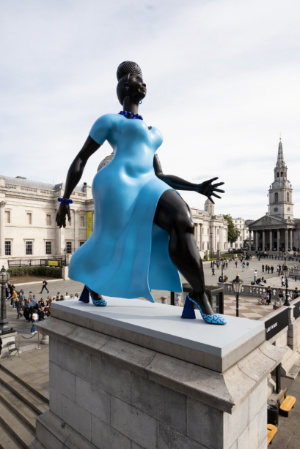
‘Lady in Blue’, unveiled by artist Tschabalala Self on Trafalgar Square’s Fourth Plinth in London on 10th September, 2026. PA Photo. PICTURE: Jeff Spicer/PA Media Ass

The work of New York artist Tschabalala Self, the bronze sculpture features a dress painted a vibrant blue and jewellery replicating the colour of lapis lazuli, used as a pigment since ancient times.

“My work Lady in Blue will bring to Trafalgar Square a woman that many can relate to,” says Self. “She is not an idol to venerate or a historic figure to commemorate. She is an everyday person much like the many who occupy the square daily. She is striding forward into our collective future with ambition, purpose and optimism.”

Self added: “I have always found London to be an inspiring city, London is to thank for many milestones in my life. My first institutional show was held here in London, along with my first major gallery exhibition. I have come to know London as a truly global metropolis, and Lady in Blue reflects the sophistication of this city.”

Lady in Blue is the 16th sculpture commissioned for the Fourth Plinth and follows on from Teresa Margolles’ Mil Veces un Instante (A Thousand Times in an Instant).

Self was announced as winning the commission in March 2024, along with Andra Ursuţa whose work will be unveiled on the Fourth Plinth in 2028. The artists are selected by the Fourth Plinth Commissioning Group, chaired by Ekow Eshun. The decision is informed by the public who are invited to have their say on shortlisted works.

Lady in Blue will move to a permanent location in Fornebu, Norway, after it leaves Trafalgar Square in 2028.
LondonLife – The Fourth Plinth readorned…

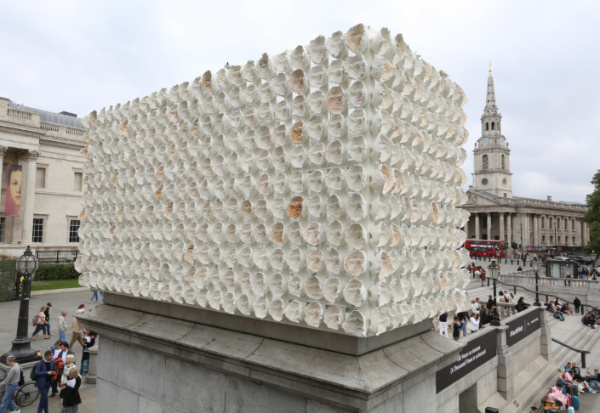
‘Mil Veces un Instante’ by Teresa Margolles. PICTURE: © James O Jenkins
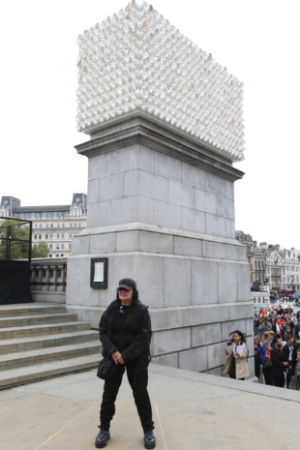
Teresa Margolles with ‘Mil Veces un Instante’ PICTURE: © James O Jenkins

The 15th commission in Mayor of London’s Fourth Plinth programme has been unveiled in Trafalgar Square.

Artist Teresa Margolles’ Mil Veces un Instante (A thousand times an Instant) is made up of plaster casts of the faces of 726 trans, non-binary, and gender non-conforming people which were made in Mexico City and Juárez, Mexico; and London. 

The casts – which Margolles spent more than 1,000 hours making – were created by applying plaster directly onto the faces of participants, meaning the plaster is infused with their hair and skin cells.

The next artworks to grace the Fourth Plinth will be Tschabalala Self’s Lady in Blue – a bronze work patinated with Lapis Lazuli blue which will be installed in 2026 – and Andra Ursuţa’s Untitled – a shrouded equestrian statue which will be installed from 2028.

Mil Veces un Instante replaced Samson Kambalu’s Antelope which had been on the Fourth Plinth since 2022.

For more on the Fourth Plinth programme, head to https://www.london.gov.uk/programmes-strategies/arts-and-culture/current-culture-projects/fourth-plinth-trafalgar-square. You can also download the free arts and culture app Bloomberg Connects.

LondonLife – ‘Antelope’ debuts on The Fourth Plinth…

Samson Kambalu’s Antelope was unveiled on Trafalgar Square’s Fourth Plinth last week. The sculpture – the 14th commission since the Fourth Plinth programme began – depicts the restaged of a photograph taken of Baptist preacher and educator John Chilembwe and European missionary John Chorley which was taken in 1914 in Nyasayland (now Malawi) at the opening of Chilembwe’s new Baptist church.

Chilembwe, who is shown wearing a hat in defiance of rules forbidding Africans from wearing hats in front of white people and is depicted as almost twice the size of Chorley, led an uprising in 1915 against British colonial rule, triggered by the mistreatment of refugees from Mozambique and the conscription to fight German troops during World War I. He was killed and his church destroyed by the colonial police.

Though his rebellion was ultimately unsuccessful, Malawi, which gained independence in 1964, celebrates John Chilembwe Day on January 15th and the uprising is viewed as the beginning of the Malawi independence struggle.  

The artist Samson Kambalu was born in 1975 in Malawi, and is now associate professor of fine art and a lifelong fellow at Magdalen College, Oxford University.

“I am thrilled to have been invited to create a work for London’s most iconic public space, and to see John Chilembwe’s story elevated,” he said in a statement. “Antelope on the Fourth Plinth was ever going to be a litmus test for how much I belong to British society as an African and a cosmopolitan. Chilembwe selected himself for the Fourth Plinth, as though he waited for this moment. He died in an uprising but ends up victorious.”

LondonLife – ‘THE END’ at Trafalgar Square…

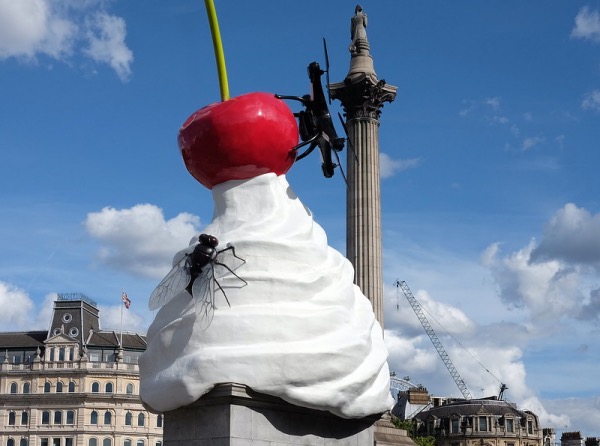
The 13th sculpture to occupy Trafalgar Square’s famous Fourth Plinth is a nine tonne, 9.4 metre high swirl of cream topped with a cherry. Unveiled in late July, THE END is the work of Heather Phillipson and also features a giant fly as well as a drone that transmits a live feed of Trafalgar Square to a specially created website, www.theend.today. The sculpture, which plays on the idea of the square as a site of celebration and protest, replaced Michael Rakowitz’s The Invisible Enemy Should Not Exist and both Phillipson and Rakowitz were selected by the Fourth Plinth Commission Group in 2017 following an exhibition at the National Gallery where 10,000 people voted for their favourite shortlisted artwork. PICTURE: astonishme (licensed under CC BY 2.0)

LondonLife – New art on the Fourth Plinth…

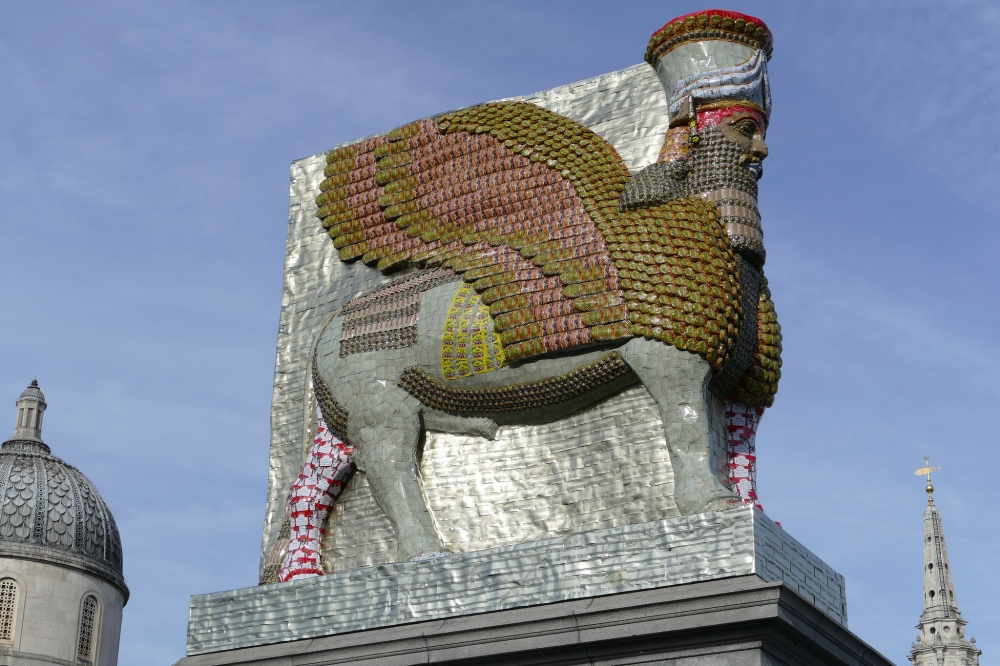
A life-sized copy of Lamassu, a winged deity that stood at Nineveh’s Nergal Gate from 700 BC until the so-called Islamic State destroyed it in 2015, Michael Rakowitz’s work The Invisible Enemy Should Not Exist is the 12th to adorn the Fourth Plinth in Trafalgar Square. The American artist’s work is made from 10,500 empty Iraqi date syrup cans, representative of a once-renowned industry which has been devastated by war in the Middle Eastern nation, while the use of recycled food packaging can be seen as a reference to the recycling of cannons once carried on the HMS Royal George to create the reliefs at the base of Nelson’s Column. Unveiled at the end of March by Mayor of London, Sadiq Khan, the work will remain on the plinth until early 2020.

PICTURE: Loz Pycock/licensed under CC BY-SA 2.0)