The Royal Parks – 4. St James’s Park

The fourth in a line of parks stretching from Kensington Palace to Westminster, St James’s Park largely owes its foundation to King James I. 

Given its early history is covered in our earlier post, we’ll skip forward to the time of King Charles II when, under to instruction of Frenchman Andre Mollet, the park was redesigned with new landscaping including wide lawns, avenues of trees and a wide, centrally positioned canal. It was King Charles II who also opened the park up to the public (he even mingled with them there along with his mistress Nell Gwynn). Interestingly the first pelicans were also introduced to the park around this time when the Russian ambassador presented a pair of pelicans to the king.

In the 18th century, Horse Guards Parade was added to the park by filling in one end of the park’s canal and was later used for parades. The ceremonies of Beating Retreat and Trooping the Colour are still held there today.

The next major changes came in the 19th century when in 1827-28, architect John Nash oversaw a more romantically inspired renovation, including the transformation of the canal into a natural looking lake and the addition of winding paths, as part of his grand scheme which still shapes much of London today.

It was also at this time that The Mall (which like Pall Mall takes it name from the game of Pelle Melle – see our earlier post) was transformed into a grand processional route (it was opened to traffic later, in 1887). The park, bounded to the west by Buckingham Palace, also takes in the Queen Victoria Memorial – completed in 1914 to replace the Marble Arch which was moved to its current location at the corner of Oxford Street and Park Lane in 1851 – and flower beds which are planted annually with 12,000 geraniums, the color of which is chosen to match the guardsmen’s tunics.

Meanwhile, in 1837, the Ornothological Society of London erected a cottage for the birdkeeper (the thatched cottage can still be seen there today and the post of birdkeeper still exists). The first bridge was placed across the lake in 1851 (and replaced in 1951 with the one that now stands there).

Little has changed in the 23 hectare (58 acre) park since Nash’s day. Newer facilities include a restaurant and a playground at the western end.

WHERE: St James’s Park (nearest tube station is St James’s Park); WHEN: 5am to midnight daily; COST: Free entry; WEBSITE: www.royalparks.gov.uk/St-Jamess-Park.aspx 

PICTURE: © Anne Marie Briscombe  (courtesy Royal Parks)
The Royal Wedding – A view from The Mall…

Along with tens of thousands of others, Exploring London took up a post in The Mall to watch festivities surrounding the London wedding of Prince William and Kate Middleton. Here’s some of what we saw…

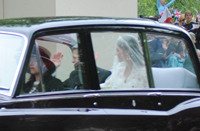
Kate Middleton, newly titled Her Royal Highness the Duchess of Cambridge, rides in a 1977 Rolls Royce Phantom IV from the Goring Hotel in Belgravia to Westminster Abbey via The Mall, greeting crowds along the way. Others, including Prince William, had already passed by.

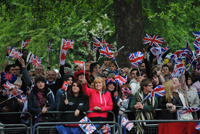
The crowds cheered along The Mall throughout the morning, including after Rowan Williams, the Archbishop of Canterbury, was heard over loudspeakers announcing that the couple were now man and wife. The Bishop of London, Dr Richard Chartres, delivered the address while James Middleton read the lesson.

After the ceremony, the newly married couple processed in the 1902 State Landau down Whitehall and The Mall through a sea of flag-waving well-wishers towards Buckingham Palace after the wedding ceremony. The Landau was the same used by Prince Charles and Princess Diana after their 1981 wedding.

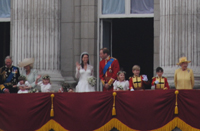
The couple, along with other members of the royal family and Kate Middleton’s parents, appear on the balcony of Buckingham Palace at around 1.30pm, waving to the crowd and exchanging kisses. Here they are flanked by Queen Elizabeth II (right) and the Duke and Duchess of Cornwall (left) along with bridesmaids and pageboys.

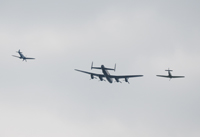
A Lancaster bomber and two Spitfires flew over the top of Buckingham Palace as part of an RAF flypast. They were followed by two tornados and two typhoons. The flypast brought official celebrations to an end after which the royal rejoined the champagne and canape reception already underway.

Crowds fill The Mall in the wedding’s aftermath. The newly weds later left Buckingham Palace driving a vintage convertible Aston Martin owned by Prince Charles. Overhead hovered a Sea King helicopter manned by some of Prince William’s colleagues.

The Royal Wedding – Royal residences…

Word is that Prince William and his soon-to-be wife, Catherine Middleton, have yet to formally decide where they will live when in London (they are expected to spend much of their first two-and-a-half years of marriage in North Wales). 

Their initial London base, however, will reportedly be Clarence House. Located in The Mall, just down the road from Buckingham Palace and beside St James’s Palace, the grand building is currently the home of William’s father Charles, the Prince of Wales, his wife Camilla, Duchess of Cornwall, and, William’s brother, Prince Harry (it is also the home of William himself).

In years gone past, Clarence House served as the home of the newly married Queen Elizabeth II (then Princess Elizabeth) and her husband, Prince Philip, the Duke of Edinburgh. Prince Charles, who lived there with his parents until the age of three, returned to the property in August 2003 after the death of his grandmother Queen Elizabeth, the Queen Mother, who had lived in the building from 1953.

Clarence House was built between 1825 and 1827 to the designs of architect John Nash on the orders of Prince William Henry, the Duke of Clarence and later King William IV.

Choices for a permanent home in London for the soon-to-be married couple reportedly include Buckingham Palace (see yesterday’s entry), as well as Kensington Palace.

It was converted from a Jacobean mansion for King William III and Queen Mary II and has since been the home of many royals including, most famously, Diana, Princess of Wales. She and her then husband, Prince Charles, moved in following their wedding in 1981, and Princess Diana continued to live there after her divorce in 1996.

Other notable royal residents have included Queen Anne and Princess Margaret, sister of Queen Elizabeth II.

Another option – St James’s Palace – was built in 1531 on the site of a medieval leper hospital by King Henry VIII. Used initially for state occasions and to house royal relatives (Tudor monarchs actually lived at Whitehall Palace), it became the official royal residence in 1702, when Whitehall Palace burnt down, and remained so until the 1830s when King George III moved to Buckingham Palace.

The Royal Wedding – London’s royal reception venue

Following the wedding ceremony at Westminster Abbey on Friday, the now married happy couple will head in a carriage via a processional route down The Mall to Buckingham Palace.

There, they will enjoy a champagne reception with 600 guests hosted by the Queen before, at 1.30pm, appearing on the balcony of the palace to wave to the crowds and watch an aircraft flypast expected to include a Lancaster, Spitfire, Hurricane, two Typhoons and two Tornados.

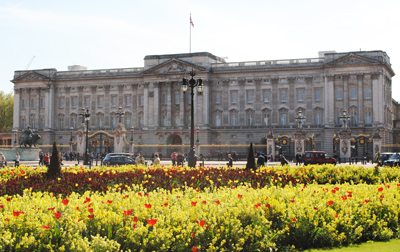
Buckingham Palace, which has served as the official London residence of the reigning monarch since 1837, has a long tradition of hosting royal events. Then much smaller and known as Buckingham House, the property was built for the Duke of Buckingham in 1705.

It passed into royal hands when it was bought by King George III in 1761 for his wife, Queen Charlotte, to use as a family home located conveniently close to St James’s Palace where many court functions were held.

The house was extensively remodelled in 1762 and again, this time on the orders of King George IV, in the 1820s (after initially wanting to use it, like his father, as a family home, the king decided after the works had started to instead transform it into a palace, created to the designs of architect John Nash).

When King George IV died in 1830, his brother King William IV ordered the works to be continued albeit with a new architect, Edward Blore (the spiralling costs of Nash’s work are said to have cost him the contract). The king himself never lived in the house – even offering at at one stage as a seat for Parliament after the Houses of Parliament were destroyed by fire in 1834 – and it wasn’t until the accession of Queen Victoria in 1837 that the palace became the sovereign’s official residence.

Further works were subsequently needed to ensure there was adequate accommodations for the Queen’s family and it was during these works that the monumental Marble Arch – designed as the centrepiece of the palace’s courtyard – was moved away to its present location on the north-eastern corner of Hyde Park.

The palace, which now boasts 775 rooms including 19 staterooms, has since been the site of numerous royal wedding receptions – it was on the balcony  where Queen Elizabeth II and Philip, the Duke of Edinburgh, greeted crowds on 20th November, 1947, after their wedding in Westminster Abbey and, similarly, where Prince William’s parents, Prince Charles and Princess Diana, held a reception before greeting crowds on 29th July, 1981, after their ceremony at St Paul’s Cathedral.

Buckingham Palace was also the location for Queen Victoria’s wedding breakfast following the ceremony in the Chapel Royal at St James’s Palace on 10th February, 1840.

What’s in a name?…Pall Mall

This curiously named street in the heart of London’s St James district traces the origins of its moniker back to the 17th century when the game of “pall mall” (“pell mell” and “paille maille” being among a host of alternative spellings) was played there.

The game, mentioned by Samuel Pepys in his famous diary, involves the use of a mallet and ball similar to that used in modern croquet but, according to some commentators, pall mall was more likely a predecessor of golf than croquet, with players attempting to belt the ball as far as possible along a pitch before putting the ball through a hoop suspended high off the ground.

Pall Mall, which runs parallel to The Mall from St James’ Street in the west to Haymarket in the east with an eastern extension, Pall Mall East, completing the journey from Haymarket into the northern end of Trafalgar Square, became famous in the 19th and early 20th centuries for housing numerous ‘gentlemen’s clubs’. Among those still in business are the Travellers Club, the Athaenaeum Club, the Reform Club, the Army and Navy Club, the Oxford and Cambridge Club, and the Royal Automobile Club.

St James’s Palace sits at the street’s western end and it is of note that nearly all of the southern side of the street is still part of the Crown Estate (the exception being a home Charles II is believed to have given to the actress Nell Gwynne, who apparently sensibly demanded the freehold on the property).

Other buildings along the street include Schomberg House, built for the Duke of Schomberg in the late 17th century (only the facade of which remains), and the Sir Christopher Wren-designed Marlborough House, which is tucked in between Pall Mall and The Mall and sits opposite St James’s Palace. The National Gallery and the Royal Academy also both briefly had homes in Pall Mall.