London Explained – London Theatreland…

Said to be the largest theatre district in the world, London’s Theatreland is located in the West End (and some say synonymous with it) and features some 40 playhouses.
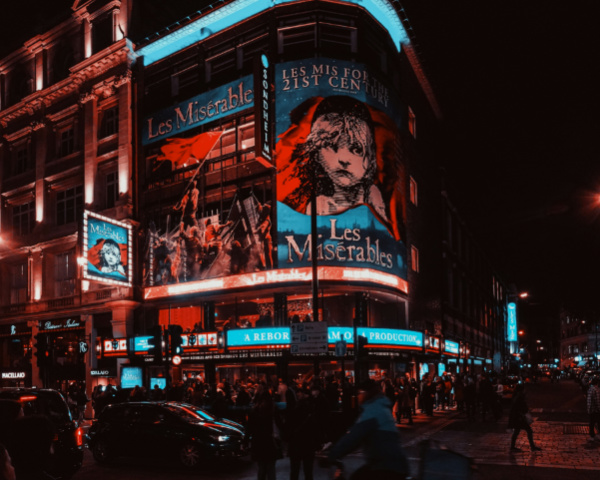
The lights of Theatreland – pictured is the production of Les Miserables at the Sondheim Theatre. PICTURE: Samuel Regan-Asante/Unsplash

The theatres are primarily located in Covent Garden, around Leicester Square and Piccadilly Circus and in Soho. The street most associated with today’s Theatreland is perhaps Shaftsbury Avenue.

Many of the privately owned theatres date from the Victorian or Edwardian period and are protected against inappropriate development (although this means they also sometimes lack more modern amenities)

Among the theatres in the district is the Theatre Royal, Drury Lane (the oldest theatre in London, it opened in 1663) as well as the Savoy Theatre (which in 1881 became the first to be lit by electricity), the London Palladium in Soho (which has hosted the Royal Variety Performance 43 times), and the Lyceum Theatre (where Bram Stoker was once manager).

The longest-running production in the world – Agatha Christie’s play The Mousetrap – has been running at St Martin’s Theatre since 1952 (though it was interrupted during the COVID-19 pandemic). The longest-running musical in the West End – Les Miserables – has been running since 1985 (first at the Palace Theatre and now at the Sondheim Theatre (formerly Queens Theatre)).

A Moment in London’s History – The mysterious case of the ‘Bottle Conjurer’…

London was agog. Gathering at what is now the Theatre Royal in Haymarket on the evening of 16th January, 1749, the city’s inhabitants were ready to experience a most amazing spectacle as a man would not only play a “common walking cane” as if it were any instrument but, apparently shrinking himself, step inside a common, ordinary sized wine bottle placed upon a table.

Spurred on by newspaper advertisements promising a night of “surprising things” (which also included the promise of the performer taking on the likeness of any person, living or dead), it was with great expectation that the crowd, which included the Duke of Cumberland, settled into their seats in the theatre, having willingly paid at least two shillings (and some substantially more) for the privilege of being present.

When the time came for the curtain to rise and nothing happened, there were no doubt some who thought it merely a tactic of the performer to build suspense. But the crowd was getting restless and soon after began booing and stamping their feet in their annoyance.

One of the theatre’s staff then appeared on stage to inform them the performer had not arrived and that all entrance fees would repaid  – his comments were apparently answered by a wit who claimed they would pay double if the magician could enter a pint bottle instead of a quart bottle. Further catcalls followed and before long someone apparently threw a candle, setting the stage curtains on fire. Panic broke out among those in the theatre as people sought to escape but for some rage took over as they realised that they had been the victims of a hoax.

The theatre was destroyed as people tore up the seats and smashed the scenery, carting what they could out into Haymarket where it was burnt in a bonfire. The theatre manager called out the guards but the rioting was largely over by the time they arrived. There were apparently no casualties, apart from the theatre itself, although the Duke of Cumberland did, it was said, lose a jewelled sword.

Apparently a bizarre hoax, attention quickly turned to who was behind it. It was commonly believed that it had been the 2nd Duke of Montagu, a notorious practical joker, who had placed the advertisement in order to win a bet that he could fill a theatre by promising something impossible such as a man being able to step inside a bottle. Yet to this day, the identity of the hoaxer remains something of a mystery and the case went on to be cited in reference to the gullibility of the London populace.

PICTURE: Kbthompson at English Wikipedia/CC BY-SA 3.0