Treasures of London – Geffrye almshouses…

GeffryeIt’s a big year for the Geffrye Museum in Shoreditch – not only 300 years since the almshouses were first opened to house the poor and elderly, it’s 100 years since the almshouses were converted into the museum which now occupies the site.

Geffrye2With that in mind, we thought we’d take a look at the almshouses themselves (we’ve looked at the museum – which features 11 period rooms from the 17th to 20th centuries – a couple of times previously). The Grade I-listed almshouses were built in 1714 by the Worshipful Company of Ironmongers, using funds that had been bequeathed to them by Sir Robert Geffrye, a Cornishman who became twice-master of the company and a Lord Mayor of London (there’s a fine statue of him adorning the front of the building).

They comprised 14 houses, each of which had four rooms, and provided accommodation for up to 56 pensioners. Arranged in a U-shape around a courtyard, the two storey almshouses came complete with a chapel which still stands at the centre of the the complex and where residents were expected to attend each week (a walkway which runs around the back of the chapel was added in 1914 offers some great views of the garden).

The almshouses, which had originally been built in what was a largely rural context, remained in use until the early 20th century by which time the area had become one of London’s most crowded with poor sanitation. In 1910, the Ironmongers’ decided to sell off the almshouses and move out to the safer, cleaner area of Mottingham in Kent.

In 1912, the houses and gardens were purchased by the London County Council – attracted by the public open space – and following representations from members of the Arts and Crafts movement, the museum opened its doors in 1914.

It’s still possible to visit a former almshouse – number 14 –  which was restored and opened in 2002 and has been furnished to show what life was like there for the pensioners (contrast the sparse furnished there with that with some of the more opulent rooms on display in the museum – and don’t forget to allow some time to visit the gardens; there is also a shop and cafe on site).

WHERE: 136 Kingsland Road, Shoreditch. Nearest tube is Liverpool Street or Old Street (a fair walk) or Hoxton Overground Station (next door); WHEN: The almshouses are open on select days only – check website. The museum is open Tuesdays to Sundays, 10am-5pm (gardens open until 31st October); COST: £3 for admission to  almshouses/admission to the museum and gardens is free; WEBSITE: www.geffrye-museum.org.uk

Treasures of London – The grave of Karl Marx…

Karl-Marx3

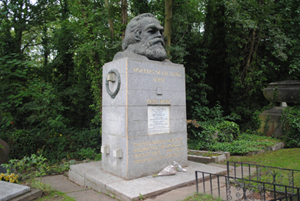
One of the highlights of any visit to Highgate Cemetery, the grave of Karl Marx is one of London’s most visited final resting places even though it didn’t attract a crowd at the time of his death.

Karl-Marx2Marx died in London on 14th March, 1883, having battled ill health for many months beforehand. He was buried at Highgate Cemetery just three days later and there were reportedly only between nine and 11 mourners at the funeral (his wife Jenny was not among them – she had died in late 1881 and is buried in the same grave). Among those who did attend was Friedrich Engels, who, in his eulogy, described Marx as “the greatest living thinker” and told of how he had “peacefully gone to sleep”.

While the original tomb was modest, the grander memorial which stands on the grave today was erected in 1954 by the Communist Party of Great Britain. It is inscribed with Marx’s words “Workers of all lands unite” and “The philosophers have only interpreted the world in various ways – the point however is to change it” and topped with a larger-than-life bust of Marx created by Laurence Bradshaw.

As well as Marx’s wife, others buried in the tomb include Marx’s grandson, Harry Longuet, who died only six days after his grandfather at the age of four, Eleanor Marx, his daughter, who died in 1898, and Helene Demuth, the Marx family housekeeper.

The monument was attacked in 1970 by vandals using a home-made bomb, reportedly causing £600 of damage which was quickly fixed. There have been a couple of further attacks on the tomb.

WHERE: Highgate East Cemetery, Swain’s Lane (nearest Tube station is Archway); WHEN: 10am to 5pm Monday to Friday/weekends and public holidays 11am to 5pm (last admission 4.30pm); COST: £4 adults/children under 18 free (tours additional); WEBSITE: www.highgatecemetery.org

Treasures of London – Apollo 10 command module…

Apollo-10-Command-Module,-c.Science-Museum-and-the-National-Air-and-Space-Museum,-Smithsonian-InstitutionLondon isn’t particularly known for its association with the space program – at least, not that we know of – but the Science Museum in South Kensington gives you the chance to get up close and personal with a piece of NASA’s history.

Located in the Making the Modern World gallery is the Apollo 10 command module, on long-term loan from the Smithsonian in the US. Launched in May, 1969, it carried three astronauts – Tom Stafford, John Young and Gene Cernan – around the moon in what was a dress rehearsal for the Apollo 11 moon landing which followed in July that year.

Stafford and Cernan descended in the accompanying lunar module to within 14 kilometres of the moon’s surface before rejoining the command module. The command module had the call sign ‘Charlie Brown’ (named for the character created by Charles M Schulz) while the lunar module was ‘Snoopy’.

The command module travelled some 500,000 miles during its eight day mission and reached a speed in excess of 24,790 mph on its return to earth, faster than any crewed vehicle since. The module splashed down in the Pacific Ocean on 26th May and the crew were recovered by the USS Princeton.

WHERE: Science Museum, Exhibition Road, South Kensington (nearest Tube station South Kensington);  WHEN: 10am to 6pm daily (7pm during school holidays); COST: free; WEBSITE: www.sciencemuseum.org.uk.

PICTURE: © Science Museum and the National Air and Space Museum, Smithsonian Institution