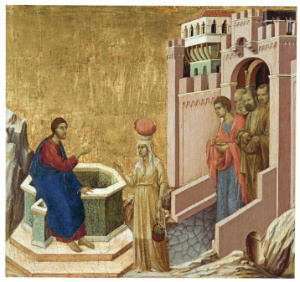
• Paintings by some of the greatest Italian artists of the 14th century have been reunited in a new exhibition opening at the National Gallery on Saturday. Siena: The Rise of Painting 1300‒1350, which is being held to mark the gallery’s 200th anniversary, features around 100 works including some of the most innovative in the Western tradition. Highlights include Maestà, painted by Sienese artist Duccio di Buoninsegna (active 1278, died 1319). The first double-sided altarpiece in Western painting, it was dismantled in the 18th century and the National Gallery’s own three panels are now reunited with others from the original ensemble including Christ and the Woman of Samaria from the Museo Thyssen- Bornemisza in Madrid, and The Calling of the Apostles Peter and Andrew from the National Gallery of Art in Washington DC. Another work being reunited for the exhibition is the Orsini Polyptych by Sienese artist Simone Martini (1284‒1344). A folding work of art made for private devotion, probably for Cardinal Napoleone Orsini, it is today divided into six works held by the Louvre, Paris, the Royal Museum of Fine Arts, Antwerp and the Gemäldegalerie, Berlin. All six panels are being brought together for the National Gallery’s exhibition. Two triptychs by Duccio which seem to have been conceived as a single work are also being reunited and the display also features works by Pietro Lorenzetti (active possibly 1306; died probably 1348) and his brother Ambrogio Lorenzetti (active 1319; died 1348/9) as well as Sienese works in a variety of media (metalwork, enamel, gilded glass, wood, marble, and manuscript illumination). The display runs until 22nd June. Admission charge applies. For more, see www.nationalgallery.org.uk.

• An installation featuring new work by artist duo Hylozoic/Desires (Himali Singh Soin & David Soin Tappeser) has opened at Tate Britain. In The Hedge of Halomancy, which runs in parallel with a large-scale new commission by Hylozoic/Desires at Somerset House, the artists excavate the lost archive of the Inland Customs Line, a 4,000 kilometre-longe barrier which comprised 2,500 kilometres of planted hedge and was created by the British Empire in the 19th century to prevent salt smuggling between British-occupied territories and neighbouring independent states. A 23-minute film at the heart of the installation focuses on Mayalee, a character inspired by a courtesan who defied the British Empire’s attempts to cut off her stipends of salt. Alongside it sits an embroidered tapestry, entitled Mokshapat (Snakes and Ladders) which was woven as mashru fabric – cotton on one side and silk on the other. Runs until 25th August. Admission is free. For more, see www.tate.org.uk.
• On Now: Unfolding Time: The Medieval Pocket Calendar. A “remarkable” set of medieval concertina-fold almanacs grappling with the concept of time is on display at the Lambeth Palace library. Less than 30 such manuscripts are known to exist and the display brings a group of the works, in which time is expressed in colourful pictures, poems, tables and devices, together for the first time. Runs until 15th May. For more, see https://www.lambethpalacelibrary.info.
Send all items for inclusion to exploringlondon@gmail.com.
 Exploring London