What’s in a name?…Stockwell…

This district in the Borough of Lambeth in south London was formerly a rural manor located on the southern edge of London.

The name, variants of which date back to at least the late 12th century, is said to relate to the Old English words for a tree trunk – ‘stoc’ – and a well or spring, ‘wella’, and has been interpreted as meaning the well or spring by a tree stump, tree truck or perhaps a wood (there was apparently a Stockwell Wood which has long since disappeared).
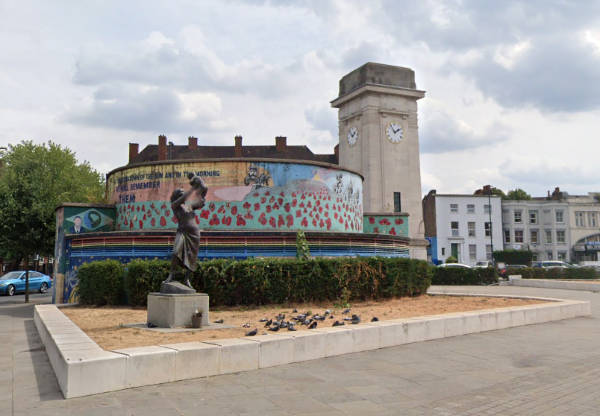
The War Memorial and mural painted on a ventiliation house in Stockwell. PICTURE: Courtesy of Google Maps

The manor of Stockwell was formed at the end of the 13th century when King Edward I acquired the manor of South Lambeth and divided it into two, creating the manors of Stockwell and Vauxhall (the manor house itself, parts of which survived until the 19th century, stood on the north side of Stockwell Road).

The area become known for its market gardens and was transformed into an urban landscape until the mid-19th century. Remnants of the 19th century housing stock can still be found in areas including the Stockwell Park Conservation Area in the west of the district.

The area around Stockwell Tube station, which first opened in 1890 and has since been rebuilt a couple times, was heavily bombed during World War II and rebuilt following the war. New developments included a number of social housing estates.

Today, Stockwell and nearby South Lambeth host the district known as Little Portugal which, centred on South Lambeth Road, is home to one of the UK’s largest Portuguese communities. The area is also home to several other immigrant communities.

Local landmarks include the oldest surviving building in the area – St Andrew’s Church, Stockwell Green (built in 1767), the Stockwell Congregational Church (1798) and the Stockwell War Memorial.

The latter – a white stone tower – is located on a site first laid out in the 1920s and features a mural on an adjoining ventilation shelter commemorating French Resistance fighter Violette Szabo (there’s a Blue Plaque on her former home in Burnley Road) and other Stockwell residents who died in war. There is also the ‘Bronze Woman’ statue which was unveiled in 2008 as a tribute to Black Caribbean women.

Residents of Stockwell have included artist Arthur Rackham and pioneering theatre director Joan Littlewood as well as musician David Bowie (born in Stansfield Road), actors Joanna Lumley (who still lives there) and Roger Moore (born in Aldebert Terrace).

Tragically, Stockwell Tube station was where Brazilian man Jean Charles de Menezes was fatally shot by police on 22nd July, 2005, after being misidentified as one of four suicide bombers who were on the run after their devices had failed to detonate the previous day (the attempts had come just two weeks after the 7th July bombings in which more than 50 people had been killed).

LondonLife – Celebrating International Women’s Day…

Cavell

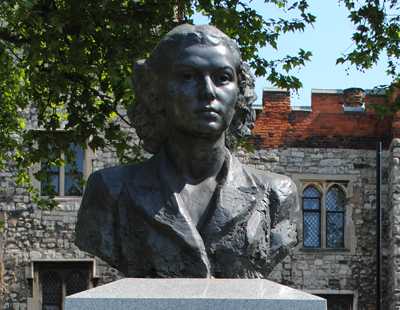
It’s International Women’s Day, so we’re celebrating by remembering two heroic women immortalised in statues in central London. Above is Edith Cavell, a British nurse who was trapped in Brussels by advancing German armies in 1914 and then subsequently arrested for aiding French and British soldiers to escape before being executed by firing squad on 12th October, 1915 – an event widely condemned around the world. The marble statue, located in St Martin’s Place at the intersection of Charing Cross Road and St Martin’s Lane, is by George Frampton and was erected in 1920. Below, meanwhile, is a bust of Violette Szabo which tops a memorial to the Special Operations Executive (SOE). Szabo, who was posthumously awarded the George Cross and the Croix de Guerre after she was captured and eventually executed by the German Army in early 1945, was among 117 SOE agents who did not return from their missions to France. Located on Albert Embankment, the statue – which is the work of Karen Newman – was unveiled in 2009.
Szabo

10 (more) curious London memorials…8. The SOE Memorial…

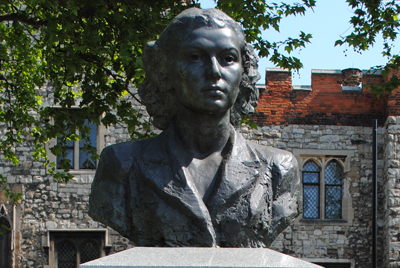
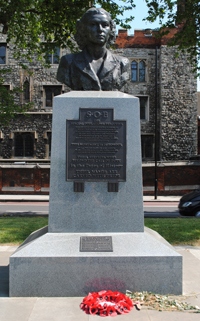
SOE-bigTucked away on Albert Embankment just to the north of Lambeth Bridge, this moving memorial was only unveiled in 2009 and formally honours the under-cover agents who worked for the Allies behind enemy lines during World War II.

The plinth is topped with a larger-than-life bust of Londoner Violette Szabo, sculpted by London artist Karen Newman. Szabo, who here gazes out across the Thames, was tortured and executed after being captured by the Germans while on a mission behind enemy lines following the D-Day landings.

SOEThe daughter of a French mother and English father, Szabo grew up in South London and, when World War II broke out in 1939, volunteered to work as an undercover operative in France as member of the British Special Operations Executive (SOE).

She had successfully completed one mission and had returned to France for a second when she was discovered and sent to a prison camp where she was unsuccessfully tortured for information.

Posthumously awarded the George Cross and the Croix de Guerre, a plaque on the memorial says she was among the 117 SOE agents who did not survive their missions to France. As many as 407 SOE agents were sent on “sabotage missions” to occupied France to fight with the French resistance.

Surprisingly, this SOE Memorial was apparently the first public memorial to honour the work of the unit. Formed on the orders of PM Sir Winston Churchill, it consisted of agents from various countries who were devoted to the Allied cause. Its feats included a raid which destroyed a factory in the Telemark region of Norway where the Germans were trying to produce heavy water which is used in the creation of atomic bombs – an operation which receives a special mention on the memorial.

The memorial was officially unveiled by the Duke of Wellington on 4th October, 2009. One of the plaques on it states that the monument “is in honour of all the courageous S.O.E. Agents: those who did survive and those who did not survive their perilous missions”. “Their services were beyond the call of duty. In the pages of history their names are carved with pride.” Enough said.

For more on the history of women serving in the SOE, see Squadron Leader Beryl E Escott’s book The Heroines of SOE: F Section: Britain’s Secret Women in France.