Treasures of London – The Cosmati Pavement

Hidden underneath carpet and a layer of grime for years, this unique medieval “carpet of stone” before the High Altar of Westminster Abbey can now be seen in all its glory, thanks to two years of restoration works.
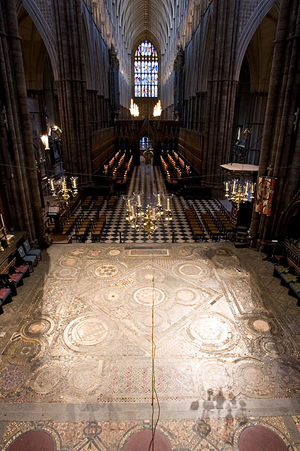
Laid down in 1268 on the orders of King Henry III who, 23 years earlier had started rebuilding the abbey in the new Gothic style, it was created by a team of workmen from Rome headed by a man called Odoricus.

The decision to create the pavement was apparently taken after the Abbot of Westminster, Richard de Ware, visited the Pope, saw a newly made pavement in His Holiness’ summer residence, and thought it would be just the ticket for the abbey.

The pavement, described by one writer as a “prayer set in stone”, takes its name from ‘Cosmati’ work which describes the type of inlaid stone decoration used in its making (Cosmati work, in turn, was named after one of the families that specialised in it).

Made from rare marbles, gemstones and even glass (with some pieces recycled from earlier projects), the design is abstract. Unlike Roman and earlier medieval mosaic work which tended to feature stones cut into squares of equal sizes, it features stones of various colors and sizes cut into a range of different shapes which create a geometric pattern and is believed to symbolise the world, the universe and the end of both.

In this regard, the pavement also features three brass inscriptions, now damaged, which refer to the end of the world and suggest that at the time of its creation, there were 19,683 years left to go. The inscriptions, which also express the date of its making in a most unusual style, are a unique feature of the pavement and are not found on other Cosmati works.

The pavement has recently undergone a two year restoration program, now completed, which has removed the dirt and stains which had covered it – this was in part caused by the thick carpets which have covered it for the most of the 150 years.

WHERE: Westminster Abbey, Westminster (nearest Tube station is Westminster or St James’s Park); WHEN: Open to tourists everyday except Sunday  (times vary so check the website); COST: £15 an adult/£12 concessions/£6 schoolchildren (11-18 years), free for children aged under 11/£36 for a family (two adults, two children); WEBSITE: www.westminster-abbey.org

PICTURE: Copyright: Dean and Chapter of Westminster.
Around London…

• A 145-year-old replica of an Eleanor’s Cross was unveiled outside Charing Cross railway station last month following a major restoration. The monument, located near Trafalgar Square, was built in 1865 and was a copy of one of the 12 which were constructed by King Edward I to mark the route where the body of his wife Eleanor of Castile rested each night on its way to Westminster Abbey following her death in 1290. Only three of the original crosses remain intact – at Geddington north of Northamptonshire, Hardingstone near Northamptonshire, and Waltham Cross in Hertfordshire. The original monument at Charing Cross, which was demolished in 1647, marked the point from which distances are measured from London (a plaque now marks the site). The restoration involved replacing some 100 damaged and missing features. Due to deterioration, the monument has been hidden behind scaffolding for the past five years.

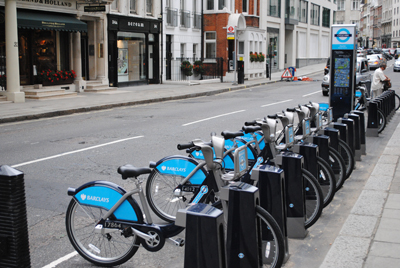
• None of London’s Barclay bikes will be available to tourists until the end of the year, reports the London Evening Standard. The newspaper says plans to widen the scheme to allow tourists to hire the bikes have been put on hold after the emergence of logistical problems. The hire scheme was launched for locals at the end of July.

• A new heritage trail has been opened at Kenley Common in the city’s outer south to commemorate the 70th anniversary of the Battle of Britain. The 56 hectare common in Surrey surrounds Kenley Airfield, a former Battle of Britain airfield these days used by the RAF for glider training. The trail, which was an initiative of a range of organisations including the Kenley Airfield Friends Group, RAF Association, Tandridge District Council, English Heritage, the Ministry of Defence and City of London Corporation, kicks off at the RAF Tribute on Kenley Common (off Hayes Lane in Surrey) and features a series of interpretative panels, the first two of which are mounted on scaled down Spitfire wings. These explain the role the area played in defending London from attacks and the significance of the tribute and the World War II blast pens. For more information, follow this link. For information on London’s Battle of Britain memorial, head here www.bbm.org.uk.

The Tip – In Westminster and need to go?

There’s nothing worse than getting caught without a toilet nearby – especially when travelling with kids. Westminster City Council operate a handy text service, Sat Lav, to locate the nearest public toilet to where you are. Just text 80097 and they’ll reply with the location. It’s in operation 24/7.

Around London…

• London’s bicycle hire scheme is up and running. The scheme was launched at the end of July and boasts 5,000 bikes which can be found at 315 docking stations. More than 21,000 people signed up in the first weeks and some of the early popular hire sites included Soho Square, Drury Lane in Covent Garden and Wardour Street. The bikes are available 24 hours a day, seven days a week. Members of the scheme must be 18 years old and you must be at least 14 years old to ride the bikes. A membership key costs £3 while the membership itself costs at £1 for a 24-hour membership, £5 for seven days and £45 for an annual membership. The first 30 minutes of any journey is then free (with fees applicable after that). As the bikes don’t come with a lock, it’s expected people will simply make a journey to another docking station before getting off. For more information on the Barclay’s Cycle Hire scheme, see Transport for London’s website at www.tfl.gov.uk. Meanwhile, in other transport news, the first air-conditioned Tube train is now in active service on the Metropolitan Line.

• A cafe has been opened at Buckingham Palace, 173 years after Queen Victoria first moved in following her accession to the throne. Located on the West Terrace overlooking the lawn and lake, the Garden Café is open during visiting hours. The Palace’s State Rooms, meanwhile, are open to the public until 1st October. The palace this year hosts The Queen’s Year exhibition which features displays of ceremonial robes, gifts, uniforms, dresses and jewellery, as well as archive photography and film in an illustration of the monarch’s work throughout the year at everything from the State Opening of Parliament to the Garter Day ceremony at Windsor Castle and investitures, garden parties and State Visits. Entry to the State Rooms – which comprise just 19 of the palace’s 775 rooms – is £17.00 an adult, £15.50 concessions, £9.75 for under 17s and under fives are free. Family tickets are £45 and combined tickets – including the Royal Mews and the Queen’s Gallery – are also available. www.royalcollection.org.uk/default.asp?action=article&ID=30. For more on the special exhibition, see www.royalcollection.org.uk/microsites/thequeensyear/

• The Tower of London was the most visited royal site in Britain last year, attracting 2.4 million tourists, according to a report from VisitBritain. The tourism agency found that while overseas tourists spent some £4.6 billion while in the UK last year, more than £500 million was spent on tourism associated with the Royal Family. The top 10 most visited sites included several royal attractions – Edinburgh Castle came in at number six with 1.2 million visitors, Windsor Castle at number seven with 987,000 and Buckingham Palace at number 11 with 402,000. Other top London sites included the National Maritime Museum in Greenwich (#2 – 2.4 million), the Victoria and Albert Museum in South Kensington (#3 – 2.3 million), St Paul’s Cathedral (#4 – 1.8 million), Westminster Abbey (#5 – 1.4 million) and Hampton Court Palace (#9 – 541,646).