Famous Londoners – William Camden…

Famed 16th century historian and writer William Camden is celebrated not only for the influence he and his career had on writers including the likes of Ben Jonson and Edmund Spenser, but also for his work in helping to transform the idea of historical inquiry.
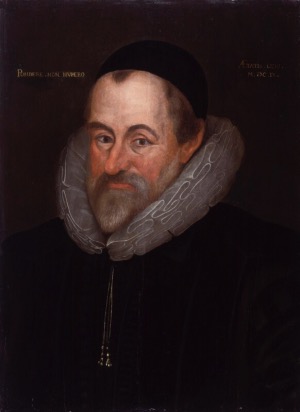
‘William Camden’ by or after Marcus Gheeraerts the Younger, oil on panel, 17th century, based on a work of 1609 NPG 528. PICTURE: © National Portrait Gallery, London

Camden was born in London on 2nd May, 1551, the son of Sampson, a painter-stainer originally from Lichfield, and his wife Elizabeth (Curwen).

He attended a school at Christ’s Hospital and then St Paul’s School before going on to study at the University of Oxford., graduating with a BA in 1573.

He had returned to London a couple of years earlier and in 1575 was appointed the second master of Westminster School (Jonson was one of his pupils; according to tradition, Camden sponsored his position).

It was during this period that, when not attending his duties at Westminster, he travelled the country, collecting material for what would be the first topographical survey of England. Titled Britannia and written in Latin, it was published in 1586.

Camden was made head master in 1593 and in 1595 published a Greek grammar which became seen as standard work.

In 1597, he was made Clarenceux king-of-arms (one of the three principal heralds at the College of Arms) which allowed him more time for writing (in 1589, he had been granted the prebend of Ilfracombe at Salisbury Cathedral).

Camden, who had established the Society of Antiquities with friends in about 1585 (it helped lay the foundations for the school of 17th century historians), published several history-related works between 1600 and 1607 including the first guide to Westminster Abbey’s monuments.

He was, from the end of that period, also working on his Annales Rerum Anglicarum et Hibernicarum Regnante Elizabetha (Annals of the Affairs of England and Ireland During the Reign of Elizabeth), the first volume of which was published in 1615 (a second volume was completed in 1617 but not published until after Camden’s death).

In 1618, in poor health, Camden retired two Chislehurst in Kent and while there founded the first chair of history at the University of Oxford (in fact the first such chair at any English university). He died, having never married, at Chislehurst on 9th November, 1623.,

Camden was buried in Poet’s Corner, in the south transept, of Westminster Abbey and has a monument which features his bust.
Lost London – Christ’s Hospital…

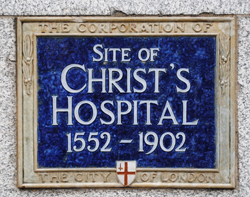
One of the achievements of the short-lived reign of King Edward VI, son of King Henry VIII, was the establishment of this hospital for orphans in 1552 in what were once buildings used by the Greyfriars Monastery (for more on the history of Greyfriars, see our earlier post here).

Christs-HospitalLocated in Newgate Street, the hospital soon had a school attached which became known as the Blue Coat School thanks to the distinctive long blue coats the students wore (and still do, the school is now located near Horsham in West Sussex).

Many of the hospital buildings were destroyed in the Great Fire of London of 1666 but most were later rebuilt under the supervision of Sir Christopher Wren, although the actual work was apparently carried out by others.

Students at the school have included antiquarian William Camden, Romantic poet Samuel Taylor Coleridge and writer Charles Lamb.

New buildings for girls were opened in Hertford in 1704 and the school moved out to Sussex in 1902 with the General Post Office built over the top of the demolished buildings.

What’s in a name?…Camden Town…

Camden-Lock

As with so many London locations, the name Camden Town comes from a previous landowner – but more indirectly it originates with the great 16th and 17th century antiquarian and topographer William Camden.

The story goes like this: late in his life William Camden – author of Britannia, a comprehensive description of Great Britain and Ireland – settled near Chislehurst in Kent on a property which became known as Camden Place.

In the 18th century, the property came into the possession of Sir Charles Pratt, a lawyer and politician (among other things, he was Lord Chancellor in the reign of King George III), who was eventually named 1st Earl of Camden.

It was Pratt who, having come into the possession of the property by marriage, in about 1791 divided up land he owned just to the north of London (which has apparently once been the property of St Paul’s Cathedral) and leased it, resulting in the development of what became Camden Town (Pratt, himself, meanwhile, is memorialised in the name of Pratt Street which runs between Camden High Street and Camden Street).

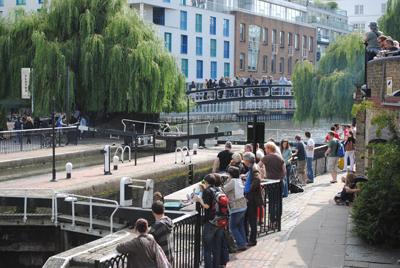
In 1816, the area received a boost when Regent’s Canal was built through it – the manually operated, twin Camden Lock is located in the heart of Camden Town.

Although it has long carried a reputation of one of the less salubrious of London’s residential neighbourhoods (a reputation which is changing), Camden Town is today a vibrant melting pot of cultures, thanks, in no small part, to the series of markets, including the Camden Lock Market, located there as well as its live music venues.

Past residents have included author Charles Dickens, artist (and Jack the Ripper candidate) Walter Sickert, a member of the so-called ‘Camden Town Group’ of artists, and, in more recent times, the late singer Amy Winehouse.

Of course, the name Camden – since 1965 – has also been that of the surrounding borough.