This Week in London – William Tyndale’s New Testament; Marilyn Monroe portraits; and, the Great Exhibition Road Festival…

PICTURE: Alex Tai/Unsplash

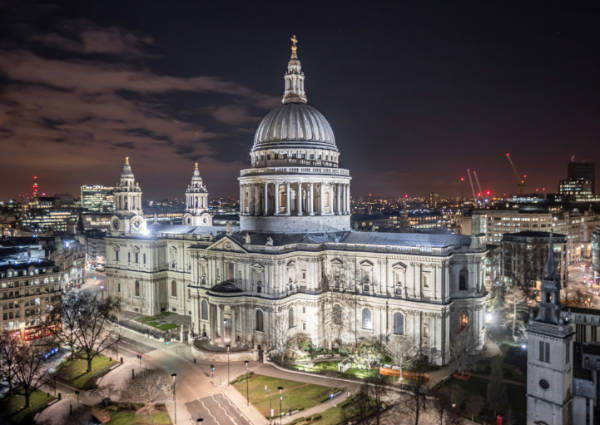
The 500 year story of one of the smallest yet most revolutionary books in English history is being told at St Paul’s Cathedral. A Dangerous Calling: 500 Years of William Tyndale’s New Testament, which opens tomorrow, provides a rare chance for visitors to see a first edition of Tyndale’s translation up close in the cathedral library (one of only three in existence) as well as access to a new digitised version on the cathedral floor. The exhibition can be seen until 27th February. Admission charge applies. For more, see www.stpauls.co.uk/whats-on/exhibition-dangerous-calling-500-years-of-william-tyndales-new-testament

• Marilyn Monroe’s life, career and legacy is the subject of a new exhibition which opened at the National Portrait Gallery this week. Marking 100 years since her birth, Marilyn Monroe: A Portrait features works by the likes of Andy Warhol, Pauline Boty, Cecil Beaton and Richard Avedon. There’s also unseen photographs portraits taken by Allan Grant at Monroe’s Brentwood residence a day before her death in August, 1962, in a session for Life magazine. The display can be seen until 6th September. Admission charge applies. For more, see www.npg.org.uk/whatson/exhibitions/2026/marilyn-monroe-a-portrait

• The Great Exhibition Road Festival kicks off in South Kensington this weekend, marking 175 years since the 1881 Great Exhibition. The event features workshops, talks, performances and installations with organisations ranging from the Natural History Museum and Science Museum taking part along with Imperial College London, the Royal Parks, the V&A and Royal Albert Hall. For more on the festival, head to https://www.greatexhibitionroadfestival.co.uk/.

Send all items for inclusion to exploringlondon@gmail.com.
Lost London – St Paul’s Cross…

Paul's-Cross-Memorial

Located in the north-east corner of the churchyard of St Paul’s Cathedral, St Paul’s Cross – also known simply as Paul’s Cross – was a large free-standing cross which served as an open-air pulpit for at least 500 years.

The history of the Cross goes back to at least the 12th century and it long served as a public gathering place for Londoners to hear sermons or matters of public importance. King Henry III met Londoners here in 1259 so they could swear their allegiance, people like 15th century chaplain Richard Walker appeared here to plead guilty for crimes against the church (in his case to charges of sorcery) and it was here that William Tyndale’s testaments were burnt in the 16th century.

Pauls-Cross2Conversely, it was also from here that the English Reformation was preached (there’s a painting in the Houses of Parliament of King Edward VI listening to a sermon preached from the Cross by reformist Bishop Latimer). It has been said that if all the sermons preached here had been collected, they would effectively make a history of the Church of England.

While it was a simpler structure in its earlier years, in the late 15th century, the then Bishop of London, Thomas Kempe, ordered the construction of a ‘preaching station’ on the site. It was an elevated small wooden structure with a lead roof topped by a cross under which a preacher and a couple of others could stand.

The cross and pulpit were destroyed during the English Civil War in 1643.

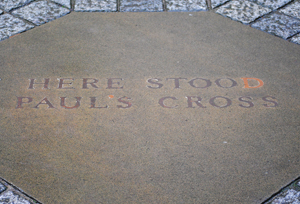
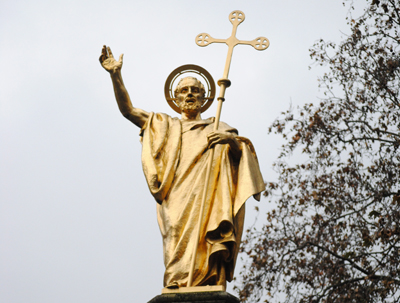
These days there’s a plaque marking the original site of the cross (above). In 1910, the St Paul’s Cross Memorial – a column topped with a gilt statue of St Paul designed by Sir Reginald Blomfield (pictured top), was installed nearby (as ordered by the will of HC Richards, according to a plaque on the site) and remains there today.

The Virtual Pauls Cross website, led by Professor John N Wall of North Carolina State University in the US, reconstructs what the site would have looked like when John Donne gave his Gunpowder Day sermon on 5th November, 1622.