A master builder and architect responsible for the development of key historic streets and squares in inner London during the first half of the 19th century, Thomas Cubitt’s legacy can still be seen in many places around London today.
Born in Buxton, near Norwich in Norfolk, on 25th February, 1788, Cubitt was the son of carpenter Jonathan Cubitt and his wife Agnes.
He took up his father’s trade at an early age and, drawing on those skills, journeyed to India as a ship’s carpenter, earning enough that he could start his own building firm around 1810. Joined by his brother William, they established themselves on Gray’s Inn Road in Holborn.
Their first major job was the construction of the London Institution in Finsbury Circus in 1815 and they went on to work on speculative housing projects in Camden Town and in Highbury Park in Stoke Newington.
Cubitt’s approach to such housing developments was somewhat revolutionary – he was one of the first builders to employ people of various trades, meaning he could offer those who sought his services something of a one-stop shop.
It was around this time – 25th March, 1821 – that he married Mary Anne Warner at St Marylebone Church. They would go on to have at least 12 children (and his descendants reportedly include Queen Camilla – he’s her great-great-great grandfather).
Cubitt’s major works in the development of London came in the 1820s when he was commissioned to build housing on the Duke of Bedford’s estate in Bloomsbury and by Richard Grosvenor, later 2nd Marquess of Westminster, to build homes in Belgravia, centred on Belgrave and Eaton Squares.
He also built housing to the south of Belgravia in an area which become known as Pimlico, nicknamed “Mr Cubitt’s District”, and as part of that development built several hundred yards of the Thames Embankment.
Said to be called the “Emperor of the Building Trade” by some, Cubitt also undertook development in Clapham Park and was responsible for a large part of Kemp Town in Brighton.
In 1827, the partnership between Thomas and his brother William (which also included younger brother Lewis, an engineer) was dissolved. William, later a Lord Mayor of London, took over management of the Gray’s Inn Road business, while Thomas focused his attentions on other projects (Lewis, meanwhile, would late rejoin William in the business).
Thomas’ subsequent projects included working with Prince Albert on the design and construction of Osborn House on the Isle of Wight, and, between 1847-50, building extensions to Buckingham Palace (as part of that work, he was responsible for moving the Marble Arch from the palace to Hyde Park). Cubitt was also one of those behind plans to turn Battersea’s water-logged fields into a public park.
Later in life, Cubitt bought and built a mansion for himself, Denbies House near Dorking. It was there that he died on 20th December, 1855. He was buried at the West Norwood Cemetery in south London. He was survived by his wife, seven of his children and both William and Lewis. Queen Victoria was among those who paid tribute to his life and career.
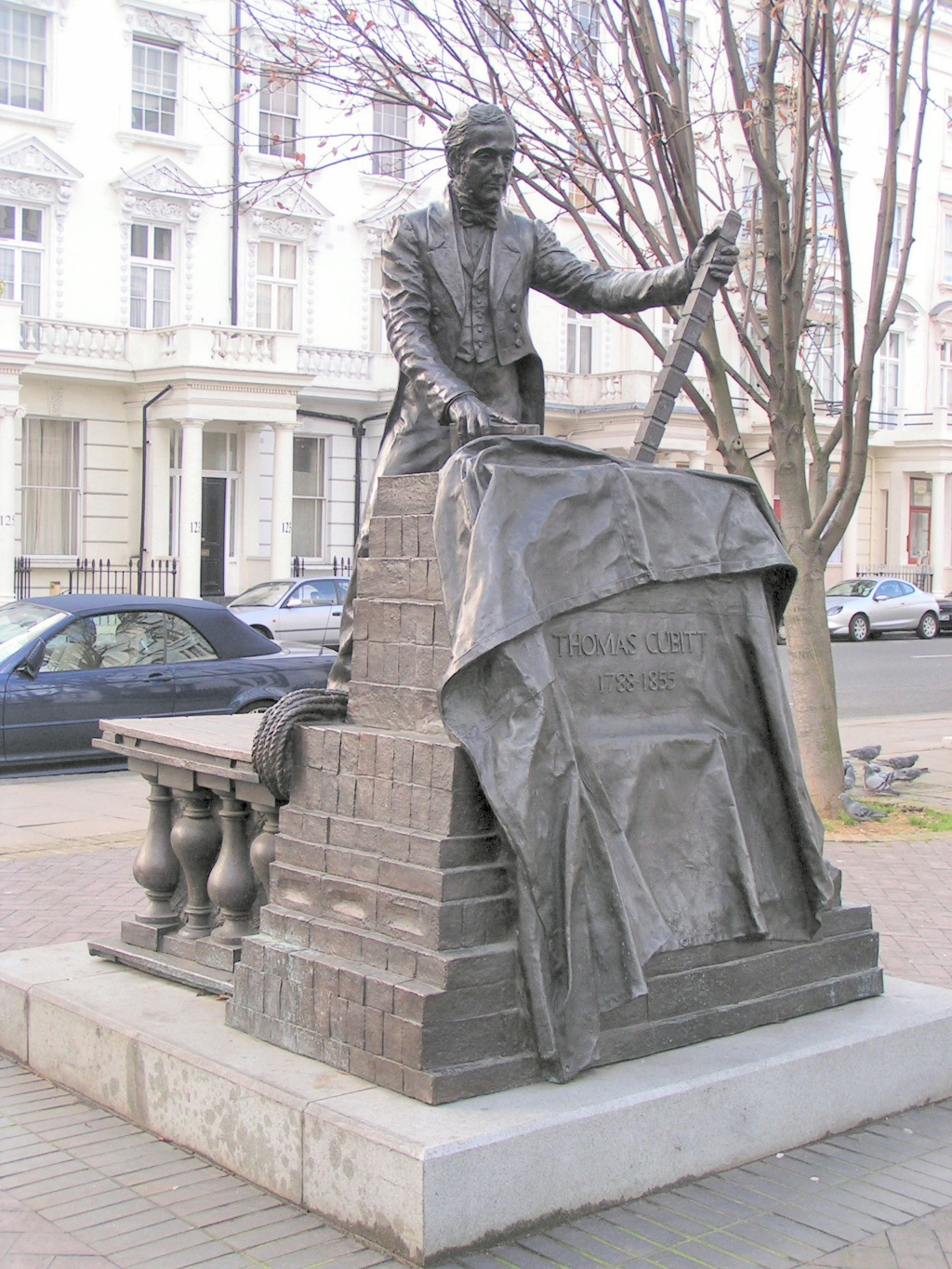
A statue of him (pictured) in Denbigh Street, London – near some of his former workshops – was unveiled by Gerald Grosvenor, 6th Duke of Westminster, in 1995. It is the work of William Fawke and donated by the Sanctuary Housing Association. There is a second statue of him in Dorking.
An English Heritage Blue Plaque marks the site of his former workshop at 3 Lyall Street – known as Cubitt Lodge, the building was built by him in 1847 and remained his headquarters and workshop until his death.

