Famous Londoners -Thomas Cubitt…

A master builder and architect responsible for the development of key historic streets and squares in inner London during the first half of the 19th century, Thomas Cubitt’s legacy can still be seen in many places around London today.

Born in Buxton, near Norwich in Norfolk, on 25th February, 1788, Cubitt was the son of carpenter Jonathan Cubitt and his wife Agnes.

He took up his father’s trade at an early age and, drawing on those skills, journeyed to India as a ship’s carpenter, earning enough that he could start his own building firm around 1810. Joined by his brother William, they established themselves on Gray’s Inn Road in Holborn.
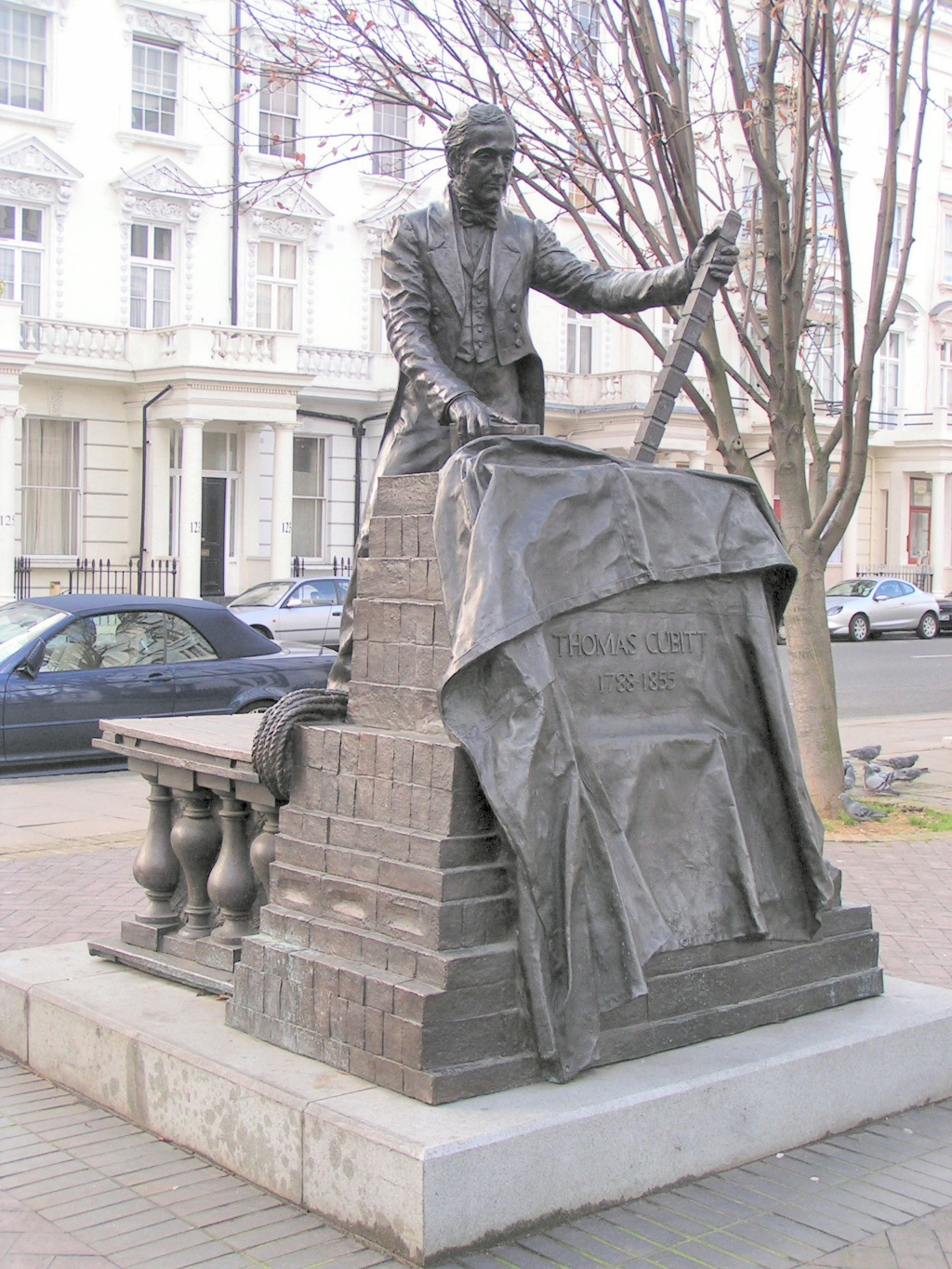
Statue of Thomas Cubitt by William Fawke. PICTURE: Canthusus at English Wikipedia (licensed under CC BY-SA 3.0/image cropped).

Their first major job was the construction of the London Institution in Finsbury Circus in 1815 and they went on to work on speculative housing projects in Camden Town and in Highbury Park in Stoke Newington.

Cubitt’s approach to such housing developments was somewhat revolutionary – he was one of the first builders to employ people of various trades, meaning he could offer those who sought his services something of a one-stop shop.

It was around this time – 25th March, 1821 – that he married Mary Anne Warner at St Marylebone Church. They would go on to have at least 12 children (and his descendants reportedly include Queen Camilla – he’s her great-great-great grandfather).

Cubitt’s major works in the development of London came in the 1820s when he was commissioned to build housing on the Duke of Bedford’s estate in Bloomsbury and by Richard Grosvenor, later 2nd Marquess of Westminster, to build homes in Belgravia, centred on Belgrave and Eaton Squares.

He also built housing to the south of Belgravia in an area which become known as Pimlico, nicknamed “Mr Cubitt’s District”, and as part of that development built several hundred yards of the Thames Embankment.

Said to be called the “Emperor of the Building Trade” by some, Cubitt also undertook development in Clapham Park and was responsible for a large part of Kemp Town in Brighton.

In 1827, the partnership between Thomas and his brother William (which also included younger brother Lewis, an engineer) was dissolved. William, later a Lord Mayor of London, took over management of the Gray’s Inn Road business, while Thomas focused his attentions on other projects (Lewis, meanwhile, would late rejoin William in the business).

Thomas’ subsequent projects included working with Prince Albert on the design and construction of Osborn House on the Isle of Wight, and, between 1847-50, building extensions to Buckingham Palace (as part of that work, he was responsible for moving the Marble Arch from the palace to Hyde Park). Cubitt was also one of those behind plans to turn Battersea’s water-logged fields into a public park.

Later in life, Cubitt bought and built a mansion for himself, Denbies House near Dorking. It was there that he died on 20th December, 1855. He was buried at the West Norwood Cemetery in south London. He was survived by his wife, seven of his children and both William and Lewis. Queen Victoria was among those who paid tribute to his life and career.

A statue of him (pictured) in Denbigh Street, London – near some of his former workshops – was unveiled by Gerald Grosvenor, 6th Duke of Westminster, in 1995. It is the work of William Fawke and donated by the Sanctuary Housing Association. There is a second statue of him in Dorking.

An English Heritage Blue Plaque marks the site of his former workshop at 3 Lyall Street – known as Cubitt Lodge, the building was built by him in 1847 and remained his headquarters and workshop until his death.

Around London – Museums at Night; Ballgowns at the V&A; Edward Lear plaqued; and, the Queen’s portrait at the NPG…

• It’s Museums at Night weekend which means its your chance to see some of London’s best museums after hours. Culture24’s annual event, which runs from 18th to 20th May, features more than 5o late openings and special events in London – from after dark visits to Aspley House, the former home of the Duke of Wellington, to the chance to hear about the history of ‘Bedlam’, one of the world’s oldest psychiatric facilities, at the Bethlem Archives & Museum and Bethlem Gallery, and a “Cinderella shoe” workshop at the Design Museum. As well as organisations like the British Museum and National Gallery, among the lesser known museums taking part are the Cuming Museum in Southwark, the British Dental Association Museum, and the Ragged School Museum in Mile End. For all the details, follow this link

Saturday sees the opening of a new V&A exhibition featuring more than 60 ballgowns dating from 1950 to the present day – the first exhibition to be held in the newly renovated Fashion Galleries. Among those gowns on display as part of Ballgowns: British Glamour Since 1950 will be royal ballgowns including a Norman Hartnell gown designed for Elizabeth, the Queen Mother, Catherine Walker’s ‘Elvis Dress’ worn by Princess Diana (pictured), and gowns worn by today’s young royals. There will also be gowns worn by celebrities including Sandra Bullock, Liz Hurley and Bianca Jagger and works by the likes of Alexander McQueen, Jenny Packham and a metallic leather dress designed by Gareth Hugh specifically for the exhibition. Runs from 19th May to 6th January. Admission charge applies. See www.vam.ac.uk for more. PICTURE: Victoria and Albert Museum, London

The man credited with popularising the modern-day limerick, Edward Lear, has been honored with a green plaque at his former house in Westminster. The Westminster Council plaque was unveiled on Saturday – what would have been his 200th birthday – at 15 Stratford Place where he lived from 1853 until 1869. Lear, who was born in Holloway and raised in Grays Inn Road, was famous for his work The Owl and the Pussycat, and as well as for his writings, was also noted as an artist and illustrator. Councillor Robert Davis reportedly had a go himself at a limerick in honour of the artisy: “There once was man named Lear, who lived in a spot close to here. This plaque unveiled today, is a fitting way, to pay tribute on his two hundreth year”.

• On Now: The Queen: Art and Image. Having been on tour across Britian, this exhibition features some of the most remarkable images ever created of the Queen opened at the National Portrait Gallery this week. Containing works by Cecil Beaton and Annie Leibovitz, Pietro Annigoni and Andy Warhol, the exhibition is the most wide-ranging exhibition of images in different media ever devoted to a single royal sitter. Highlights include full-length 1954-55 painting by Annigoni (pictured, right, it’s displayed with his 1969 portrait), Lucian Freud’s 2000-01 portrait and Thomas Struth’s recent large-scale photograph of both the Queen and the Duke of Edinburgh as well as a never previously loaned 1967 portrait by Gerhard Richter and a specially commissioned holographic portrait. Runs until 21st October. Admission charge applies. For more, see www.npg.org.uk. PICTURE: Queen Elizabeth II, Queen Regent by Pietro Annigoni, 1954-5. The Fishmongers’ Company

What’s in a name?…King’s Cross

The location now known as King’s Cross, north-west of the City, takes its name from a monument adorned with an 11 foot high statue of King George IV which once stood on a site now occupied by King’s Cross Railway Station.

The area had been previously known as Broadford Bridge or Battlebridge – the latter a name many associated with the apparently erroneous belief that it was here, at a bridge which once crossed the River Fleet, the Iceni Queen Boudicca (also known as Boadicea) ill-fatedly confronted the Roman Army under the command of Gaius Suetonius Paulinus.

From the 1830’s (King George IV ruled from 1820 to 1830), however, the area took on the name of King’s Cross thanks to the erection of what Walter Thornbury described in his 1878 text, Old and New London, as a “ridiculus octagonal structure crowned by an absurd statue of George IV”.

The structure, said to be 60 feet high, was erected at the intersection of Gray’s Inn Road, Pentonville Road and what we now know as Euston Road, and during its relatively short lifespan, was employed at different times as a police station and as a pub (complete, apparently, with a camera obscura in the upper level).

It was completely removed by 1845 (King’s Cross Railway Station officially opened in 1852).

The area of King’s Cross has been settled back as far as Roman times – St Pancras Old Church is one of the oldest sites of Christian worship in England although the current church is Victorian – but it wasn’t until the 1700s and 1800s that it was transformed in to an urban area with the arrival of canals – including The Regent’s Canal – and the railways.

Traditionally one of London’s poorest areas, it survived World War II bombings but subsequently suffered as the railways declined in the post-war period. By the 1980s, it had become notorious as a red light district.

It has since gone through – and is still going through – a gradual gentrification process, however, with the 67 acre development King’s Cross Central among the projects currently under construction.

Key attractions of the area include The British Library, The London Canal Museum, arts centre King’s Place, and the recently refurbished St Pancras Renaissance London Hotel.

It’s also now home to St Pancras International – London’s Eurostar terminus (having been moved here from Waterloo) – as well as King’s Cross Railway Station which is believed by many, despite the lack of any evidence, to be the burial site of Queen Boadicea (it’s said she still lies beneath platform 9 or 10) and which is the home of the fictitious platform 9 and 3/4 from which Harry Potter catches the train to Hogwarts.