This church, which was located on the bank of the Walbrook, dates from at least as back as the 13th century (the earliest recorded mention being in 1282).
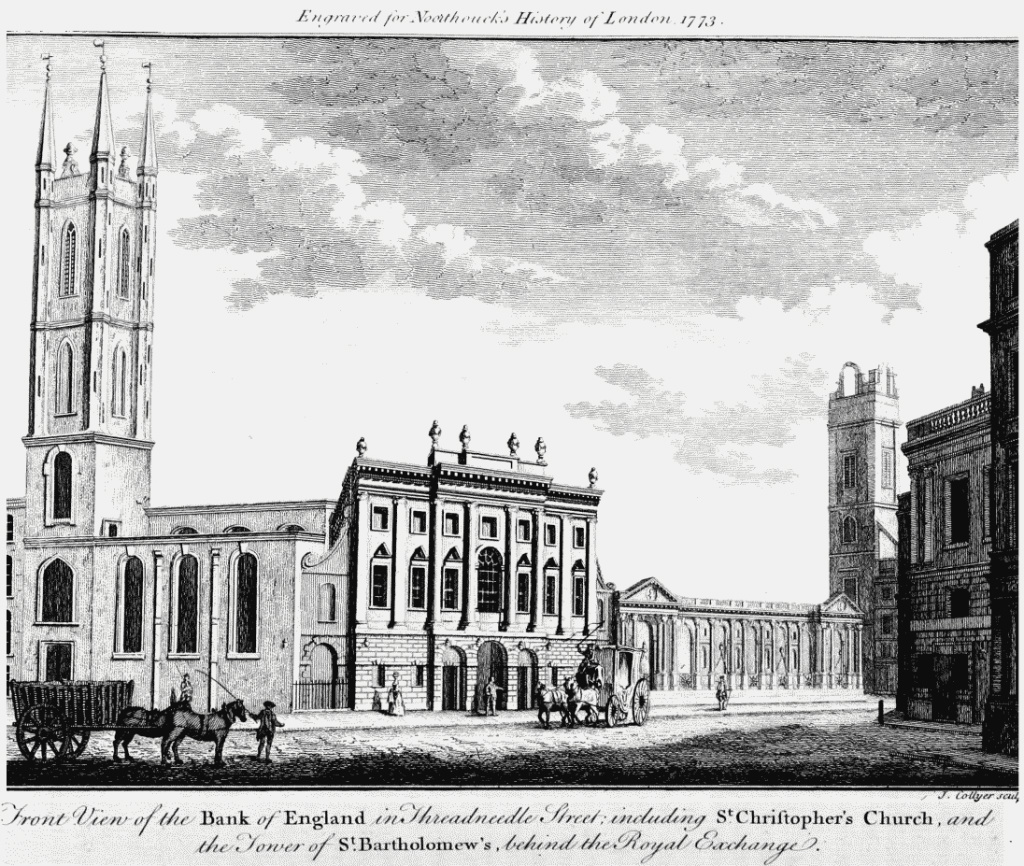
Dedicated to St Christopher, the patron saint of watermen, the church was originally variously known as St Christopher on Cornhill or St Christopher in Bread Street but later changed its name to St Christopher le Stocks.
The origin of this name has various possibilities – some say it was due to the proximity of the City Stocks, a medieval instrument of punishment; others that it was named after the nearby Stocks Market where meat and vegetables were sold (although it’s suggested that the market itself was so named because of the nearby fixed pair of stocks, so maybe both are true).
The church was rebuilt in 1462 and after being damaged in the Great Fire of London in 1666 was the first to be rebuilt by Sir Christopher Wren who did so in 1670-71, using much of what had remained of the medieval building. The new church, which featured oak wainscoting on the interior walls and tower at the west end (apparently with only one bell – the former peal of bells were destroyed in the fire) had a churchyard at the rear and
Troops were garrisoned in the church on Threadneedle Street during the Gordon Riots of 1780 to protect the Bank of England which had moved into a new building next door in 1724. The emergency prompted a petition for the demolition of the church so the bank could be better protected amid fears its tower could be used for another attack on the bank (not to mention the bank’s desire to expand!)
The church was demolished in 1782 and the parish was united with St Margaret Lothbury, which took most of the fittings (except for the reredos which went to St Vedast-alias-Foster and some upper panels of the pulpit which, carved by Grinling Gibbons, ended up at St Nicholas Church Canewdon in Essex).
The Dividend Warrant Office was built on the church site and the churchyard left as open space but now lies beneath the bank’s Garden Court.
Several Lord Mayors were buried in the churchyard as was the Thomas Harriot, the first person to map the Moon’s surface using a telescope, and the 6′ 7.5″ tall William Dan Jenkins who was buried in the then-disused churchyard in 1798 by special permission (partly to keep him safe from body-snatchers).
The remains of those interred at the church and in the churchyard were taken to Nunhead Cemetery in London’s south-east during work on the bank in 1867 and later in 1933. There’s a memorial to those reinterred in the cemetery.
Interestingly, a couple of parish boundary markers for the church can still be seen on the walls of the Bank of England.


