LondonLife – Millicent Fawcett unveiled…

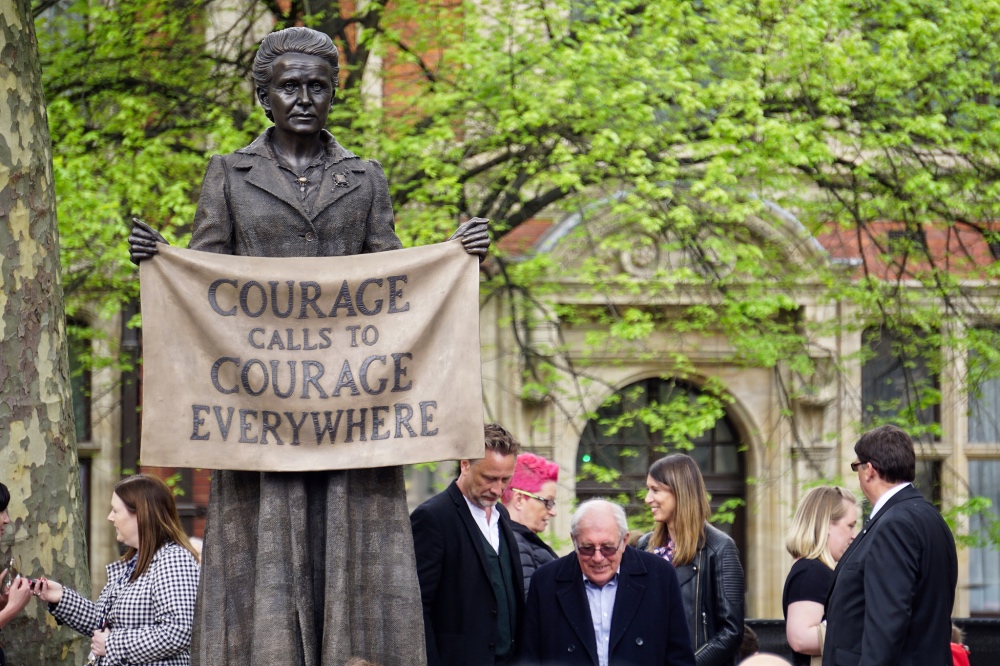
Prime Minister Theresa May (below) and the Mayor of London, Sadiq Khan, recently attended the unveiling of the first statue commemorating a female in Parliament Square – that of Suffragist leader Dame Millicent Fawcett. The work of Turner Prize-winning artist Gillian Wearing, the statue is not only the first of a woman to grace the square outside the Houses of Parliament but also the first in the square created by a woman. Its arrival marks 100 years since women were given the right to vote in the Representation of the People Act 1918. Mrs May paid tribute to Fawcett for her role in the “long and arduous” struggle to achieve votes for women while Mr Khan pointed out that the statue would stand near that of Mahatma Gandhi and Nelson Mandela – “two other heroic leaders who campaigned for change and equality”. “There couldn’t be a better place to mark the achievements of Millicent Fawcett, in the heart of UK democracy in Parliament Square,” he said. The statue, which was funded through the Government’s £5 million Centenary Fund, was unveiled by three generations of women including Jennifer Loehnis, a descendant of Millicent Fawcett, and activist Caroline Criado Perez who led the campaign lobbying for the statue to be placed there.

PICTURES – Top – Garry Knight/Flickr (public domain); Below Number 10/Flicker (licensed under CC BY-NC-ND 2.0)

Where’s London’s oldest…statue of a female?

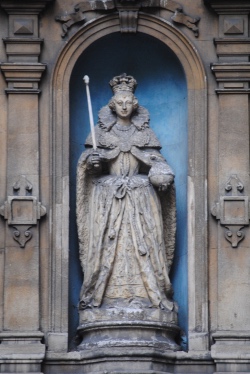
News recently that Parliament Square has its first female statue (more about that in an upcoming post) so we thought it timely to consider London’s oldest statue of a female.

It’s actually of a queen – Elizabeth I – and can be found on the facade of the Church of St Dunstan-in-the-West on Fleet Street in the City of London (also home to a rather famous clock).

Believed to have been made in 1586, the statue is said to be the work of one William Kerwin and originally adorned Ludgate.

It was moved to its current position over the church’s vestry door in 1760 when Ludgate was demolished due to road widening. Along with other statues from the gate, it had been given to Sir Francis Gosling who had it placed at the church.

The statue features a rather regal looking Queen, standing formally in royal robes with sceptre and orb.


This Week in London – James Cook’s voyages; Diana’s landmine moment remembered; and, the influence of the Greeks on Rodin…

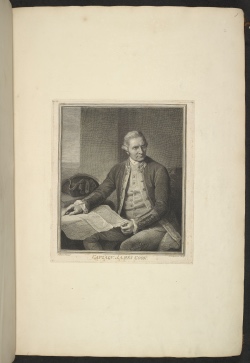
Marking 250 years since Captain James Cook set sail from Plymouth aboard the Endeavour in 1768 comes a new exhibition at the British Library focusing on the explorer’s three world-changing voyages aboard the Endeavour, the Resolution and the Discovery. Maps, artworks and journals from the voyages will be on show in James Cook: The Voyages alongside recently commissioned films bringing contemporary perspectives. The display features a collection of drawings by Polynesian high priest and navigator Tupaia – on display for the first time, as well as Sydney Parkinson’s natural history drawings including the first European depiction of a kangaroo, John Webber’s watercolour landscapes including the first European illustrations of Hawaii and works by William Hodges including the first artworks depicting the Antarctic. There’s also the first chart of New Zealand, specimens including the mouth parts of a squid from the first voyage, and, jewellery and musical instruments including a necklace from Tierra del Fuego, a ceremonial rate from Nootka Sound (Vancouver Island) and a bamboo flute from Tahiti. The display, which runs until 28th August, is being accompanied by a programme of public events. Admission charge applies. For more, see www.bl.ukPICTURE: Portrait of Captain James Cook (1728-79) © British Library Board.

A HALO Trust branded flak vest as well as a denim shirt and Armani chinos all worn by Diana, Princess of Wales, during a high profile visit to Angolan landmine fields in 1997 is among new items on show at Kensington Palace. Running since February last year, Diana: Her Fashion Story – which traces the evolution of the Princess’ style and her impact on British and global fashion – has been spruced up with the addition of new items including the landmine visit outfit as well as a pink Bellville Sassoon suit worn to board the train for her honeymoon, a Victor Edelstein evening gown worn for an official portrait by Terence Donovan (on public display for the first time), a floor length Yuki gown designed for the Prince and Princess of Wales’ visit to Japan, and a tartan dress by Caroline Charles worn to the 1982 Braemar Games in the Scottish Highlands. Admission charge applies. For more, see www.hrp.org.uk/Diana.

The influence of ancient Greek art on 19th century sculptor Rodin is the subject of a new exhibition opening at the British Museum today. Rodin and the art of ancient Greece displays his work alongside the Parthenon sculptures that inspired him. Thanks to a collaboration with the Musée Rodin in Paris, the exhibition features more than 80 of Rodin’s works in marble, bronze and plaster along with sketches. Key works on show include The Kiss (1882), which, like two female goddesses originally on the East Pediment of the Parthenon, was carved from a single block of stone. Runs until 29th July. Admission charge applies. For more, see www.britishmuseum.org.

Send all items to exploringlondon@gmail.com for inclusion.

10 islands in the Thames – 3. Brentford Ait…

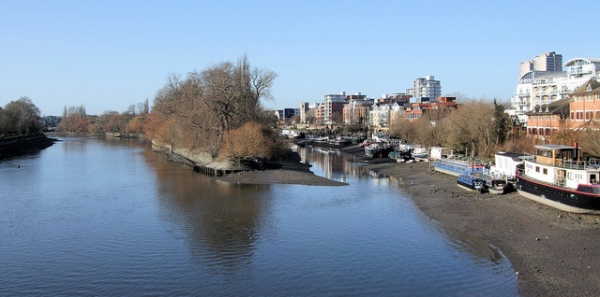
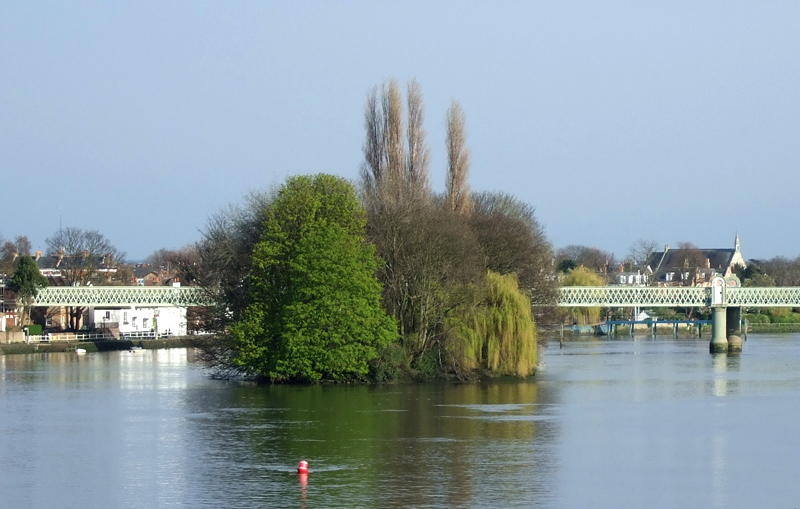
Located just upstream (and around the bend) from Oliver’s Island, this 4.5 acre island (ait being a word for a river island) has also been known by numerous other names including Makenshaw and Twigg Ait.

It was (in)famously home to a pub known as The Three Swans – there’s still a series of steps on the Brentford bank which lead down to the river where people crossed it to the pub.

The pub ceased trade around the turn of the 18th century and the island is now uninhabited.

In 1920s, this long ait was planted with trees to screen the local gasworks from those looking across the river from Kew Gardens.

The island, which features willows and alders and is reportedly home to a “significant heronry” as well as other birdlife, has a gap in the middle known as Hog Hole which can apparently be seen at high tide when it effectively creates two islands.

At the western end of Brentford Ait can be found the smaller Lot’s Ait (also known previously as Barbel Island, apparently after the Barbel fish found in the river there).

This island was previously used for growing osiers used for basket-making as well as grass for cattle fodder. It has appeared on the screen including in Humphrey Bogart’s 1951 film, The African Queen.

It’s now privately owned and currently home to a boat-builders. It’s been linked to the riverbank by a footbridge since 2012.

PICTURE: Brentford Ait (Jim Linwood licensed under CC BY 2.0)

LondonLife – New art on the Fourth Plinth…

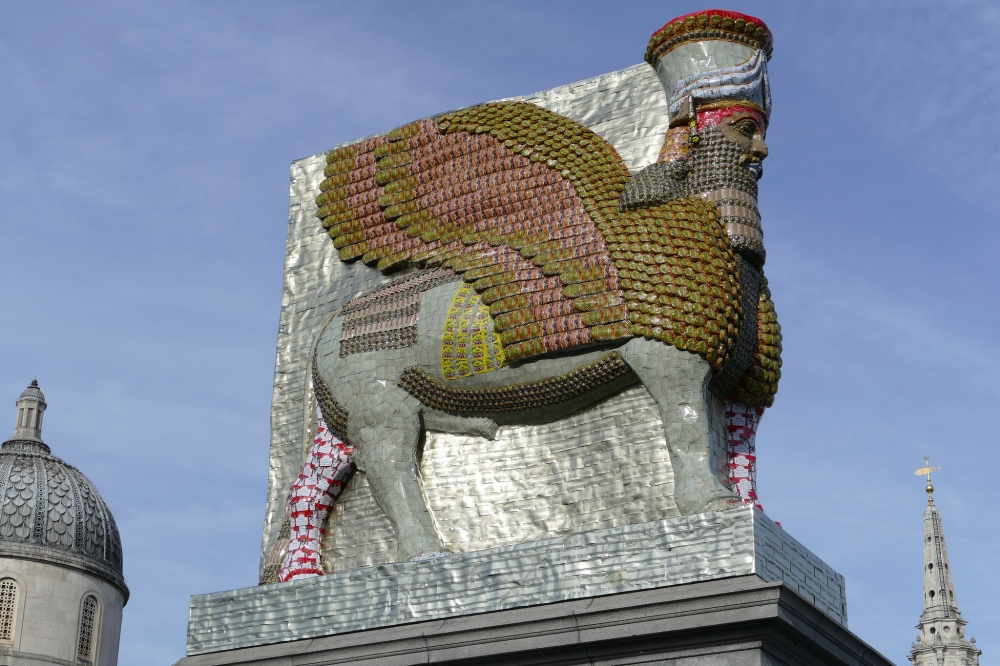
A life-sized copy of Lamassu, a winged deity that stood at Nineveh’s Nergal Gate from 700 BC until the so-called Islamic State destroyed it in 2015, Michael Rakowitz’s work The Invisible Enemy Should Not Exist is the 12th to adorn the Fourth Plinth in Trafalgar Square. The American artist’s work is made from 10,500 empty Iraqi date syrup cans, representative of a once-renowned industry which has been devastated by war in the Middle Eastern nation, while the use of recycled food packaging can be seen as a reference to the recycling of cannons once carried on the HMS Royal George to create the reliefs at the base of Nelson’s Column. Unveiled at the end of March by Mayor of London, Sadiq Khan, the work will remain on the plinth until early 2020.

PICTURE: Loz Pycock/licensed under CC BY-SA 2.0)

What’s in a name?…Horseferry Road…

There’s no prizes for guessing that this Westminster road, which runs from Greycoat Place to Millbank and Lambeth Bridge, in pre-bridge days led down to a horse ferry across the Thames.

The ferry was, in fact, the only licensed horse ferry along the river and did quite a trade in conveying horses and their riders as well as carriages across the river. Mentions of the ferry date back to medieval times but it’s suggested there may have been a ford here back as far as the Roman era.

The income from the ferry went to the Archbishop of Canterbury (his official London residence lay across the river at Lambeth). So lucrative were the ferry rights that when Westminster Bridge was built in the mid 18th-century, the archbishop was paid £3,000 in compensation.

There are a number of famous figures associated with the ferry – Princess Augusta, later the mother of King George III, reportedly used it on the way to her wedding in 1736, and almost 50 years before that, the ferry pier is said to have been the starting point for King James II’s flight from England in 1689.

There are also a couple of high profile disasters associated with the horse ferry – Archbishop Laud’s belongings apparently sank to the bottom when the ferry overturned in 1633 and  Oliver Cromwell’s coach was apparently lost during a similar incident in 1656 – both events were apparently seen as bad omens (not to mention expensive).

Horseferry Road, meanwhile, is these days home to government buildings including Horseferry House and the City of Westminster Magistrate’s Court, as well as the Royal College of Veterinary Surgeons and, since the mid 1990s, Channel 4’s HQ.

Horseferry Road was also the location of the Australian Imperial Force’s administrative HQ during World War I and it was in this thoroughfare that Phyllis Pearsall was living when she conceived the London A to Z.

PICTURE: Top – Lambeth Bridge, site of the horse ferry which gives Horseferry Road its name/Right – Horseferry Road (Tagishsimon, licensed under CC BY-SA 4.0)


Treasures of London – Gilbert and Sullivan memorials…

 Located on the west bank of the Thames between Waterloo and Hungerford Bridges are two separate memorials to the dramatist Sir WS Gilbert (1836-1911) and composer Sir Arthur Sullivan (1842-1900) – a partnership better known simply as Gilbert and Sullivan.

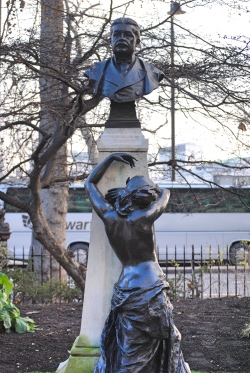
The first to be unveiled was a now Grade II-listed bronze bust of Sullivan in 1903. Located at the northern end of Victoria Embankment Gardens, it is the work of Sir William Goscombe John and, along with the bust which sits atop a pedestal, the monument features a scantily clad female muse leaning against the pillar in apparent grief.

Sheet music, a mandolin and a Pan mask all lie in a heap beside her – the discarded props of Sullivan’s profession – and on the side of the plinth are inscribed some lines from his work, The Yeoman of the Guard: “Is life a boon? If so, it must befall that Death, whene’er he call, must call too soon” (the same lines are inscribed on the sheet music).

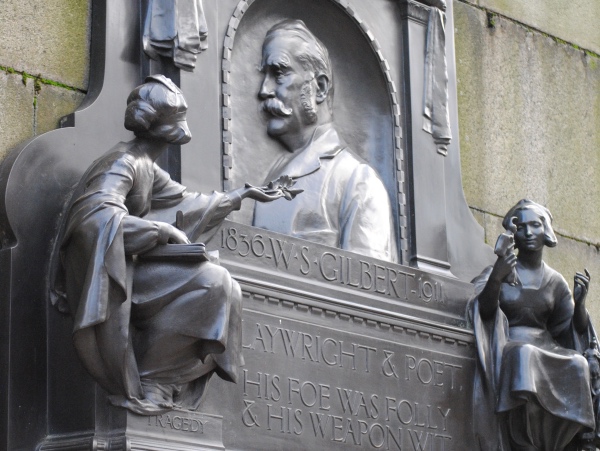
The bronze memorial plaque to Gilbert, meanwhile, was unveiled in 1915, four years after his death. It’s attached to Charing Cross Pier on the downstream side of Hungerford Bridge and, the work of Sir George Frampton, shows Gilbert in profile relief flanked by figures of Comedy and Tragedy.

Gilbert is accompanied by an inscription which reads: “His foe was folly & his weapon wit”. A shield underneath bears a Latin inscription which translates as “I would rather die than change”.

The location of the memorials is not coincidental – the career of Gilbert and Sullivan was closely associated with the nearby Savoy Theatre, where many of their works were premiered thanks to its owner Richard D’Oyly Carte – he’s also commemorated in a memorial opposite the entrance to the Savoy nearby.


This Week in London – Fashion and raw materials; music and museum; and, lates at Tate…

• The relationship between the glitzy world of fashion and the raw materials used to make it is the subject of a new exhibition opening at the V&A on Saturday. Fashioned from Nature features more than 300 “beautiful, intriguing and unsettling objects” spanning the period since 1600 and including everything from a a pineapple fibre clutch bag, a Calvin Klein dress made from recycled bottles worn by actor Emma Watson (pictured) and a cape of cockerel feathers. One focus of the exhibition is the damage done to the environment due to the demands of fashion and the display highlights some of the campaigners and groups which have been vocal in protesting about the issue. The display also looks at the role design has played in creating a more sustainable fashion industry. Runs until 27th January, 2019. Admission charge applies. For more, see vam.ac.uk/fashionedfromnature. PICTURE: Emma Watson wearing Calvin Klein at The Metropolitan Museum of Art’s Costume Institute Benefit Celebrating the Opening of Manus x Machina: Fashion in an Age of Technology, Arrivals, The Metropolitan Museum of Art, NYC, New York, America, 2nd May 2016 (Matt Baron/REX/Shutterstock).

The British Museum has kicked off a first-of-its-kind two week festival of musical performances exploring the idea of museums as “diplomats of the 21st century”. Running until 29th April, Europe and the world: a symphony of cultures explores Europe’s interactions with the world and looks to create a dialogue between works of classical and contemporary music and objects in the museum which have come from around the world. There’s 17 performances taking place over the two weeks which started last Monday as well as some panel discussions. The works include those of Ligeti, Berio, Stockhausen, Liszt, Messiaen, Strauss, Bartók, and Nono and are being performed along with pieces from historical musical traditions such as medieval temple music from China, classical music from India, Spanish colonial and flamenco music, Spiritual Japanese music from the 7th century and Byzantine choral music. Among those performing are London Sinfonietta, Ensemble für Intuitive Musik Weimar, Accademia del Piacere, Zhang Jun and his Kunqu Ensemble, Kaushikiji Charkraborty and Ensemble, and Reigakusha Ensemble Tokyo. Supported by the German Foreign Office, more details on the festival can be found at www.britishmuseum.org/whats_on/europe_and_the_world.aspx.

Tate Britain has launched a series of new night events curated by young people aged 15 to 25. The gallery, which already held the first event in early April, will open late on the first Friday evenings of June, August, October and December for a series of special events featuring music, live performances and workshops and inspired by displays, exhibitions and artworks in Tate’s collections including the current Art Now installation by Marguerite Humeau, John Constable’s Salisbury Cathedral from the Meadows, the upcoming Duveens Commission by Anthea Hamilton​ and the Turner Prize. Lates at Tate Britain are free, drop-in events with spaces available on a first come, first served basis. For more, head to www.tate.org.uk.

Send all items for inclusion to exploringlondon@gmail.com.

10 islands in the Thames – 2. Oliver’s Ait…

Formerly known as Strand Ait (or Ayt), this small island’s name was changed after the English Civil War, inspired by a story that Oliver Cromwell himself had taken refuge here during the war.

There’s apparently no truth to that story (or at least no evidence has been found) or to the legend that there was a secret tunnel which ran under the river from the mid-stream island to the nearby Bull’s Head pub on Strand-on-the-Green in Chiswick where Cromwell was said to have had established a headquarters (the tunnel was apparently so he could escape if the Cavaliers got too close).

The island, which stands in a stretch of the river between Kew and Chiswick (just upstream from Kew Railway Bridge and downstream from Kew Bridge) in London’s west, is not quite an acre in size (and, like Chiswick Ait, it’s roughly ship-shaped) but has served various purposes over the years.

In 1777, the City of London’s navigation committee built a wooden, castle-shaped tollbooth on the island with a barge moored alongside to catch passing river trade and so fund improvements to the navigability of the river. One story says it’s that barge that apparently lent its name to the delightful nearby pub, The City Barge, but others say the pub is named after the Lord Mayor of London’s State Barge which had winter moorings nearby for a time.

In 1865 a smithy was built on the island which was used in the building and repair of barges. It was later, after the Port of London Authority took over ownership in 1909, used as a storage facility and wharves for derelict vessels. The building survived until the 1990s but is now gone – along with any other signs of civilisation.

The island, which now has a dense canopy largely made up of sycamore trees, is these days inhabited by birds – those spotted there have included mallards, cormorants, Black-headed gulls, Canada geese, Egyptian geese, mute swans, magpies and robins – as well as  a range of other life – a 2014 survey found 11 species of mollusc and 35 species of vegetation and the island has also been cited as a habitat for bats and Thames door snails.


LondonLife – Still waters at Hampstead Heath…

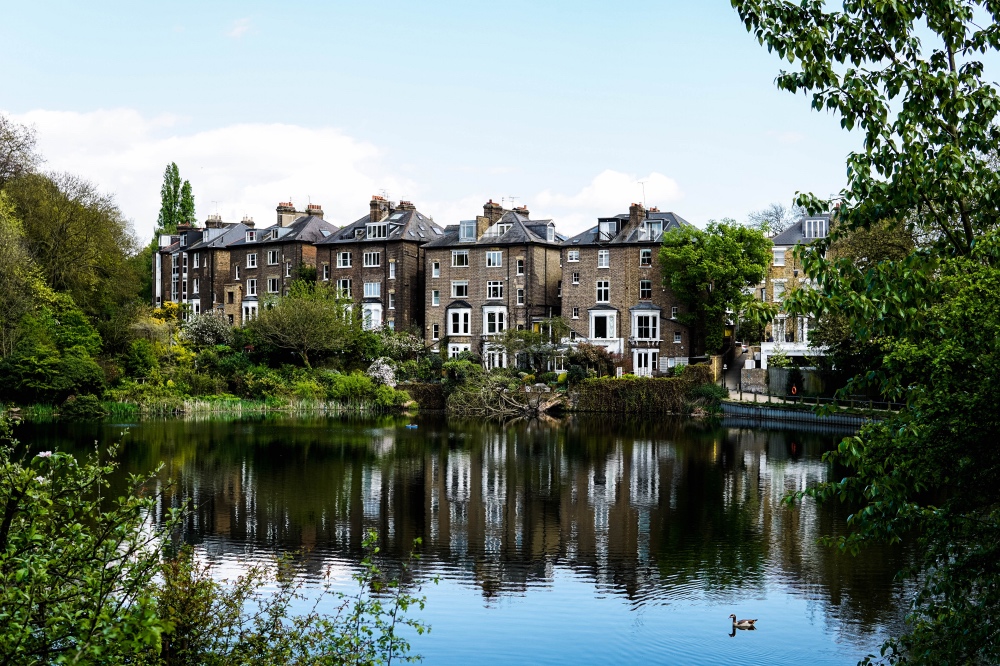
PICTURE: Amadeusz Misiak/Unsplash.

Lost London – The Church of St Peter-le-Poer…

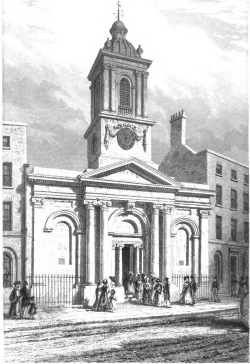
This medieval-era church, located on Broad Street in the City of London, survived the Great Fire of 1666 but was demolished in the early 20th century when, due to the lack of residents in the City, it was no longer needed as a church.

The church, also sometimes referred to as St Peter-le-Poor, was in existence by the end of the 12th century but it’s thought the name ‘le poer’ (generally said to refer to either the poverty of the surrounding area or its proximity to an Augustinian monastery) didn’t come to be added until the 16th century.

The church was rebuilt in 1540 and then enlarged and repaired – including the addition of a new steeple – in the first half of the 17th century.

By 1788, the church had, however, fallen into such disrepair that it had to be rebuilt and the new building, designed by Jesse Gibson and located further back from Broad Street (into which it had previously projected), was consecrated in November, 1792.

The layout of the new church was somewhat unusual – the altar was located on the north-west side of the church, opposite the entrance (altars were traditionally located in the east), and the nave was circular with a wooden gallery running around the interior.

There was a large lantern in the centre with glass walls. The entrance on the eastern side of the church, featured a facade which gave no hint of the circular nature of the building behind – it featured a square tower and columned entrance.

With the declining population living in the City of London, the church was no longer needed as a place of worship by the early 20th century and so it was demolished in 1907.

The parish was united with St Michael Cornhill and the proceeds from the sale of the site were used to build the church of St Peter-le-Poer in Friern Barnet. This church was also given the City property’s font, pulpit and panelling.


This Week in London – Kew celebrates 10 years of The Shirley Sherwood Gallery with botanical art, and BBC great honoured with Blue Plaque…

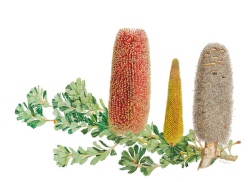
A unique collection of contemporary botanical art from The Florilegium Society at the Royal Botanic Gardens in Sydney, Australia, has opened at The Shirley Sherwood Gallery in Kew Gardens. Among several exhibitions marking the gallery’s 10th anniversary, this display features life-sized works by 64 Australian and international artists of the society (the name florilegium means ‘a gathering of flowers’). Meanwhile, a showcase of botanical works by Australian and New Zealand painters selected by Dr Shirley Sherwood from among her collection has also gone on show. Down Under II: Works from the Shirley Sherwood Collection follows an earlier exhibition in 1998. And finally, with the Temperate House set to reopen next month after a five year restoration, the gallery is also hosting Plans and plants – the making of the Temperate House which takes a look at the history of this Victorian-era landmark through plans, drawings and photographs taken from Kew’s archives. All three displays can be seen until 16th September. Admission included with Gardens entry.  For more, see www.kew.org. PICTURE: Banksia praemorsa by Margaret Pieroni. The Florilegium Society at the Royal Botanic Gardens, Sydney.

Sir Hugh Carlton Greene, director-general of the BBC during the 1960s, has been honoured with an English Heritage Blue Plaque at his former home in Holland Park. Greene (1910-1987) lived in the two-storey semi-detached home at 25 Addison Avenue between 1956 and 1967, a period which mostly coincided with his time as director-general. A former journalist and younger brother to novelist Graham Greene, he had joined the BBC in 1940 and was appointed director-general in 1960, remaining in the post for more than nine years before resigning in 1969. He presided over the BBC during a period in which the broadcaster was forced to reinvent itself following the arrival of ITV. The plaque was unveiled by veteran broadcaster, naturalist and former colleague, Sir David Attenborough. For more on Blue Plaques, see www.english-heritage.org.uk/visit/blue-plaques/.

Send all items for inclusion to exploringlondon@gmail.com.

10 islands in the Thames – 1. Chiswick Eyot…


We kick of a new series this week looking at islands in the River Thames in Greater London and start with the uninhabited Chiswick Eyot or Ait (a word for a river island).

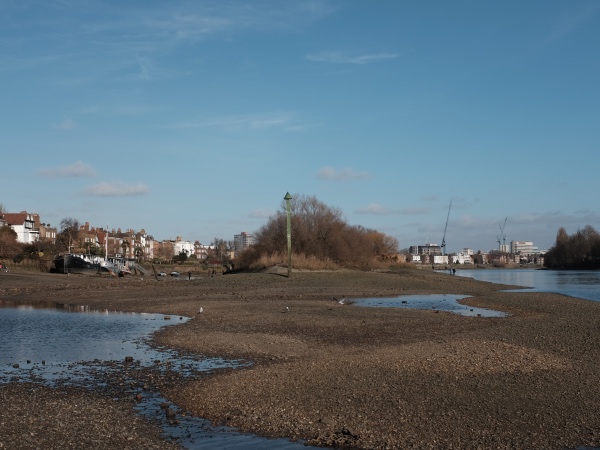
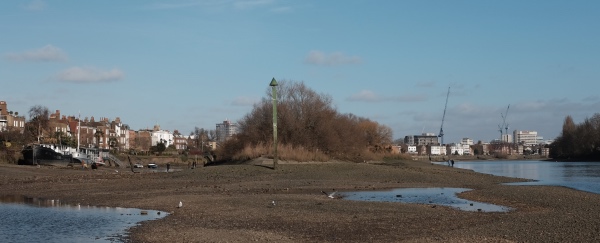
Located just off Chiswick Mall in London’s west, this 3.2 acre tidal island (one of 42 unbridged tidal islands in England) is the lowest in The Thames (and hence gets submerged at high tide – the island appears in the picture above at low tide).

Historically, the island – which is shaped like the plan of a ship sitting parallel to the Mall – was used as a location for the growing of osiers (basket willows) which were used to make baskets.

Formerly owned by the church, in 1934 ownership passed to the local council, now the London Borough of Hounslow. It declared the island a local nature reserve in 1993. Conservation days are regularly held on the island by river conservation group Thames21 (but otherwise people are requested to stay off the island).

The island is a key point on The Championship Course during the annual Boat Race between Oxford and Cambridge from Putney to Mortlake.

PICTURE: henry… (licensed under CC BY-NC-ND 2.0/image cropped)

LondonLife – Trafalgar Square…

PICTURE: Kevin Grieve/Unsplash

A Moment in London’s History – The execution of George, Duke of Clarence…

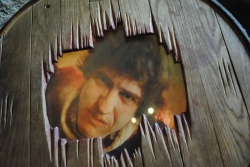
Among the gruesome deaths said to have taken place at the Tower of London is that of George, the Duke of Clarence, who, so the story goes, was drowned in a butt of Malmsey wine on 18th February, 1478 – 540 years ago this year.

George, who was born on 21st October, 1449, was the younger brother of King Edward IV and older brother of (although he was only king after George’s death) King Richard III.

George, who was made Duke of Clarence and Lord Lieutenant of Ireland soon after the House of York’s King Edward IV’s ascendancy to the throne in 1461 during the volatile period known as the Wars of the Roses, had betrayed his brother King Edward IV at least twice before his death.

The first time came in the late 1460s when he joined with Richard Neville, Earl of Warwick, in helping the previously deposed Lancastrian King Henry VI back onto the throne. The second time came after his brother Edward has retaken the throne in March, 1471, and the two of them had reconciled. George had sought to wed Mary of Burgundy, but Edward had objected – one of a series of events which apparently led George, whose mental state was said to be deteriorating fast by this point, to once again scheme against the king and eventually saw King Edward IV have him thrown in prison in June, 1477.

The King brought charges – including that he had slandered the King and prepared for rebellion – against George in Parliament in January, 1478, and both houses subsequently passed a bill of attainder with the sentence of death carried out in private (thus perhaps sparing him the humiliation of a public execution?) in the Tower soon after.

The story that he had been drowned in a butt of his favourite malmsey (a sweet wine) in the Bowyer Tower apparently circulated soon after his death – among proponents of the story was William Shakespeare who in Richard III has the duke stabbed and then drowned in a butt of malmsey – and to this day it remains something of a mystery as to whether it actually occurred (although, interestingly, his body when exhumed was not beheaded which was the common means of executing members of the nobility).

It has been suggested that sawn down wine butts were used for baths at the time – which may mean George was drowned in a wine butt, but one he was using to take a bath rather than one which had wine stored in it. It has also been suggested that the reference to a butt of wine refers to a barrel used for storing his body for removal to Tewkesbury where he was buried alongside his wife rather than his actual execution.

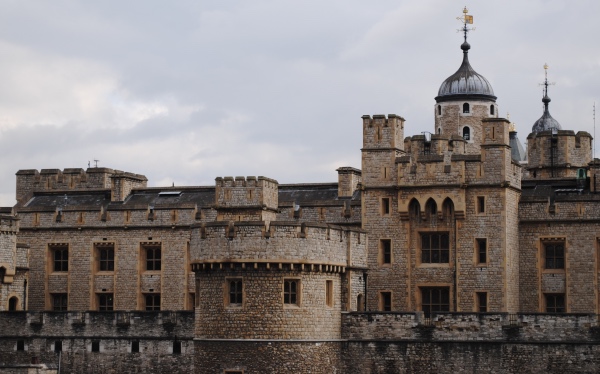
PICTURES: Top – The Tower of London where the Duke was executed; Right – A virtual re-enactment of George’s death at the Tower.


This Week in London – Monet and architecture; Abbey Road Studios on show; and, Maqdala recalled…

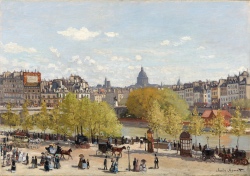
An exhibition showcasing the works of Impressionist artist Claude Monet with a focus on his depictions of architecture opens at the National Gallery on Monday. The Credit Suisse Exhibition: Monet & Architecture is the first exhibition concentrating solely on Monet’s works in London in more than 20 years. It spans his entire career from the mid-1860s to early 20th century and features more than 75 paintings depicting everything from villages to cities like Venice and London as well as individual structures and monuments. The display includes a rare gathering of some of Monet’s great ‘series’ paintings including five pictures from trips to Holland made in the early 1870s, 10 paintings of Argenteuil and the Parisian suburbs from the mid-1870s, seven pictures depicting the cathedral at Rouen from 1892–5, eight paintings of London from 1899–1904, and nine canvases showing Venice from 1908. Highlights include the Quai du Louvre (1867) (pictured), the Boulevard des Capucines (1873), and the flag-filled Rue Montorgeuil, 30 June 1878. Can be seen in the Sainsbury Wing until 29th July. Admission charge applies. For more, see www.nationalgallery.org.uk. PICTURE: The Quai du Louvre (Le Quai du Louvre), 1867, Claude Monet, Oil on canvas © Collection Gemeentemuseum Den Haag.

London’s Abbey Road Studios are celebrated in an exhibition of the work of rock photographer Jill Furmanovsky which opens at the Barbican Music Library on Monday. Inside Abbey Road Studios – Through the lens of Jill Furmanovsky is a showcase of her work since 1976 when she photographed Pink Floyd during the Wish You Were Here recording sessions and, as well as those images, includes more recent images of the likes of Nile Rodgers, Royal Blood, Novelist, and Mura Masa, as well as emerging musical talent. The display is a collaboration between Abbey Road Studios, Furmanovsky – who became artist-in-residence at the studios last year – and the Barbican Music Library. The exhibition, which is free to enter, can be seen until 27th June. For more, see www.barbican.org.uk/whats-on/2018/event/inside-abbey-road-studios.

Some 20 objects from Ethiopia are featured in new exhibition at the V&A marking the 150th anniversary of the siege and battle at Maqdala, culmination of the British Expedition to Abyssinia. Maqdala 1868, which focuses on the battle and its aftermath, features some of the earliest examples of military photography in Britain as well as a portrait of Emperor Tewodros II’s son Prince Alemayehu taken by Julia Margaret Cameron soon after the prince was brought to England by the British military. There’s also examples of metalwork and textiles including a gold crown with filigree designs and embossed images of the Evangelists and Apostles, a solid gold chalice, jewellery and a wedding dress believed to have belonged to the Emperor’s wife, Queen Terunesh. All of the objects were taken during Sir Robert Napier’s military expedition of 1867-68 which was aimed at securing the release of British hostages held by the Emperor and which culminated in the Emperor’s suicide and the destruction of his fortress. The exhibition, which is free to see, has been organised in consultation with the Ethiopian Embassy in London and an advisory group including members of the Orthodox Tewahedo Church, members of the Anglo-Ethiopian society and representatives from the Rastafarian community. Runs until July, 2019, in Room 66 of the Silver Galleries. There is a program of related events. For more, see www.vam.ac.uk.

Send all items for inclusion to exploringlondon@gmail.com.

10 of London’s modern icons – The Recap…

We’ve finished our series on modern icons (we’ll be looking at some more in another special series). But before we move on to our next series, here’s a quick recap. Which one is your favourite?

10 of London’s modern icons…1. Lloyd’s of London building

10 of London’s modern icons…2. 30 St Mary Axe (aka ‘The Gherkin’)

10 of London’s modern icons…3. The BT Tower…

10 of London’s modern icons…4. One Canada Tower…

10 of London’s modern icons…5. The London Eye…

10 of London’s modern icons…6. Millbank Tower…

10 of London’s modern icons…7. The O2…

10 of London’s modern icons…8. Tower 42…

10 of London’s modern icons…9. 20 Fenchurch Street (The Walkie Talkie)…

10 of London’s modern icons…10. The Shard…

This Week in London – Happy Easter!; Egg hunting at English Heritage properties; Peter Rabbit at Kew; and The Science Museum’s Frankenstein Festival…

Wishing all of our readers a very Happy Easter!

Six special eggs designed by six top children’s book illustrators have been hidden at English Heritage sites across the country for Easter. The illustrators – including Ian Beck, Polly Dunbar, Olivia Lomenech Gill, Trisha Kraus, Lydia Monks and Grahame Baker Smith – have all designed eggs inspired by English Heritage properties. Young visitors taking part in the Easter Adventure Quests – which will be held at 20 English Heritage properties including London’s Eltham Palace and Gardens and Down House – will need to hunt for a special “chicken token” hidden in the undergrowth with those who find one presented one of the six “eggsclusive” eggs. The tradition of decorating Easter eggs has been recorded as far back as 1290 in England when King Edward I purchased 450 of them to be decorated and covered in golf leaf for his courtiers. In the early 16th century, King Henry VIII received a silver-mounted egg as an Easter gift from the Pope. The Easter Egg Adventure Quest will be held from 30th March (Good Friday) through to 2nd April (Easter Monday). For more on what’s happening at Easter, see www.english-heritage.org.uk/easter/.

Peter Rabbit and his furry friends are visiting Kew Gardens this Easter. From tomorrow until 15th April, the Peter Rabbit themed festival – A big day out with Peter Rabbit – will see visitors presented with a copy of Mr McGregor’s garden notebook so they can follow a Peter Rabbit-themed trail to the Secluded Garden where they can find life-sized selfie boards of Peter and other characters and take part in a range of activities including games, craft activities and workshops (including how to build their own rabbit warren). The nearby Kitchen Garden will also be on display with mini-tours for families to show off the growing produce. Admission charge applies. For more, see www.kew.org.

An Easter Egg Hunt will take place at The Royal Mews, Buckingham Palace, on Saturday. Between 11am and 3pm, children are invited to hunt for pictures of Rex the corgi and the royal horses Majesty and Scout among the carriages as well as dress up as a footman, learn how to harness a horse, take part in art activities and find out what it’s like to ride in a royal carriage. Each child will be able to claim an Easter egg to take home. For more, see www.royalcollection.org.uk.

The Science Museum’s free Frankenstein Festival – celebrating the 200th anniversary of the publication of Mary Shelley’s Frankenstein or the Modern Prometheus – kicks off on 3rd April. Featuring immersive theatre, experiential story-telling and hands-on activities, the festival will encourage visitors to examine the ethical scientific questions surrounding the artificial creation of life and allow them to step into Dr Frankenstein’s shoes and create a creature which they can bring to life using stop-motion animation. There’s puzzles and experiments to do, a Frankenstein-themed audio tour of the museum called It’s Alive, a choose-you-own-adventure experience – Pandemic – in which visitors decide how far Dr Frankenstein should go to tackle a virus sweeping across the world, and, Humanity 2.0, a play performed by Emily Carding which examines what could happen if a benevolent AI recreated humanity in an apocalyptic future world. There’s also the opportunity to meet researchers at the cutting edge of science including bio chemists who manipulate DNA and engineers creating artificial intelligence. The festival runs daily between 3rd and 8th April (some activities have limited availability so tickets can be found at sciencemuseum.org.uk/Frankenstein). A Promethean Tales Weekend will be held on 27th to 28th April, featuring panel discussions and special screenings of Terminator 2: Judgement Day and The Curse of Frankenstein in the IMAX cinema. For more, head to sciencemuseum.org.uk/Frankenstein.

Send all items for inclusion to exploringlondon@gmail.com.

10 of London’s modern icons…10. The Shard…


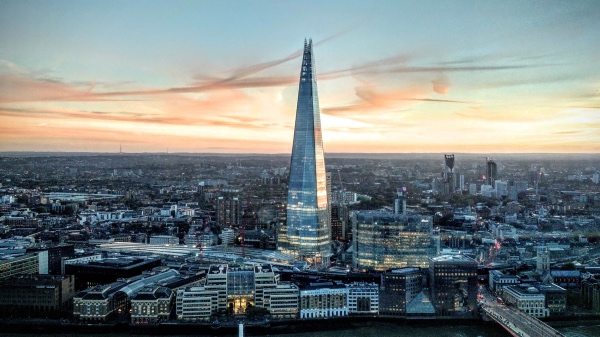
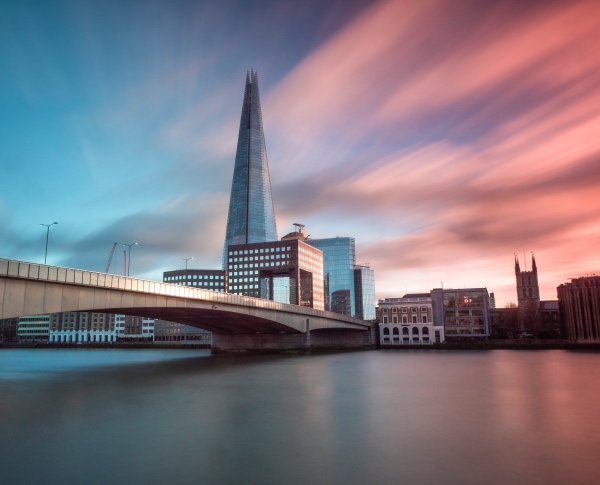
For the final in our series of modern icons of London, we’re looking at the tallest in London (and, at the time it was completed, the tallest in Europe) – the Shard.

Based in London Bridge, the 310 metre high skyscraper, was constructed between 2009 and mid-2012, and inaugurated by Qatar’s Prime Minister, Sheikh Hamad Bin Jassem Bin Jabor Al Thani, and Prince Andrew, the Duke of York, in July, 2012 – an event marked by a light and laser show (late that year, Prince Andrew abseiled down the building in a fund-raising effort for charity).

The observation deck of the building – originally known as London Bridge Tower and often referred to as The Shard of Glass – was opened to the public on 1st February, 2013, in an event overseen by the then Mayor of London, Boris Johnson.

Architect Renzo Piano’s lofty design for the building – first sketched out on the back of a napkin in a Berlin restaurant back in 2000 – was inspired by the London church spires and ship masts as seen in the work of 18th century Venetian painter Canaletto, to appear as a “spire-like sculpture emerging from the River Thames”.

It features eight sloping glass walls – the shards – with gaps or “fractures” between them to provide natural ventilation and a tapered structure to give the impression of lightness and transparency as it disappears into the clouds.

As well as office space, the building’s 72 habitable floors features shops, restaurants and bars, as well as a hotel – the Shangri-La, and apartments. News organisation Al Jazeera is also based in the building.

Located on floors 68, 69 and 72, the visitor attraction, The View from The Shard, offers panoramic views of up to 40 miles from an indoor viewing platform and the open air Skydeck (as well as the view, there are also virtual reality experiences available on the Skydeck for an additional cost).

The Shard – which attracted a million visitors in its first year alone – remained the tallest building in Europe until November, 2012, when it was surpassed by Moscow’s Mercury City Tower (it is still the tallest building in the European Union).

We’ll be kicking off a new special Wednesday series after Easter.

WHERE: The View from the Shard, Joiner Street (nearest Tube station is London Bridge); WHEN: Times vary, so check the website for details; COST: Pre-purchased timed and dated tickets range from £22.95 for adults/£16.95 for children aged four to 15 (check website for further details); WEBSITE: www.theviewfromtheshard.com.

PICTURES: Top: The Shard (Fred Mouniguet/Unsplash); Below – The Shard from the Thames (Matt Holland/Unsplash).


LondonLife – Crenellations…

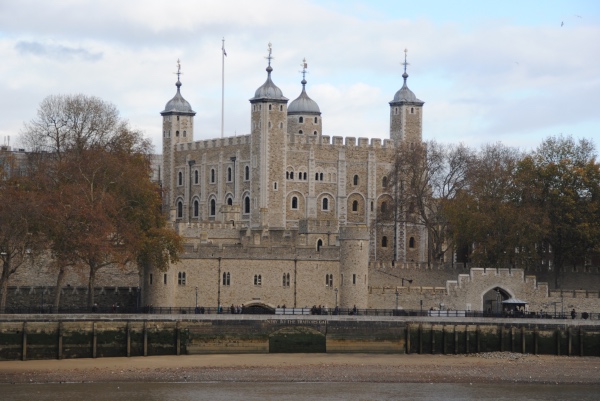
Tower of London crenellations from Tower Hill.