It was 100 years ago last month that on a wet Tuesday evening in Soho, Scottish engineer and inventor John Logie Baird demonstrated an experimental prototype that provided live moving pictures – the precursor to what we now know as television.
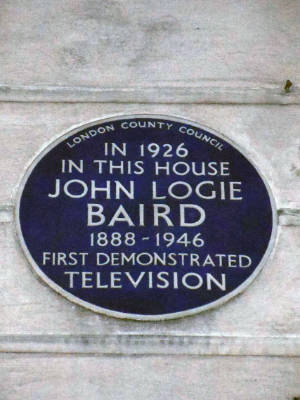
The successful, albeit rather low key, demonstration took place before some 40 members of the Royal Institution, all reportedly attired in evening dress, in an upper room which served as his laboratory at 22 Frith Street on 26th January, 1926.
According to a report in The Times on 28th January, the “transmitting machine” consisted of a “large wooden revolving disc containing lenses, behind which was a revolving shutter and a light sensitive cell”.
The first image to be transmitted was that of the head of a ventriloquist’s dummy but the image of a human face was transmitted later, “first on a receiver in the same room as the transmitter and then on a portable receiver in another room”.
“The image as transmitted was faint and often blurred, but substantiated a claim that through the ‘Televisor’, as Mr Baird has named his apparatus, it is possible to transmit and reproduce instantly the details of movement, and such things as the play of expression on the face,” The Times reported.
Present at the demonstration was William Edward Taynton, a 20-year-old office boy whose face Baird had transmitted in an experiment at the property the previous October.
Baird continued to refine his invention in the following months with the picture becoming clearer and was recognised in the years following for being the first to show television in colour,
In 1928 he completed a demonstration in which live images sent by radio from London were received in New York and the same year he demonstrated colour television. In 1929, the first television programmes were officially transmitted by the BBC using Baird’s system.
An English Heritage Blue Plaque todays marks the property where the demonstration took place (there’s also one at Baird’s former home at 3 Crescent Wood Road in Sydenham, where he lived from 1933 until 1945).







 Exploring London


