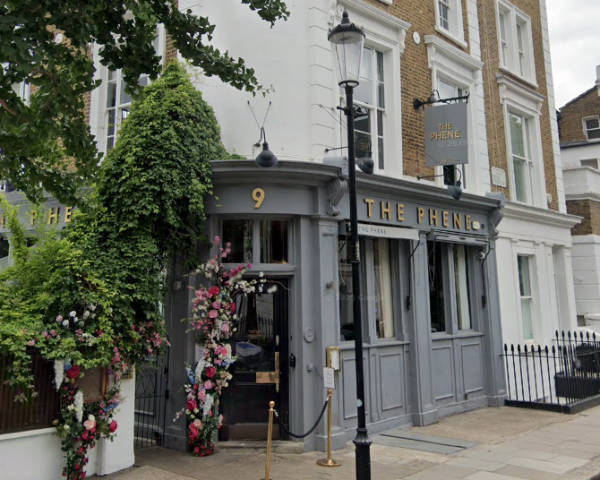
This Chelsea pub has a rather unusual name and it, like that of the street in which it can be found, comes John Samuel Phene, the architect who built it.
PICTURE: Courtesy of Google Maps
The pub dates from 1850 – Phene, who in 1903 constructed a now demolished five-storey house at in nearby Upper Cheyne Row which became known as “Gingerbread Castle” due to its elaborate decorations – had it constructed as a venue for servants and tenants to drink at.
It became known as a favourite of the likes of Northern Irish footballer George Best and the poet Dylan Thomas.
It was saved from being redeveloped in 2013 after a campaign by local residents backed by high profile celebrities such as Hugh Grant.
The pub at 9 Phene Street, which these days sports a rather plain sign, is now run by the City Pub Company.
The real person behind writer Charles Dickens’ ‘Inspector Bucket’, Charles Frederick Field was a police officer with the Metropolitan Police who rose to the rank of inspector before, following retirement, becoming a private detective.
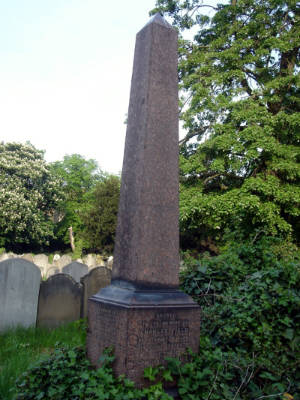
Field’s funerary monument in Brompton Cemetery. PICTURE: Edwardx (licensed under CC BY-SA 1.0)
Field, the son of a Chelsea pub proprietor, had apparently wanted to be an actor but due to his straitened economic situation had instead joined the Metropolitan Police at its founding in 1829.
Field served in several divisions across London, eventually rising to the rank of inspector. He joined the Detective Branch, which had only been formed in 1842, in 1846.
It was while with the Detective Branch that he encountered Dickens and they formed what’s described as a lasting friendship. From 1850 onwards Dickens wrote as series of articles about the world of the Detective Branch and the work of Field (sometimes using a pseudonym) including his essay ‘On Duty With Inspector Field’.
Dickens is also believed to have used Field as the model for Inspector Bucket in Bleak House, first published as a serial in 1852 and 1853.
Field, who was noted as a bit of a raconteur and for his love of disguises even when not really required (perhaps explained by theatrical bent), retired from the Met in 1852 and set up his own enquiry office. He apparently caused controversy after his retirement by using his rank in his private work which somewhat soured his relationship with the force.
Field, who died in 1874 and is buried in Brompton Cemetery, has since been the subject of several works of fiction.
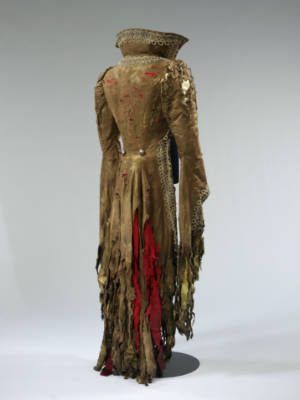
Frockcoat designed by Alexander McQueen and David Bowie for his 50th Birthday Concert, 1997. Image courtesy of the V&A
• David Bowie’s final, unrealised musical projects – The Spectator, an unseen Ziggy Stardust guitar, and Bowie’s costume designs are just some of the treasures housed in the new David Bowie Centre which opened to the public this month. Located at the V&A East Storehouse in Queen Elizabeth Olympic Park, the new home for David Bowie’s archive features nine displays show-casing more than 200 items which also include handwritten lyrics, photography, costumes and sketches. As well as seeing the displays, visitors can book one-on-one time with some of the 90,000-plus objects in the archive through the ‘Order an Object’ service. More than 500 items were requested in the first week of the service going live with a frockcoat designed by Alexander McQueen and David Bowie for his 50th birthday concert in 1997 the most frequently requested item. Entry to the archive is free, but ticketed. For more, including bookings, see www.vam.ac.uk/exhibitions/david-bowie-centre.
• The annual Chelsea History Festival kicked off yesterday with more than 80 events taking place until Sunday. Events include tours of the Royal Hospital Chelsea, and the chance to visit the Soane Stable Yard, the free exhibition Lost and Found in Hong Kong: The Unsung Chinese Heroes at D-Day at the hospital, walking tours including ‘Rock ‘n’ Roll Chelsea’ and ‘1960s Chelsea’, and a medicinal trees tour at the Chelsea Physic Garden. For the full programme head here.
• A major exhibition on the Blitz club – which helped shape London’s culture not only in the mid-1980s but in the decades that followed – has opened at the Design Museum in Kensington High Street. Located in a Covent Garden side street, the club is credited with having “transformed 1980s London style”, generating a creative scene that had an enormous impact on popular culture in the following decade. Blitz: The Club that Shaped the 80s features more than 250 items including clothing and accessories, design sketches, musical instruments, flyers, magazines, furniture, artworks, photography, vinyl records and rare film footage. Runs until 29th March. Admission charge applies. For more, see https://designmuseum.org/exhibitions/blitz-the-club-that-shaped-the-80s.
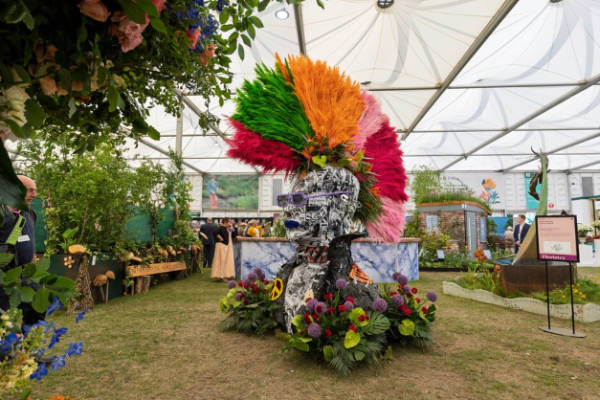
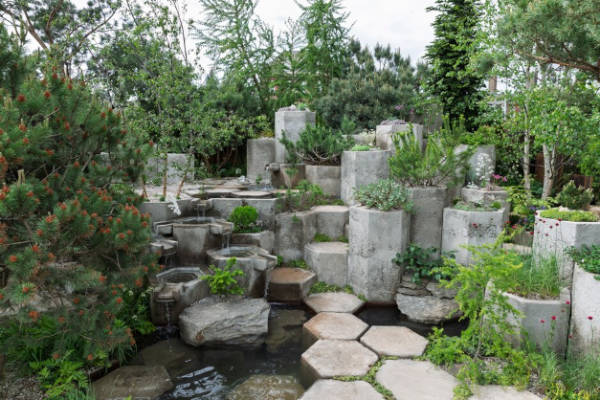
It’s that time of year again and the flowers are blooming at the annual RHS Chelsea Flower Show which started today and runs until Saturday. Here’s some images from this year’s event…
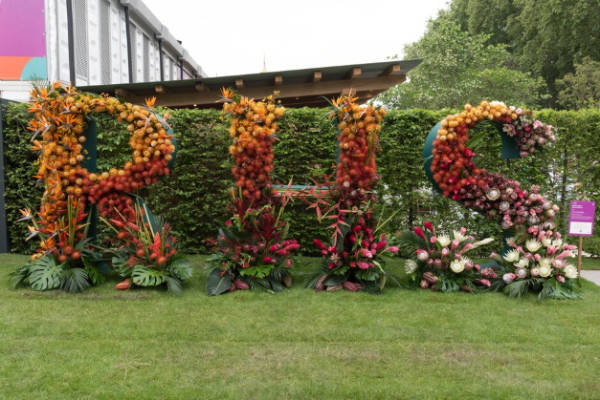
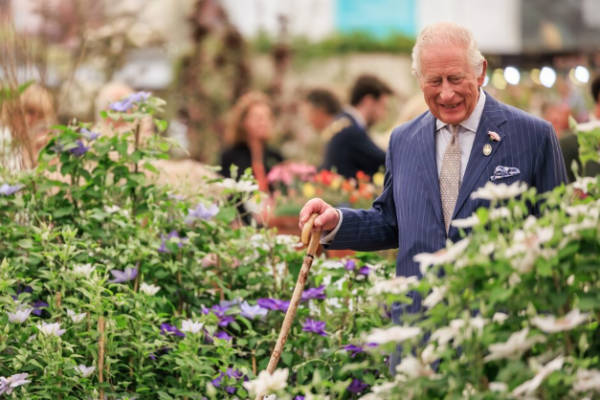
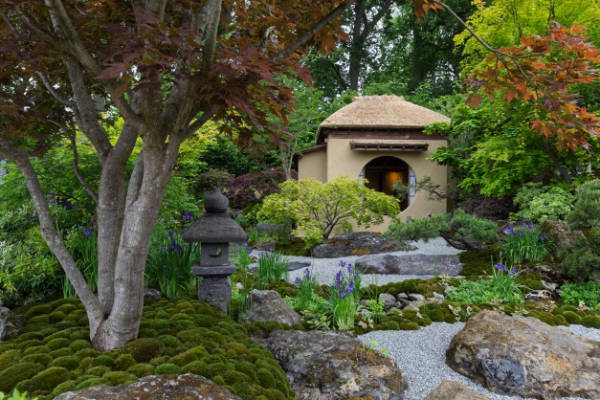
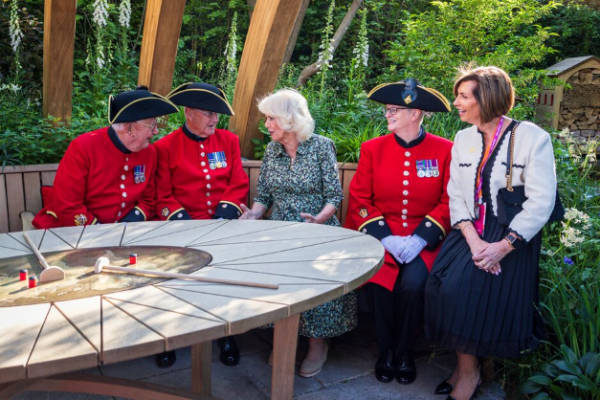
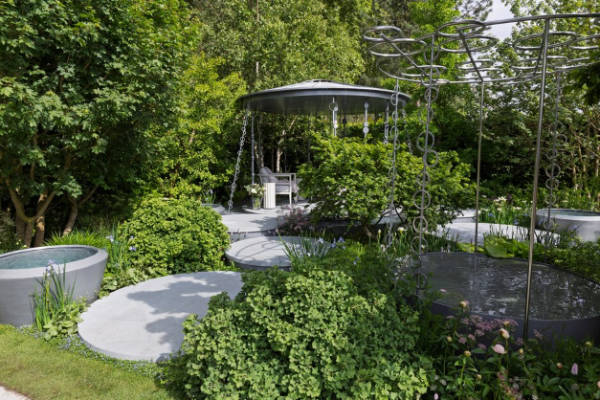
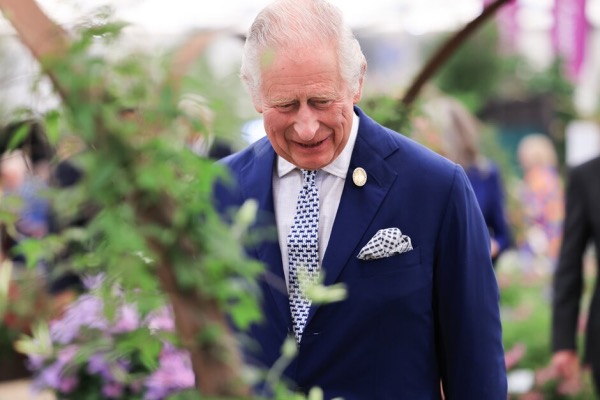
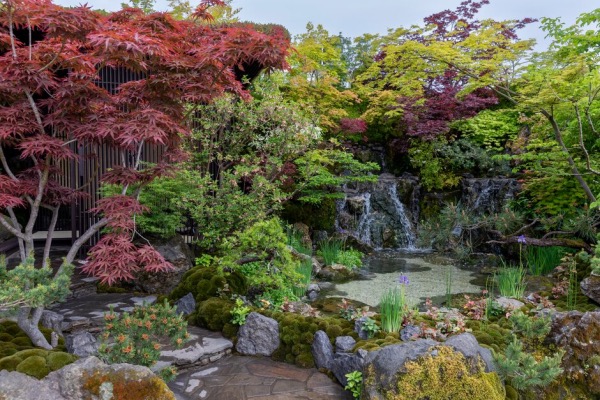
RHS Letters. Designed by Acacia Creative Studio at the RHS Chelsea Flower Show 2025. PICTURE: RHS/Tim SandallKing Charles III visits the Chelsea Flower Show 2025. PICTURE: RHS/Ollie DixonThe ‘Cha No Niwa – Japanese Tea Garden’, designed by Kazuyuki Ishihara which won the RHS Chelsea Garden of the Year. PICTURE: RHS/Neil HepworthQueen Camilla meets Chelsea Pensioners at The London Square Chelsea Pensioners Garden. PICTURE: RHS/Ollie DixonThe ‘Boodles Raindance Garden’, designed by Dr Catherine MacDonald. PICTURE: RHS/Neil Hepworth‘The Chelsea Punk’, created by Chelsea in Bloom at the RHS Chelsea Flower Show 2025. PICTURE: RHS/Neil HepworthThe ‘British Red Cross ‘Here for Humanity’ Garden’, designed by John Warland and Tom Bannister. PICTURE: RHS/Sarah Cuttle
The Chelsea Flower Show returned to London this week with King Charles III making his first visit to the show as monarch and tributes in honour of his coronation and the passing of Queen Elizabeth II last year. The show runs until 27th May. For more, see www.rhs.org.uk/chelsea.
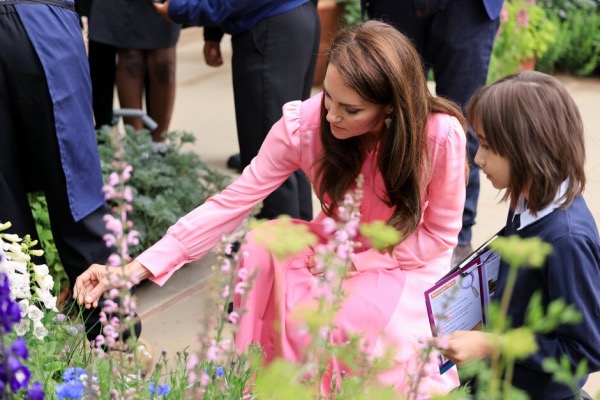
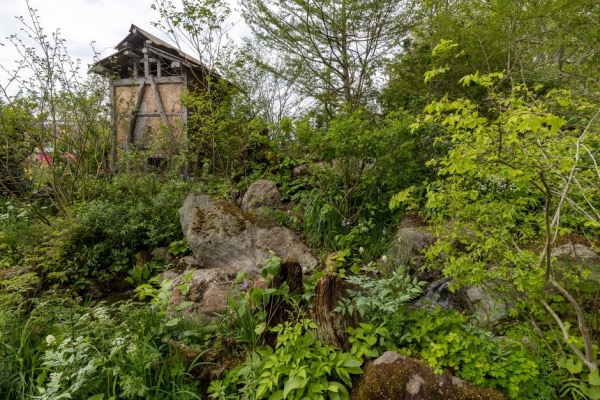
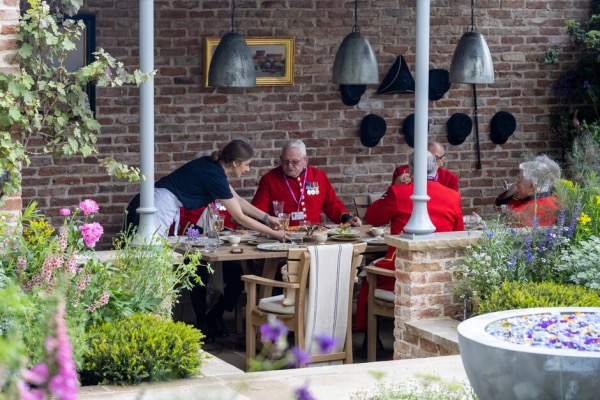
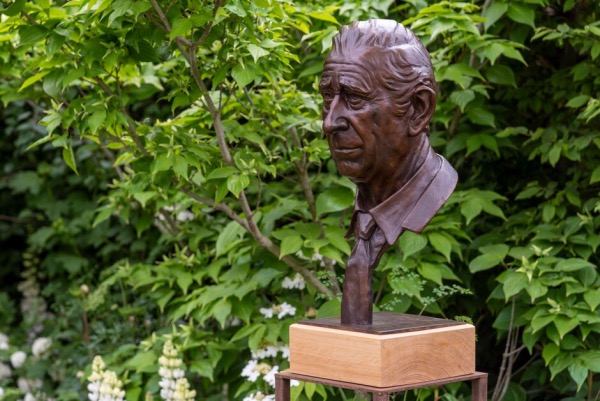
King Charles III visits The Chelsea Flower Show 2023. ALL PICTURES: Courtesy of Royal Horticultural Society/Chelsea Flower Show 2023Princess of Wales Kate Middleton visits RHS Chelsea Flower Show 2023. She is pictured on Savills Garden designed by Mark Gregory.‘A Letter from a Million Years Past’. Designed by Jihae Hwang. Sponsored by Korea Forest Service, Hoban Cultural Foundation and MUUM Ltd. Show Garden. RHS Chelsea Flower Show 2023. Stand no 328.Chelsea pensioners eating at meal in the Savills Garden. Designed by Mark Gregory. Sponsored by Savills. Show Garden. RHS Chelsea Flower Show 2023. Stand no 324.RHS Garden of Royal Reflection and Celebration featuring a bust of King Charles III. Designed by Dave Green. Feature Garden. RHS Chelsea Flower Show 2023. Stand no 111.‘The Biophilic Garden Otsu – Hanare’. Designed by Kazuyuki Ishihara. Sponsored by Glion and Ishihara Kazuyuki Design Laboratory. Sanctuary Garden. RHS Chelsea Flower Show 2023. Stand no 280.
This Chelsea terraced house, now owned by the National Trust, was once the home of the Victorian literary couple, essayist and historian Thomas Carlyle and his wife (and skilled letter writer) Jane.
The Carlyles moved into the red brick property at 24 Cheyne Row (formerly number 5) in 1834, having left rural Scotland to see what they could make of themselves in London.
As their stars rose – by mid 19th century Thomas, the “sage of Chelsea”, had become an influential social commentator, the home became something of a hub for Victorian literati with the likes of Charles Dickens, Alfred, Lord Tennyson, George Eliot and William Thackeray all visiting them here.
When Thomas died at the property on 5th February, 1881 (Jane had died in 1866), the home reverted to the landlord but a group of admirers decided it needed to be preserved as a memorial to their friend. They raised funds through a public subscription and in 1895 opened it as a shrine to the writer.
The National Trust took over the running of the house, which was built in around 1708, in 1936 with the enthusiastic support of founder Octavia Hill who herself was a Carlyle fan.
The property, which still retains many of its original fixtures and fittings, features a recreation of the couple’s parlour based on Robert Tait’s painting A Chelsea Interior which depicts the Carlyles in the room in 1857.
The property also boasts the attic study that Thomas had constructed in August, 1853, and where he wrote The French Revolution, Latter Day Pamphlets and Fredrick the Great. His attempts at sound-proofing it had failed.
Meanwhile, Jane’s dressing room features a pair of original chintz curtains which she made in the late 1840s.
Inside the parlour at Carlyle’s House. PICTURE: Kotomi_ (licensed under CC BY-NC 2.0)
Among the items on show in the property is a necklace given to Jane by German writer and stateman Johann Wolfgang von Goethe which features a pendant containing a portrait of him. There’s also a a decoupage screen made by Jane using prints in 1849 and wallpapers by William Morris.
The property, which also features a small walled garden and a bust of Thomas Carlyle on the facade, is currently undergoing restoration work and will reopen in March.
WHERE: Carlyle’s House, 24 Cheyne Row, Chelsea (nearest Tube stations are Sloane Square and South Kensington); WHEN: Check website when it reopens; COST: £9 adults/£4.50 children; WEBSITE: www.nationaltrust.org.uk/carlyles-house.
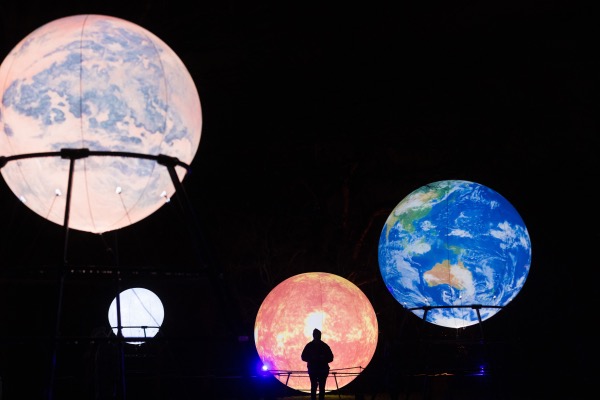
• An after-hours light trail featuring clocks, moons, planets and sundials has opened at Hampton Court Palace this week. Palace of Stardust takes people through the palace’s historic cobbled courtyards and gardens which have been filled with magical illuminations inspired by the palace’s famous astronomical clock installed at the command of King Henry VIII. Visitors to the display, designed and created by award-winning outdoor event producers Wild Rumpus, will uncover the mysterious meanings on the clock’s dial, attend a flickering moonlit ball in the East Front Gardens, hear the ancient royal trees as they whisper their secrets and peek into mysterious miniature shadow worlds before being transported to another planet in the deepest depths of the Wilderness, once home to King Charles II’s formal pleasure garden. Seasonal food and drink will also be available. Runs until 3rd January. Admission charge applies. For more, see www.hrp.org.uk/hampton-court-palace/whats- on/palace-of-stardust-at-hampton-court-palace.
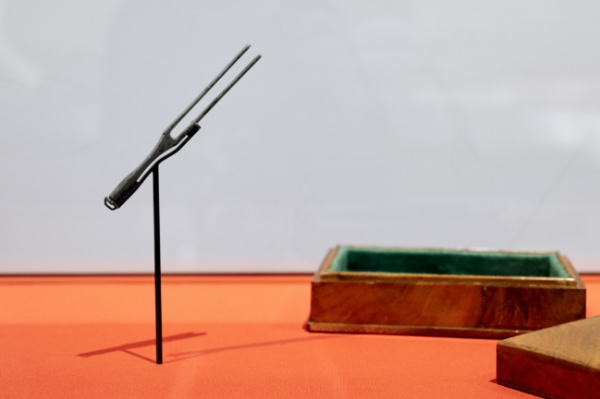
• One of the greatest composers of all time, Ludwig van Beethoven (1770-1827), is the subject of a new exhibition opening at the British Library. The display, which draws on the library’s world-famous collection, features manuscripts, archival documents, personal belongings and sound recordings with highlights including Beethoven’s own copy of his earliest published works which he composed at age 12 and 13, sketches for his Pastoral Symphony and late string quartets, a tuning fork which is thought to have belonged to him until 1803, and a pocket sketchbook the composer used to note down musical ideas when out walking, which dates from 1825. There is also a specially commissioned audio-visual incorporating bone conduction to present extracts from the composer’s music in an engaging and immersive way, in particular to those with hearing impairments. The exhibition runs until 24th April. Admission charge applies. For more, see www.bl.uk/events/beethoven. To coincide with the 250th anniversary of Beethoven’s birth, the library last year launched ‘Discovering Music: 19th century‘, a free online resource which explores key works of 19th-century classical music and the social, political and cultural contexts in which they were written.
• The World War II story of the elite tank regiment, the Sherwood Rangers Yeomanry, is being told in a new exhibition which opens today at the National Army Museum in Chelsea. Based on broadcaster and historian James Holland’s book, Brothers in Arms, the exhibition spans the period fromthe D-Day landings on 6th June, 1944, to VE Day almost a year later and focuses on the stories of eight soldiers who served in the regiment as it explores the dangers and pressures they faced and the camaraderie and bonds that bound them together. The exhibition is being accompanied by a programme of events. This Saturday, the Museum is putting a spotlight on tanks with free talks, tours and tank challenges for the family – plus the chance to see a Sherman tank parked up at the Museum. Online booking is recommended. For more, see www.nam.ac.uk/whats-on/brothers-arms.
Send all items for inclusion to exploringlondon@gmail.com.
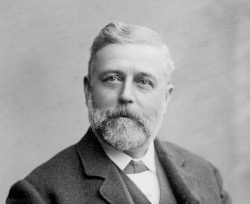
One of the most famous plumbers in the world, Thomas Crapper was the founder of London-based sanitary equipment company, Thomas Crapper & Co, and a man whose name has become synonymous with toilets (although he was not, contrary to popular belief, the inventor of the flushing toilet).
A portrait of Thomas Crapper. PICTURE: Via Wikipedia.
Crapper was born in the town of Thorne in Yorkshire in 1836, the son of Charles Crapper, a sailor (his exact birthday is unknown but he was baptised on 28th September, so it’s thought to have been around that time).
In 1853, he was apprenticed to his brother George, a master plumber based in Chelsea, and, having subsequently gained his own credentials, established himself as a sanitary engineer in Marlborough Road in 1861 (he had married his cousin, Maria Green, the previous year).
Sometime in the late 1860s, in a move some saw as scandalous, his company became the first to open public showrooms displaying sanitary-related products. He was also a strong advocate for the installation of flushing toilets in private homes.
While not the inventor of the modern flushing toilet (that is often credited to Sir John Harington, godson of Queen Elizabeth I, in 1595, although there are even earlier examples), he was responsible for a number of advances in the field including making design improvements to the floating ballcock, a tank-filling mechanism, and the U-bend, an improvement on the S-bend.
Crapper’s company did have some high profile clients – in the 1880s it supplied the plumbing at Sandringham House in Norfolk for then Prince Albert (later King Edward VII). This resulted in Crapper’s first Royal Warrant and the company would go on to receive others from both Albert, when king, and King George V.
Crapper’s branded manhole covers, meanwhile, can still be seen in various parts of London, including around Westminster Abbey where he laid drains. His name can also be found on what are said to be London’s oldest public toilets.
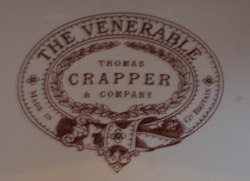
Thomas Crapper & Company logo. PICTURE: Oxyman (licensed under CC-BY-SA 3.0).
Crapper retired in 1904 (his wife had died two years earlier) and the firm passed to his nephew George (son of his plumber brother George) and his business partner Robert Marr Wharam (the firm, Thomas Crapper & Company, continues to this day – now based in Huddersfield, it still sells a range of vintage bathroom products).
Having spent some time commuting from Brighton, Thomas lived the last six years of his life at 12 Thornsett Road, Anerley, in south-east London (the house now bears a plaque). He died on 27th January, 1910, of colon cancer and was buried at Elmer’s End Cemetery nearby.
While it is often claimed that it’s thanks to Thomas Crapper and his toilets that the word ‘crap’ came to mean excrement, the word is actually of Middle English origin and was already recorded as being associated with human waste when Crapper was just a young boy.
But there is apparently more truth to the claim that toilets became known as ‘crappers’ thanks to Thomas Crapper’s firm. It was apparently American servicemen who, when stationed overseas during World War I, encountered Crapper’s seemingly ubiquitous branding on toilets in England and France and, as a result, started referring to toilets as such.
We know, we know – Napoleon Bonaparte never visited London. But given this month marks the bicentenary of his death on 5th May, 1821, we thought we’d mention a couple of places where you can find traces of the French Emperorin the British capital…
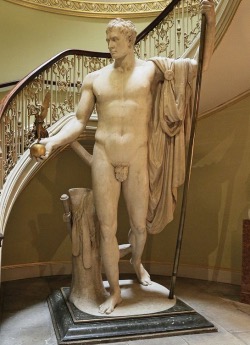
1. Napoleon As Mars The Peacemaker. This larger than life statue – it stands 11 feet tall – is the work of Italian artist Antonio Canova and depicts Napoleon as the Roman God. Napoleon didn’t like the almost naked statue – when he saw it in 1811, he declared it “too athletic” and as a result, it was never displayed in public. Following the defeat of Napoleon at the Battle of Waterloo in 1815, the British Government purchased the statue and presented it to the Duke of Wellington as a gift. Recently cleaned, it is now on display in the Iron Duke’s former home, Apsley House at Hyde Park Corner (and can be seen there when it reopens to the public this week). The house also counts a recently restored bronze death mask of Napoleon among its treasures. The bronze is a copy of a plaster mask modelled on Napoleon’s corpse. For more, see www.english-heritage.org.uk/visit/places/apsley-house/.
2. Napoleon’s horse Marengo. A small grey Arab, Marengo was named after Napoleon’s victory at the Battle of Marengo in Italy in 1800 and apparently served the Emperor between 1800 and 1815. Marengo was captured on the battlefield after Napoleon’s defeat at Waterloo and transported to England. After its death, the horse’s skeleton was preserved and initially displayed at the Royal United Services Institute, moving to the National Army Museum in Chelsea in the 1960s. The skeleton is currently undergoing conservation work at the Natural History Museum before returning to the National Army Museum where it will be displayed in the Battle gallery. For more on the National Army Museum, see www.nam.ac.uk.
3. Portrait of Napoleon. A small image of a young Napoleon, this portrait – which arrived in England in 1797 – was the first many British people had seen of the Emperor (it was copied in engravings which were published across Britain). It was painted in a campaign tent on the road from Verona to Vienna in March, 1797, by Venetian artist named Francesco Cossia. Cossia had been commissioned by Francophile Maria Cosway, an artist then living in Oxford Street, London, to paint likenesses of several French Revolutionary generals including Napoleon. It is believed to have entered the collection of Sir John Soane somewhere between 1827 and 1830 and can now be seen in the Breakfast Room at the Sir John Soane’s Museum in Lincoln’s Inn Fields (reopening on 19th May). For more, see www.soane.org.
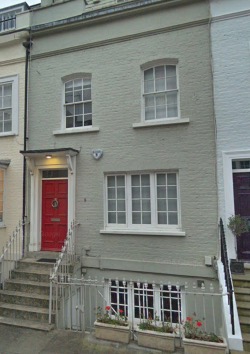
News this week that spy turned novelist John Le Carré has died at the age of 89. His family reportedly confirmed the author had died of pneumonia at the Royal Cornwall Hospital on Saturday night.Born as David Cornwall, Le Carré worked as an intelligence officer for the British Foreign Service and, drawing in his work, began writing Cold War spy thrillers under the pseudonym of Le Carré with his first, Call for the Dead, published in 1961. It was in this novel – Le Carré went on to write others – that his most famous character, George Smiley, made his first appearance. Initially a minor character, Smiley went on to become a star in three novels published in the 1970s, the most famous of which is Tinker Tailor Soldier Spy (Smiley’s last appearance was in a later book, 2017’s A Legacy of Spies). In tribute to Le Carré and George Smiley, pictured is 9 Bywater Street in Chelsea, the fictional home of Smiley (albeit a very real property!)
This tradition, the origins of which go back centuries, centres on a ceremony at the Royal Hospital Chelsea which involves the blessing and cutting of a ‘Christmas Cheese’ with a sword.
The origins of the tradition go back to 1692 when a local cheesemonger donated cheese to the Chelsea Pensioners – retired members of the British Army – for Christmas. Since 1959, it’s been organised by industry body Dairy UK and sees cheesemongers from across the UK donate cheeses to the hospital.
The ceremony involves the largest cheese among those donated being blessed and then cut with a sword by a selected pensioner. The cheese is then distributed to the pensioners at meal times in the run-up to Christmas.
This year a special COVID-safe ceremony was held and some 258 kilograms of cheese were donated to the hospital. The largest cheese – a 25 kilogram Montgomery Cheddar – was cut by Chelsea Pensioner George Reed who had a 25 year career in military as well as a career at the BBC.
As well as last year’s 60th anniversary ceremony aside, other milestones have taken place in 2016 – when Chelsea Pensioner Mary Johnston became the first woman to cut the ceremonial cheese – and in 2009, when two members of Territorial Army London Regiment bound for Afghanistan joined the ceremony for the first time.
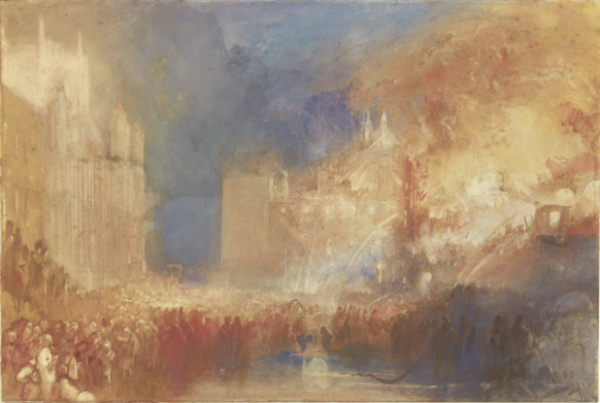
JMW Turner, ‘The Burning of the Houses of Parliament’ (c 1834-35), oil paint on canvas, Tate (accepted by the nation as part of the Turner Bequest 1856)
• A landmark exhibition on the work – and times – of JMW Turner opens at the Tate Modern in Millbank today. Turner’s Modern World features some 160 works and attempts to show how the landscape painter found “new ways to capture the momentous events of his day, from technology’s impact on the natural world to the dizzying effects of modernisation on society”. Highlights include war paintings such as The Battle of Trafalgar (1806-8) and Field of Waterloo (1818), works capturing political events like The Burning of the Houses of Lords and Commons (1835) and maritime disasters like A Disaster at Sea (1835) and Wreck of a Transport Ship (c1801), as well as works related to the industrial advances taking place such as Snow Storm (1842), The Fighting ‘Téméraire’ (1839), and Rain, Steam and Speed (1844). Admission charge applies. Runs until 7th March (online booking required). For more, see www.tate.org.uk.
• An exhibition at the National Army Museum in Chelsea marks the 100th anniversary of the Unknown Warrior being laid to rest in Westminster Abbey. Using objects, paintings, photography and personal testimony, Buried Among Kings: The Story of the Unknown Warrior tells the story of the creation of this symbolic memorial dedicated to the hundreds of thousands of British servicemen who died during World War I. Highlights include a union flag on loan from the Railton family (it was Chaplain David Railton who conceived the original idea for an Unknown Warrior following an encounter in 1916 with a wooden cross on the Western Front which was inscribed ‘An Unknown British Soldier’), a Bible carried by Chaplain George Kendall during the selection of the Unknown Warrior, a fragment of the original wooden Cenotaph erected in 1919-1920, and Frank O Salisbury’s large scale painting, The Passing of the Unknown Warrior, which depicts the procession of the Unknown Warrior from Victoria Station to Westminster Abbey. In connection with the exhibition, Victoria Station is hosting a pop-up display between 9th and 16th November on the journey of the Unknown Warrior from the Western Front to Westminster Abbey (the coffin actually arrived in London on 10th November, 1920). Admission charge applies (at Chelsea). Runs until 14th February (online booking required). For more, see www.nam.ac.uk.
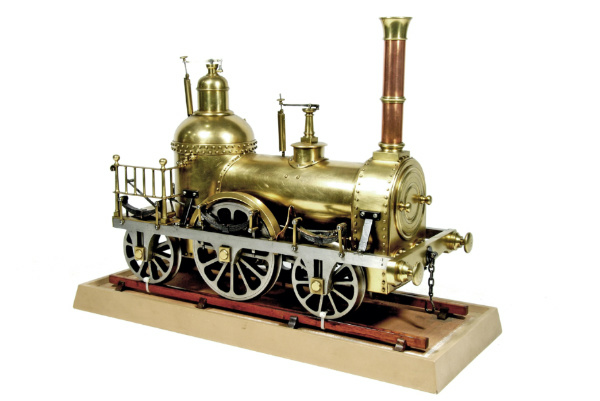
Model steam locomotive, 1:12 scale, working, represents a standard passenger type locomotive c.1837, made by Mr. J. Dawson, District Superintendent at Southampton of the London & Southampton Railway.
• Model making in the “age of the railways” is the subject of a free exhibition now on at the Science Museum in South Kensington. Brass, Steel and Fire features intricate models from the Science Museum Group Collection as well as stunning miniature locomotives and a display of almost 200 tools used by model-maker Keith Dodgson. Highlights include ‘Salamanca’, the world’s oldest model locomotive (on loan from Leeds Museums and Galleries), a model of ‘Fire King’ – made in the 1840s by apprentice Josiah Evans who used his experience to later build full size locomotives, and the world’s oldest working model steam engine, the Etherley winding engine model. The exhibition is free and runs until 3rd May. Online booking required. For more, see sciencemuseum.org.uk/see-and-do/brass-steel-and-fire.
Send all items for inclusion to exploringlondon@gmail.com
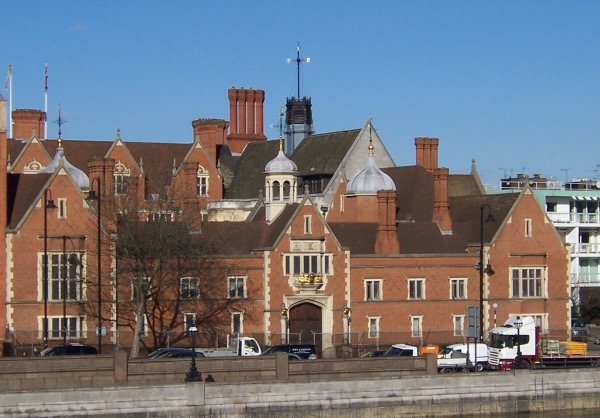
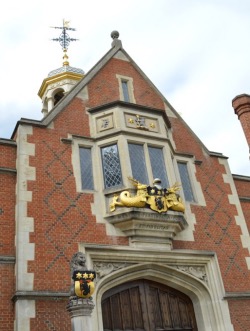
This hall was originally constructed in Bishopsgate as the great hall at the heart Crosby Place, the mansion of wealthy merchant and courtier Sir John Crosby.
Built over the decade from 1466 to 1475 on land which had previously been part of St Helen’s Convent, the property became famous for royal connections.
Richard, Duke of Gloucester, had apparently acquired the property from Sir John’s widow by 1483 and it was one of his homes when the Princes in the Tower – Edward V and his younger brother Richard – were murdered, leading to his coronation as King Richard III (as a result the hall is the setting for several scenes in Shakespeare’s Richard III).
Catherine of Aragon, meanwhile, resided in the hall with her retinue after she arrived from Spain on her way to marry Prince Arthur, King Henry VII’s eldest son and then heir (and King Henry VIII’s older brother).
The property was later – in the 1530s – owned by Sir Thomas More (although he probably never lived here), and subsequently, from about 1576 to 1610 by Sir John Spencer, a Lord Mayor of London (Queen Elizabeth I was apparently among his guests) while Sir Walter Raleigh had lodgings here in 1601.
It served as head office of the East India Company from 1621 to 1638 and, having survived the Great Fire of London, was used in various capacities including as a Presbyterian Meeting House and for various commercial uses, including as a warehouse and restaurant.
In 1908, it was bought by the Chartered Bank of India, Australia and China who wanted to build new offices on the site. The hall was saved from demolition and in 1910 moved stone-by-stone and, under the eye of Walter Godfrey, reconstructed on its present location in Cheyne Walk in Chelsea, a Thames-side site which had formerly been part of Sir Thomas More’s Chelsea garden which was provided by the London County Council.
Having been used to house Belgian refugees during World War I, it was formerly opened by Elizabeth, Duchess of York (later the Queen Mother), in 1926.
Around that time, the property was leased by the British Federation of University Women which had WH Godfrey build a tall Arts and Crafts residential block at right angles to the great hall (the residential block has subsequently bene adapted to appear Jacobean to fit with the hall).
The now Grade II*-listed hall – which, although not complete, is the only surviving example of a City of London medieval merchant’s house – was purchased by philanthropist and businessman Sir Christopher Moran in 1988 and is now part of an expansive private residence designed with the hall as its centrepiece (recent visitors have included Prime Minister Boris Johnson).
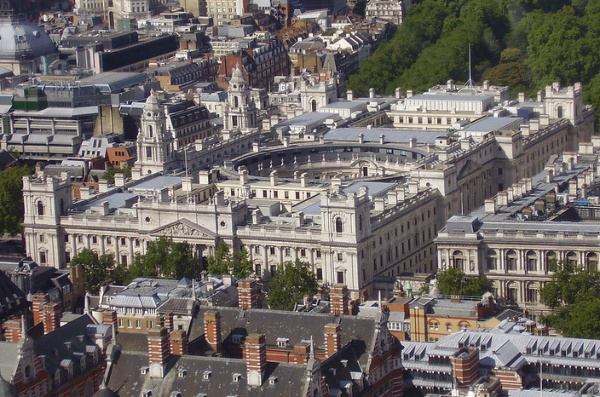
• It’s Open House London this weekend and, thanks to the coronavirus pandemic, this programme features a host of documentary films, online events and self-led walking tours. Highlights from the festival, which runs over Saturday and Sunday with some additional events taking place until 27th September, include online tours of the HM Treasury in Whitehall (pictured) and Dorich House Museum in Kingston-upon-Thames, a self-guided walking tour of Fosters + Partners buildings in London’s centre, and the chance to visit Rochester Square in Marylebone. The programme features a series of collections of related events – such as those related to ‘colonial histories’ or ‘architecture for the climate emergency’ – to help make it easier for people to access. For the full programme of events, head to https://openhouselondon.open-city.org.uk.PICTURE: HM Treasury Building taken from the London Eye (Dave Kirkham/licensed under CC BY-ND 2.0/Image cropped)
• The work and lives of the more than million British Army soldiers who have served in Germany following World War II is the subject of a new exhibition opening at the National Army Museum in Chelsea next Tuesday. Foe to Friend: The British Army in Germany since 1945 charts how the Army helped to rebuild a broken nation in the aftermath of the war, provide protection during the Cold War and, later, how they used Germany as a base to deploy troops all around the world. It will include stories of family life as well as those involving espionage and massive military training exercises. The free exhibition can be seen until 1st July, 2021. For more, see www.nam.ac.uk.
• Christine Granville, Britain’s first and longest-serving female special agent, has been honoured with an English Heritage Blue Plaque. The plaque is located at the 1 Lexham Gardens hotel (previously known as the Shelbourne Hotel) in Kensington which was Granville’s base after the war. Granville, who was once described by Churchill as his “favourite spy”, was born in Warsaw as Krystyna Skarbek. She joined British intelligence after Germany invaded Poland in 1939 and undertook missions including skiing over the snow-bound Polish border in temperatures of -30 degrees Celsius, smuggling microfilm revealing Hitler’s plans to invade the Soviet Union across Europe and rescuing French Resistance agents from the Gestapo (in fact, it’s said she was also the inspiration for Vesper Lynd, a spy in Ian Fleming’s first James Bond novel, Casino Royale). Christine Granville was one of her aliases she had been given during her time with intelligence and it was a name she decided to keep after the war. For more, see www.english-heritage.org.uk/visit/blue-plaques/.
Send all items for consideration to exploringlondon@gmail.com.
Newly awarded upgraded heritage status, Ropers Garden in Cheyne Walk, Chelsea, was created in the wake of World War II.
The buildings which had formerly stood here were destroyed on 17th April, 1941, thanks to a parachute mine.
The first gardens were planted on the site by the Chelsea Society but these were then redesigned by Peter Shepheard in 1960.
Shepheard used the basements of the terraced housing previously on the site to create a sunken garden, maintaining a link with the history of the site and reducing the noise of traffic from nearby Chelsea Embankment.
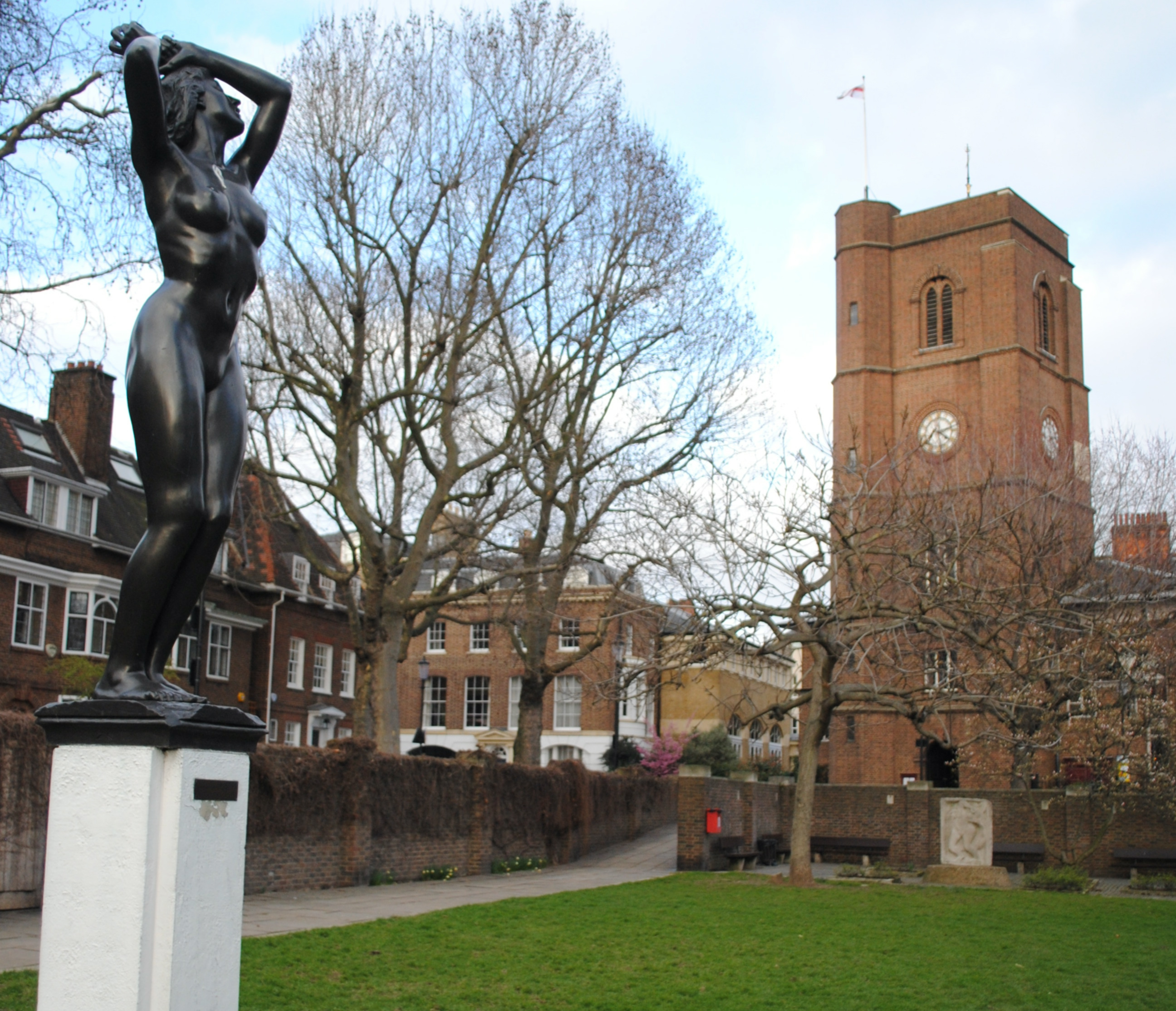
The centrepiece of the now Grade II-listed gardens – which were recently added to the Register of Parks and Gardens – is a sculpture called “The Awakening”. The work of Gilbert Ledward, who lived and worked in the area, it depicts a bronze standing nude figure of a woman (apparently modelled on the artist’s wife and cast in the 1920s).
The sculpture (pictured at the top with Chelsea Old Church in the background) was recently added to the garden’s Grade II listing.
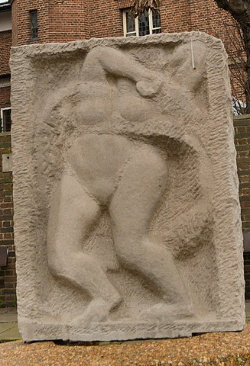
Other features of the garden include an unfinished stone relief by Jacob Epstein (pictured, right) who had a studio nearby in the early 20th century (the sculpture was unveiled in 1970) and a cherry tree which commemorates Gunji Koizumi the father of British Judo (1885-1965).
And the garden’s name? That comes from the history of the land on which it lies – once an orchard and part of the marriage gift of Sir Thomas More to his daughter Margaret and son-in-law William Roper in 1521.
PICTURES: Top – David Adams; Right – Andy Scott (licensed under CC BY-SA 4.0)
A traveller, archaeologist and diplomat, Bell’s legacy includes a mountain named after her in the Alps – Gertrudspitze – and the key role she played in the creation of the modern state of Iraq.
Born on 14th July, 1868, in Washington, County Durham, Bell was the daughter of affluent and progressive mill-owner Sir Hugh Bell and Mary Shield Bell, who died just three years after she was born. Her paternal grandfather was industrialist and MP Sir Isaac Lowthian Bell whose role in international policy-making undoubtedly influenced her interest in the world and politics.
Bell was educated at Queen’s College in London and then at Lady Margaret Hall at Oxford University and was the first woman to graduate in modern history at Oxford with a first class honours degree. Following her graduation in 1892, he travelled to Persia to visit her uncle, Sir Frank Lascelles, a British ambassador based in Tehran.
It was the start of more than a decade of travels which included mountaineering in Switzerland – where she conquered peaks including La Meije and Mont Blanc and recorded 10 new paths or first ascents in the Bernese Alps (one previously uncharted peaks was named after her) – and visits to the Middle East including to Palestine and Syria.
During this period, Bell became fluent in Arabic along with a number of other languages and developed an interest in archaeology, working with Sir William M Ramsay on excavations in Binbirkilise in what was then the Ottoman Empire (and is now modern Turkey).
In 1909 she traveled to Mesopotamia, mapping and describing the Hittite city of Carchemish and visiting Babylon and Najaf. Her last journey across the Arabian Peninsula – a 1,800 mile trek – took place in 1913 during which she travelled from Damascus in Syria to Ha’il in Saudi Arabia.
Bell volunteered with the Red Cross in France during World War I before British intelligence put her to work using her expertise to get soldiers through the deserts, working in places including Basra, Damascus and Baghdad.
Following the war she was involved in mediating between Arab and British officials and played a significant role in the creation of the nation of Iraq, becoming an advisor to Faisal bin Hussein, the first King of Iraq, who named her director of antiquities. She was also among attendees at the 1921 Conference in Cairo.
Bell, who wrote a number of books about her travels, including Safar Nameh: Persia Pictures (1894) and Syria: The Desert and the Sown (1907), returned to Britain in 1925 where she faced family problems and ill-health before returning to Iraq where she died in Baghdad on 12th July, 1928, apparently from an overdose of sleeping pills. She was buried at the British Cemetery there.
PICTURE: An image of Gertrude Bell in Iraq in 1909. (Wikimedia Commons)
• The National Army Museum in Chelsea is joining with the Royal Air Force Museum, the National Museum of the Royal Navy and the Commonwealth War Graves Commission to mark the 75th anniversary of VJ (Victory over Japan) Day, this Saturday, 15th August, with a series of free events including online talks. Among those taking part are World War II veteran Captain Sir Tom Moore, recently knighted by the Queen for his efforts in helping raise funds for the NHS during the coronavirus pandemic, author and explorer Levison Wood (who explores the story of his grandfather’s service in Burma), and Professor Tarak Barkawi, author of Soldiers of Empire: Indian and British Armies in World War II, as well as General Lord Richards, Grand President of the Royal Commonwealth Ex-Services League who’s involved in a conversation about the contribution of Commonwealth soldiers during the Far East campaign. For the full programme of events, head to www.nam.ac.uk/series/vj-day-75.
• Steve McQueen is back at Tate Modern. The exhibition, which reopened last Friday following the reopening of all Tate galleries, spans 20 years of McQueen’s work and features 14 major pieces spanning film, photography and sculpture. The exhibition adds to the three visitor routes already in place at the Tate Modern and coincides with McQueen’s latest artwork Year 3, an epic portrait of London’s Year 3 pupils created through a partnership between Tate, Artangel and A New Direction which can be seen at Tate Britain until 31st January. Visitors must prebook. For more, head to tate.org.uk/visit.
Beyond London (a new regular feature in which we include sites around Greater London) • The East Terrace Garden at Windsor Castle – commissioned by King George IV in the 1820s – has opened to weekend visitors for the first time in decades. Overlooked by the castle’s famous east facade, the formal garden features clipped domes of yew and beds of 3,500 rose bushes planted in a geometric pattern around a central fountain. It was originally designed by architect Sir Jeffry Wyatville between 1824 and 1826 on the site of an old bowling green made for Charles II in the 1670s. Plants, including 34 orange trees sent by the French King Charles X, were specially imported for the garden and statues were brought from the Privy Gardens at Hampton Court, including a set of four bronze figures by Hubert Le Sueur which were made for Charles I in the 1630s and which remain in the garden today. Prince Albert is known to have taken a particular interest in the garden and the Queen, then Princess Elizabeth, and her sister Princess Margaret grew vegetables there during World War II. As well as the opening of the East Terrace Garden on weekends, visitors with young children on Thursdays and Fridays in August are being given special access to the Castle’s Moat Garden beneath the iconic Round Tower, thought to have dated from the period of King Edward III and believed to be the setting for Geoffrey Chaucer’s The Knight’s Tale, the first story in Canterbury Tales. Pre-bookings essential. For more, see www.rct.uk.
Send all items for inclusion to exploringlondon@gmail.com.



 Exploring London