Lost London – Newgate Prison

The most notorious of London’s many prisons, Newgate remained in use for more than 700 years.

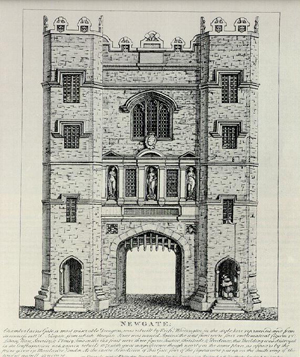
The prison – located on the corner of Newgate Street and Old Bailey on the site of what is now London’s Central Criminal Court (known as the Old Bailey thanks to its position on the street known as Old Bailey) – was apparently first constructed around the end of the 1100s on the orders of King Henry II at the site of one of the gates in the Roman wall (see picture).

It was enlarged and renovated several times over the ensuing centuries (including a complete rebuilding after the Great Fire of London in 1666 and another to the design of George Dance after the prison was badly damaged during the Gordon Riots of 1780, sparked by opposition to Catholic emancipation).

The prison, which was infamous for the squalid conditions in which prisoners were housed, was used for a range of purposes including housing debtors and the incarceration of people awaiting execution (by the 18th century, it’s said that more than 350 crimes had become punishable by death).

In 1783 public executions were moved from Tyburn, west of the city, to a site just outside the prison. In 1868, executions were no longer open to the public at large and the gallows moved inside. The prison closed in 1902 and was eventually demolished in 1904.

Famous prisoners who spent time in Newgate include Shakespeare’ contemporary Ben Jonson (for killing a man in a duel), 17th century author Daniel Defoe (for his authorship of political pamphlets), Captain William Kidd (for piracy), and William Penn, Quaker and founder of Pennsylvania (for contempt of court during a case brought after he was accused of having illegally preached ).

But perhaps the most infamous is the 18th century criminal Jack Sheppard, known for having escaped from the prison several times before finally being hanged at Tyburn (close to where Marble Arch now stands).

The only surviving part of the prison in its original location is part of the prison wall which can be seen in Amen Corner.

PICTURE: Wikipedia.com

LondonLife – Jonquils in Bow Lane

Jonquils add a splash of color on a grey day during a busy lunchhour in Bow Lane in the City. Bow Lane runs from Poultry down to the junction of Queen Victoria and Cannon Streets.

The return of the Temple Bar

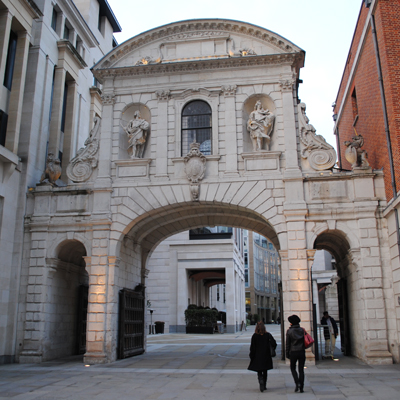
Temple Bar, LondonIt’s been a while since I was in London so I was delighted to find that the Temple Bar had been restored (not to its original site, but to the city as a whole!). The only surviving gateway into the city of London, it was constructed in 1672 to replace a crumbling wooden predecessor and was designed by Sir Christopher Wren (he of St Paul’s fame). The Temple Bar stood at the junction of Fleet Street and the Strand until 1878 when, to help traffic flow, it was removed. Apparently it was intended that it would be rebuilt somewhere else in the city, but time passed and no suitable site was found, so it eventually ended up on an estate in Hertfordshire. Where it remained until 2004 when – thanks to the work of the Temple Bar Trust – it was able to be returned to the city – it is now located between St Paul’s and Paternoster Square – for all to now enjoy.

WHERE: Between Paternoster Square and St Paul’s Cathedral. Nearest tube station is St Paul’s. COST: Free to see (actual building not open to public). WEBSITE: www.thetemplebar.info.

The Temple Bar isn’t the only ‘monument’, for want of a better word, which has been relocated in London. Another is the Wellington Arch, a magnificent structure which was originally finished (though not really completed) in 1830. Then known as the Green Park Arch, it stood parallel with the Hyde Park Screen (it was created to be seen in conjunction with it) and was later adorned with a huge – and controversial – statue of Wellington. But by the 1880s, traffic flow was again a problem and so it was decided to move the arch to its current location, perpendicular to the Hyde Park Screen. As a footnote, when the arch was moved in 1883, the statue of Wellington was not placed back on top but moved to a new site – Aldershot, where it is now.

WHERE: Grosvenor Place, Westminster, SW1X 7. Nearest tube station is Hyde Park Corner. COST: Adults £3.70/child £1.90 (English Heritage members free – there is a joint offer for others combined with Apsley House). WEBSITE: www.english-heritage.org.uk/daysout/properties/wellington-arch/.