What’s in a name?…Cheapside

One of the major thoroughfares of the City of London, the name is reflective of its role as a marketplace with the medieval English word ‘cheap’ generally been taken to mean market.

Starting from the intersection of Newgate Street and St Martin’s Le Grand through to where it runs into Poultry, the street was apparently originally known as Westcheap – Eastcheap is still located down near the Monument. Cheapside’s surrounding streets – including Poultry, Milk Street, and Bread Street give indication of the sorts of goods that were once sold in the area.

Cheapside was, in medieval times, an important street and was on the processional route royalty would have taken from Westminster to the Tower of London. It is the site of St Mary-le-Bow Church (it’s said that if you’re born within hearing of the Bow bells you’re a true Londoner), and, until the Great Fire of 1666, the eastern end of Cheapside was the site of the end of the Great Conduit where water arrived after being piped in from the Tyburn River in the west.

Key figures associated with Cheapside include slain Archbishop of Canterbury Thomas Becket, born there in 1118, poet John Milton, born on the adjoining Bread Street in 1608, and writer Geoffrey Chaucer. A glimpse into the street’s past was found in 1912 when the Cheapside Hoard was unearthed during the demolition of a building there (you can see our earlier post on that here).

The area was heavily bombed during World War II.

Lined with shops, restaurants and office buildings, Cheapside today remains close to the heart of the city and is currently undergoing significant redevelopment, the recently opened swanky shopping centre at One New Change being an example.

10 Questions – Martin Stancliffe, Surveyor to the Fabric, St Paul’s Cathedral…

In the first of a new series in which we ask 10 questions of someone involved with one of London’s historic sites, we speak to Martin Stancliffe, Surveyor of the Fabric at St Paul’s Cathedral, about the £40 million, 15 year cleaning and restoration project at the iconic London structure which came to an end last month…

1. What does your job at the cathedral involve? “Advising on all aspects of the care and repair of the fabric of the cathedral, and its setting. This involves devising and leading all fabric projects, major or minor.”

 2. What prompted the 15 year repair and cleaning project? “The perception that the cathedral could reach out more to all its visitors both as a great centre for worship and as a great tourist attraction if it were in better condition and had improved facilities.”

3. How much of a difference has the cleaning and repair project made to the look of the cathedral, both inside and out? “I think it is not too much to say that the cleaning has transformed the appearance of both the exterior and the interior. In particular, the interior now speaks much more clearly of its primary purpose as a great church and a setting for great national services of memorial or celebration. In addition, the programme of repair works in almost all parts of the cathedral has put it into good condition in ways that can be sensed, but cannot  – I hope – be seen.”

4. How many people have been involved? “It is hard to make a count, but the number must run into several hundred.”

5. What trades did the task require and was it easy to source the sort of expertise required? “The various different tasks required a great range of skills, from masons to electricians and scaffolders,  and from expert painters and gilders to conservators. There is a wonderful supply of skilled craftsmen and professionals in this country; but younger people need to be encouraged to understand how creative and rewarding such work is, and to learn the expert skills required to continue to care for buildings like this.”

6. What was the most challenging aspect of the project? “The most challenging aspect was the organisation of the internal cleaning project, which required special techniques and special scaffolding to enable the cathedral to continue its day to day work uninterruptedly throughout the 15 year programme – including having to remove all scaffolding from the interior for the Queen’s Golden Jubilee right in the middle of the project!”

7. Is the cathedral we now see as (original architect) Sir Christopher Wren envisaged it? “No, the interior had already been substantially altered in the 19th century by the removal of the original choir screen, the stripping of paint from all the internal stonework, and the installation of mosaic decorations. However, the atmosphere in the cathedral is certainly closer to how Wren envisaged it than in its gloomy state 15 years ago; and he would certainly have recognised – and welcomed – the radiant quality of light which has been restored to the interior.”

8. Did you make any interesting discoveries about the building during the restoration project? “A building like this is always revealing new things. We discovered much more about how the lower parts of the dome were constructed, and we have understood much better why and how the building moved and settled as a structure over the last 300 years. We also discovered many fragments of the great cathedral which stood on this site for some 600 years before the destruction of the Great Fire, built into the structure of  Wren’s cathedral.”

 9. What’s your favorite part of the cathedral?  “I love all parts of the dome, from the top of the lantern down to its complex foundations on the top of the arches of the nave.”

10. Can you tell us something about St Paul’s that many visitors may be unaware of? “Many people are unaware of the reason why the dome seems so all embracing when you are in the interior. This is because the dome spans right across the whole width of the church,  allowing the aisles to pass through it, unlike St Peter’s in Rome, for instance.”

WHERE: St Paul’s Cathedral, St Paul’s Churchyard (nearest tube station is St Paul’s); WHEN: St Paul’s is open from 8.30am to 4pm (galleries from 9.30am to 4.15pm), Monday to Saturday. Open for worship only on Sundays;  COST: £14.50 an adult/£13.50 concessions/£5.50 a child (6-18 years)/£34.50 a family of four; WEBSITE: www.stpauls.co.uk

10 small (and fascinating) museums in London…2. Bank of England Museum

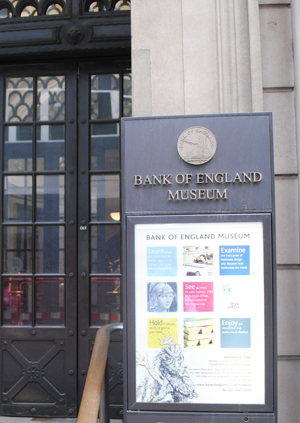
The Bank of England Museum, located on the east side of the “Old Lady of Threadneedle Street”, provides a fascinating account of life behind the bank’s fortress-like walls, spanning the period from its origins and founding in 1694 to its nationalisation in post-World War II Britain through to the high-tech nature of banking – and banknotes – today. 

The museum is partly housed in a 1988 reconstruction of architect Sir John Soane’s 1793 stock office (Sir John designed the bank’s original headquarters –  much of this was later demolished with the exception being the outer windowless walls of the bank which still frown down on passersby) as well as in the Rotunda – designed by Herbert Baker and dating from the 1930s, it features some of the original Caryatids which decorated Soane’s design.

Highlights among the permanent exhibition include the Great Iron Chest, a precursor to today’s safes dating from around 1700, the Bank of England Charter of 1694 still afixed with the Great Seal, the earliest known Bank of England running cash note (relating to a deposit of £22 and dating from 1697), muskets and pistols used for security at the bank, and documents relating to some of the bank’s more high profile customers (these include Admiral Lord Nelson and former US President George Washington) as well as extensive collection of banknotes and coins. There’s also the opportunity to feel the weight of a solid gold bar (worth £393,884 at the time of our visit).

The exhibition also includes a display on Kenneth Grahame, author of The Wind in the Willows and a long-time (30 year) employee of the bank until his sudden resignation, possibly in part due to him being shot by an intruder several years before, in 1908, only four months before his internationally renowned book was published. Key artifacts include his resignation letter in which he asks for “relief” from the burden of his responsibilities at the bank.

Among current temporary exhibitions is The Pound in Your Pocket which looks in detail at the issue of inflation through a variety of entertaining devices including a balance in which you have to keep inflation at a level during a series of “economic shocks”.

WHERE: The Bank of England Museum, Bartholomew Lane off Threadneedle Street (nearest Tube stations are Bank/Monument and Mansion House); WHEN: 10am to 5pm, Monday to Friday (last entry 4.45pm); COST: Free; WEBSITE: www.bankofengland.co.uk/education/museum/index.htm.

Around London – Website to showcase UK’s oil paintings; Arctic explorer John Rae gets Blue Plaque; sharing experiences of kindness; and Toulouse-Lautrec and Jane Avril hit the Courtauld…

• A new website has been launched to showcase the UK’s vast national collection of oil paintings. While the website, which is a partnership between the BBC, the Public Catalogue Foundation, and participating collections and museums, currently hosts around 60,000 works, it is envisaged that by the end of 2012 it will carry digitised images of all 200,000 oil paintings in the UK (in an indicator of how many there are, the National Gallery currently has around 2,300 oil paintings, about one hundredth of all those in the nation). The works on the site will eventually include almost 40,000 by British artists. The 850 galleries and organisations participating so far include 11 in London – among them the National Gallery, the Tate Gallery, the Victoria and Albert Museum, the Bank of England, the Imperial War Museum and Dr Johnson’s House. For more, see www.bbc.co.uk/arts/yourpaintings/

• Arctic explorer John Rae has had a Blue Plaque unveiled in his honor at his former home in Holland Park. Although his feats were relatively unsung in his lifetime, the explorer’s expeditions in the Canadian Arctic saw him travel 13,000 miles by boat and foot and survey more than 1,700 miles of coastline. He is also credited with having “signposted” the only north-west passage around America that is navigable without icebreakers. Rae, who died in 1893, lived at the property at 4 Lower Addison Gardens in Holland Park for the last 24 years of his life.

Transport For London is calling on Londoners to share experiences of “kindness” that they have witnessed or participated in while travelling on the Underground. Artist Michael Landy has created a series of posters which are calling on people to submit their stories. Some of the stories will then be shown at Central Line stations (the first four posters go up on 23rd July at stations including Hollard Park, Holborn and Liverpool Street). For more, go to www.tfl.gov.uk/art.

On the Olympic front, the City of London Corporation has announced Tower Bridge will be bedecked with a set of giant Olympic Rings and the Paralympic Agitos during the 45 days of next year’s Games. Meanwhile, the Corporation has also unveiled it will host next week the launch of a London-wide campaign to get people involved in sport and activity in the lead-up to the Games. More to come on that.

On Now: Toulouse-Lautrec and Jane Avril Beyond the Moulin Rouge. The Courtauld Gallery, based at Somerset House, is running an exhibition celebrating the “remarkable creative partnership” between Jane Avril, a star of the Moulin Rouge in Paris during the 1890s, and artist Henri de Toulouse-Lautrec. Lautrec created a series of posters featuring Avril which ensured she became a symbol of Lautrec’s world of “dancers, cabaret singers, musicians and prostitutes”. Runs until 18th September. See www.courtauld.ac.uk for more.


Around London – 250,000 British Library titles to be available online; summer in Bunhill Fields Burial Ground; funding for church and synagogue repairs; and, the British Museum takes a closer look at relics and reliquaries…

The British Library is to digitise 250,000 books and make them available on the internet under a deal with tech giant Google. The works, which are all out of copyright, date from between 1700 and 1870 and include printed books, pamphlets and periodicals. Among them are feminist pamphlets about the ill-fated French Queen Marie Antionette dating from 1791, blueprints of the first combustion engine-driven submarine dating from 1858, and a 1775 account which tells of a stuffed hippopotamus owned by the Prince of Orange. The works will all be available online via Google Books which has partnered with more than 40 libraries around the world. The project will include material published in a range of European languages and will focus on works not already freely available in digital form online. For more see www.bl.uk.

A series of events running under the banner of ‘Green Garden Lunchtimes’ will be held at the Bunhill Fields Burial Group (off City Road) in the City of London from next Monday until 1st July. The events include free yoga and tai chi classes, a bike repair workshop, a history tour from City Guides and a wildlife talk courtesy of the Natural History Museum. The Wren Clinic will also be providing free advice and treatments. Bunhill Fields is famous for its connections to the Nonconformists and contains the graves of writers William Blake, Daniel Defoe and John Bunyan. For dates and times, follow this link.

• Six churches and a synagogue in London have been granted £582,000 to carry out repair works under the Repair Grants for Places of Worship scheme. The grants, which are administered by English Heritage and funded by the Heritage Lottery Fund, include £199,000 for the Church of St Augustine in Honor Oak Park – an early example of the Gothic Revival in the Early English style, £122,000 for Christ Church in Christchurch Park, Sutton, and £111,000 for the Golders Green Synagogue in Barnet. The grants were part of £8 million worth of funding given to 67 of England’s most important Grade II listed churches, chapels and synagogues. For more, see www.hlf.org.uk.

On Now: Treasures of Heaven: saints, relics and devotion at the British Museum. The museum’s major summer exhibition looks at the spiritual and artistic significance of Christian relics and reliquaries in medieval Europe. Among the highlights are: an arm reliquary of St George, which was housed in the treasury of St Mark’s in Venice following its capture in the sack of Constantinople in 1204; the British Museum’s bejewelled Holy Thorn reliquary, dating from 1390-97 and said to contain a relic from the Crown of Thorns; and, a 12th century bust of St Baudime from France, which once contained a vial of the saint’s blood and is being seen for the first time in Britain. Other exhibits come from the Cleveland Museum of Art in Ohio and the Walters Art Museum in Baltimore as well as from the Vatican. Runs until 9th October. There is an admission charge. For more, see www.britishmuseum.org.

LondonLife – St Paul’s celebrates 300 years since its completion…

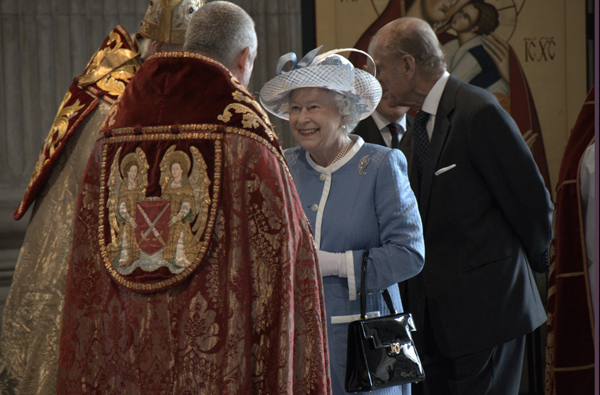
Queen Elizabeth II attends the tercentenary service at St Paul’s. PICTURE: Graham
Lacdao/St Paul’s Cathedral

A service was held at St Paul’s today in celebration of the 300 year anniversary of the cathedral’s completion.

The tercentenary service also marks the end of a massive 15 year, £40 million repair and cleaning project, meaning the cathedral is now clear of scaffolding for the first time in 15 years.

Designed by the indomitable Sir Christopher Wren, work on St Paul’s Cathedral began in 1677 and was formally completed in 1710 (although it had been holding services since 1697). (For more on the history of St Paul’s, see our earlier post, part of our series on Wren’s London, here).

Said to have the largest dome after St Peter’s in Vatican City, St Paul’s has been at the centre of London’s (and the United Kingdom’s) religious and political life for centuries, hosting state funerals (Lord Nelson, the Duke of Wellington and Winston Churchill’s were all held here) as well as the royal wedding of Prince Charles and Lady Diana and many celebration services.

Sights include the crypt – containing the tombs of both Nelson and Wellington – and the Whispering Gallery (see our earlier post on the Whispering Gallery here) as well as the exterior viewing galleries.

To celebrate the cathedral’s liberation from scaffolding, St Paul’s is holding a 300th Anniversary Photography Competition in which photographers are invited to submit their best exterior shots of the building. The 10 winning images will then be displayed in the cathedral crypt. The competition runs until 16th July.

To enter, upload pictures to St Paul’s 300th anniversary competition group at Flickr – www.flickr.com/groups/stpaulslondon/. For more information, see www.stpauls.co.uk/photocomp.

King James I’s London – 8. The New World

It was during the reign of King James I that the first permanent English settlement was made in what was then called the New World (and is now better known as the United States of America).

Named Jamestown (after the King) and located on Jamestown Island, it was the capital of the new Virginia Colony and was founded by the London Company.

The ‘discovery’ and settlement of the New World impacted London itself in various ways – here we look at a couple of related sites in London…

First up is Blackwall in East London, from where three small merchant ships of the Virginia Company of London sailed in 1606 under orders from King James I to bring back gold from the New World. The site is now marked by the First Settlers Monument, first unveiled in 1928 and then restored in 1999.

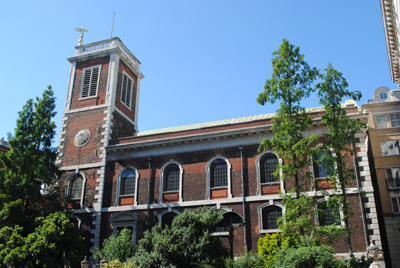
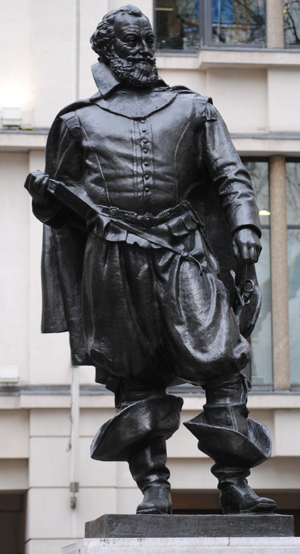
Among those who was on board the ships is Captain John Smith (he of Pocahontas fame) – a statue of him can be found in Bow Churchyard in the City (pictured right, it’s a replica of an original in Richmond, Virginia). Captain Smith was buried in St Sepulchre-without-Newgate, where there is a window commemorating him.

Next we turn to the former, now non-existent, property of John Tradescant and his son, also John Tradescant. Gardeners to the rich and famous and avid collectors of all sorts of artefacts, they are noted for having founded “The Ark” – a house in Lambeth, in they showed off a collection of curiosities that they had gathered on his trips (both were were widely travelled).

These included objects presented to by American colonists including John the Elder’s friend Captain John Smith and those collected by personally by John the Younger (he made several trips to the New World). Among them was the mantle of Powhattan, the father of Pocahontas.

The pair’s name lives on in Tradescant Road in Lambeth (it marks one side of the Tradescant estate). They are both buried at St Mary-at-Lambeth which now houses the Garden Museum.

LondonLife – Knollys Rose Ceremony

A London tradition which has its origins in the fourteenth century, the Knollys Rose Ceremony surrounds the presentation of a single red rose to the Lord Mayor of London at Mansion House.

The ceremony, which was held in the City yesterday, relates to a judgement of 1381 in which the fine was the annual payment of a single red rose.

The fine was levied after Lady Constance Knollys, the wife of prominent citizen Sir Robert Knollys, bought a property opposite her own in Seething Lane and then added a footbridge linking the two without first gaining planning permission (it’s suggested that she bought the property which had previously been used as a threshing ground because she was annoyed with the constant chaff in the air).

Following discovery of her breach, it was agreed that she would pay the annual ‘peppercorn rent’ of a single red rose from the new property’s garden to the Lord Mayor.

Lady Constance’s footbridge is long gone but the tradition of paying the annual rent was revived last century and is now presided over by the Company of Watermen and Lightermen of the River Thames.

The ceremony starts at the church of All Hallows by the Tower and then involves a procession to Seething Lane Gardens (a modern garden close to where the original may have been; the gardens were once the site of the Navy Office) where the Master of the Company of Watermen and Lightermen snips off a rose before heading on to Mansion House where it is presented to the Lord Mayor on a velvet altar cushion from All Hallows.

The ceremony usually takes place on the second Monday in June.

Where’s London’s oldest…public park?

Dating from the early 1600s, London’s oldest public park is Finsbury Circus Gardens, located just to the north of London Wall and east of Moorgate.

The now heritage-listed gardens were open as a public park from 1606 (and was originally known as Moor Fields – the moors were drained and gravel walks laid out in 1527 but it wasn’t until 1606 that the area was laid out with elm trees and benches).

The park wasn’t enclosed until 1815-17 when City of London surveyor William Montague laid the area out according to the designs of prominent London architect George Dance the Younger.

The gardens were acquired by the City of London Corporation in 1900 and in 1909 were replanned. The oval-shaped park, the largest of the City’s gardens, is these days home to the City of London Bowling Club, the only bowling club in the City (founded in 1924; the bowling green dates from the following year and the current pavilion from 1968).

During World War II a barrage balloon was anchored here to deter low level air raids. Among it’s other claims to fame is the Tudor era bat (apparently a forerunner of the modern cricket bat) found on the site in the 1980s and skulls which have also been found dating from the Roman period.

The gardens are currently partly closed due to the Crossrail development.

PICTURE: Wikipedia

LondonLife – Beating the Bounds at All Hallows

Thursday is Ascension Day and, at All Hallows by the Tower in the City, that means conducting the ancient ceremony of Beating the Bounds.

The origins of the custom go back to medieval times when parishes annually reaffirmed their boundaries by undertaking a procession during which each parish boundary marker was beaten with wands while praying for protection and blessings.

At All Hallows, the beating party consists of students from Dunstan College in Catford (these students have an association with the church of St Dunstan-in-the-East which is now part of the parish of All Hallows) along with parish clergy and the masters of livery companies associated with the parish and Thames waterboatmen. (Pictured right is last year’s procession).

Highlights of the procession at All Hallows include the beating of the parish’s southern marker – this is located in the middle of the Thames and must be reached by boat – and the mock ‘confrontation’ which occurs between the beating party and the Governor and Yeoman Warders of the Tower of London.

The ‘confrontation’ relates to the fact that the parish and the tower share a boundary – this was apparently a common cause of dispute in the Middle Ages and led, in 1698, to a ‘battle’ between the people of the parish and those of the tower. The ceremony is followed by attendance at a festal evensong at the church.

For more, see www.ahbtt.org.uk/history/beating-the-bounds/

PICTURE: Courtesy of All Hallows by the Tower.

Curious London Memorials – 10. The Bard or not The Bard?

For the last in our series of curious London memorials, we’re looking at one which isn’t quite what it seems.

At first glance, the granite plinth topped by a bronze bust of William Shakespeare which stands in gardens at the junction of Love Lane and Aldermanbury in the City, looks like yet another tribute to the Bard.

But take a closer look and you’ll read that the inscriptions in fact refer to John Heminge and Henry Condell, two actors and friends of the Bard, who were responsible for collecting his works and giving them “to the world”.

The two men were partners with Shakespeare at the Globe and it was they who were behind the publication of his First Folio in 1623. They were both buried here in what was formerly the churchyard of St Mary Aldermanbury (first destroyed in the Great Fire of 1666 and then again in the Blitz although the surviving walls were later rebuilt in the US – more on that another time), Heminge on 12th October, 1630, and Condell on 29th December, 1627.

It’s worth quoting the inscription on the memorial – and there is a lot of it – at greater length. “The fame of Shakespeare,” it reads, “rests on his incomparable dramas. There is no evidence that he ever intended to publish them and his premature death in 1616 made this the interest of no-one else. Heminge and Condell had been co-partners with him in the Globe Theatre Southwark and from the accumulated plays there of thirty-five years with great labour selected them. No men living were so competent having acted with him in them for many years and well knowing his manuscripts. They were published in 1623 in folio, thus giving away their private rights therein. What they did was priceless, for the whole of his manuscripts with almost all those of the dramas of the period have perished.”

The memorial was erected by Charles Clement Walker, of Shropshire, in 1896. Walker, who has his own memorial in Northampton Square in Clerkenwell, was a Justice of the Peace for the counties of Salop and Stafford and a native of the parish of Clerkenwell.

The bronze bust of Shakespeare was by Charles Allen.

Treasures of London – The Whispering Gallery, St Paul’s Cathedral

Found 98 feet (30 metres) above the cathedral’s floor, the Whispering Gallery at London’s iconic St Paul’s Cathedral is an architectural marvel.

As with other “whispering galleries” found around the world, its construction is such that something whispered into the wall on one side of the gallery, which runs around the interior of the cathedral’s inner dome (part of the first ever ‘triple dome’), can be heard on the other side of the gallery, around 100 feet (30 metres) away.

The dome (pictured right), the design of which draws inspiration from that of St Peter’s Basilica in Vatican City, was constructed to the designs of Sir Christopher Wren. The cathedral, including the dome, was essentially completed in 1708.

As well as giving views down into the cathedral, the Whispering Gallery – a relatively easy climb of only 257 steps – also provides a close-up view of murals painted on the dome’s inner surface by Sir James Thornhill. Painted between 1715 and 1719, these depict images from St Paul’s life.

Two further galleries on the dome are also publicly accessible – the Stone Gallery, which stands 173 feet (53.4 metres) above the cathedral floor, and the Golden Gallery, which stands 280 feet (85.4 metres) above the cathedral floor and offers stunning views of the city as well as southward over the Thames. But be prepared for a long climb – 528 steps – up what are in places narrow, winding staircases.

The current ball and cross on top of the dome date from 1821 (these replaced those which had first topped the cathedral). Together they stand 23 feet (seven metres) high and weigh seven tonnes.

WHERE: St Paul’s Cathedral, St Paul’s Churchyard (nearest tube station is St Paul’s); WHEN: The galleries are open from 9.30am to 4.15pm, Monday to Saturday (small children must be accompanied by an adult)/Cathedral is open from 8.30am;  COST: £14.50 an adult/£13.50 concessions and students/£5.50 a child (6-18 years)/£34.50 a family of four; WEBSITE: www.stpauls.co.uk

Curious London memorials – 9. The Golden Boy of Pye Corner

It’s widely known that Pudding Lane was the place where the Great Fire of London is believed to have started in 1666 – hard to miss given the site is commemorated nearby in the form of The Monument, the world’s tallest freestanding stone column – but what about where it was stopped? Standing in a niche on the corner of a building overlooking the junction of Giltspur Street and Cock Lane is a small gilt statue known as the ‘Golden Boy of Pye Corner’.

It’s not known how old the statue is but it is known that it was previously located on the front of a pub, The Fortune of War, which stood on the site until it was demolished in 1910 (and was apparently used by body-snatchers as a place to display stolen corpses for surgeons to peruse).

The statue – which apparently marks the place where the fire was ‘stayed’ (that is, buildings were destroyed to stop the fire spreading any further) –  is accompanied by an inscription which reads “This Boy is in Memmory put up for the late Fire of London Occasion’d by the Sin of Gluttony 1666”.

Below it an explanatory note below explains that the boy was made deliberately fat in reference to the fact the fire was started in Pudding Lane as a result of gluttony and not by Papists as was claimed on The Monument (this reference – “But Popish frenzy, which wrought such horrors, is not yet quenched” – was added to the inscriptions on the Monument in 1681 but was removed in 1831).

Where’s London’s oldest…lived in house?

Like many in our series on London’s oldest, this one is a little subjective. But based on our survey of the data out there, we’re opting for 41-42 Cloth Fair, right beside St Bartholowmew the Great, in the City.

The only house to have survived the Great Fire of London in 1666, this five bedroom property – which we can confirm is still up for sale with a guide price of more than £5.9 million following a major restoration – was apparently completed around 1614.

It was originally constructed as part of a development initiated by Robert, Baron Rich, which featured 11 houses around a courtyard and was known as Launders Green (being located on what was the former laundry ground of the monastery at St Barts).

The red brick house, which was awarded a City Heritage award in 2000 for the sensitive restoration work, retains many of its original features.

Interestingly, windows on the second floor contain autographs of some of the famous people who have been to the property over the years including Queen Elizabeth, the Queen Mother, former PM Winston Churchill and Poet Laureate John Betjeman.

Around London – Burial place of Bunyan, Defoe and Blake gets Grade I listing; Kew Gardens joins Streetview; and, Afghan treasures on show…

The London burial place of writers John Bunyan and Daniel Defoe and artist and poet William Blake has been recognised as one of the city’s most significant historic landscapes with a Grade I listing on the national Register of Parks and Gardens. The news, which was announced last month, also sees 75 tombs located within Bunhill Fields Cemetery individually listed. Bunhill, located between City Road and Bunhill Row, is one of 106 registered cemeteries in London (and now one of only seven Grade I listed cemeteries). It was established in 1660 and, thanks to its not being associated with Anglican place of worship, is viewed as the “pre-eminent graveyard for Nonconformists in England” . About 123,000 burials took place in its four acres before it was closed in 1869. The oldest monument is that of theologian Theophilus Gale, who died in 1678. As well as the tombs of Buynan, Defoe and Blake, others listed on the register include that of Dame Mary Page, who died in 1728 and whose tomb inscription talks of her stoicism in the face of 240 gallons of water being taken out of her prior to her death, and Joseph Denison, a banker who died in 1806 and was one of England’s wealthiest commoners at the time. The listing was made by the Department of Culture, Media and Sport following advice from English Heritage. For more on Bunhill Fields, follow this link

Kew Gardens has joined Google Streetview, meaning it’s now possible to navigate your way around the gardens from the comfort of your own home. More than 26 kilometres of paths and the interiors of some of the garden’s glasshouses – including the Palm House and the Temperate House – can now be seen on Streetview which offers 360 degree views. Professor Stephen Hopper, director at Kew, says the new technology is “bound to encourage people to visit us and experience Kew for themselves”. Follow this link to see the gardens on Streetview.

• On Now: Afghanistan’s heritage is on display in a newly opened exhibition at the British Museum. Afghanistan: Crossroads of the Ancient World showcases more than 200 objects from the National Museum of Afghanistan as well as some items from the British Museum and includes sculptures, ivory inlays once attached to furniture, Roman glassware and Egyptian stone tableware, and inlaid gold ornaments once worn by the area’s “nomadic elite”. The objects were found between 1937 and 1978 and were preserved thanks to officials who kept them out of harm’s way during the Soviet and Taliban eras. The museum announced this week that they would be joined by carved ivory fragments that were stolen from Afghanistan’s national museum in the early 1990s and only recently presented to the British Museum by a benefactor with the idea that they will eventually be returned to Kabul. The exhibition runs until 3rd July. There is an admission charge. For more information, see www.britishmuseum.org.

Lost London – Newgate Prison

The most notorious of London’s many prisons, Newgate remained in use for more than 700 years.

The prison – located on the corner of Newgate Street and Old Bailey on the site of what is now London’s Central Criminal Court (known as the Old Bailey thanks to its position on the street known as Old Bailey) – was apparently first constructed around the end of the 1100s on the orders of King Henry II at the site of one of the gates in the Roman wall (see picture).

It was enlarged and renovated several times over the ensuing centuries (including a complete rebuilding after the Great Fire of London in 1666 and another to the design of George Dance after the prison was badly damaged during the Gordon Riots of 1780, sparked by opposition to Catholic emancipation).

The prison, which was infamous for the squalid conditions in which prisoners were housed, was used for a range of purposes including housing debtors and the incarceration of people awaiting execution (by the 18th century, it’s said that more than 350 crimes had become punishable by death).

In 1783 public executions were moved from Tyburn, west of the city, to a site just outside the prison. In 1868, executions were no longer open to the public at large and the gallows moved inside. The prison closed in 1902 and was eventually demolished in 1904.

Famous prisoners who spent time in Newgate include Shakespeare’ contemporary Ben Jonson (for killing a man in a duel), 17th century author Daniel Defoe (for his authorship of political pamphlets), Captain William Kidd (for piracy), and William Penn, Quaker and founder of Pennsylvania (for contempt of court during a case brought after he was accused of having illegally preached ).

But perhaps the most infamous is the 18th century criminal Jack Sheppard, known for having escaped from the prison several times before finally being hanged at Tyburn (close to where Marble Arch now stands).

The only surviving part of the prison in its original location is part of the prison wall which can be seen in Amen Corner.

PICTURE: Wikipedia.com

LondonLife – Jonquils in Bow Lane

Jonquils add a splash of color on a grey day during a busy lunchhour in Bow Lane in the City. Bow Lane runs from Poultry down to the junction of Queen Victoria and Cannon Streets.

The return of the Temple Bar

Temple Bar, LondonIt’s been a while since I was in London so I was delighted to find that the Temple Bar had been restored (not to its original site, but to the city as a whole!). The only surviving gateway into the city of London, it was constructed in 1672 to replace a crumbling wooden predecessor and was designed by Sir Christopher Wren (he of St Paul’s fame). The Temple Bar stood at the junction of Fleet Street and the Strand until 1878 when, to help traffic flow, it was removed. Apparently it was intended that it would be rebuilt somewhere else in the city, but time passed and no suitable site was found, so it eventually ended up on an estate in Hertfordshire. Where it remained until 2004 when – thanks to the work of the Temple Bar Trust – it was able to be returned to the city – it is now located between St Paul’s and Paternoster Square – for all to now enjoy.

WHERE: Between Paternoster Square and St Paul’s Cathedral. Nearest tube station is St Paul’s. COST: Free to see (actual building not open to public). WEBSITE: www.thetemplebar.info.

The Temple Bar isn’t the only ‘monument’, for want of a better word, which has been relocated in London. Another is the Wellington Arch, a magnificent structure which was originally finished (though not really completed) in 1830. Then known as the Green Park Arch, it stood parallel with the Hyde Park Screen (it was created to be seen in conjunction with it) and was later adorned with a huge – and controversial – statue of Wellington. But by the 1880s, traffic flow was again a problem and so it was decided to move the arch to its current location, perpendicular to the Hyde Park Screen. As a footnote, when the arch was moved in 1883, the statue of Wellington was not placed back on top but moved to a new site – Aldershot, where it is now.

WHERE: Grosvenor Place, Westminster, SW1X 7. Nearest tube station is Hyde Park Corner. COST: Adults £3.70/child £1.90 (English Heritage members free – there is a joint offer for others combined with Apsley House). WEBSITE: www.english-heritage.org.uk/daysout/properties/wellington-arch/.