LondonLife: Those Christmas Lights (part two)…

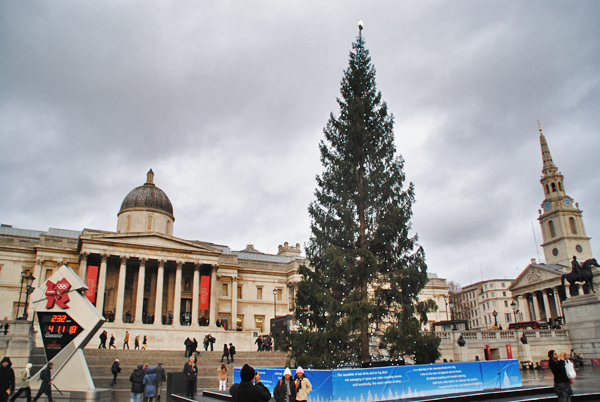
The Trafalgar Square Christmas Tree – donated  by the people of Oslo each year since 1947 as a thanks for the support Britain gave to Norway during World War II. On the left is the Olympic countdown clock.

A giant hedge-like reindeer outside Covent Garden, a market since at least the 1600s but once the site of a large kitchen garden for the monks of the Convent of St Peter, Westminster (see our earlier post for more).

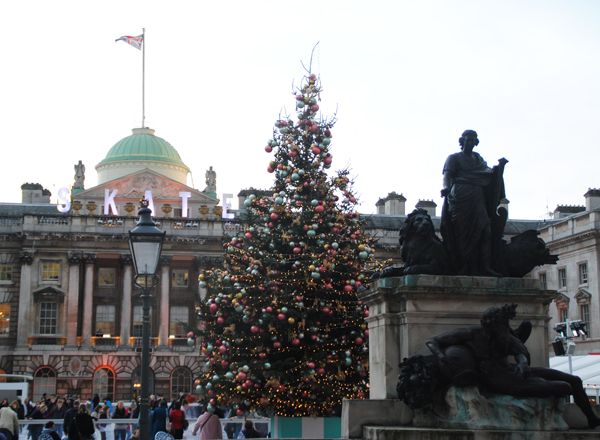
Christmas tree near the ice-skating rink at Somerset House, now an arts and cultural centre but originally built on the site of a Tudor palace in the late 1770s as a home for three “learned societies” – the Royal Academy of Arts, the Royal Society, and the Society of Antiquaries – as well as government offices (including the Navy Board).

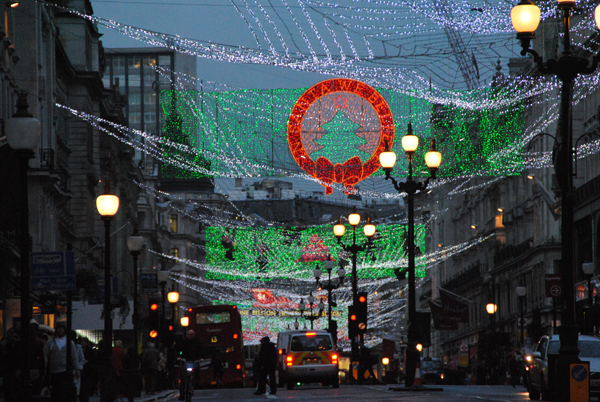
Christmas lights in Regent Street, one of the city’s premier shopping streets, in the West End. It’s current shape was designed by architect John Nash in the early 19th century.

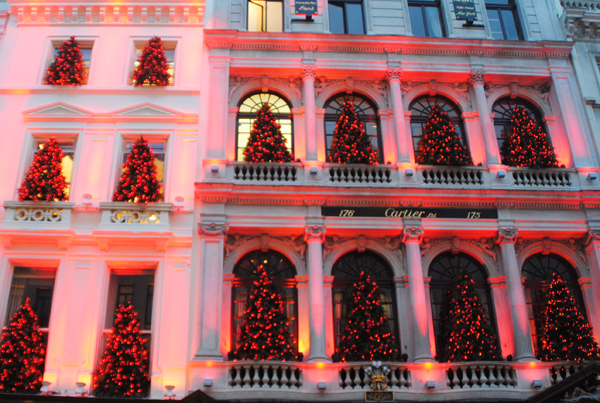
Christmas decorations on the exterior of Cartier in Old Bond Street, Mayfair. The area takes its name from the May Fair once held there and is now one of the most expensive areas within London (see our earlier post for more).

Looking for a book about London? See The Exploring London Little List of Books for Christmas…

Where’s London’s oldest…hotel?

Brown’s Hotel in Mayfair (now officially the Rocco Forte Brown’s Hotel) is generally awarded the accolade of being London’s oldest hotel. 

The hotel, which initially fronted on to Dover Street, was founded in a series of former Georgian townhouses in 1837 by James and Sarah Brown, formerly valet and maid to Lord and Lady Byron.

After being sold to the Ford family in 1859, the hotel was extensively modernised with electricity, the installation of permanent bath tubs, lifts, and in first for London hotels, an on-site restaurant. The building itself underwent a major expansion in the late 1890s when the family bought the St George’s Hotel which backed onto Brown’s and fronted onto Albemarle Street. The two buildings were merged into one, an extra floor added, and a new facade built for the hotel facing out onto Albemarle Street (pictured right). Three further townhouses were incorporated into the building in the early 1900s.

Possibly the most notable event to take place at the hotel was in 1876 when Alexander Graham Bell made the first ever telephone call there. Other visitors included authors Rudyard Kipling (who wrote The Jungle Book while resident) and Agatha Christie (At Bertram’s Hotel is said to be based on Brown’s), royalty such as Queen Victoria and the French Emperor Napoleon III and his wife Empress Eugenie (they stayed in 1871), and world leaders like US Presidents Theodore Roosevelt and Franklin Roosevelt, British Prime Minister Winston Churchill (said to count the bar among his favorities), Cecil Rhodes, founder of Rhodesia, and Emperor Haile Selassie, who took refuge there in 1936 after the Italians invaded Ethiopia.

The hotel, which now features 117 guestrooms, underwent a multi-million pound refurbishment in the mid-Noughties after becoming part of the Rocco Forte Collection of hotels. As well as The Albemarle restaurant and The Donovan Bar, it also serves award-winning afternoon teas at The English Tea Room.

For more about Brown’s Hotel, see www.brownshotel.com.

Around London – Ronald Reagan unveiled, two ways in Pall Mall, Hungarian photography at the RA, and a celebration of the Arab world…

A new statue of former US President Ronald Reagan was unveiled in Grosvenor Square near the US embassy on Monday, 4th July. The 10 foot tall bronze statue of the president, who died in 2004, was unveiled at a private ceremony by the Foreign Secretary William Hague – former US Secretary of State Condoleezza Rice were also among the more than 2,000 people who attended along with current US ambassador Louis Susman (a frail Margaret Thatcher was reportedly too frail to attend). Commissioned by the Ronald Reagan Presidential Foundation, the statue is the work of sculptor Chas Fagan. Its unveiling is one of a series of events marking the centenary of the birth of the former actor turned politician.

Pall Mall and St James Street in the West End were opened to two-way traffic this week for the first time in 50 years. The changeover came into effect last Sunday morning. The roads were made one-way in 1963 under a scheme to deal with increasing traffic in the area. But it has been reopened in the first stage of a £14 million overhaul of traffic around Piccadilly Circus – home to world-famous neon billboards and the Eros Statue. The area is visited by 200,000 every day.

Time to get your togs on. Scores of swimmers will be taking the plunge at the Hampstead Heath Lido tomorrow and Saturday to raise funds for the Lord Mayor’s Appeal, Bear Necessities. A 4,000 metre swim, the City Dip, will be swum by teams and individuals with every swimmer receiving a commemorative certificate and medal. The current Lord Mayor of London is Michael Bear. To sign up or for more information, see  www.lordmayorsappeal.org.uk/dip

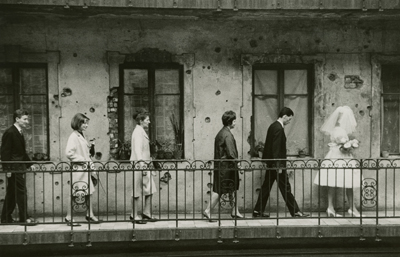
On Now: Eyewitness: Hungarian Photography in the 20th Century – Brassaï, Capa, Kertész, Moholy-Nagy, MunkácsiThis new exhibition at the Royal Academy of the Arts at Burlington House in Piccadilly, organised to mark the Hungarian Presidency of the EU, is dedicated to the birth of modern photography and features the work of Brassaï, Robert Capa, André Kertész, László Moholy-Nagy and Martin Munkácsi. It comprises more than 200 photographs, dating from 1914 to 1989, which usually form part of the collection of the Hungarian National Museum of Photography as well as the National Museum in Budapest and other public and private collections in both Hungary and the UK. Runs until 2nd October. For more information, see www.royalacademy.org.ukPICTURE: Laszlo Fejes, Wedding, Budapest, 1965, Copyright Hungarian Museum of Photography.

On Now: Shubbak: A Window on Contemporary Arab Culture. London’s first ever celebration of contemporary culture from across the Arab world will feature more than 100 artists involved in 70 events at some 30 venues over the weeks until 24th July. The program includes visual arts, film, music, theatre, dance, literature, architecture, lectures and discussions with many events boasting free admission. Highlights include A Girl in her Room, an exhibition of photo works by highly acclaimed Lebanese/American artist, Rania Matar, at the Mosaic Rooms, one of London’s leading centres for Arab contemporary arts (runs until 23rd July), Shopopolis, a series of collaborations with shoppers at Westfield Shopping Centre (runs until 24th July) and this weekend’s Interference, a series of free films, talks and workshops at the ICA curated by Mathaf: Arab Museum of Modern Art in Doha. For full details of all events, see www.london.gov.uk/shubbak.
LondonLife – The visit of the American President…

President Barack Obama has been in London for the past two days, so Exploring London decided to take a break from our series on King James’ I’s London and instead, in honor of the president’s visit, take a look at where you’ll find some other US presidents in London.

First up, it’s President George Washington. A life-sized statue of the first US president stands outside the National Gallery on the north side of Trafalgar Square. It’s a replica of an eighteenth century marble statue by Jean Antoine Houdon which stands in the State Capitol building in Richmond, Virginia. A gift of the Commonwealth of Virginia in 1924.

Civil War President Abraham Lincoln stands looking toward Parliament Square and the Houses of Parliament (pictured). The statue dates from 1920 – it was originally proposed to put a statue of President Lincoln in Parliament Square to mark the 1915 centenary of the last time the US and Britain were at war but the plans were put on ice until several years later. The statue, a gift of the US government, is a replica of the Chicago Lincoln Memorial by Augustus Saint-Gaudens. (There is also a bust of Lincoln inside the Royal Exchange building).

Next in the chronology is President Franklin D. Roosevelt, whose statue can be found on the north side of Grosvenor Gardens (overlooked by the vast and soon-to-be replaced US embassy). This bronze was unveiled by the president’s wife, Eleanor, on the third anniversary of FDR’s death- 12th April, 1948. The statue depicts the president standing – apparently at Mrs Roosevelt’s insistence – instead of seated in a wheelchair.

Across the gardens stands another wartime president, President Dwight D. Eisenhower. A bronze by sculptor Robert Dean, this life-size statue was the gift of the US city of Kansas in 1989 and was unveiled by British PM Margaret Thatcher and US Ambassador Charles Price. It stands only a short distance from Eisenhower’s wartime HQ. (Grosvenor Square has also been home to then future US President John Adams who lived at number nine as the first US Ambassador to the Court of St James between 1786-97).

A bronze bust of the 35th president, President John F. Kennedy, can be found on the corner of Park Crescent and Marylebone Road. Unveiled by his brother, Senator Robert Kennedy, in 1965, it’s a copy of a bust located in the Library of Congress in Washington DC.

Among those mooted for the future is one of President Ronald Reagan (also in Grosvenor Square), planning permission for which was granted by Westminster City Council in 2009.

What’s in a name?…Mayfair

Still the address to have in London, the origins of the name Mayfair are just as they appear – this area to the west of the City was named for the annual May Fair which was held at what is now the trendy (and picturesque) cafe precinct of Shepherd Market during the late 17th and early 18th centuries.

The two week long annual fair was established by King James II as a cattle market on what was then known as Brookfield Market in the 1680s. Attracting other pleasure-related activities, it soon became known for its licentiousness and, having survived Queen Anne’s attempts to have it banned, was eventually stopped in the mid-1700s. Edward Shepherd, who today gives his name to the area on which Brookfield Market once stood, was an architect and developer who subsequently redeveloped the site.

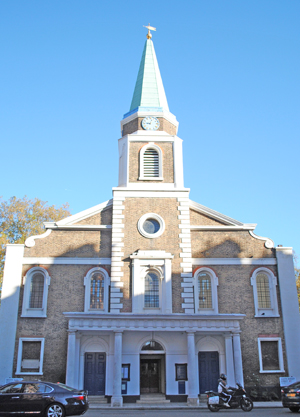
These days Mayfair is generally taken to encompass an area bordered by Hyde Park to the west, Oxford Street to the north, Piccadilly to the south and Regent Street to the east. The area’s development really took off in the century following the mid 1600s (landowners included the Grosvenor family – whose name is reflected in landmarks like London’s third largest square Grosvenor Square and Grosvenor Chapel (pictured) – as well as the Berkeleys and Burlingtons) and it became a favored residential location among the wealthy – indeed, it was this very gentrification which indirectly put an end to the fair.

Today, as well as being known for high end residential real estate, it’s one of London’s most expensive shopping precincts. Landmark buildings in the area today include the hulking bulk of the US Embassy at the western end of Grosvenor Square, the Royal Academy of Arts in Piccadilly, the Handel House Museum (located in what was the home of composer George Frideric Handel), shopping arcades such as the Burlington and Royal Arcades, and various luxury hotels like Claridge’s and The Dorchester in Park Lane.

Famous Londoners – Beau Brummell

Generally acknowledged as having introduced the concept of men wearing a suit and tie during the Regency, ‘Beau’ Brummell’s sense of fashion continues to impact the way we dress right across the globe.

George Brummell was born in London 0n 7th June, 1788, the son of William Brummell, the private secretary of Lord North. Educated at Eton and Oxford, Brummell later joined the army and it was there that he became friends with George, Prince of Wales (the future King George IV). It was the prince who aided his promotion to captain before he resigned his commission.

Setting up home in Chesterfield Street, Mayfair, using the small fortune he inherited on his father’s death, Brummell became a member of the prince’s inner circle and quickly established a reputation for his elegant – and sober – dress sense and skills at the art of conversation.

But Brummell’s talent for spending above his means and his reckless gambling began to catch up with him as did his, at times, overly sharp tongue, and he gradually fell out of favour with his highly placed friends, including the Prince Regent whom he is said to have famously insulted after the prince snubbed him.

In 1816 he fled to France to escape debtor’s prison and remained there for the rest of his life. While friends helped him to secure the position of British consul in Caen briefly during the 1830s, he gradually slipped into decline and spent time in a French debtor’s prison until, impoverished and now insane, he died in an asylum in Caen in 1840.

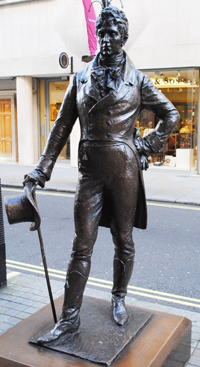
Brummell, whose life has since inspired numerous books, plays and films, can be seen standing on Jermyn Street where a statue of him by Irena Sedlecka was erected in 2002 (pictured). His legacy to fashion lives on.

What’s In A Name? – Piccadilly

One of the principal thoroughfare’s of London’s West End – and lending its name to that most famous of intersections, Piccadilly Circus, the name Piccadilly derives from the stiff ruffs known as ‘piccadils’ which were widely worn by the fashionable during the 17th century.

The street was known as Portugal Street until the 17th century. While there are several different stories explaining the name, the most widely accepted story is that the name’s origins go back to a tailor by the name of Robert Baker.

He’d made a fortune from making and selling piccadils and used that money to purchase a large tract of land in the area, then largely countryside, and 1611-12 built a mansion there which became known, probably derisively, as Piccadilly Hall in reference to his trade.

When the area came to be developing in the years after the Restoration of Charles II in 1660, the name stuck.

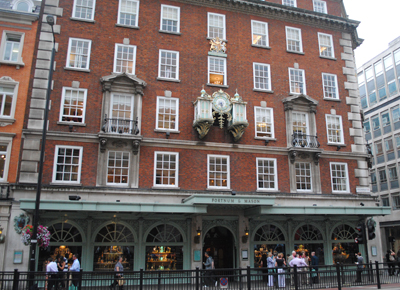
Famous sights along Piccadilly include grocer Fortnum & Mason, founded in 1707 by one of Queen Anne’s footmen (pictured above), the Royal Academy of the Arts, the Ritz Hotel, which opened in 1906 and indicated a new level in luxurious hotels, the Wren-designed St James’ Church, and the entry to the 19th century Burlington Arcade.