LondonLife – Forget the halls, they’re decking the city…part two…

There’s still a weekend to go before Christmas and if, having finished all Christmas shopping, you’re still in the mood for seeing some light displays, here’s some more places to look for some amazing (and in some cases historic), Christmas decorations (for the first part of this overview, head here)…

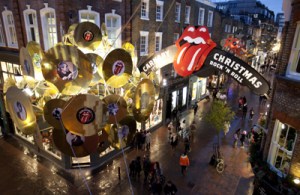
Carnaby-StreetLast week we mentioned some of the key sites to look for light displays in the West End this Christmas. Some of the other places to look include: the iconic shopping strip of Carnaby Street (decorations there this year are inspired by the 50th anniversary of the Rolling Stones – pictured) as well as South Molton Street, off Oxford Street (which again features some beautiful illuminated archways), and streets throughout St James (the St James Christmas lights were this year switched on by opera star Katherine Jenkins who earlier led a carol service at St James’s Church) and Mayfair.

Around Bow Lane and Watling Street in the City of London. Daubed with more than 10,000 lights, these narrow streets provide a wonderful sense of London past.

Marylebone. The lights here are well worth venturing out for. Turned on this year by Strictly Come Dancing‘s Claudia Winkleman.

Historic West End arcades. Still a place for fashionable shopping and tasteful Christmas decor, these include the Burlington Arcade, Royal Arcade, Princes Arcade and the Piccadilly Arcade.

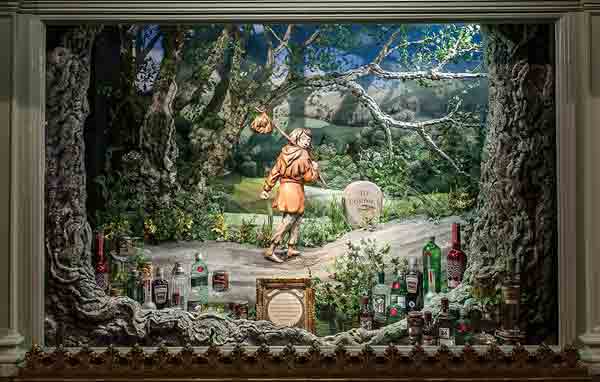
And, of course, throughout London many shops have Christmas window displays. They include that of Fortnum & Mason in Piccadilly which this year have a Dick Whittington theme (see our earlier post here); Harvey Nichols in Knightsbridge which have gone with an oriental theme; Harrods in Brompton Road which have a Disney Princess theme; and Liberty in Great Marlborough Street which have gone with a theme inspired by the age of steam trains.

Of course, our list is by no means been comprehensive and is only confined to London’s heart – please share any other sensational Christmas decorations you’ve come across elsewhere in the city…

Around London – Christmas at the Tower and Kew Gardens; Old Flo on display; African Diaspora on show at MoL Docklands; and, Mariko Mori at the Royal Academy…

Victorian-Christmas The Tower of London is going Victorian this Christmas with visitors able to experience some of what the Yuletide celebrations in the foreboding, much storied buildings were like in the mid-to-late 1800s. Visitors will be shown how many of the Christmas customs we now participate in each year – like writing cards, pulling crackers and the setting up of family Christmas trees – owe their origins to the Victorian era. The Yeoman Warders will be receiving a Victorian makeover and writer of the age – Charles Dickens – will be reciting some of his works before joining in a “raucous” lunch party with some of his fellow writers, artists and benefactors. It’s even rumoured that Queen Victoria and Prince Albert themselves may make an appearance (take that as a given). Bah! Humbug! A Very Merry Victorian Christmas runs from 27th until 31st December. The festivities will all be included in the usual admission price. For more, see www.hrp.org.uk. PICTURE: Nick Wilkinson/NewsTeam.

Kew Gardens are celebrating Christmas with a host of events including a “Twelve trees of Christmas” family trail. The trail, a map of which can be picked up as you enter, includes facts about trees along the route. Volunteer guides are also leading free tours of seasonal highlights and the Kew Christmas tree can be seen at Victoria Gate. Other festive treats at Kew include the chance to see Father Christmas in his grotto (until Sunday only) and a vintage carousel on the Kew Palace Lawn. Many of the Christmas-related events end on 6th January. See www.kew.org for more.

A display focusing on the history of Henry Moore’s sculpture, Draped Seated Woman (better known as Old Flo), has opened at the Museum of London Docklands. Henry Moore and the East End provides a glimpse into 1950s East London and looks at why public art was considered important at the time. It features some of the maquettes (scale models) Moore used in creating the piece. The exhibition was opened following a decision by the Mayor of Tower Hamlets, Lutfur Rahman, to sell Old Flo (now at the Yorkshire Sculpture Park) rather than display the artwork in a public space. The move is being contested by the Museum of London Docklands who have offered to put the work on public display. An online exhibition can be seen at www.museumoflondon.org.uk/oldflo and a ‘pop-up exhibition’ on Old Flo will be launched in January. The museum is also encouraging people to tweet their views about the selling of the sculpture under the hashtag #saveoldflo.

On Now: Take Another Look. Still at the Museum of London Docklands, this exhibition focuses on the visual representation of people from the African Diaspora who were living and working in Britain in the late 18th and early 19th century. The display of 17 exhibits in the London, Sugar and Slavery gallery features prints by artists including Thomas Rowlandson and George Cruikshank as well as newspaper cuttings, mostly dating from 1780-1833, which show black Britons in perhaps what were unexpected roles – soldiers, musicians and sportsmen – during what was the period in which the abolition of slavery occurred. There are a series of events planned around the exhibition which runs until 4th August. Entry is free. For more see www.museumoflondon.org.uk/Docklands/.

On Now: Mariko Mori: Rebirth. The first major museum exhibition of the New York-based Japanese artist Mariko Mori in London since 1998 has opened at the Royal Academy of Arts in Piccadilly. The exhibition features some of the artist’s most acclaimed works from the last 11 years, many of which have never before been seen in the UK, as well as works created just for the exhibition. Highlights include Tom Na H-iu, a five metre high glass monolith lit by hundreds of LED lights and connected back to the Institute for Cosmic Ray Research at the University of Tokyo; Transcircle, described as a “modern day Stonehenge”; and, Flatstone, an installation of “22 ceramic stones assembled to recreate an ancient shrine”. Runs until 17th February. Admission charge applies. For more, see www.royalacademy.org.uk.

LondonLife – Dick Whittington at Fortnum & Mason…

Dick-Whittington-at-FM
“Turn again, Dick Whittington!” This year’s Christmas window display at Piccadilly’s Fortnum & Mason tell the story of thrice Lord Mayor of London (and popular panto figure), Dick Whittington. The windows were unveiled by the current Lord Mayor of London, Roger Gifford (his wife Clare has just written a new version of the story) and the cast from Hackney Empire’s Dick Whittington. For more on the story of Dick Whittington, see our earlier post here. For more on Fortnum & Mason see our earlier post here. PICTURE: Courtesy of Fortnum & Mason.

Treasures of London – Duke of York’s Column…

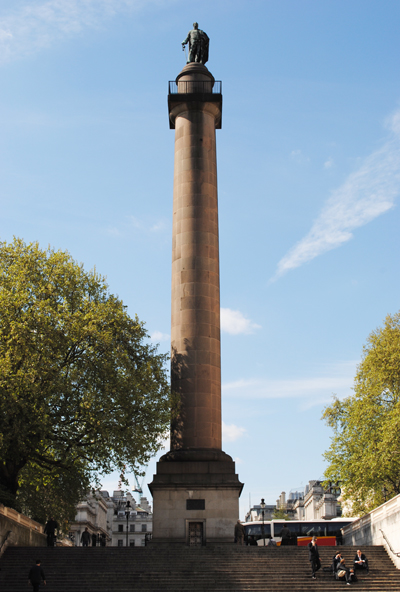
With Nelson’s Column in Trafalgar Square stealing much of the limelight, the Duke of York’s Column in Waterloo Place tends to get overlooked. So we thought it was time we took a more in-depth look at its history.

The monument is dedicated to Prince Frederick (1763-1827), the second son of King George III and commander-in-chief of the British Army during wars which were fought between France and European powers including Britain between 1792 and 1802.

The Duke was not a successful military commander on the field – his one outing in Flanders was a disaster and is said to have resulted in him being immortalised in the song, The Grand Old Duke of York – but he is celebrated for reforming the army after his return to England.

The almost 42-metre high monument  features a larger-than-life bronze statue of the Duke dressed in the robes of the Knights of the Garter – the work of Sir Richard Westmacott – standing on the top of a granite column and gazing down a series of steps and over The Mall towards St James’s Park.

The overall monument was designed by Benjamin Dean Wyatt. His design was selected by a committee from among other submissions and erected between 1830-33. While the Duke was an inveterate gambler and died deeply in debt, the British Army is said to have voted to forgo a day’s pay to fork out the £25,000 required to build the commemorative monument. It was said in jest that the height of the monument allowed the Duke to escape his creditors.

Interestingly, the hollow column contains a spiral staircase which originally gave access to a viewing platform at the top. Access was apparently prohibited after a spate of suicides.

Looking for more on statues and monuments around London – why not check out Peter Matthews’ London’s Statues and Monuments?