10 Historic London Garden Squares…4. St James’s Square…

A quiet square at the heart of the area known as St James, the square’s origins go back to the 1660s when King Charles II granted what was initially a lease (and later the freehold) over a section of St James’s Field to Henry Jermyn, a favourite of King Charles I’s queen Henrietta Maria who was created the 1st Earl of St Alban.
William-IIIThe earl began developing the residential square (the original design had houses on the south-side fronting onto Pall Mall) and, thanks to its proximity to Whitehall and St James’s Palace, quickly attracted some of the who’s who of London to live there.

Indeed it’s said that by the 1720s, seven dukes and seven earls were in residence in the square – other residents included PMs William Pitt the Elder and William Gladstone (both lived in Chatham House, at numbers 9 and 10, albeit at different times) as well as two of James II’s mistresses, Arabella Churchill and Catherine Sedley, who apparently lived at number 21 in the late 1600s.

Among the architects who designed houses around the square were Robert Adam, Sir John Soane, and, in more recent times, Edwin Lutyens.

The square – which reached its final layout, designed by John Nash, around 1854 – remained a desirable place to live even as in the 19th century, some of the houses gave way to financial institutions, private clubs, offices and even lodging houses. These days it’s dominated by business and other institutional organisations.

Organisations located in the square today include the Naval and Military Club (number four – former home of Nancy Astor), the East India Club (number 16) and the London Library (located at number 14, it was founded by Thomas Carlyle in 1841) as well as the international headquarters of BP.

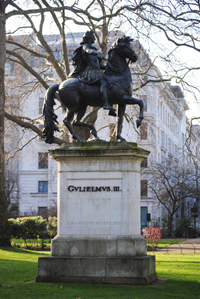
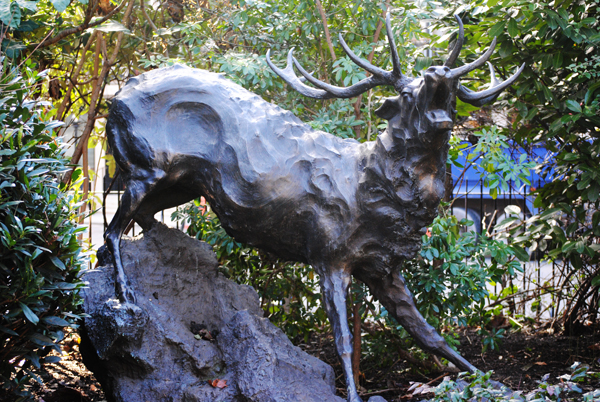
The gardens feature an equestrian statue of King William III at their centre (the work of John Bacon Sr and Jr, it was installed in 1808 and is pictured above). Other monuments include The Stag (located in the south-west corner, it is the work of Marcus Cornish and was installed in 2001) and, just outside the garden railings in the north-east corner, a memorial to WPC Yvonne Fletcher who was killed when a gun was fired from the Libyan Embassy (known as the Libyan People’s Bureau, it was located at number 5) during a demonstration on 17th April, 1984. The pavilion on the south side was designed by John Nash.

The gardens are private – managed by the St James’s Square Trust – but open to the public on weekdays from 10am to 4.30pm.
Where is it?…#60…

Where-is-it--#60
Can you identify where in London this picture was taken and what it’s of? If you think you can, leave a comment below. We’ll reveal the answer early next week. Good luck!

Well done to Jameson, this is indeed located in St James’s Square. Called – rather aptly – Stag, the sculpture dates from 2001 and is the work of Marcus Cornish. The larger-than-life bronze sculpture is located in the south-west corner of the West End square. For more on the work of Mr Cornish, see www.marcuscornish.com. Other statues in the square include an equestrian statue of King William III, the work of John Bacon Senior and Junior, which was installed in 1808.

10 of London’s greatest Victorian projects – 7. Foreign and Commonwealth Office, Whitehall…

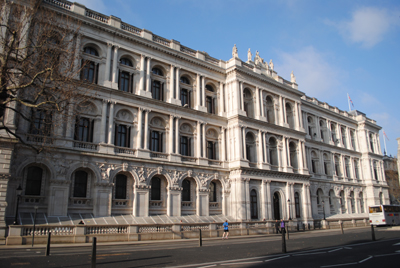
We’ve previously mentioned the home of the British Government – the Houses of Parliament – in this series but this week we’re looking at another government building – a gem of 19th century architecture.

FCOIn existence since 1782, the Foreign Office had originally been housed in two houses in St James and then, as the department grew, to properties in Whitehall – first in The Cockpit (this building has an interesting history we’ll look at in a later post) and then in Downing Street. Initially lodged in what had been Lord Sheffield’s house in Downing Street, the department soon spilled over into neighbouring properties.

The deteriorating quality of these abodes, however, was such that there were fears for their collapse and plans to build a new Foreign Office were mooted. But it wasn’t until the 1850s that it was decided the government announced plans for a competition to design new Foreign and War Offices on Downing Street. There was something of a heated debate over the style of the building between those favouring classical and those favouring gothic architecture but in 1858 George Gilbert Scott (knighted in 1872) was finally appointed as architect.

While Scott apparently originally favoured a building in the gothic style, this was opposed by then Prime Minister Lord Palmerston whose preferences for a classical building eventually won the day.

Work on the new building began in the early 1860s and it eventually opened in July, 1868. While the War Office was never constructed, other departments were located in adjoining premises within the same block. These included the India Office – while Scott oversaw the exterior design, the interior was designed by Matthew Digby Wyatt, surveyor of the former East India Company and subsequently Architect to the Council of India. It opened in November 1867 but was taken over by the Foreign Office in 1947 following India’s independence – and the Colonial and Home offices – designed by Scott, these were completed by 1875.

Plans to build a new Foreign Office were mooted in the mid-20th century and there was talk of demolishing the existing building but after a public debate, Scott’s building was protected after being given Grade I listed building status.

In 1968, the Foreign and Commonwealth Office merged (the latter had only been created two years before) and the Home Office moved out of its premises, meaning that the Foreign and Commonwealth Office now occupied all four original departmental premises. A modernisation program subsequently took place and there was also a significant restoration program which was completed by January 1997.

Stand out rooms in the complex include the grand Locarno Suite – three interlinked rooms designed by Scott to host dinners, receptions and conferences which gained its current moniker in 1925 when  the Locarno Treaties were signed here; as well as the India Office Council Chamber – designed by Wyatt, it features a great marble chimney taken from the former Director’s Court Room in East India House located in Leadenhall Street in the City; and, Wyatt’s spectacular Durbar Court which features a glazed cast-iron roof added in 1868 (the name dates from 1902 when some of coronation celebrations of King Edward VII were held here). The many grand staircases in the building – including the beautiful Muses Stair with its octagonal lantern – are also worth noting.

While the buildings, which are officially entered off King Charles Street, are not usually open to the public, they have been opened for the past few years during London’s Open House weekend. There is an audio tour available which details much of the fine artwork in the building.

LondonLife – ‘White Shirt Week’ in St James’s…

Freddie-Fox-launches-White-Shirt-Week-in-St-James's-London


Freddie Fox (who plays Lord Alfred Douglas opposite Rupert Everett as Oscar Wilde in David Hare’s The Judas Kiss now playing at the Duke of York Theatre) marks the start of ‘White Shirt Week’ which kicked off in St James’s on Monday. The West End area is home to Jermyn Street which apparently boasts “the highest number of world renowned shirt makers on one luxury shopping street” with each shirt maker having their own signature design. While the origins of the white shirt date back as far as ancient Egypt, it was only in more recent centuries that in the UK the white shirt developed from being simply an undergarment to a fashion item in its own right – in fact, by the 19th century, the white shirt was worn by gentlemen as a statement that they weren’t engaged in manual labour and could employ servants to launder it. For more on St James’s, see www.stjameslondon.co.uk.

LondonLife – Forget the halls, they’re decking the city…part two…

There’s still a weekend to go before Christmas and if, having finished all Christmas shopping, you’re still in the mood for seeing some light displays, here’s some more places to look for some amazing (and in some cases historic), Christmas decorations (for the first part of this overview, head here)…

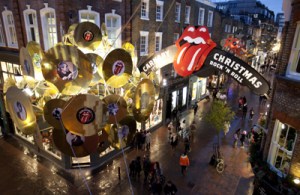
Carnaby-StreetLast week we mentioned some of the key sites to look for light displays in the West End this Christmas. Some of the other places to look include: the iconic shopping strip of Carnaby Street (decorations there this year are inspired by the 50th anniversary of the Rolling Stones – pictured) as well as South Molton Street, off Oxford Street (which again features some beautiful illuminated archways), and streets throughout St James (the St James Christmas lights were this year switched on by opera star Katherine Jenkins who earlier led a carol service at St James’s Church) and Mayfair.

Around Bow Lane and Watling Street in the City of London. Daubed with more than 10,000 lights, these narrow streets provide a wonderful sense of London past.

Marylebone. The lights here are well worth venturing out for. Turned on this year by Strictly Come Dancing‘s Claudia Winkleman.

Historic West End arcades. Still a place for fashionable shopping and tasteful Christmas decor, these include the Burlington Arcade, Royal Arcade, Princes Arcade and the Piccadilly Arcade.

And, of course, throughout London many shops have Christmas window displays. They include that of Fortnum & Mason in Piccadilly which this year have a Dick Whittington theme (see our earlier post here); Harvey Nichols in Knightsbridge which have gone with an oriental theme; Harrods in Brompton Road which have a Disney Princess theme; and Liberty in Great Marlborough Street which have gone with a theme inspired by the age of steam trains.

Of course, our list is by no means been comprehensive and is only confined to London’s heart – please share any other sensational Christmas decorations you’ve come across elsewhere in the city…

London Pub Signs – The Devereux

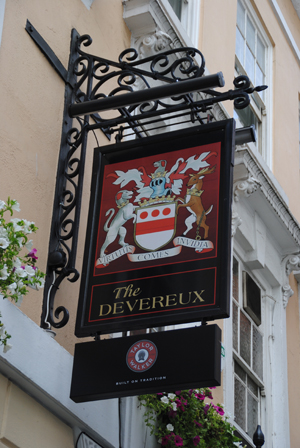
Located at 20 Devereux Court, just off the Strand in the area of London known as Temple, The Devereux takes its name from Elizabethan Robert Devereux, the 2nd Earl of Essex, whose mansion, Essex House, once occupied the site on which it stands.

Devereux, a favorite of Queen Elizabeth I, inherited the mansion from his step-father, Robert Dudley, the Earl of Leicester, in 1588 (the house was originally called Leicester House). A spectacular fall from favor which culminated in an abortive coup, however, led to Devereux’s beheading in 1601 (interestingly, he was the last person to be executed inside the Tower of London – the tower where he is held was named after him).

Used by other members of Devereux’s family following his death, a plaque outside the pub explains that the property was sold to property developer, Nicholas Barbon (also noted as the founder of fire insurance), in 1674, and that he had it demolished soon after.

The present building is said to date from 1676 and was originally two houses. Soon after its construction, it became the premises of the famous Grecian Coffee House which had moved from Wapping Old Stairs.

Noted as a meeting place for prominent Whigs, it was also frequented by members of the Royal Society such as Sir Isaac Newton, Sir Hans Sloane and Dr Edmund Halley as well as writer, poet and politician Joseph Addison and Richard Steele, editor of The Tatler (who gave the coffee house as the magazine’s postal address).

The early 1840s, the premises was into lawyers’ chambers and then later into the public house which now occupies it.

There’s a bust of Essex on the facade beneath which is written the inscription, “Devereux Court, 1676”. The pub is these days part of the Taylor-Walker group. For more, see www.taylor-walker.co.uk/pub-food/devereux-temple/pid-C7177.

For a great book on London’s pubs, take a look at London’s Best Pubs: A Guide to London’s Most Interesting & Unusual Pubs.

Exploring London’s 10 most popular posts for 2011 – Numbers 4 and 3…

We’re getting down to the pointy end of the countdown now. Here’s numbers four and three in Exploring London’s list of our most popular posts for 2011…

4. Curious London Memorials – 4. The Suffragette MemorialOne of our series on curious London memorials, this looked at a memorial in St James, erected in the 1970s to mark the contribution of those who fought for women’s right to vote;

3. The Royal Wedding – London’s royal reception venue: Another of our Royal Wedding themed posts, this looked at the history of Buckingham Palace, location of the reception which took place after the wedding of Prince William and Kate Middleton, now the Duchess of Cambridge.

King James I’s London – 2. St James’s Park

Although royal connections with St James’s Park, the oldest royal park in London, go back to the time of King Henry VIII – it was he who first purchased the marshy watermeadow in 1532 with the idea of creating another of his many deer parks, it was on the accession of King James I that orders were given for the swamp to be drained and landscaped.

The landscape features included a large pool known as Rosamond’s Pond at the west end and, at the east end, a collection of waterways and islands used to attract birds that could then stock the royal larder. There was also a flower garden next to St James’s Palace (this had been built by King Henry VIII).

Among the other uses King James I had for the park were as a site to keep the royal menagerie which included exotic animals like crocodiles and camels. There were also bird aviaries placed along what is now appropriately named Birdcage Walk.

The layout of the park became more formal during the later reign of King Charles II who had been inspired by what he’d seen while in exile in France.

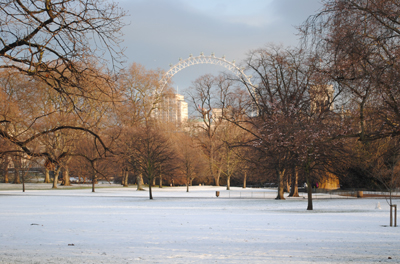
PICTURE: Looking across St James’s Park toward Whitehall in the snow.

WHERE: St James’s Park (nearest tube station is St James’s Park); WHEN: 5am to midnight daily; COST: Free entry; WEBSITE: www.royalparks.gov.uk/St-Jamess-Park.aspx

Where’s London’s oldest…department store?

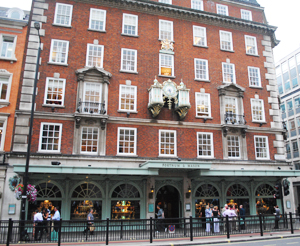
A 304-year-old institution, Fortnum & Mason on Piccadilly is generally believed (depending, of course, on definition) to be London’s oldest department store.

Founded in 1707, it owes its establishment to the meeting of shopkeeper Hugh Mason and William Fortnum, a footman in the house of Queen Anne, who was his lodger. The story goes that their joint venture began when Fortnum began retrieving the half-used candles discarded by the royal family (they insisted on fresh candles each night) and they started selling them on to ladies at the Royal Court.

Initially founded as a grocery store, Fortnum & Mason, which moved to its current site on Piccadilly in 1756 (see picture to right), become known for its high quality and rare goods – in particular tea.

It has held numerous Royal Warrants since the mid 1800s with the first granted in 1863 when the firm was appointed as grocers to the then Prince of Wales.

A supplier of British officers during the Napoleonic Wars, it was also active during the Crimean War when Queen Victoria had shipments of “concentrated beef tea” sent to Florence Nightingale for use in her hospitals there.

Among its other claims to fame are that the first Scotch egg was created there in 1738 and that in 1886, it became the first store in Britain to stock tins of Heinz baked beans.

The massive clock which hangs on the facade of the building was commissioned in 1964 by Canadian businessman Garfield Weston who bought the business in 1951. Every hour models of Mr Fortnum and Mr Mason come forth and bow to each other.

The store, now famous for its luxury food hampers, underwent a £24 million restoration in the lead-up to its 300th anniversary in 2007. As well as the flagship store, there are now branches – “stores within stores” – in Japan. The firm also reportedly plans to open Fortnum & Mason stand-alone shops in locations like China, the Middle East and India (its last overseas stand alone store was opened on Madison Avenue in New York in the 1930s but the business was short-lived thanks to the Depression).

As well as its array of goods for sale, the Piccadilly store now houses a number of eateries including St James’s Restaurant, The Parlour, The Fountain, The Gallery and the 1707 Wine Bar.

See www.fortnumandmason.com.

Curious London Memorials – 4. The Suffragette Memorial

Tucked away in a corner of Christchurch Gardens, opposite New Scotland Yard in Victoria Street, St James, this memorial was only erected in 1970.

Designed to resemble an uncurling scroll, the bronzed glass fibre scroll – designed by Edwin Russell – was put there by the Suffragette Fellowship (a group which was founded in 1926 to commemorate the suffrage movement of the early 20th century) and dedicated to the “courage and perseverance of all those men and women who in the long struggle for votes for women, selflessly braved derision, opposition and ostracism, many enduring physical violence and suffering”.

The monument, which is located near Caxton Hall – a now-listed building opened as the Westminster Town Hall in 1883 and “historically associated with women’s suffrage meetings”, was unveiled by former campaigner and hunger-striker Lillian Lenton.

While we’re on the subject of women’s suffrage, we should also mention the memorial to the most prominent member of the early 20th century women’s suffrage movement, Emmeline Pankhurst (1857-1928). Located not far away in Victoria Tower Gardens, right under the shadow of Victoria Tower at the southern end of the Houses of Parliament, stands a 1930 statue of the suffrage leader, who was imprisoned for her stand.

The statue is accompanied by two bronze medallions – one commemorating Mrs Pankhurst’s daughter and suffragette, Dame Christabel Pankhurst (1880-1958), and the other showing the badge of the Women’s Social Political Union (WSPU).

What’s in a name?…Pall Mall

This curiously named street in the heart of London’s St James district traces the origins of its moniker back to the 17th century when the game of “pall mall” (“pell mell” and “paille maille” being among a host of alternative spellings) was played there.

The game, mentioned by Samuel Pepys in his famous diary, involves the use of a mallet and ball similar to that used in modern croquet but, according to some commentators, pall mall was more likely a predecessor of golf than croquet, with players attempting to belt the ball as far as possible along a pitch before putting the ball through a hoop suspended high off the ground.

Pall Mall, which runs parallel to The Mall from St James’ Street in the west to Haymarket in the east with an eastern extension, Pall Mall East, completing the journey from Haymarket into the northern end of Trafalgar Square, became famous in the 19th and early 20th centuries for housing numerous ‘gentlemen’s clubs’. Among those still in business are the Travellers Club, the Athaenaeum Club, the Reform Club, the Army and Navy Club, the Oxford and Cambridge Club, and the Royal Automobile Club.

St James’s Palace sits at the street’s western end and it is of note that nearly all of the southern side of the street is still part of the Crown Estate (the exception being a home Charles II is believed to have given to the actress Nell Gwynne, who apparently sensibly demanded the freehold on the property).

Other buildings along the street include Schomberg House, built for the Duke of Schomberg in the late 17th century (only the facade of which remains), and the Sir Christopher Wren-designed Marlborough House, which is tucked in between Pall Mall and The Mall and sits opposite St James’s Palace. The National Gallery and the Royal Academy also both briefly had homes in Pall Mall.

Wren’s London – 9. Marlborough House

We’re nearing the end of our series on Wren’s London (next week we’ll take a final look at some of the Wren designs we’ve not yet mentioned), so this week we look at one of his lesser known (and less accessible) designs – Marlborough House.

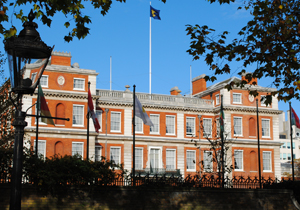
Tucked away behind high brick walls next to St James’ Palace just off Pall Mall, Marlborough House was built for Sarah Churchill, the Duchess of Marlborough – a confidant of Queen Anne – and completed in 1711.

The duchess, who secured a lease of the site from Queen Anne, selected Sir Christopher as the architect in preference to Sir John Vanbrugh, but she later fell out with Wren and, after dismissing him, oversaw the completion of the building herself. It is believed that the design of the house was actually the work of Wren’s son, also named Christopher, although the plans were undoubtedly drawn up under Wren senior’s watchful eye.

The house, built of red Dutch bricks brought to England as ballast in troop transports, was noted for its plain design. But the walls of the central salon and staircases were decorated with scenes of battles the Duke had fought in.

The property remained in the hands of the Dukes of Marlborough until it was acquired by the Crown in 1817. The building – which was substantially extended in the mid 1800s to the designs of Sir James Pennethorne – was subsequently used by members of the royal family including Princess Charlotte (only daughter of the future King George IV) and her husband Prince Leopold (later the King of the Belgians), Queen Adelaide, widow of William IV, Edward, Prince of Wales (later Edward VII), George, Prince of Wales (later George V), King Edward VII’s widow, Queen Alexandra, and, lastly, Queen Mary, widow of  George V.

Following the death of the Queen Dowager in 1953, Queen Elizabeth II donated it for use by the Commonwealth Secretariat who still occupy the building today.

WHERE: Pall Mall (nearest Tube stations are Green Park and Piccadilly); WHEN: Two hour tours are usually held every Tuesday morning (check first); WEBSITE: www.thecommonwealth.org/Internal/191086/34467/marlborough_house/

LondonLife – Horse Guards Parade…

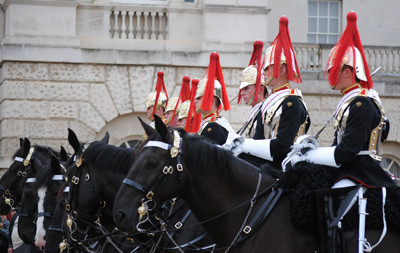
The Queen’s Life Guard at Horse Guards Parade. The parade ground, which lies between Whitehall and St James’ Park, was formerly the site of the tiltyard of the Palace of Whitehall and was the location for tournaments during the rule of Henry VIII. It now serves as the site for the annual Trooping the Colour ceremony. The men pictured (wearing blue tunics and red plumed helmets) are part of a squadron of The Blues and Royals (Royal Horse Guards and 1st Dragoons) who, along with a squadron of The Life Guards (wearing red tunics and white plumed helmets), make up the Household Cavalry Mounted Regiment, responsible for providing The Queen’s Life Guard. The “Horse Guards” have guarded this site – still regarded as the official entrance to St James’ Palace and Buckingham Palace – since the Restoration of Charles II in 1660 and can be seen there in the Changing of the Guard ceremony on weekdays and Sundays. For more information, visit www.army.mod.uk/events/ceremonial/2355.aspx