Treasures of London – Big Ben…

Often used to describe the clock on the Houses of Parliament (or the tower in which it is located), the name Big Ben was actually first given to the bell that resides within.

Officially known as the Great Bell, it is believed the popular nickname of Big Ben came from Sir Benjamin Hall,  First Commissioner for Works (there is an alternative theory that it was named after Ben Caunt, a popular heavyweight boxer in the 1850s but the parliamentary website describes this as “unlikely”).

The initial bell intended for the clocktower of the Houses of Parliament was cast by Warners of Norton, near Stockton-on-Tees, in August, 1856. Transported to London, it was tested in Palace Yard (where a clock tower had stood in medieval times) but a crack appeared during testing and so the bell had to be recast.

With Warners apparently asking too much for the recasting, George Mears at the Whitechapel Bell Foundry was appointed instead. The new bell was cast on 10th April, 1858.

With a diameter of 2.7 metres, the bell was too big to fit up the clocktower’s shaft vertically so it was turned on its side and the 13.7 tonne bell was winched up to the belfry in October that year. Four quarter bells, which chime on the quarter hour and varying in weight from 1.1 to 4 tonnes, were already in place (interestingly, all of the bells are fixed in position and struck on the outside rather than being allowed to swing and have a hammer strike the inside).

Big Ben debuted on 11th July, 1859 (the clock had been started on 31st May), but in September that year the second bell also cracked. It took four years to find a solution (during that time, the bell was struck on the fourth quarter bell) and it was the Astronomer Royal, Sir George Airy, who found it.

The solution involved turning the bell a quarter turn so the hammer didn’t restrike the crack site and replacing the hammer with a lighter one (the current hammer still weighs 200 kilograms!). A small square was also cut into the bell’s crack to prevent it spreading.

Apart from occasional stoppages, the bell has struck ever since.

For more on Big Ben, visit www.parliament.uk/bigben. Tours are only available to UK residents and can be arranged via local MPs (see here for more) or there are virtual tours for those who either don’t live in the UK or can’t get there (see here for more).

IMAGE: Big Ben with a quarter bell in the fourground. PICTURE: Courtesy of UK Parliament.

Favourite Places – London Historians’ Mike Paterson on war memorials in London…

In a special Favorite Places to mark Remembrance Day, Mike Paterson, director of London Historians, talks about his favorite war memorials…

At this time of year, the focus is inevitably on Lutyens’ Cenotaph in Whitehall. Version 1, in wood and plaster,  was hurredly constructed in just two weeks in time for the 1919 victory parade. The version we know today was unveiled on 11th November the following year and is a plain, austere and fitting tribute to all our lost service personnel, the centre of the nation’s attention every Remembrance Sunday.

It is estimated there are over 70,000 war memorials in Britain. As a nation we have, let’s face it, a bellicose history, and London in particular has been intimately involved in both World Wars. No surprise then, that as you walk the streets, you happen upon something referencing conflict around every corner. In addition to memorials themselves, we have dozens of now largely forgotten field marshals, generals and other martial leaders.

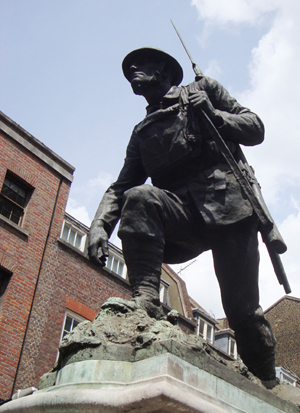
But the best, I believe, are the ones celebrating the common soldier. I have some favourites. The City of London Regiment infantryman atop a tall plinth in Holborn by Albert Toft (1922), dramatically standing tall, his rifle by his side, bayonet fixed. In Borough High Street there is a fine statue by P Lindsay Clark (1922), remembering the men from St Saviour’s (pictured, right). It is of a soldier, rifle slung, purposefully leaning forward as he trudges through the mud. A very recent statue unveiled by the Queen in 2000 is of a five-man tank crew, in Whitehall Place very near Embankment Station. By Vivien Mallock, it gives a very strong feeling of cameraderie and I always find it uplifting when walking by.

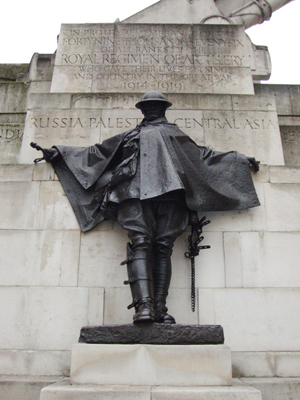
But of all the memorials to the rank and file soldier, by far the most outstanding is, for me, the Royal Artillery monument on Hyde Park Corner, unveiled in 1925. It commemorates the 49,000 artillerymen who lost their lives in the Great War.

The piece comprises a massive Portland stone plinth mounted by a 9.2 inch howitzer gun, augmented on all sizes by statues in bronze of gunners in various poses. One of these men – controversial at the time – is dead, covered by his great coat; you can see his hand and part of the side of his face.

The memorial (pictured, right) was designed by Charles Sargeant Jagger (1885 – 1934). Lionel Pearson constructed the stone parts while Jagger himself sculpted the soldiers.  Informally posed, they are all exquisite examples of the sculpor’s art.

The most striking is that of the artillery driver, leaning back onto the plinth and resting his outstretched arms on it. His cape – stretched from wrist to wrist – hangs down limply. In fact, the man rather resembles a crucified figure without the cross. I was delighted some months ago to discover a maquette (small working model) of this figure at the Honourable Artillery Company HQ in the City.

Jagger – a First World War veteran himself – was an outstanding memorial sculptor. If you’re waiting for a train at Paddington and have a little time on your hands, do check out his memorial to the fallen soldiers of the Great Western Railway. It’s a deeply poignant depiction of a squaddie – his coat draped over his shoulders and wearing a long, home-made scarf – reading a letter from home. You can find it on Platform 1, and I defy you not to be deeply moved.

PICTURES: Mike Paterson

LondonLife – Clive of India in silhouette…


Located on the steps at the end of King Charles Street in Whitehall, this somewhat controversial statue of Robert Clive, known to many as Clive of India, stands outside what was the India Office (and is now the Foreign and Commonwealth Office). The statue was erected in 1912, apparently it was suggested by Lord Curzon, a former viceroy to India.

LondonLife – Beating Retreat…

This week Horse Guards in London hosts the annual ceremony of Beating Retreat with massed bands playing and marching in formation. But where does the tradition come from?

The origins of the ceremony date back several hundred years to at least the 16th century when the beating of drums signalled the end of a day’s fighting, the closure of camp gates and the lowering of flags. Among the English kings credited with having ordered troops to “beat retreat” are old enemies King James II and King William III.

The ceremony was standard practice by the early 1700s with flutes or fifes added to the drum beating before, following the Napoleonic Wars, these were both replaced with bugles, to help ensure the sound reached greater distances.

The ceremony has been held annually at Horse Guards Parade since 1966 and this year involves the Massed Bands and Corps of Drums of the army’s Household Division along with The King’s Troop Royal Horse Artillery as well as The United States Army Europe Band and Chorus.

The event is a prelude to the Trooping the Colour on Saturday when more than 1,300 troops will parade in honor of the Queen’s Official Birthday.

Beating Retreat will be held at Horse Guards Parade on 8th and 9th of June (Wednesday and Thursday night), from 9pm. For more information and tickets, see www.guardsbeatingretreat.com

Where’s London’s oldest…outdoor statue?

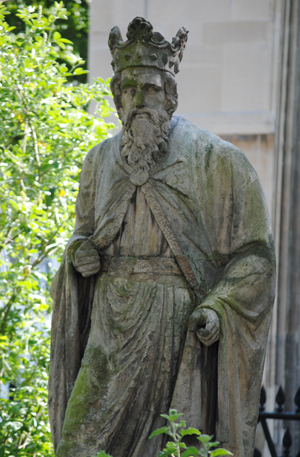
It’s generally believed that London’s oldest outdoor statue is that of King Alfred the Great which stands in Trinity Church Square in Southwark but there are a few others worth mentioning for their age.

But first, to the statue of Alfred the Great. Located now in Trinity Church Square, it is thought to have been made in the late 14th century (although it’s also suggested it could be much younger) in honor of the man who ruled Wessex in the 9th century and is often credited as being the first “king of the English”.

The statue (right) was apparently located at the Palace of Westminster before it was brought to its present location in 1823 at about the time the square was being laid out.

Others among London’s oldest statues is that of King Charles I sitting astride his horse and looking from Whitehall from its position on the southern side of Trafalgar Square.

Credited as being London’s “oldest equestrian bronze”, this statue is the work of French sculptor Hubert Le Sueur and was cast in 1633 (during King Charles I’s rule) at the behest of Richard Weston, one of the king’s favorites, who that year became the 1st Earl of Portland.

It was removed during the Civil War but later reacquired by the Portland family and, following the Restoration, was reinstalled on its current site – once that of the Charing Cross (see our previous entry for more details) – in 1675 by King Charles II.

Another of London’s oldest statues is that of Queen Elizabeth I which stands on the facade of the church St Dunstan-in-the-West in Fleet Street. This statue, which has been attributed to William Kerwin although other names have also been suggested, dates from 1586 (created during her reign) and decorated the west side of Ludgate until its demolition in 1760, after which it was apparently put into storage until being brought to the church in the 19th century.

Standing nearby in the vestry porch as statues of the legendary pre-Roman British king, Lud, and his sons, Androgeus and Tenvantius, which were also removed from Ludgate and probably date from the same period (about 1586).

King James I’s London – The Banqueting House

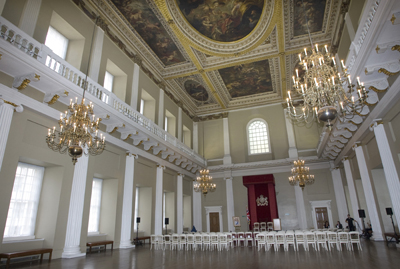
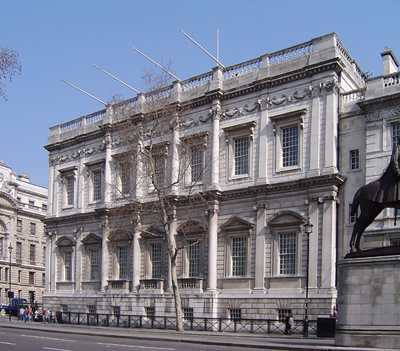
This year marks 400 years since the creation of the King James Bible (it was completed in 1611). So, in a new special Wednesday series, we’re taking a look at London during the reign of King James I (he’s the one who commissioned the Bible). First up in our list of some of the key sites from his reign in 1603 to 1625, is the Banqueting House in Whitehall.

All that’s left of the Palace of Whitehall after a fire destroyed the rest in 1698, the Banqueting House was completed towards the end of King James I’s reign in 1622. In a sharp break from the fiddly Elizabethan architecture found in the remainder of the palace, the Banqueting House was the first building in central London which paid homage to the plainer Palladian style, brought back from Italy by ‘starchitect’ Inigo Jones.

The three floor Banqueting House replaced an earlier banqueting house which, funnily enough, had been destroyed by fire only a few years earlier. The new building was built to host royal ceremonies such as the reception of ambassadors and, most importantly, performances of court masques, which at the time were growing in sophistication and were being designed to communicate to audiences messages about the Stuart concept of kingship.

The building is centred on a “double cube” room  – a hall built so that its length is exactly double its width and height. The great chamber also features a balcony believed to have been created not for ministrels but as a space for an audience to watch the proceedings going on below.

It should be noted that the massive ceiling paintings were added after King James I’s death – it was his ill-fated son, King Charles I, who commissioned Flemish artist Peter Paul Rubens to paint them around 1630 (they were in place by March, 1636). It was, incidentally, from one of the windows in the Banqueting House that King Charles I stepped out onto a scaffold and had his head cut off – although that was in 1649, long after the era we’re focusing on here.

Inigo Jones and Ben Jonson’s Masque of Augurs was the first masque performed here in 1622, even before the building was complete. The last was Sir William Davenant’s The Temple of Love in 1635 after which the masques were stopped, apparently because the torches typically used to illuminate them would cause smoke damage to the paintings now on the ceiling.

WHERE: The Banqueting House, Whitehall (nearest tube station is Westminster); WHEN: 10am to 5pm, Monday to Saturday (check website for closing dates as the hall is used for functions) ;  COST: £5 an adult/£4 concessions/children under 16 free; WEBSITE: www.hrp.org.uk/BanquetingHouse/

PICTURE: Wikipedia

What’s in a name?…Whitehall

Running southward from Trafalgar Square towards the Houses of Parliament (the southern part of Whitehall is actually known as Parliament Street), Whitehall is lined with government buildings – everything from the Foreign Office to the Cabinet Office, from the Scotland and Wales Offices to the Ministry of Defence – and has become so identified with government that its very name is now used to mean just that. But where does the name come from?

Whitehall takes its name from the Palace of Whitehall which once stood on the site of the current street. The palace’s origins go back to the 14th century when a grand house known as York Place was built as the London residence of the Archbishops of York.

The building was gradually expanded over the years – work which continued when Thomas Wolsey was made Archbishop of York in 1513. When Cardinal Wolsey fell from favour in the late 1520s, however, King Henry VIII seized the house along with his other assests.

With the royal Palace of Westminster badly damaged in a fire in 1512, King Henry VIII had been staying at Lambeth Palace. He saw the newly acquired palace, renamed Whitehall, as a suitable new home and continued expansion works, constructing a series of recreationally-oriented buildings on the west side of what is now Whitehall including tennis courts, a cockfighting pit and a tiltyard for tournaments. By the time of Henry VIII’s death in 1547, the palace covered 23 acres and was the largest in Europe.

The palace continued to be used by subsequent monarchs until much of it was destroyed by fire in 1698. These days the only surviving part of the palace is the Banqueting House. Built by Inigo Jones for King James I, it was from a window on the first floor of this 1622 building that King Charles I stepped onto a scaffold where his head was cut off.

Apart from the Banqueting House, other significant sites in Whitehall including the Cenotaph, the focus of Remembrance Sunday commemorations. Downing Street, meanwhile, runs off the south-eastern end of Whitehall and behind gates which have blocked it off since 1989, stands the Prime Minister’s official residence.