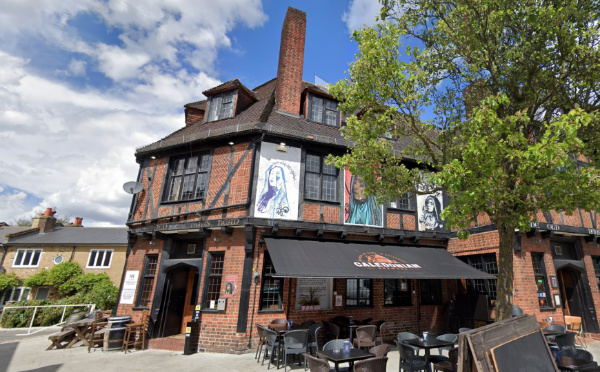
Looking north up Basinghall Street from Gresham Street. The buildings on the left are part of the Guildhall complex. PICTURE: Google Maps
This City of London street, which sits on the eastern side of the Guildhall complex, is named for the wealthy Basing (or Bassing) family who had a hall here in the 13th century.
The street, which links Gresham Street in the south to Basinghall Avenue in the north, has been the site of numerous prominent buildings including the medieval hall of the Weaver’s Company (demolished in 1856, having replaced an earlier hall which burnt down in the Great Fire of London in 1666, the hall is now located in Gutter Lane), the Cooper’s Company (demolished in 1867, the hall is now located in Devonshire Square) and the Girdler’s Company (destroyed in the Blitz in 1940; the hall is now located in Basinghall Avenue).
It was also the location of the Sir Christopher Wren-designed Church of St Michael Bassishaw until 1899 after it was seriously damaged when the crypt was being cleared of human remains in line with the orders of City authorities. The parish with united with St Lawrence Jewry.
Famous denizens included the goldsmith, banker and civil engineer Sir Hugh Myddelton, most renowned for his design of the New River scheme to bring clean water to the City, who, according to The London Encyclopaedia, would sit in the doorway of his office and smoke his pipe while chatting with the likes of Sir Walter Raleigh.
The family also gave their name to the City of London’s Bassishaw Ward.
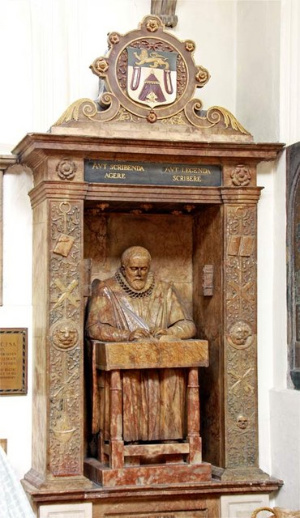
Sixteenth century historian John Stow wrote numerous chronicles of English history but is mostly remembered for his landmark survey of London, a monumental work which has lead to him being informally given the title “founding father of London history”.
The monument depicting John Stow. PICTURE: John Salmon / St Andrew Undershaft, St Mary Axe, EC2 – Wall monument of John Stow / CC BY-SA 2.0
Stow (sometimes written as Stowe) was born a Londoner in about 1525 in the parish of St Michael, Cornhill. He was the eldest of seven children of Thomas Stow, a tallow chandler, and his wife Elizabeth.
Nothing is known about Stow’s early education - whether he attended a grammar school or was self-taught – but he is known to have developed a deep knowledge of English history, culture and customs as well as of Latin.
He didn’t follow his father’s trade but instead became an apprentice tailor and in 1547 was named a freeman of the Merchant Taylors’ Company. He is said to have worked as a tailor in London for almost 30 years.
In 1560, he started on his best known work, A Survey of London, a detailed topographical survey of the City of London and its suburbs – it was eventually published in 1598 (a second, longer edition followed in 1603). But his first book, on the works of Geoffrey Chaucer, was published in 1561, and he went on to publish numerous editions of English chronicles.
Stow was in contact with many of the era’s leading antiquarians, including the likes of John Dee and William Camden, and he was an active member of the first Society of Antiquaries, established in about 1586.
He also attracted the patronage of some significant figures including the Archbishops of Canterbury Matthew Parker and John Whitgift and Robert Dudley, Earl of Leicester, and was well-known for his collection of manuscripts, the largest group of which is now within the Harley collection at the British Library.
Stow, whose work never made him a wealthy man and who, at times, was the subject of his acquaintances’ charity (although Barrett L Beer in an entry in the Oxford Dictionary of National Biography describes his pleas of poverty as “exaggerated”), married his wife Elizabeth sometime after 1549. They lived initially in Aldgate where his business was also based (and later moved to the Lime Street ward). The couple had three daughters, two of whom – Joan and Julyan – survived him.
Stow died on 5th April, 1605. He was buried in the church of St Andrew Undershaft and his wife commissioned a marble monument to commemorate him which depicts Stow seated at his desk. A commemorative service, organised by the Merchant Taylors Company, is still held in the church every three years during which the quill he writes with is regularly replaced in a sign of respect.
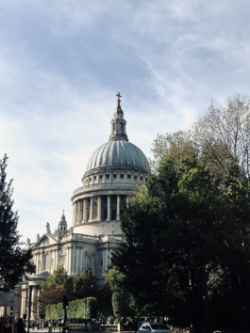
For the final entry in our Wednesday special series, we go to see Sir Christopher Wren’s greatest work – and also his resting place, St Paul’s Cathedral.
Following his death on 25th February, 1723, Wren was buried in the crypt of St Paul’s Cathedral on 5th March.
His burial location was in the south-east corner of the crypt and a simple memorial was placed there near that of his daughter Jane and his sister Susan Holder and her husband William.
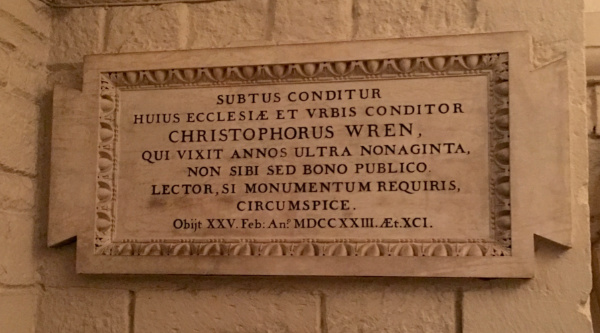
The plaque which marks the location was written by his eldest son Christopher. Inscribed in Latin, it reads: “Here in its foundations lies the architect of this church and city, Christopher Wren, who lived beyond ninety years, not for his own profit but for the public good. Reader, if you seek his monument – look around you. Died 25 Feb. 1723, age 91.”
It’s a fitting tribute to one responsible for some of London’s most famous landmarks.
Interestingly, a fragment of Wren’s coffin can be seen at the RIBA Library. It was taken from his tomb in 1851 when it was last opened to allow for his last surviving direct descendent to be placed within.
WHERE: St Paul’s Cathedral (nearest Tube stations are St Paul’s, Mansion House and Blackfriars); WHEN: 8.30am to 4.30pm Monday to Saturday; COST: £23 adults/£20.50 concessions/£10 children/£56 family (these are walk-up rates – online advanced and group rates are discounted); WEBSITE: www.stpauls.co.uk.
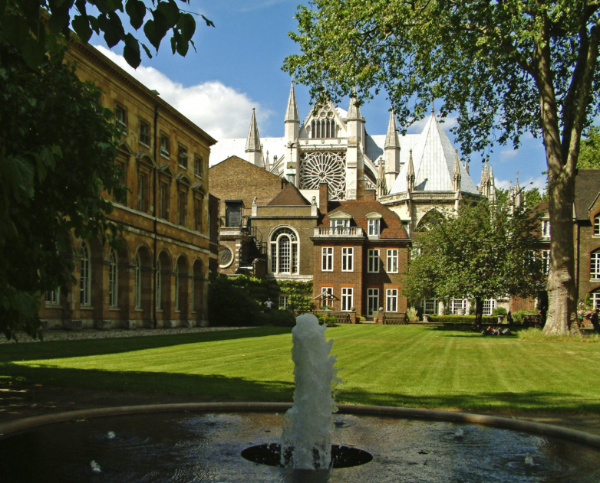
The College Garden. PICTURE: Anguskirk/Flickr (licensed under CC BY-NC-ND 2.0)
Not to be confused with London’s oldest botanic garden (The Chelsea Physic Garden), the College Garden at Westminster Abbey is believed to be the oldest garden in England under continuous cultivation.
In monastic times, the garden, as well as providing eye-pleasing flower displays, was used to grow vegetables and medicinal herbs for the abbey’s resident monks and it also included an orchard, as well as fishponds and beehives. The first herbarium dates from at least 1306 although the infirmary garden was originally established in the 11th century..
The garden was under the overall supervision of the abbey’s Infirmer – responsible for caring for the sick or infirm – and was tended to by a head gardener and two under-gardeners (all of whom were monks).
The oldest surviving feature of the garden today is a high stone wall which dates from 1376. Today the garden features London plane trees planted in the 1850s and a broad expanse of lawn.
There is also a small rose garden which marks Queen Elizabeth II’s accession to the throne and a herb garden planted to commemorate the lives of the monks and the founding of the Westminster School.
A 1993 bronze sculpture depicting the Crucifixion of Jesus Christ, by Enzo Plazzotta, sits out the south end of the garden. A single jet fountain was added in 2002.
The west side of the garden is bordered by the 18th century dormitory for the Westminster School. Two late Victorian houses, originally used for clergy, stand at the north end.
The garden is accessed from the south-east corner of the abbey cloister.
While this series is more focused on Sir Christopher Wren’s life rather than the many works he left behind, we’ve included the remarkable church of St Stephen Walbrook for a couple of reasons.
The first is that it is generally seen as being one of the more important church designs he created, particularly with regard to his later design of St Paul’s Cathedral, of which the St Stephen Walbrook dome is said to be a prototype.
The second is it’s claimed St Stephen Walbrook had a rather personal connection in that Wren lived at number 15 Walbrook during the period the church was being built, making it his parish church.
But the church was built between 1672 and 1679 and we know that from 1669 onwards – when Wren was appointed Surveyor-General of the King’s Works by King Charles II – Wren had a substantial home and office at Scotland Yard which was a perk of the office. Prior to that, he was largely based in Oxford and had rooms within Gresham College.
We’ve been unable to find any detailed reference to Wren living at 15 Walbrook either online or in the biographies we’ve read (we’ll keep searching).
But, his residency in Walbrook aside, it’s clear that St Stephen Walbrook – which has been described as the “pride of English architecture” – was a special church for Wren.
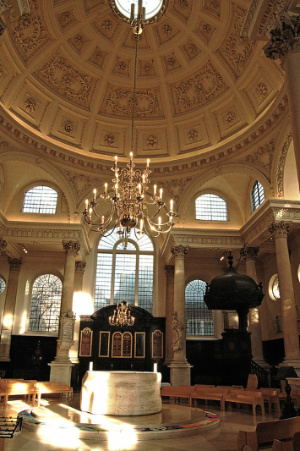
Designed to a rectangular form by Wren (and it’s certain this design was that of Wren himself), the church features a dome located toward the east end supported by eight Corinthian columns with the interior light by sizeable windows at the east end. A tower stands at the west end. The altar, a modern design by Henry Moore, sits under the centre of the dome.
As an interesting final note, it is recorded that Wren attended a dinner hosted by the church wardens – along with collaborator Robert Hooke – at the Swan Tavern in Old Fish Street on 4th March, 1673, as work for the church was underway.
WHERE: St Stephen Walbrook, 39 Walbrook (nearest tube stations are Bank and Cannon Street); WHEN: Opening times vary – check website details; COST: Free; WEBSITE: www.ststephenwalbrook.net.
You may have noticed small stone or metal plaques installed on buildings which are inscribed with some letters and a date.
These are typically parish boundary markers, marking the geographical reach of a particular parish. The letters refer to the parish name and the date when the boundary was set or marked (some markers actually have more than one date, the second being when parish boundaries were confirmed).
Parish boundary markers in Chancery Lane. PICTURE: R~P~M (licensed under CC BY-NC-ND 2.0)
Traditionally, parishioners were reminded of the boundaries each year at Rogationtide – the three days of the Monday, Tuesday and Wednesday before Ascension Day (39 days after Easter Sunday) – in a ceremony known as the ‘Beating the Bounds’.
This custom involved the priest and parishioners, led by the churchwardens and beadle, walking around the stones which served as boundary markers and pausing to beat each one with sticks and pray for protection and blessings (apparently there was also a practice of pushing boys from the charity schools into the boundary walls so they’d remember them or beating them with willow wands when there was no wall).
The boundary stones have, in more recent centuries, been replaced by the plaques in London but the ceremony is still carried out in some parishes.
Interestingly, in some parishes, the boundary is located in the midst of the Thames and boats are taken to ‘beat the mark’ in the middle of the river.
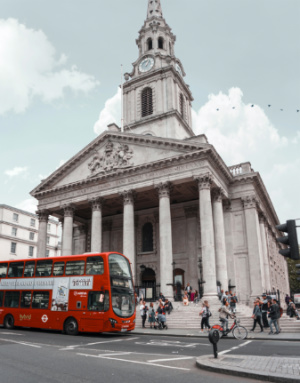
The current Church of St Martin-in-the-Fields. PICTURE: Javier Martinez/Unsplash
Not one of the many churches rebuilt by Wren after the Great Fire of 1666, St Martin-in-the-Fields, located just to the east of what is now Trafalgar Square, is special to the great architect for very personal reasons.
For it was in this church that his first wife Faith (nee Coghill) and his first son Gilbert were both buried, having died within a few years of each other, along with his second wife Jane (nee Fitzwilliam).
Wren married Faith Coghill, a childhood neighbour and daughter of Sir Thomas Coghill of Bletchingdon, at the age of 37 on 7th December, 1669, at the Temple Church (it’s been suggested it was his appointment that year as Surveyor of the King’s Works that may have provided him with the financial security he desired before marrying).
Their first child – Gilbert – was born in October, 1762. But he died at the age of just 18-months-old. A second child, Christopher (Wren the Younger), was born in February, 1675 (he would go on to live a full life and follow in his father’s footsteps as an architect).
Faith died of smallpox on 3rd September that same year. She was buried beneath the chancel of St Martin-in-the-Fields beside Gilbert.
On 24th February, 1677, Wren married again, this time to Jane Fitzwilliam, daughter of William FitzWilliam, 2nd Baron FitzWilliam, and Jane Perry, in a private ceremony believed to have been undertaken in the Chapel Royal at Whitehall. The couple had two children together – Jane in November that year and William in June, 1679.
Tragically, Jane also died after only a few years of marriage of tuberculosis on 4th October, 1680. She was buried alongside Wren’s first wife and child in St Martin-in-the-Fields.
Wren was not to marry again – and for his long 90 years of life, he was only in the end married for nine.
The medieval church of St Martins-in-the-Fields was altered several times during its lifetime – including being enlarged and beautified – but it’s this earlier church that Wren would have known. The current church was rebuilt to the designs of James Gibbs in the early 1720s and was completed in 1726 after Wren’s death in 1723.
Interestingly, the first wife of Wren’s son Christopher – Mary – was also buried in the church in 1712 and a monument to her can still be seen in the crypt.
• Three of the City of London’s oldest charters go on display at the City of London Heritage Gallery on Saturday as part of a series of events commemorating the coronation of King Charles III. On display will be the William Charter, which, drawn up in 1067 following the coronation of King William the Conqueror, was the earliest known royal document in Europe to guarantee the collective rights of all people in a town and not just a select few. Also to be seen is the Shrievalty Charter, which, issued by King John in 1199, confirms the rights of Londoners to elect their own sheriffs, and the Mayoralty Charter, which, also issued by King John – this time in 1215, confirmed that the Mayor of London could also chosen by Londoners with the proviso that they were publicly presented. Visitors can also see the beautifully illustrated Cartae Antiquae which records charters and statutes covering laws enacted from the reign of Edward III (1327 onwards) to the accession of Henry VII in 1485 and was used as an essential reference tool by City officials, as well as prints of the 19th century coronations of Queen Victoria, King William IV and King George IV. Admission is free but booking is recommended. Runs until 5th October. For more, see www.cityoflondon.gov.uk/events/heritage-gallery-exhibition.
• Other events marking the coronation kick off in the City of London in the coming week. Among the extensive list of activities is a pop-up well-being garden in Seething Lane where you can pose for pictures with a floral crown installation, a guided walking tour of the City entitled ‘1000 Years of Royalty – the Best, the Worst and the Very Horribilus’, and a “Cockney knees-up” with Pearly King and Pearly Prince at Leadenhall Market. For more details and the full list of events, head to www.cityoflondon.gov.uk/events/coronation.
• A new exhibition commemorating the expansive career of Sir Christopher Wren opens today in St Paul’s Cathedral – the extraordinary building designed by Wren to replace the medieval cathedral destroyed in the Great Fire of London in 1666 Part of a series of events marking the 300th anniversary of the death of Sir Christopher in 1723, Sir Christopher Wren: The Quest for Knowledge explores not only his early life and career as an architect but also his lesser-known contributions to the fields of mathematics, astronomy and physiology. The display, located in the north aisle of the crypt, features drawings, photographs and objects from the cathedral’s collections. Entry to the exhibition is included in general admission. For more, see www.stpauls.co.uk/whats-on/exhibition-christopher-wren-quest-for-knowledge.
• The Pre-Raphaelite model and artist, Marie Spartali Stillman, has been honoured with an English Heritage Blue Plaque at what was her family home in Battersea. It was while living at The Shrubbery – a 1770s Grade II-listed property now located on Lavender Gardens – that Stillman first modelled for Pre-Raphaelite artists. Tutored by Ford Madox Brown, she went on to become one of a small number of professional women artists in the late 19th century, creating more than 150 works over a period spanning 50 years. Stillman is the first female Pre-Raphaelite artist and one of only very few female artists to receive a Blue Plaque. For more, see www.english-heritage.org.uk/visit/blue-plaques/.
Send all items for inclusion to exploringlondon@gmail.com
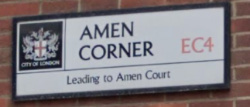
Located off Ave Maria Lane in the City of London is a tiny thoroughfare named Amen Corner.
This location of this short laneway – which leads to the U-shaped (and gated) Amen Court – makes the name no great surprise. It lies just to the north-west of St Paul’s Cathedral and is one of a number of religiously named streets in the area (others include Paternoster Lane, Paternoster Square, Paternoster Row and Canon Alley).
The corner apparently became so-named in relation to a prayer chanted by monks. It’s said that on the day of the Feast of Corpus Christi, the monks would process through the streets, chanting prayers as they did so.
The first prayer, the Lord’s Prayer, was started in Paternoster Row – itself named after the first couple of words in the prayer when recited in Latin (“Pater Noster” which translates as “Our Father”). The monks would then process westward and by the time they reached the corner of Paternoster Lane and Ave Maria Lane, they would be at the end of the prayer – “Amen”. Hence Amen Corner.
Amen Corner was, from 1614 until the Great Fire of London in 1666 when it was destroyed, the location of a three storey house which served as the headquarters of the the Royal College of Physicians.
Ave Maria Lane, meanwhile, is named after the next prayer the monks would recite after turning the corner – “Ave Maria” (Hail Mary”).
Amen Court, which isn’t accessible to the public, is home to a short terrace of 17th-century houses where the cathedral’s canons have traditionally lived.
At its western end is a wall which once marked the boundary of Newgate Prison and which itself has an interesting history. The spectral ‘Black Dog of Newgate’ was said to have been sighted crawling along its top just prior to an execution taking place in the prison.
• The Princess of Wales will host a Christmas carol service at Westminster Abbey today. The service, which will be attended by members of the Royal Family, will recognise the selfless efforts of individuals, families and communities across the UK as well as paying tribute to Queen Elizabeth II and the values she demonstrated at Christmas and throughout her life, including empathy, compassion and support for others. The service will be broadcast on ITV One in the UK on Christmas Eve. Meanwhile, a special Christmas episode of Westminster Abbey: Behind Closed Doors will be shown on Channel 5 next Wednesday, 21st December. For more, see My5: Westminster Abbey: Behind Closed Doors.
• An exhibition show-casing the work of photographer Peter Marlow, who has photographed all 42 Church of England cathedrals, can be seen at St Paul’s Cathedral. Commissioned in 2008 by Royal Mail to photograph six cathedrals – images of which were used on commemorative stamps marking the 300th anniversary of the completion of St Paul’s Cathedral, Marlow went on to continue taking pictures of cathedrals using just natural light. The display, which is touring all 42 cathedrals, can be found in the South Nave aisle until 26th January. Included in admission charge. For more, see www.stpauls.co.uk/whats-on/exhibition-peter-marlows-english-cathedral.
• On Now: Making Modernism. The first major UK exhibition devoted to women artists working in Germany in the early 20th century, this exhibition at the Royal Academy’s Gabrielle Jungels-Winkler Galleries includes 67 paintings and works on paper. The artists featured include Paula Modersohn-Becker, Käthe Kollwitz, Gabriele Münter and Marianne Werefkin, with additional works by Erma Bossi, Ottilie Reylaender and Jacoba van Heemskerck. Runs until 12th February. Admission charge applies. For more, see www.royalacademy.org.uk.
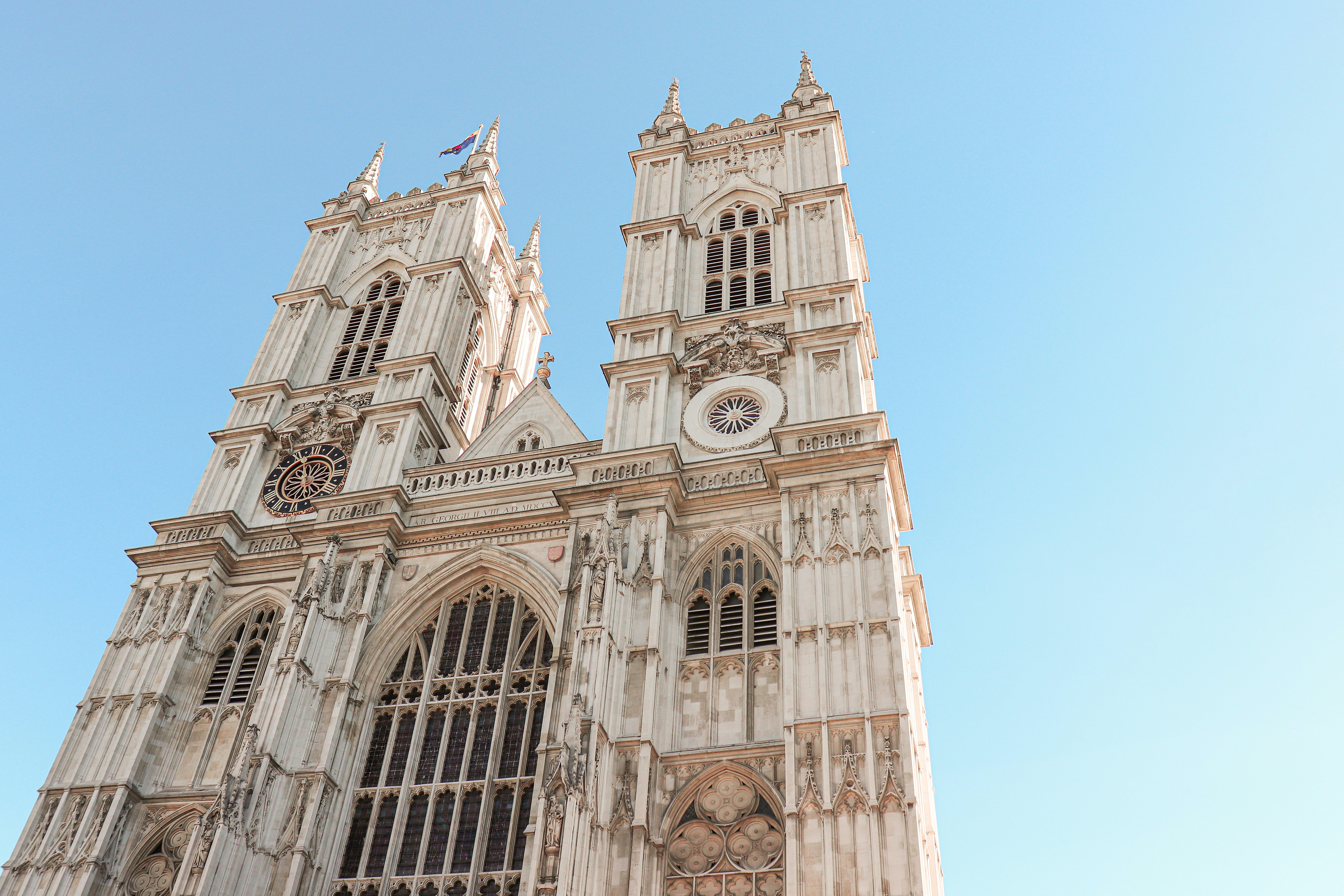
Located just to the east of St Edward the Confessor’s Chapel in Westminster Abbey is the lavishly ornate Lady Chapel built on the orders of King Henry VII.
Described as the “last masterpiece of English medieval architecture”, the chapel is the resting place of King Henry VII and his wife Queen Elizabeth of York.
Effigies of King Henry VII and Queen Elizabeth of York. PICTURE: Ann Longmore-Etheridge/Public domain
The couple were the first to be buried in a vault under the floor rather than a tomb but still features an elaborate monument above the floor.
The monument was designed in the Renaissance style by Italian sculptor Pietro Torrigiano and features gilt bronze effigies of the King and Queen lying side-by-side above a black marble base decorated with six medallions representing the Virgin Mary and Henry’s patron saints (who included St Edward the Confessor). At either end of the base are coats of arms supported by cherubs.
A fine grille, designed by Thomas Ducheman, surrounds the monument – once gilded, it featured 30 statues in niches but only six – depicting saints – now remain. The lengthy Latin inscription written on the grille lauds King Henry as “a wise and watchful monarch, a courteous lover of virtue” among other superlatives. There are further inscriptions on the monument.
They’re not the only kings and queen’s buried in the chapel. King James I is buried in the vault under the King Henry VII’s tomb and his wife Queen Anne of Denmark is buried nearby.
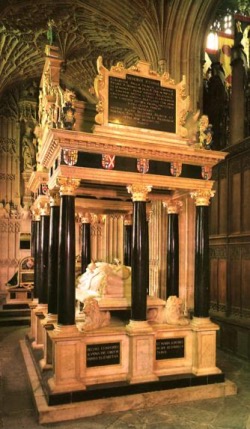
Tomb of Elizabeth I. PICTURE: Wikimedia Commons (licensed under CC BY-SA 4.0)
Queen Elizabeth I is buried in the chapel’s north aisle with a monument above depicting her effigy. Her coffin was placed on top of her half-sister Queen Mary I whose body had been placed there after her death in 1558. The monument was installed on the orders of King James I who, while commissioning a depiction of Queen Elizabeth, didn’t order an effigy of Mary to be made. Instead, she is commemorated with an inscription translated as “Partners both in throne and grave, here rest we two sisters, Elizabeth and Mary, in the hope of the Resurrection.”
The religious differences of the two Queens – Elizabeth being a Protestant and Mary a Catholic – are meanwhile commemorated in an inscription on the floor which reads: “Remember before God all those who divided at the Reformation by different convictions laid down their lives for Christ and conscience sake.”
Buried in a vault beneath the south aisle of the chapel – with just simple inscriptions on stones above (no monuments were erected due to the lack of space apparently – are the remains of the Stuart monarchs King Charles II, Queen Anne (and her husband Prince George), Queen Mary II and King William III.
The rather flamboyant tomb of Mary, Queen of Scots, is also in this aisle. King James I had her remains brought to the abbey from Peterborough Cathedral in 1612 and laid to rest in a marble tomb featuring an elaborate canopy and a white marble effigy at the feet of which stands a crowned Scottish lion. The eldest son of King James I, Henry Frederick, Prince of Wales, was also buried in the Queen’s vault (she was his grandmother), probably due to lack of space.
The young king Edward VI is buried beneath the floor in front of the altar and the last monarch to be buried in the abbey – King George II – lies in a vault under the central aisle along with his wife Queen Caroline and some of their children as well as other family members. On the King’s orders, the sides of the coffins of King George II and that of Queen Caroline were removed so their remains could mingle.
Several other royals – including Princess Mary of Orange, eldest daughter of Charles I and Henrietta Maria, and Prince Rupert of the Rhine – are also buried in the chapel.
HERE: Lady Chapel, Westminster Abbey (nearest Tube stations are Westminster and St James’s Park); WHEN: Times vary – see the website for details; COST: £27 adults/£24 concession/£12 children (discounts for buying online; family rates available); WEBSITE: www.westminster-abbey.org
These include the second wife of King Edward I, Queen Marguerite, who partly financed construction of the church which commenced in the 1290s and finished well after her death in the 1360s.
Marguerite, who was the first uncrowned queen since the Norman Conquest (apparently due to the expense), was only 26 when she was widowed in 1307 (having married the king in 1299 when he was at least 40 years her senior).
She died on 14th February, 1318, while at her castle at Marlborough but her remains were brought to London where she was buried in Greyfriars wearing a Francisan habit. Her tomb, sadly, was destroyed during the Reformation.
Also buried in Greyfriars was Queen Isabella, the widow (and adversary) of the ill-fated King Edward II. Isabella, who was also known as the ‘She-wolf of France’, is said to have been buried in the clothes she wore at her wedding to the King 50 years earlier. Despite rumours to the contrary, her lover, Roger Mortimer, was not buried with her (although Isabella’s daughter – Joan of the Tower, who was the wife of King David II of Scotland – was).
While their predecessor as Queen, Eleanor of Provence, wife of King Henry III, was buried at Amesbury Priory in Wiltshire where she had died (the grave is unmarked), her heart was brought to London and buried in Greyfriars.
Others buried in the church include King Henry III and Eleanor’s daughter, Beatrice of England, and King Edward III’s daughter Isabella, Countess of Bedford.
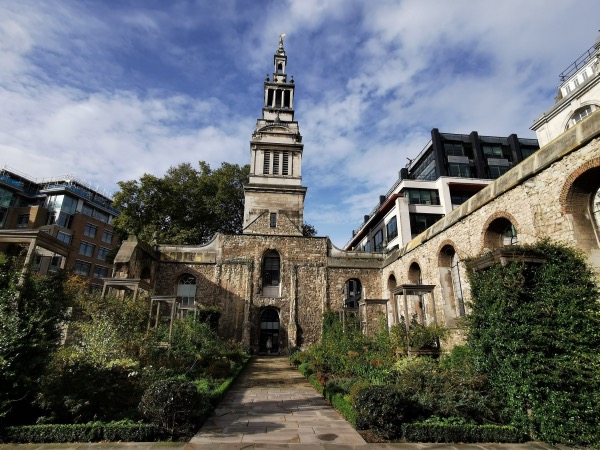
There’s not much left of Greyfriars these days – the medieval church, one of the largest then in London, burned in the Great Fire of London of 1666 and following a rebuild under Sir Christopher Wren’s supervision, it was again all but destroyed during the Blitz in World War II.
It was decided not to rebuild and what remained of the church – some of the outer walls and tower – were designated a Grade I-listed building in 1950. Plantings inside are laid out to resemble the pews of the church in plan.
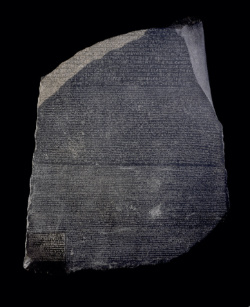
• Marking 200 years since French Egyptologist Jean-Francois Champollion (1790-1832) was able to decipher hieroglyphs using the Rosetta Stone, a new exhibition opening at the British Museum explores how the stone and other inscriptions and objects helped scholars unlock one of the world’s oldest civilisations.Hieroglyphs: unlocking ancient Egypt centres on the Rosetta Stone but also features more than 240 other objects, many of which are shown for the first time. Alongside the Rosetta Stone itself, highlights include: “the Enchanted Basin”, a large black granite sarcophagus from about 600 BCE which is covered with hieroglyphs and images of gods; the richly illustrated, more than 3000-year-old Book of the Dead papyrus of Queen Nedjmet which measures more than four metres long; and the mummy bandage of Aberuait, a souvenir from one of the earliest ‘mummy unwrapping events’ in the 1600s where attendees each received a piece of the linen, preferably inscribed with hieroglyphs. There’s also the personal notes of key figures in the race to decipher hieroglyphs including those of Champollion which come from the Bibliothèque nationale de France as well as those of England’s Thomas Young (1773 – 1829) from the British Library. The exhibition can be seen in the Sainsbury Exhibition Gallery until 19th February. Admission charge applies. For more, see britishmuseum.org/hieroglyphs.
• King Charles III will be crowned at Westminster Abbey on 6th May next year, Buckingham Palace has announced this week. The Queen Consort, Camilla, will be crowned alongside him in the first such coronation since 12th May, 1937, when King George VI and Queen Elizabeth were crowned in the abbey. The ceremony, which will be conducted by the Archbishop of Canterbury, will, according to the palace, “reflect the monarch’s role today and look towards the future, while being rooted in longstanding traditions and pageantry”. King Charles III is expected to sign a Proclamation formally declaring the coronation date at a meeting of the Privy Council later this year. The first documented coronation at Westminster Abbey was that of King William the Conqueror on 25th December, 1066, and there have been 37 since, the most recent being that of Queen Elizabeth II on 2nd June, 1953.
• A new dark comedy, The Admiral’s Revenge, has opened in The Admiral’s House in the Old Royal Naval College, Greenwich. The play, set in 1797, features sea shanties, puppetry and follows a crew of shipmates in the wake of the ill-fated Battle of Tenerife. Audiences have the chance to explore the Admiral’s House before the show and enjoy a complimentary rum cocktail. Runs until 12th November. For ticket prices, head to https://ornc.org/whats-on/1797-the-mariners-revenge/.
• A new exhibition exploring Charles Dickens’ interest in the paranormal has opened at the Charles Dickens Museum in Bloomsbury.To Be Read At Dusk: Dickens, Ghosts and the Supernatural explores Dickens’ famous ghost stories, including A Christmas Carol, and reveals his influence on the genre. Highlights include a copy of The Chimes which Dickens gifted to fellow author Hans Christian Anderson, original John Leech sketches of Dickens’ ghosts of the past, present and future and original tickets and playbills relating to the author’s public performances of his ghost stories. The display will also look into Dickens’ own views on the supernatural as a fascinated sceptic and includes correspondence in which he was asking about the location of a supposedly haunted house. Runs until 5th March. Admission charge applies. For more, see https://dickensmuseum.com/blogs/all-events/to-be-read-at-dusk-dickens-ghosts-and-the-supernatural.
This “island church”, located in the middle of the Strand just outside the Royal Courts of Justice, is believed to have been the eventual burial site of King Harold I “Harefoot” who died in 1040.
The son of King Cnut, Harold’s rule was brief. Following the death of his father, he initially ruled as regent on behalf of his father’s heir and younger half-brother Harthacnut (Harthacnut was in Denmark and threats to the kingdom meant he couldn’t leave).
While Harold had apparently sought to be crowned king from the start of his rule (without success thanks to the opposition of Aethelnoth, the Archbishop of Canterbury), it was only in 1037 that, with the support of Leofric, the Earl of Mercia, and other nobles, he was crowned king.
But Harold (who was known by the name Harefoot apparently due to his speed and skill at hunting) died in 1040 and his brother subsequently returned from Denmark to claim the throne peacefully.
The story goes that King Harold had originally been buried in Westminster but that Harthacnut (clearly not a fan) had his body exhumed and flung into marshlands by the River Thames. The body was said to have been found by a fisherman who then had him buried at the church.
It had been established in the ninth century to serve the Danish community which was established after King Alfred the Great had granted them land.
Of course, the current church was not one King Harold would have recognised, having last been completely rebuilt in the 1680s to the designs of Sir Christopher Wren (and then having had its interior completely restored after it was gutted when bombed during World War II).
St Clement Danes, also known as one of the contenders for the church mentioned in the song Oranges and Lemons, is now the central church of the Royal Air Force. It’s one of two “island churches” in the Strand, the other being St Mary le Strand.
WHERE: St Clement Danes, Strand (nearest Tube stations are Temple, Covent Garden and Holborn); WHEN: 10am to 3:30pm weekdays; 10am to 3pm weekends; COST: Free (donations appreciated); WEBSITE:https://stclementdanesraf.org
Following the laying to rest of Queen Elizabeth II in St George’s Chapel, Windsor, we’re taking a look at where some royal burials have taken place within London.
We start our new series with Old St Paul’s Cathedral which believed to have been the burial site of two Anglo-Saxon kings before it was destroyed in the Great Fire of 1666.
Aethelred (Ethelred) the Unready, who ruled from 978 until 1013 (and then again from 1014 until his death on 23rd April, 1016) was known to have been buried in the quire of the old cathedral (it’s marked on Wenceslaus Hollar’s 1658 plan of the cathedral as being on the northern side of the quire, just past the north transept) but his tomb was lost in the fire.
His memorial is among those which were lost in the Great Fire mentioned on a modern plaque in the crypt of the St Paul’s of today.
While his was the last royal burial to take place in St Paul’s, Aethelred wasn’t the only Anglo-Saxon king who was interred there.
Sæbbi, a king of the East Saxons who ruled from 664 to 694 (and is also known as Sebba or Sebbi), is also listed as being buried there (Aethelred was apparently buried close to him) and his grave also lost in the great fire.
There’s a story that when Sæbbi was about to be buried in a stone coffin, it was found it was too short for his body to lie at full length. Various solutions were proposed – including burying him with bent legs, but when they put the body back in the stone coffin this time, miraculously, it did fit.
Following an earlier fire in St Paul’s – in 1087 – Sæbbi body was transferred to a black marble sarcophagus in the mid-1100s and it’s that which was lost in the Great Fire.
• A new entrance to a memorial dedicated to those who died as a result of the COVID-19 pandemic has opened at St Paul’s Cathedral. The Remember Me memorial entrance portico, which is accessed through the cathedral North Transept door, has been designed by Caroe Architecture with Connolly Wellingham and is an elliptical structure made from British Oak into which the words ‘Remember Me’ have been etched in gold. It leads through to the Middlesex Chapel where a digital book of remembrance can be accessed. The inner portico is the first project of its kind to be built inside St Paul’s for nearly 150 years and this is the first time the North Transept of the cathedral has been used as a permanent entrance since this part of the cathedral was bombed during World War II. For more, see www.stpauls.co.uk/remember-me-memorial.
• A temporary 35 metre high observation wheel providing new views of London is being placed in Somerset House’s central open-air courtyard as part of a new cultural festival which kicks off Monday. This Bright Land features art installations and a programme of events featuring everything from music and dance performances through to workshops and talks. As well as the wheel, the courtyard will host a ‘Wonder Garden’, a soundscape installation telling Londoners’ stories, a futuristic custom-built ‘Clubhouses’ where complimentary make-up services will be provided, and a pop-up experimental zone which will feature immersive installations and complimentary light treatments. The month-long festival, which runs until 29th August, will also include a series of open air balls and parties at night as well as weekly family-friendly activities. There is free daytime entry on weekdays and pay-what-you-can entry on Monday to Thursday evenings and Saturday daytimes. Charges apply for special events and observation wheel rides. For more, see www.somersethouse.org.uk/whats-on/this-bright-land.
• Two 16th century works have gone on display in The National Gallery for the first time following their acquisition. Paolo Veronese’s ful-length Portrait of a Gentleman of the Soranzo Family (about 1585) can be seen in Room 12 while Lo Spagna’s Christ Carrying the Cross (perhaps 1500–5) can be seen in Room 61. Admission to the gallery is free. For more, see www.nationalgallery.org.uk.
Send items for inclusion to exploringlondon@gmail.com
The medieval church, which was rebuilt after being destroyed in the Great Fire of London only be badly damaged in the Blitz and finally demolished in 1962, was located on the corner of the laneway’s intersection with Cannon Street.
The church was the resting place of Catrin Glyndŵr, wife of the rebel Edmund Mortimer and daughter of Welsh leader Owain Glyndŵr, who, after being held in the Tower of London, died in mysterious circumstances (there’s a memorial to her in a garden on the former site of the church).