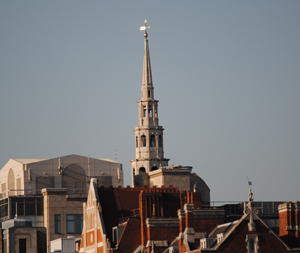
What’s in a name?…Fleet Street

Renowned around the world for its associations with journalism (not to be mention, it’s desirability as a Monopoly property), the origins of Fleet Street’s name go back to a river which still runs through London today.
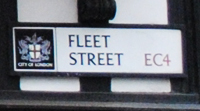
The River Fleet (the name Fleet is believed to come from a Saxon word, fleot, which means ‘flood’) these days actually runs under London, flowing from Hampstead Heath in the city’s north via sewers to spill into the Thames beneath Blackfriars Bridge.

A significant river in Roman times, by the medieval period the river had become polluted, thanks to the growth of industry along its banks. After the Great Fire of 1666, it was converted into the New Canal but this rather quickly fell out of use and sections of the river were covered for various urban projects from the 1730s onwards (the final sections, near the headwaters, were apparently covered in the 1870s).

Fleet Street, which takes its name from the river, has been known as such since medieval times and along its length, which runs east from where The Strand ends at Temple Bar to Ludgate Circus, is the location of a number of significant properties – from the Temple, formerly the property of the Knights Templar and now site of two Inns of Court, through to St Bride’s Church, St Dunstan-in-the-West and several old taverns, including Ye Olde Cheshire Cheese.

The street’s association with publishing goes back to the early 1500s when Wynkyn de Worde, apprentice to William Caxton, set up shop there and other printers and publishers followed. London’t first daily newspaper, The Daily Courant, was published there from 1702 and the street subsequently became home to many national newspapers (the press in the UK is still referred to as ‘Fleet Street’ although these days no newspapers are based there – the last media outlet, Reuters, moved out in 2005).

There have recently been suggestions that the river Fleet could once again be uncovered as part of a bid to revitalise London’s “lost” waterways.
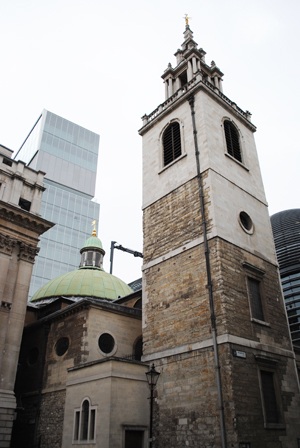
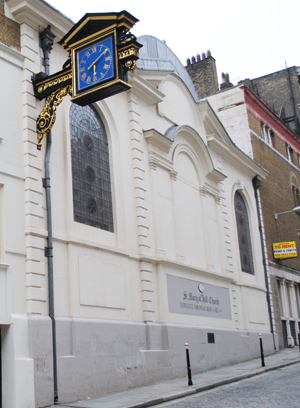
Wren’s London – 6. St Stephen Walbrook, St Mary-le-Bow, and St Mary-at-Hill

Sir Christopher Wren was responsible for designing more than 50 churches in the City of London after the Great Fire of 1666. We’ve already touched on a couple in this series – St Paul’s, of course, and St Bride’s in Fleet Street – and while we won’t be looking at all of rest in detail, here are three stars that have survived…

• St Stephen Walbrook, which is the parish church of the Lord Mayor and was that of Wren himself, is a little gem of a church and is generally thought to be the finest of Wren’s city churches from an architectural perspective. Tucked away behind Mansion House in Walbrook, the church as we know it was built between 1672-79 (although there may have been a Christian church on the site as early as 700 AD) and features a beautiful coffered dome (a sign of what was to come when Wren built St Paul’s). These days the chairs are arranged around white altar stone by sculptor Henry Moore which has been placed under the centre of the dome. Other features worth noting are Wren’s original altar screen and a glass-encased telephone which was the first dedicated help-line in London for the suicidal established by the charity Samaritans. These days the church is home to the London Internet Church. For more information, see http://ststephenwalbrook.net.

• St Mary-le-Bow, which is named for the bow-shaped arches in the Norman-era crypt, was rebuilt by Wren in 1670-80 after the Great Fire. In keeping with the church’s name, he designed a steeple with arches resembling the ‘bows’ below. While the church, located in Cheapside, was badly damaged when bombed in World War II, the steeple – topped by an original 1674 weathervane shaped like a dragon – remained standing along with the outer walls. The church was restored in the mid-Twentieth century and the bells, destroyed in a German air raid, rehung. It’s said that only those born within the sound of St Mary’s bells can be said to be true Cockneys (the Bow bells were also those Dick Whittington apparently heard when leaving London, leading him to turn around and embrace fame and fortune). For more information, see www.stmarylebow.co.uk.

• St Mary-at-Hill, which has served the parish of Billingsgate for almost 1,000 years, was one of the first to be rebuilt after the Great Fire. Both Wren and his assistant Robert Hooke were believed to have been involved in building the church, which was completed in 1677 and lies in Lovat Lane, just off Eastcheap. It was designed as a Greek cross with a dome at its centre  – Wren later put forward a similar design for for St Paul’s which was rejected. Overhauled in the late 1700s and a couple of times in the 1800s, it survived World War II only to be damaged extensively by fire in 1988 after which it was restored. The church’s connection to Billingsgate – the site of London’s former fish market lies just down the road – means that the fish harvest is still celebrated here every October. For more information, see www.stmary-at-hill.org.

Famous Londoners – Samuel Pepys

A navy administrator and an MP who lived in London for much for the 17th century, it is for his remarkable diary – filled with reflections on great events and the intimate goings on of daily life – that Samuel Pepys is renowned around the world.

Born the son of a tailor in Salisbury Court, Fleet Street (the site is now marked with a plaque), on 23rd February, 1633, Pepys (pronounced ‘peeps’) attended St Paul’s School before moving on to Cambridge University. After graduation, he entered the household of one of his father’s cousins, Sir Edward Montagu, as a secretary around 1655 – the same year he married Elisabeth de St Michel.

Under the patronage of Sir Edward – after he became the Earl of Sandwich – Pepys was appointed Clerk of the Acts to the Navy Board – a task which saw him playing a key role in shaping the English fleet which fought (unsuccessfully) in the Second Anglo-Dutch War (1665-1667).

In 1673, he became Secretary to the Admiralty and the same year was elected an MP for Castle Rising in Norfolk (he later became an MP for Harwich). Pepys also served as president of the Royal Society from 1684-1686, and even visited Tangier where he was involved in the evacuation of the short-lived English colony there. He was imprisoned twice in later years – at least once on suspicion of supporting the Jacobites – but the charges were dropped and he retired at the age of 57 in 1690.

In 1701 he moved out to a house in Clapham and lived there until his death on 26th May, 1703 (his wife Elisabeth had died many years earlier in 1669 and they’d had no children). His extensive library – including his six volume diary – were bequeathed to Magdalene College at Cambridge.

Despite an illustrious public career, it is his diary for which Pepys is most celebrated. Covering the years from 1660 to 1669 (he only stopped writing for fear he would go blind), it records his reactions to such monumental events as Charles II’s coronation (he was present as a youth at the beheading of Charles I), the Great Plague of London in 1665 and the Great Fire of London the following year as well as intimate details from his personal life including how he spent his leisure time, his various illnesses and his sexual liaisons. Written originally in a form of shorthand, it was first published in 1825 – and only fully published in 1976 – and has since gone on to enthral and entertain millions around the world.

Among places in London which still hold a Pepys connection are St Bride’s Church (he was baptised there), All Hallows by the Tower (it was in the tower from which Pepys watched the Great Fire), St Olave’s on Seething Lane (pictured above) where Pepys and his wife are buried (he was living in Seething Lane when he started the diary and St Olave’s served as his parish church between 1660 and 1674). Further down Seething Lane, there is a bust of Pepys in the gardens which now cover the Navy Office where Pepys once lived and worked.

There is also an exhibition on Pepy’s in Prince Henry’s Room at 17 Fleet Street (the building dates from around 1610 and was a pub when Pepys was alive), although it is currently closed.  An online version of Pepys’ diary can be found at the website Pepys’ Diary. For more on Pepys’ life, we do recommend Claire Tomalin’s best-selling biography Samuel Pepys: The Unequalled Self.

Wren’s London – 2. St Bride’s

While St Paul’s Cathedral is certainly his best-known work, Sir Christopher Wren designed 50 other churches in London in the wake of the Great Fire of 1666. Rather than look at each individually, we’ll just highlight a couple with the first being the “wedding cake” church, St Bride’s.

The site of St Bride’s has been home to at least eight churches, the first of which is believed to have been founded in the Dark Ages. Dedicated to the sixth century Irish nun St Bride – or St Bridget, the church – thanks to its location on Fleet Street – has had a long association with printers and later newspapers and journalists and, despite the fact most news organisations have long since departed the area, is still regarded as “the journalist’s church”.

The medieval St Bride’s was completely consumed in the Great Fire but a new church was opened in 1675 after works were carried out to Wren’s design (among his assistants on the job was Nicholas Hawksmoor who became a celebrated architect in his own right).

Despite the return of worshippers, however, the building remained unfinished and Wren was approached in the early 1680s about constructing the steeple. This was completed in 1703 and has become a London landmark with many believing its tiered design was the basis for the modern “wedding cake” design.

The steeple – at 226 feet or almost 70 metres, the tallest in London – was one of few things which survived after a firebomb destroyed much of the building during the Blitz in 1940. The church was subsequently restored according to Wren’s original designs (albeit with a shorter steeple than Wren’s original – eight feet or 2.4 metres were knocked off when it was struck by lightning in 1764.)

As well as its association with the printing industry and the press, these days St Bride’s is also notable for its US connections – the first American child of English descent, Virginia Dare, was the daughter of two former St Bride’s parishioners (there is a bust of Virgina above the font). The parents of Edward Winslow, three-time Governor of Plymouth in Massachusetts, were also married in St Bride’s.

The crypt contains remains dating back to Roman times.

WHERE: Fleet Street (nearest tube St Paul’s); WHEN: 8am to 6pm Monday to Friday, 11am to 3pm Saturday, 10am to 1pm and 5pm to 7.30pm Sunday; COST: Entry is free but guided tours are available on Tuesday afternoons at 3pm for £5 a person; WEBSITE: www.stbrides.com.