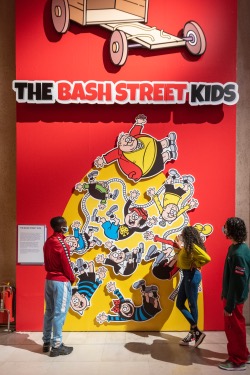
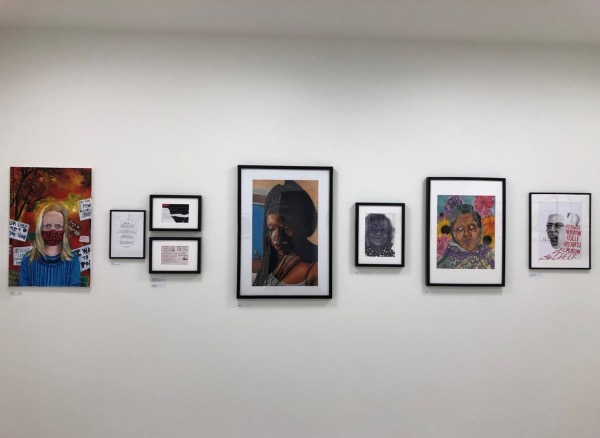
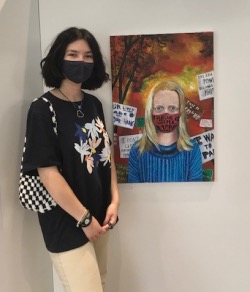
Julietta and her artwork which is among those in the exhibition..
Works by young Londoners depicting their COVID-19 experiences as well as their feelings in support of the Black Lives Matter movement have gone on show in an exhibition at the Saatchi Gallery and online. A Westminster City Council project, called Creative Collective, asked young people to produce works in any medium – audio clips, short films, poems, paintings, drawings, statements or digital works – responding to themes including lockdown, resilience and hope, community and Black Lives Matter. The results, which have previously been on display at libraries across Westminster, can now be viewed until 31st August at in the Learning Gallery at the Saatchi Gallery as part of the JR Chronicles Exhibition. The display is also available to see online here. The project is the work of the council’s cultural youth engagement programme – City Lions – in partnership with children’s services, local schools, professional artists, libraries and archives.
• A 19-year-old graphic design student from Nottinghamshire has won a competition to find an emblem for the Queen’s Platinum Jubilee. Edward Roberts, who is studying at Leeds, said that for his design, “I wanted to give a modern twist to the iconic elements of St Edward’s Crown, and so I created a continuous line, which I felt was a fitting representation of The Queen’s reign”. Paul Thompson, vice-chancellor of the Royal College of Art and a member of the judging panel which selected the winning design said it takes people “on a simple line journey to create the crown and the number 70, beautifully capturing the continuous thread of Her Majesty The Queen’s 70-year reign”. “Drawn on a computer, the ingenious emblem works across all scales and the flow of the line gives us a sense of a human touch behind the digital design process.” The competition, which was was open to young people aged between 13 and 25 from all over the United Kingdom, was judged by a panel of graphic designers, visual artists and design professionals, experts from the V&A, the Royal College of Art, the Design Museum, and a representative from the Royal Household. It was chaired by V&A Director Tristram Hunt. As the winner, Edward will be invited to next year’s Jubilee celebrations including the ‘Platinum Party at the Palace’, and his winning design, along with the other nine shortlisted emblem design entries which will be revealed next year, will be displayed at the V&A in June. Edward will also receive a prize of £1,500 and a year’s free membership of the V&A.
• The £8 entrance fee to the Marble Arch Mound has been dropped for visitors during August after it closed only two days after opening following sustained criticism from visitors. In a statement Stuart Love, chief executive of the City of Westminster, apologised that the Marble Arch Mound wasn’t ready for visitors when it opened. “London’s businesses and residents have suffered through the pandemic and we built the Mound as part of our bigger plan to get people back into the City and into the shops, restaurants, theatres and to see the amazing sights the West End has to offer,” he said. “We wanted to open the Mound in time for the summer holidays and we did not want to disappoint people who had already booked tickets. We made a mistake and we apologise to everyone who hasn’t had a great experience on their visit.” The 25 metre high temporary attraction will reopen on Monday. For more, head here.
• Explore the stories of real-life pets and their owners in a new feature at the Museum of The Home in Shoreditch. Pet Life – which features animations, projections, hands on activities and stories written by author and storyteller Bernadette Russell – aims to show “the joy, companionship and challenges our pets bring to the home”. Runs until 31st October. Admission charge applies. For more, see www.museumofthehome.org.uk/whats-on/exhibitions-and-installations/pet-life/.
Send items for inclusion to exploringlondon@gmail.com.
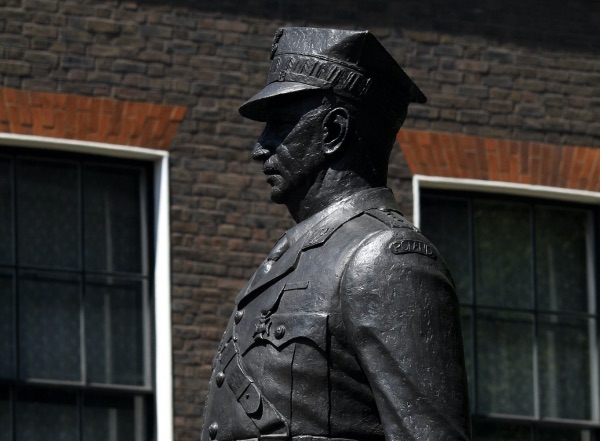
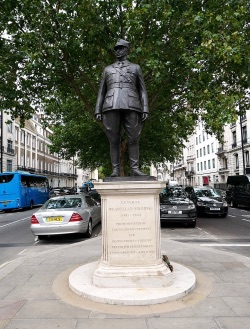
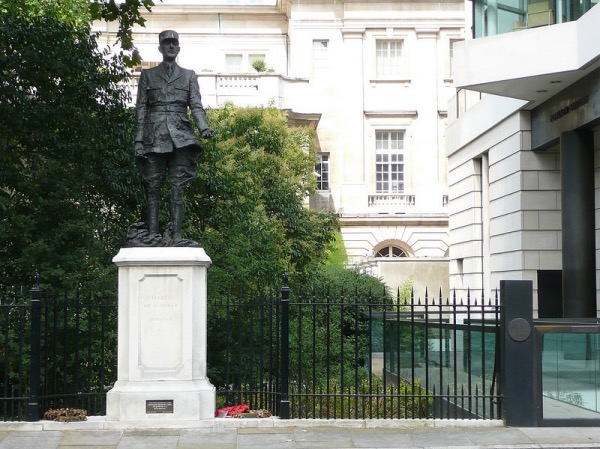
Unveiled in the early 1990s, this statue of the French leader Charles de Gaulle (1890-1970) is located in St James’s, close to the headquarters where de Gaulle headed the government-in-exile following the fall of France in 1940.
The life-sized statue is the work of sculptor Angela Conner and architect Bernard Wiehahn and was erected in Carlton Gardens following a campaign by Lady Soames, daughter of Winston Churchill. De Gaulle is depicted standing in the uniform of a General de Brigade.
The was unveiled by Queen Elizabeth, The Queen Mother, in June 1993. Nearby are an English Heritage Blue Plaque as well as another plaque, both commemorating the location of the headquarters.
A commemorative ceremony takes place each year at the statue organised by the French Embassy.
De Gaulle flew to England in June, 1940, and was subsequently recognised by Britain as the leader of the Free French. He established his headquarter at 4 Carlton Gardens on 22nd July that year, initially living at the Connaught Hotel and, from 1942 to 1944, in Hampstead. He returned to France following the D-Day invasion in 1944.
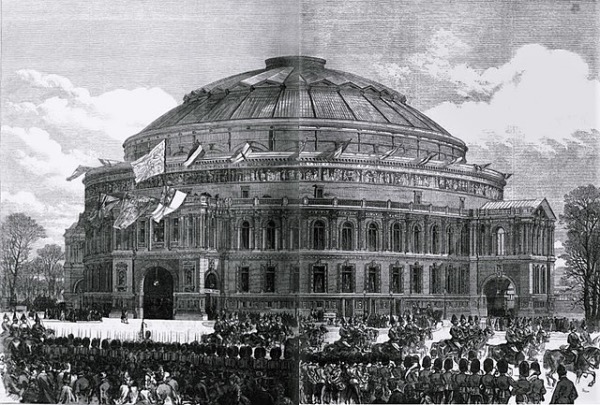
Crowds gathered at the Opening of Royal Albert Hall, on 29th March, 1871, as seems in the Illustrated London News, on the 8th April, 1871.
Next week sees the Royal Albert Hall’s 150th anniversary concert taking place, one of a number of events to mark the anniversary of the hall’s opening.
This spectacular building in South Kensington was officially opened on 29th March, 1871, as The Royal Albert Hall of Arts and Sciences (the opening was actually brought forward from 1st May – 20th anniversary of the opening of the Great Exhibition – at the request of Queen Victoria).
The Queen had laid the foundation stone in 1867 and the work on the building, the creation of which was partly funded by profits from the Great Exhibition of 1851, was complete by the end of 1870 (at least its structure – much of the interior decoration was apparently added later).
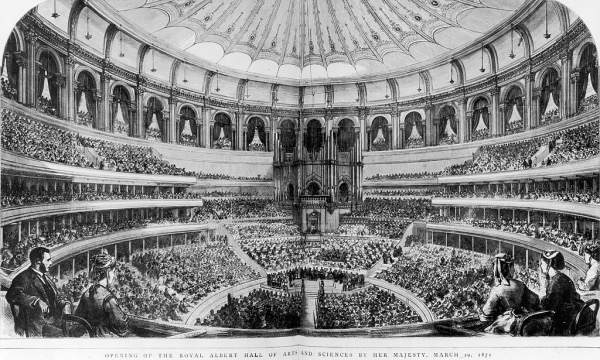
An image of the interior of the hall during the opening ceremony on 29th March. 1871. The illustration originally appeared in The Graphic.PICTURE: Via Wikipedia.
Queen Victoria and members of the Royal Family left Buckingham Palace in a line of state carriages for the event at noon escorted by the Royal Horse Guards Blue. Large crowds lined the route of her passage and a guard of honour composed of the Grenadiers stood opposite the entrance.
On arriving, the Queen was met by the Edward, the Prince of Wales (the future King Edward VII), members of the building committee and some of those who has served as commissioners of the Great Exhibition of 1851.
The Queen processed to a dais inside the building’ auditorium where some 8,000 dignitaries and invited guests waited in the audience. But she was apparently too overcome by memories of her late husband – Prince Albert, after whom the building as named – to give a speech. So it was the Prince who did so, although the Queen did reportedly add her own comments, saying according to an account in The Guardian: “I cannot but express my great admiration for this beautiful building, and my earnest wishes for its complete success.”
A battery of artillery performed a salute in nearby Hyde Park after which the Queen and Royal Family took their seats in the Royal Box to watch the musical program that followed. The Queen then returned to Buckingham Palace.
Interestingly, the first concert at the hall, held to test acoustics, actually took place month earlier on 25th February for an audience of some 7,000 people made up of those who had worked on the building and their families as well as officials and various invited members of the public.
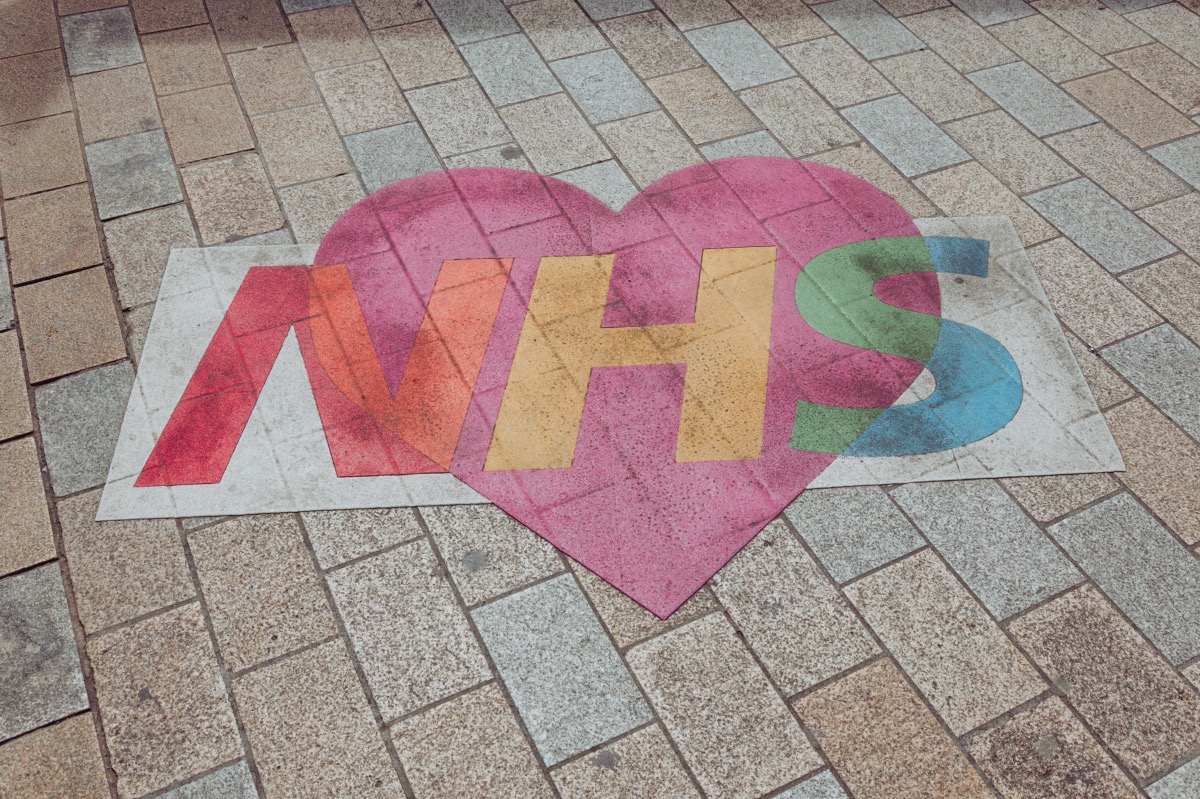
Queen Elizabeth II has awarded the George Cross – the country’s highest civilian gallantry award – to the National Health Service. In an accompanying statement, the Queen said: “It is with great pleasure, on behalf of a grateful nation, that I award the George Cross to the National Health Services of the United Kingdom. This award recognises all NHS staff, past and present, across all disciplines and all four nations. Over more than seven decades, and especially in recent times, you have supported the people of our country with courage, compassion and dedication, demonstrating the highest standards of public service. You have our enduring thanks and heartfelt appreciation.” Details of when the award will be presented are yet to be announced. It is only the third time, the George Cross has been awarded to a collective body, country or organisation, rather than an individual (the first time was when it was collectively awarded to the people of Malta in 1942 by Queen Elizabeth’s father, King George VI, and the second time when it was awarded to the Royal Ulster Constabulary by the Queen in 1999). PICTURE: Nicolas J Leclercq/Unsplash
Left to right: Abraham Gomes, Forces Recruitment ATS (girl’s head) (between 1939 and 1946); Mary Le Bon, Give yourself a happy holiday…and help our farmers. Lend a hand on the land at an agricultural camp (between 1939 and 1946); Unknown author, There’s often a listener. Silence is safety. Never talk to anyone about sailing dates, cargoes, destinations (between 1939 and 1946).
These posters are among almost 2,000 original works created by artists working for the Ministry of Information during World War II now in the collection of The National Archives based in Kew.
The posters tackle a range of issues – from saving on fuel at home to warnings about spies, posters to inspire effort on the homefront and those to recruit new men and women to the service.
Under a partnership with Wikimedia UK, in 2013 The National Archives digitised and released more than 350 images of the posters into the public domain. Here are some those released.
Left to right: Roy Nockolds, “In Germany…someone is doing the same job as you. Beat him!” (1942); Tom Purvis, “Stand Firm!” (between 1939 and 1946); and, Frank Newbould, “Give us the tools and-” – Winston Churchill (between 1939 and 1946).
A viewpoint overlooking the the ruins of Lesnes Abbey. PICTURE: M W Pinsent (licensed under CC BY-NC-ND 2.0)
Located in London’s south-east, Lesnes Abbey was founded in 1178 as the Abbey of St Mary and St Thomas the Martyr by Richard de Luci, a joint Chief Justiciar of England at the time.
It’s believed de Luci did so as an act of penance for his support of King Henry II in his dispute with St Thomas Becket (in fact, de Luci was ex-communicated by him twice before Becket was murdered in Canterbury Cathedral in December, 1170). De Luci retired here after resigning his office in 1179 and died soon after. He was buried in the chapter house.
The Augustinian monastery, never a large or wealthy community, had fallen into a state of disrepair and debt by the early 15th century apparently due to mismanagement but at least partly caused by the cost of maintaining the river wall and draining the marshes in which it was located.
Some rebuilding was carried out at the start of the 16th century but in 1525 it was closed or suppressed on Cardinal Thomas Wolsey’s orders and the monastic buildings were demolished with the exception of the Abbot’s lodging.
The site was subsequently sold off and passed through various hands – it spent some 300 years as a possession of Christ’s Hospital – and eventually became farmland with the abbot’s house forming the core of a farmhouse which was demolished in 1844.
The site was excavated under the direction of Sir Alfred Clapham in the early 20th century and was purchased by the London County Council in 1930. It was opened as a public park in 1931. Since 1986, it’s been owned and managed by the London Borough of Bexley.
The site today, a scheduled ancient monument, includes some impressive ruins from the abbey. The nearby woods takes its name from the abbey.
The Harrow School (left) and St Mary’s Church on top of Harrow Hill. PICTURE: Google Maps
This hill in outer north-west London, which rises 124 metres (408 feet) above sea level, is the location of the village Harrow-on-the-Hill.
The hill’s name is said to refer to a Saxon place of worship and was later taken to mean the Christian church that stood upon it.
That church – the historic St Mary’s, the latest incarnation of a Christian church which has stood on the hill since the Norman Conquest – dominates the hill to this day. Nearby is a spot called King Charles’ Well where King Charles I is said to have stopped and taken one last look at London as he made his way from Oxford to surrender to the Scottish army in Nottinghamshire.
The other famous landmark atop the hill, opposite the church, is the world renowned Harrow School, founded under a Royal Charter by John Lyon in 1572, during the reign of Queen Elizabeth I.
The hill is also host to a Grade II-listed war memorial and a fine array of historic homes dating from the Georgian period to the early 20th century. Among this who have lived on the hill are 19th. century critic and writer Matthew Arnold and 19th century Scottish author RM Ballantyne.
Panoramic views of Central London can be seen from the top of the hill and there is a famous viewpoint in the churchyard known as Lord Byron’s View, which looks away to the north-west. It’s so-called because Byron, while a schoolboy at Harrow, was a frequent visitor to the spot by a tombstone – called the “Peachy Tomb”- where he would apparently spend time “dreaming”.
Byron’s View atop Harrow on the Hill. PICTURE: Google Maps
Said to have been modelled on a rose window once inside Old St Paul’s Cathedral (which was destroyed in the Great Fire of London), the window, also known as Catherine (Katharine) Wheel, features some beautiful examples of 17th century stained glass.
The window, which is located in the chancel of the church of St Katharine Cree in Leadenhall Street in the City not far from Leadenhall Market, was installed when the church was rebuilt in the early 1630s (replacing an earlier medieval church – the church’s tower, however, dates from 1504 and was part of the earlier church on the site). It is abstract in design but
The window, which was removed to ensure its protection during World War II, has undergone repairs and the centre of the wheel was replaced after it was blown out in 1992 when a massive truck bomb went off at the nearby Baltic Exchange.
The Catherine Wheel, incidentally, was an execution device associated with the martyrdom of St Catherine of Alexandria. Catherine had upset the Emperor Maxentius in the early 4th century by speaking out against his persecution of Christians in the early fourth century. Tradition has it that after failing to break her spirit through torture (and, so say some, a marriage proposal which she refused), Maxentius ordered her to be put to death on a spiked wheel, it broke at her touch and she was later beheaded.
Despite the ongoing impacts of the coronavirus pandemic, we hope you have a happy Easter break!
A screenshot from ‘Sensing the Unseen: Step into Gossaert’s ‘Adoration’, mobile edition’
• The National Gallery’s first exhibition aimed at mobile phone users – exploring Jan Gossaert’s masterpiece, The Adoration of the Kings – goes live from Friday.Sensing the Unseen: Step into Gossaert’s ‘Adoration’, mobile edition features six poems in the voice of King Balthasar, a character depicted in the painting, who interprets six scenes shown in the work while interactive sound brings them to life, all in an effort to guide people to details they may have missed in the work. Users can use their zoom function to explore the masterpiece’s minutiae and share their favourite finds on Instagram. The mobile phone offering is a pre-cursor to the planned reopening of the physical exhibition Sensing the Unseen: Step into Gossaert’s ‘Adoration’ – forced to close just a week after opening last December – on 17th May. To see the mobile display, head to nationalgallery.org.uk/visiting/virtual-tours.
• Hampton Court Palace is once again holding its Lindt Gold Bunny huntfor Easter. Families are invited to join in the search for the famous Lindt Gold Bunnies which have been hidden around the palace, enjoying the gardens along the way. Using a trail map, children will be able to learn about various lesser known Hampton Court residents including John Dale, Henry VIII’s master cook, and John Blanke, the King’s royal trumpeter. Successful treasure hunters can then claim a chocolate reward and a pair of gold bunny ears. Included in admission, the trail is designed for children aged three to 12-years-old and takes about one-and-a-half hours to complete. Runs until 18th April. For more, see www.hrp.org.uk/hampton-court-palace/whats-on/easter-lindt-gold-bunny-hunt/.
• The final two blossom trees have been planted in the new London Blossom Garden. The public garden, which is being created as a lasting, living memorial to Londoners who have lost their lives to COVID-19 and the city’s shared experience of the pandemic, is located in the northern part of Queen Elizabeth Olympic Park in Newham. Scheduled to open later this spring, it has been created in partnership with the National Trust and with the support of Bloomberg, and features 33 blossoming trees representing London’s boroughs and the City of London.
Send all items for inclusion to exploring-london@gmail.com
A memorial wall for the victims of the COVID-19 pandemic has been established on The Queen’s Walk outside St Thomas’ Hospital. Bereaved family and friends on Monday began to paint the first of tens of thousands of love hearts – representing those who have died of COVID-19 – on the wall which faces the Houses of Parliament across the Thames. The memorial, which is expected to stretch for hundreds of metres, is the work of the COVID-19 Bereaved Families for Justice group which has called for a public inquiry into how the government has handled the pandemic. Co-founder Matt Fowler, whose 56-year-old father, Ian, died last April, was the first to paint a heart on the wall on Monday. “This is an outpouring of love,” he reportedly said. “Each heart is individually hand-painted; utterly unique, just like the loved ones we’ve lost. And, like the scale of our collective loss, this memorial is going to be enormous.”
The Skylon and the Dome of Discovery at the 1951 Festival of Britain PICTURE: Peter Benton(licensed under CC BY-SA 2.0/image cropped)
Built for the post-war Festival of Britain in 1951, the Dome of Discovery was a temporary exhibition building located in South Bank.
Designed by architect Ralph Tubbs, the dome was, with a diameter of 365 feet and a height of 93 feet, the largest in the world at the time. It was located next to the Skylon, another iconic structure built for the festival.
The prefabricated dome, which was made from aluminium and concrete, was filled with galleries which housed exhibitions around the overarching theme of discovery. The display was grouped under eight different sections including “the land”, “the sea”, “sky” and “outer space”. The dome also contained a 50 foot long mural on the theme of discovery by artist Keith Vaughan.
The dome was dismantled just 11 months after it was installed and sold for scrap metal (despite pleas from Tubbs and proposals for it to be relocated to places as diverse as Sao Paulo in Brazil and Coventry in England). Some of the metal was apparently made into souvenirs including commemorative paper knives.
Remembering the more than 126,000 lost. A candle is lit outside 10 Downing Street on Tuesday night to mark the first anniversary of the first national lockdown.PICTURE: Pippa Fowles/No 10 Downing Street.
Artist Karishma Puri at one of the 18 sites in ‘Isolating Together’. PICTURES: Supplied.
A new outdoor exhibition celebrating inspiring stories of community, action and solidarity during the year of the COVID-19 pandemic can be seen in Camden. Created to mark a year since the pandemic began, Isolating Together features the work of artist Karishma Puri who was inspired to capture the images after establishing Covid Mutual Aid – a WhatsApp-based community group – in Kentish Town to help neighbours support one another and overcome isolation. The images, seen at 18 locations across Camden, highlight the vital role that local businesses like Truffles Deli have played in the community during the pandemic as well as personal stories like that of Nafisa who started a support system that ensured people in the local Somali community had a steady supply of free fruit and vegetables during the pandemic. Run in collaboration with Jack Arts and No Ordinary Experience, Isolating Together uses billboards, community spaces and local shop windows to create a vast outdoor gallery with its centrepiece displayed across a 14 metre wall at Number 19, the home of community action in Camden. The exhibition can be seen on a self-guided walk until 31st March. A map and more information is available at https://isolatingtogether.co.uk/exhibition.
‘Isolating Together’ installation at Swiss Cottage.‘Isolating Together’ installation at Aces & Eights.
The final in our series on St Thomas Becket’s London is not about a static site but a pathway, one that people have been walking since the Middle Ages as pilgrims to the shrine of St Thomas Becket in Canterbury.
A Pilgrim’s Way signpost near Chaldon in Surrey. PICTURE: G Travels (licensed under CC BY-NC 2.0)
Famous today through its association with Geoffrey Chaucer’s The Canterbury Tales, the Pilgrim’s Way actually refers to not one path but a series of routes taken by pilgrims as they made their way from London to Canterbury, linking up along the way with another route originating in Winchester.
The pilgrimage from London typically started at the now long lost St Thomas Becket Chapel in the middle of Old London Bridge and then headed south through Southwark where the Tabard Inn – where Chaucer has his pilgrims staying at the start of his journey – was located.
These days, there’s several routes – the official Pilgrim’s Way website has a couple of different routes through London. Both start at Southwark Cathedral and one then follows the line of A2 south before heading east to the Thames through Deptford where it joins up with a second route. This route, on leaving Southwark Cathedral, follows the south bank of the Thames east.
On becoming one route at Deptford, the Pilgrim’s Way then follows the Thames through Greenwich and Woolwich before turning southward to Dartford and eventually linking up with the Pilgrim’s Way from Winchester in the village of Otford in Kent (and then on to Canterbury).
Other versions of the pilgrimage route start at Westminster Abbey and take in St Paul’s Cathedral before crossing over the Thames and heading east to Gravesend and on to the Medway towns and eventually Canterbury.
Interestingly, some believe that King Henry II took the route from London to Canterbury when performing his very public act of atonement for his role in the saint’s death (although others believe he made the pilgrimage from Winchester).
Eltham Palace grounds in south-east London. PICTURE: Gordon Joly (licensed under CC BY SA 2.0)
• English Heritage – which manages a number of historic properties in London including Eltham Palace, Kenwood House and Marble Hill House – has announced they will reopen progressively from 29th March. Initially only the grounds of more than 60 properties across England will be open with building interiors to open from 17th May. A summer events programme is scheduled to start on 21st June. Visits must be booked in advance and the organisation has asked that people bear in mind the government’s latest advice, and be aware that they shouldn’t travel outside of your local area. For a full list of properties that are reopening, see www.english-heritage.org.uk/visit/plan-your-visit/.
• It’s a unique place to receive a coronavirus vaccine. The NHS announced this week that a new COVID-19 vaccination clinic has opened in Westminster Abbey’s South Transept, home to Poet’s Corner. Run by Chelsea and Westminster Hospital NHS Foundation Trust, on behalf of the local GP network, the location is expected to provide up to 2,000 inoculations each week. The clinic is only open for those with an appointment. Invitation letters will explain how people can book a slot and NHS leaders are urging people not to turn up at the centres without an appointment.
Meteorite recovered from Winchcombe PICTURE: Trustees of the Natural History Museum
• A fragment of a meteorite which was located in Gloucestershire after recently falling to Earth in a rather spectacular fireball has been brought to the Natural History Museum in South Kensington. The 300 gram chunk of meteorite, which is known as a carbonaceous chondrite, was discovered on a driveway in the Cotswold town on Winchcombe. It’s path tracked by specialised cameras across the country as part of the UK Fireball Alliance, the meteorite was retrieved in such a good condition and so quickly after its fall that scientists say it is comparable to the samples returned from space missions, both in quality and size. Other pieces of the meteorite have also been recovered in the area. The rare meteorite – it is the first known carbonaceous chondrite to have been found in the UK and the first meteorite to be recovered in the UK in 30 years – will now undergo further study.
Send all items for inclusion to exploringlondon@gmail.com.
There are 110 livery companies in London, representing various “ancient” and modern trades. But the oldest is said to be the Worshipful Company of Weavers.
What was then known as the Weavers’ Guild was granted a charter by King Henry II in 1155 (although the organisation has an even older origins – there is an entry in the Pipe Rolls as far back as 1130 recording a payment of £16 made on the weaver’s behalf to the Exchequer).
Saddler’s Hall in Gutter Lane where the Worshipful Company of Weavers is based out of.
In 1490, the Weaver’s Guild obtained a Grant of Arms, in the early 16th century it claimed the status of an incorporated craft, and, in 1577 it obtained ratification of its ordinances from the City of London.
By the late 16th century, the company – its numbers swollen by foreign weavers including Protestants fleeing persecution in Europe – built a hall on land it owned in Basinghall Street. A casualty of the Great Fire of London, the hall was rebuilt by 1669 but by the mid-1850s had fallen into disrepair and was pulled down and replaced by an office block.
After the office building was destroyed during World War II (fortunately some of the company’s treasures which had been stored there had already been moved), the company considered rebuilding the hall but decided its money could be better used, including on charitable works.
For many years, the company’s business was run from various clerk’s offices outside the City of London but since 1994 it has been run from Saddlers’ House.
The company, which ranks 42nd in the order of precedence for livery companies, has the motto ‘Weave Truth With Trust’.
• A photograph of the Milky Way taken from the Cave of the Wild Horses in the southern Utah desert has won the Insight Investment Astronomy Photographer of the Year: People’s Choice Awards 2020. The stunning image by Bryony Richards was captured in the cave after a long hike through the desert. It was selected from 25 images short-listed by the Royal Observatory Greenwich. ‘Reflection of the Stars’ by Linh Nguyen won second place award and Qiqige (Nina) Zhao won third for ‘Anniversary of Apollo 11 Mission’. Meanwhile, the deadline for the Astronomy Photographer of the Year 13 competition run by the Royal Observatory Greenwich in association with BBC Sky at Night Magazine is looming – photographers need to have submitted their images by 12pm on 5th March. The overall winner of the competition will take home a top prize of £10,000 and see their image in the accompanying exhibition, which is scheduled to open at the National Maritime Museum on 18th September. For more details, see www.rmg.co.uk/astrocomp.
• The Mayor of Lambeth’s homemade ceremonial chain has been acquired by the Museum of London as part of its ‘Collecting COVID’ initiative. The chain was made by the mayor, Councillor Philip Normal, for the virtual ceremony in which he was created mayor on 22nd April, 2020, during the first national lockdown. Made of card and plaited t-shirt fabric, it features Lambeth’s coat of arms painted within a fluorescent pink oval with the words ‘Spectemur Agendo’ meaning, ‘Let us be judged by our acts’. For more on ‘Collecting COVID’, see www.museumoflondon.org.uk.
• An oil painting of Sir John Maitland by an unknown Anglo-Dutch artist, part of the art collection at Ham House in London’s south-west, is among artworks which are to undergo restoration thanks to a £3 million gift to the National Trust from American charity, the Royal Oak Foundation. The gift will support the Trust’s conservation work for the next five years mainly based at its specialist conservation studio in Knole, Kent. It was made in honour of the 125th anniversary of the National Trust, which cares for more than 200 historic properties containing more than a million objects – everything from artworks to furniture, textiles and ceramics. The painting of Sir John came to public attention in 2017 when X-ray analysis revealed what is believed to be an unfinished portrait of Mary, Queen of Scots, hidden underneath it. For more, see www.nationaltrust.org.uk.
• Looking further afield and a keepsake box containing mementos associated with Charles Darwin – including shells gathered on his famous voyage in the HMS Beagle – have been donated to English Heritage. The charity announced the gift this week to mark the 150th anniversary of the 1871 publication of his book, The Descent of Man and Selection in Relation to Sex. The red leather box and its contents will go on display at Down House in Kent later this year following conservation work. Charles and Emma Darwin initially gave the box to their eldest daughter Annie but, following her death at the age of 10 in 1851, it passed to her sister Henrietta, known as “Etty”. Among the souvenirs placed in it were locks of hair belonging to different members of the Darwin family (including Emma and Henrietta), a silk handkerchief embroidered with Charles’ initials CD, and the shells which his daughters later carefully labelled using scrap paper from the naturalist’s draft manuscripts. English Heritage is appealing for donations for the care and display of the box. To support the work, head to www.english-heritage.org.uk/support-us/.
Send all items for inclusion to exploringlondon@gmail.com.