LondonLife – A maze in Trafalgar Square

Trafalgar Square has been transformed with a temporary hedge maze which takes visitors through a potted history of some of the streets of London’s West End. The maze, created by the West End Marketing Alliance, is full of fascinating facts – did you know, for example, that the area we now know as Covent Garden was originally known, during Saxon times, as Convent Garden? Or that the Beatles last ever gig was performed on a rooftop in Savile Row? The maze is only in Trafalgar Square for this week, so get in quick if you want to visit (and pick up a free badge for your effort in conquering the maze). When Exploring London visited, waiting time was only about 10 minutes. For more, see www.WestEndLondon.com.

Around London…

• The British Military Tournament takes up where the Royal Tournament left off. The abolition of Royal Tournament in 1999 ended almost 120 years of tradition and left a significant gap in London’s annual events calender. No longer. The concept has been reborn as the British Military Tournament which will be held on 4th and 5th December this year. Presented by ABF The Soldier’s Charity, the spectacle will feature 500 troops, 145 horses, massed bands and the “field gun run” among other things. Tickets start at £29 for adults/£22 for children.  www.britishmilitarytournament.com.

• A rare sketch of pre-1666 St Paul’s is to be auctioned. The drawing, made less than 10 years before the Great Fire consumed the cathedral, is by Bohemian artist Wenceslaus Hollar and was created for William Dugdale’s illustrated history of the cathedral. www.thisislondon.co.uk/standard/article-23851487-long-lost-sketch-of-medieval-st-pauls-cathedral-for-sale.do

• On Now – Treasures of Lambeth Palace Library. At the Lambeth Palace Library (open Monday to Saturday (10am-5pm), admission £8 adults/£7 concessions, www.lambethpalacelibrary.org/content/treasuresexhibition). Held in celebration of the 400th anniversary of the library’s foundation, the exhibition in the palace’s Great Hall features some of the most significant books and documents in the English-speaking world including a Gutenberg Bible – the first great printed book in Western Europe using moveable type, the warrant for the execution of Mary, Queen of Scots, signed by Queen Elizabeth I, the 9th century Irish McDurnan Gospels, the 13th century Lambeth Apocalypse, and a rare edition of the Babylonian Talmud. Exhibition closes 23rd July.

The Weekly Roundup

Each week, we’ll be bringing you a round-up of some of the news affecting historic and interesting places in London. So, to kick it off…

The gardens surrounding the neo-Palladian masterpiece Chiswick House have been reopened following a £12 million restoration. The 65 acres of gardens, known as the birthplace of the English Landscape Movement, were designed by Lord Burlington and William Kent in the 1720s and 1730s. They were created as a backdrop for the magnificent house Lord Burlington designed and had built on the west London property following a grand tour of Italy. The garden’s original vistas have been restored and statutory and garden buildings repaired – including a 19th century conservatory housing rare camellias. More than 1,600 trees have been planted – some of which were propagated from the original 18th century Lebanon cedars planted in the garden – and the Walled Gardens have also been restored (these will only be open to the public on special occasions). There’s also a new cafe designed by award-winning architects Caruso St John. ~ www.english-heritage.org.uk/chiswickhouse

Four new Blue Plaques have been unveiled in London. They include one for Sir William Nicholson (1872-1949), painter and printmaker (1 Pilgrim’s Lane, Hampstead); another for Charles Rolls (1877-1910), motoring and aviation pioneer (14/15 Conduit Street, Mayfair); Baron Carlo Marochetti (1805-1867), sculptor (34 Onslow Square, South Kensington); and, Wing Commander FFE Yeo-Thomas GC (1902-1964), secret agent (24-28 Queen Square, Holborn). ~ www.english-heritage.org.uk/blueplaques

On Now – Magnificent Maps: Power, Propaganda and Art. At the British Library (open daily, admission free, www.bl.uk/magnificentmaps/). The exhibition contains some 80 spectacular, mainly European, maps, dating from as far back as the Roman era, and explores how they have been employed for various purposes – as propaganda, works of art, teaching aids and indoctrination. Included in the exhibition are the world’s biggest and smallest atlases – the latter created for a doll’s house. Exhibition closes 19th September.

10 sites in London you may not know about – 3. Temple Church

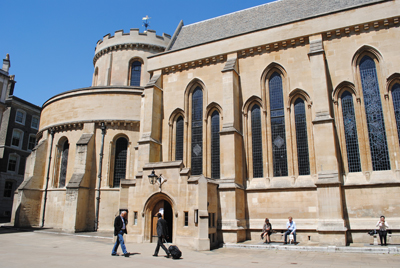
Located just outside the west end of the medieval city walls, the Temple Church is an anomaly in a city where, thanks to the Great Fire of 1666, few medieval churches remain.

First consecrated in 1185, the church – like all Templar churches – features a round nave – known as the Round Church – modelled on that of the Holy Sepulchre in Jerusalem. It adjoins a ‘Hall Church’ which features three bays dating from the 13th century.

While they have been moved several times, the Round Church contains a number of tomb effigies including those believed to be that of William Marshall, 1st Earl of Pembroke and one of the towering figures of the 12th and early 13th centuries.

It also features a series of faces around the outer wall (these were renewed and replaced in the 1820s), each of which shows a different and, at times, plain odd expression.

The church is located in the midst of what was once a large landholding – located between Fleet Street and the Thames – once owned by the Templar Knights which included quarters for the knights and serjeants. Following the disbanding of the order in early 1300s, the Temple Church passed into the hands of the Knights Hospitaller and then became the property of the Crown during the 16th century reformation.

In 1608, James I granted all the Templar’s land to the societies of the Inner and Middle Temple, two of London’s Inns of Court – the inns are still dedicated to housing those studying and practising law and it’s the inns which maintain the church today.

One of the most famous figures connected to the church is Richard Hooker, Master of the Temple between 1585-91, and author of Of The Laws of Ecclesiastical Polity, an important document in Anglican theological thought.

Christopher Wren also left his mark here – he refurbished the church’s interior in the 1670s although much of work was later removed – as did World War II – the roof of the Round Church was brought down during the Blitz.

Make sure you pop in for one of the free organ recitals which are held over lunchtimes each Wednesday.

WHERE: Off Fleet Street and down Inner Temple Lane (nearest tube station is Temple); WHEN: Check website for times; COST: £4 (free to under 18s and seniors); WEBSITE: www.templechurch.com

LondonLife: Trooping the Colour

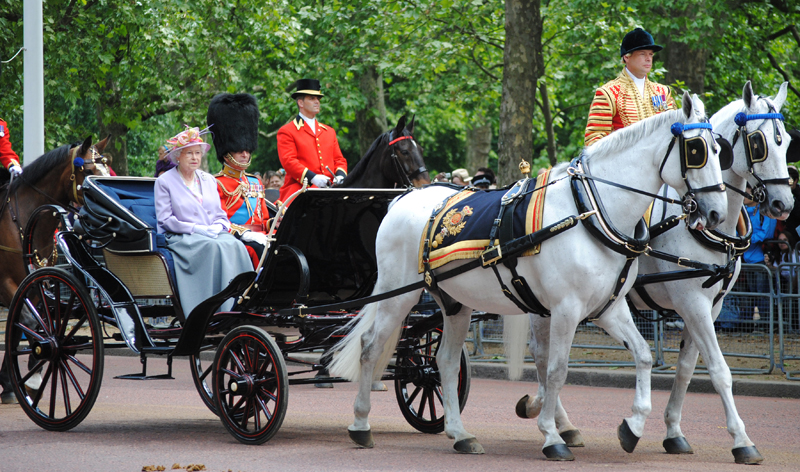
Last weekend saw thousands gather to celebrate Queen Elizabeth II’s birthday and watch the annual Trooping the Colour parade down The Mall to Horse Guards Parade in Whitehall. The tradition of Trooping the Colour began around the early eighteenth century when the ‘colours’ or flags of battalions were ‘trooped’ through the assembled ranks so they could be seen and recognised by the soldiers (important on the field of battle when the flags were used as a rallying point). Since 1748, the parade has doubled as a way of marking the King or Queen’s birthday (the current Queen’s birthday is actually 21st April). It has been an annual event since 1760 when George III succeeded to the throne and since the reign of Edward VII (1901-1910), the monarch has always been present at the parade. Up until 1986, the current Queen took the salute riding side-saddle on her horse, Burmese, but these days she rides as she did on Saturday with Prince Philip, the Duke of Edinburgh, in Queen Victoria’s 1842 phaeton, returning down the Mall to appear on the balcony of Buckingham Palace with the royal family where they watch an airforce flyby. WEBSITE www.royal.gov.uk/RoyalEventsandCeremonies/TroopingtheColour/TroopingtheColour.aspx