Remembrance Day

It’s Remembrance Day and all across the UK – and around the world – people are pausing to reflect on those who gave their lives fighting for their country. While the main events related to the day – the laying of wreaths at the Cenotaph and a parade – takes place on Remembrance Sunday, we’re marking the day today with a list of 10 of London’s World War I and II-related war memorials.

This list is by no means comprehensive – there are scores of other memorials in London which relate to the two world wars – but we’d welcome your comments of any others you think we should mention. Lest We Forget…

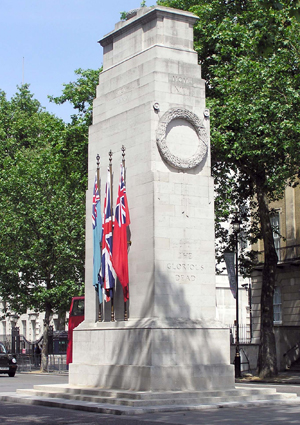
1. The Cenotaph – The most famous of London’s war memorials (pictured right), this simply designed – almost plain – monument stands in the middle of Whitehall and was designed by Sir Edwin Lutyens to commemorate the dead of World War I. It is here that the Queen and other dignitaries lay wreaths on Remembrance Sunday in remembrance of the war dead of both world wars.

2. The Monument to the Women of World War II – Located just along from the Cenotaph, this much criticised memorial marks the role more than seven million women played during World War II. Unveiled in 2005, the memorial was designed by John W. Mills and depicts a series of coats worn by women during the war hanging as though on pegs.

3. The Tower Hill Memorial – This memorial, which was originally unveiled in 1928 and then added to after World War II, commemorates the men and women of the merchant navy and fishing fleets who were killed in either world war and have no known grave. It lists more than 36,000 names. For more information, see www.cwgc.org/search/cemetery_details.aspx?cemetery=90002&mode=1.

4. The Battle of Britain Monument – Located on the north bank of the Thames at Victoria Embankment, this monument pays tribute to those who took part in the Battle of Britain during World War II. Sculpted by Paul Day, it features scenes from the battle in high relief bronze with virtually life-sized statues of airmen scrambling to their aircraft at its centre. Unveiled on 18th September, 2005, the 65th anniversary of the battle. For more information, see www.bbm.org.uk

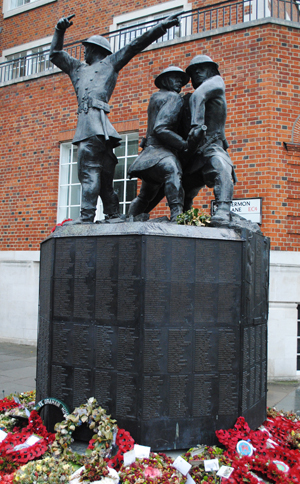
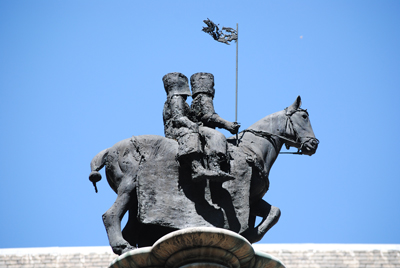
5. The National Firefighters Memorial – Marking the role played by firefighters during the Blitz of London in World War II (as well as the role of firefighters generally), the memorial (pictured right) was designed by John Mills and features the “Blitz” statue – two life-sized firefighters and an officer cast in bronze – standing atop a plinth. First unveiled in by Queen Elizabeth II in 1991, it originally featured the names of 997 men and women who died during the Blitz inscribed upon it but this was extended to include firefighters who have died in peacetime and an additional 1192 names were added prior to a rededication in 2003. Located just south of St Paul’s on the main route to the Millennium Bridge, it is the focus of the annual Firefighters Day of Remembrance held each September. For more information, see www.firefightersmemorial.co.uk.

6. The Animals in War Memorial – Commemorating all the animals that died alongside British, Commonwealth and Allied forces during the wars and conflicts of the 20th century, this unusual monument at Brook Gate in Park Lane was unveiled in 2004. The sculptures include two mules, a horse and a dog all cast in bronze while other animals are depicted in bas-relief on a wall of Portland stone. For more information, see www.animalsinwar.org.uk

7. Canada Memorial – Located in Green Park (just inside Canada Gate), the memorial, designed by Quebec artist Pierre Granche, honors the more than 100,000 Canadians who died in the world wars as well as the more than one million who served. Made of red granite inset with bronze maple leaves, it was designed to create the impression of maple leaves floating down a stream. Unveiled by Queen Elizabeth II in 1994.  www.vac-acc.gc.ca/remembers/sub.cfm?source=memorials/ww2mem/green-park-memorial

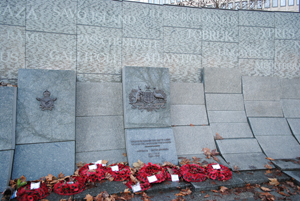
8. Australian War Memorial – Located close to Wellington Arch at Hyde Park Corner, this monumental wall (pictured right) marks the role Australians played in both World Wars. More than 100,000 Australians died during the conflicts and the names of the 23,844 towns in which they were born are inscribed on the wall over which is superimposed the names of 47 battles in which Australians fought in. Unveiled on the 85th anniversary of Armistice Day, 2003. For more information, see www.awmlondon.gov.au.

9. New Zealand War Memorial – Located at Hyde Park Corner diagonally opposite the Australian War Memorial, this monument was designed by architect John Hardwick-Smith and sculptor Paul Dibble and features 16 bronze cross-shaped ‘standards’ of varying heights set in formation and inscribed with text, patterns and some small sculptures. Dedicated on Armistice Day, 2006, by Queen Elizabeth II.

10. Soviet War Memorial – Found in the Geraldine Mary Harmsworth Park – adjacent to the Imperial War Museum in Southwark, the Soviet War Memorial was unveiled in 1999. Designed by sculptor Sergei Shcherbakov, it commemorates the 27 million people who died in the Soviet Union during World War II. For more information, see www.scrss.org.uk/sovietmemorial.htm.

Around London – HMS Belfast restored, Buckingham Palace record, plumber’s new statue

• The HMS Belfast’s newly restored masts were unveiled to the public this week following an 18 month restoration project. Moored on the Thames between Tower and London Bridges, the ship is one of only a few surviving Royal Navy ships that served in Arctic convoys supplying Russia during World War II. The restoration was carried out for free by a team of more than 20 men and women from the JSC Shipbuilding plant, Severnaya Verf, in St Petersburg, Russia as a tribute to the British and Allied sailors who risked their lives on the convoys. The work involved removed and replacing all of the masts. For more information, see http://hmsbelfast.iwm.org.uk.

A record 413,000 people visited Buckingham Palace over the summer – the highest number in 16 years. The record numbers were partly ascribed to the new Garden Cafe which served 46,000 cups of tea. Meanwhile, the palace has announced the exhibition, Victoria & Albert: Art & Love, at the Queen’s Gallery has been extended until 5th December. For more information, see www.royalcollection.org.uk.

• The Worshipful Company of Plumbers has reportedly announced it will be installing a bronze statue of a plumbers’ apprentice outside Cannon Street station next year. The statue’s installation will  mark 400 years since the company first received its Royal Charter from King James I. The station was the site of the company’s livery hall until 1863 when the site was compulsorily acquired to make way for the new railway.

Around London…

A 9 ft (2.7 metre) tall bronze statue of Air Chief Marshal Sir Keith Park, commander of the RAF in London and the south-east during the Battle of Britain, was unveiled in Waterloo Place, just off Pall Mall, this week. Sir Keith, a New Zealander who joined the RAF after fighting at Gallipoli and the Somme during World War I, was described as the “brain” behind London’s air defences. The unveiling of the statue on Battle of Britain Day (12th September) follows a three year campaign to honor Sir Keith, who died in 1975, with such a monument. A prototype of the statue occupied the Fourth Plinth at Trafalgar Square for six months after it was unveiled in November last year. For more information, see www.sirkeithpark.com.

Spend a night at the museum (well, part of one anyway). The Natural History Museum is opening its doors for one night only as part of European Researchers’ Night on Friday, 24th September. Scientists will be on hand to chat and there will be opportunities to see rare specimens not usually on display including a giant squid. There will also be three bars offering drinks and food. The event, which we can promise won’t include you being chased down hallways by dinosaur skeletons, runs from 4pm – 10pm. For more information, see www.nhm.ac.uk.

Don’t forget! Open House London kicks off this weekend. For more information, see last week’s Around London post.

Wren’s London – 2. St Bride’s

While St Paul’s Cathedral is certainly his best-known work, Sir Christopher Wren designed 50 other churches in London in the wake of the Great Fire of 1666. Rather than look at each individually, we’ll just highlight a couple with the first being the “wedding cake” church, St Bride’s.

The site of St Bride’s has been home to at least eight churches, the first of which is believed to have been founded in the Dark Ages. Dedicated to the sixth century Irish nun St Bride – or St Bridget, the church – thanks to its location on Fleet Street – has had a long association with printers and later newspapers and journalists and, despite the fact most news organisations have long since departed the area, is still regarded as “the journalist’s church”.

The medieval St Bride’s was completely consumed in the Great Fire but a new church was opened in 1675 after works were carried out to Wren’s design (among his assistants on the job was Nicholas Hawksmoor who became a celebrated architect in his own right).

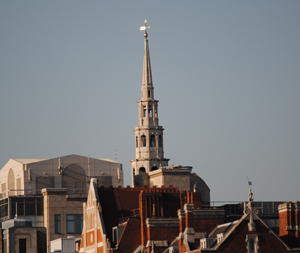
Despite the return of worshippers, however, the building remained unfinished and Wren was approached in the early 1680s about constructing the steeple. This was completed in 1703 and has become a London landmark with many believing its tiered design was the basis for the modern “wedding cake” design.

The steeple – at 226 feet or almost 70 metres, the tallest in London – was one of few things which survived after a firebomb destroyed much of the building during the Blitz in 1940. The church was subsequently restored according to Wren’s original designs (albeit with a shorter steeple than Wren’s original – eight feet or 2.4 metres were knocked off when it was struck by lightning in 1764.)

As well as its association with the printing industry and the press, these days St Bride’s is also notable for its US connections – the first American child of English descent, Virginia Dare, was the daughter of two former St Bride’s parishioners (there is a bust of Virgina above the font). The parents of Edward Winslow, three-time Governor of Plymouth in Massachusetts, were also married in St Bride’s.

The crypt contains remains dating back to Roman times.

WHERE: Fleet Street (nearest tube St Paul’s); WHEN: 8am to 6pm Monday to Friday, 11am to 3pm Saturday, 10am to 1pm and 5pm to 7.30pm Sunday; COST: Entry is free but guided tours are available on Tuesday afternoons at 3pm for £5 a person; WEBSITE: www.stbrides.com.

Marking 70 years since the Blitz began…

Today – 7th September – marks 70 years since the start of the Blitz when, between 7th September 1940 and 10th May 1941, more than 43,000 civilians were killed, at least 140,000 injured and an estimated million homes across the UK suffered damage or destruction as a result of air raids.

London, which suffered 57 consecutive nights of attacks starting on 7th September, features numerous memorials relating to World War II including the National Firefighters Memorial located on the Jubilee Walkway, just south of St Paul’s in the City. It depicts firefighters in action during the Blitz and serves as a tribute to those who fought against the fires caused by the raids as well as commemorating the lives of all firefighters who have died while on active duty. For more on the memorial, see www.firefightersmemorial.co.uk.

For a series of interesting reconstructed photos showing the difference between London during the Blitz and now, visit Sky News here. Or for more on the history of the Blitz, see the dedicated BBC website here. And for a terrific graphic showing fire brigade callouts in London on the first day of the Blitz, see The Guardian’s datablog.

Meanwhile, the London Transport Museum in Covent Garden has today opened a new exhibition, Under Attack, which explores the role public transport played during World War II in three cities – London and Coventry – both of which are marking 70 years since the start of the Blitz, and Dresden in Germany which is marking the 65th anniversary of the Dresden Firestorm. The exhibition, developed in conjunction with Coventry Transport Museum and the Verkehrsmuseum Dresden, runs until 31st March next year. For more details, visit www.ltmuseum.co.uk.

Around London…

• A 145-year-old replica of an Eleanor’s Cross was unveiled outside Charing Cross railway station last month following a major restoration. The monument, located near Trafalgar Square, was built in 1865 and was a copy of one of the 12 which were constructed by King Edward I to mark the route where the body of his wife Eleanor of Castile rested each night on its way to Westminster Abbey following her death in 1290. Only three of the original crosses remain intact – at Geddington north of Northamptonshire, Hardingstone near Northamptonshire, and Waltham Cross in Hertfordshire. The original monument at Charing Cross, which was demolished in 1647, marked the point from which distances are measured from London (a plaque now marks the site). The restoration involved replacing some 100 damaged and missing features. Due to deterioration, the monument has been hidden behind scaffolding for the past five years.

None of London’s Barclay bikes will be available to tourists until the end of the year, reports the London Evening Standard. The newspaper says plans to widen the scheme to allow tourists to hire the bikes have been put on hold after the emergence of logistical problems. The hire scheme was launched for locals at the end of July.

A new heritage trail has been opened at Kenley Common in the city’s outer south to commemorate the 70th anniversary of the Battle of Britain. The 56 hectare common in Surrey surrounds Kenley Airfield, a former Battle of Britain airfield these days used by the RAF for glider training. The trail, which was an initiative of a range of organisations including the Kenley Airfield Friends Group, RAF Association, Tandridge District Council, English Heritage, the Ministry of Defence and City of London Corporation, kicks off at the RAF Tribute on Kenley Common (off Hayes Lane in Surrey) and features a series of interpretative panels, the first two of which are mounted on scaled down Spitfire wings. These explain the role the area played in defending London from attacks and the significance of the tribute and the World War II blast pens. For more information, follow this link. For information on London’s Battle of Britain memorial, head here www.bbm.org.uk.

10 sites in London you may not know about – 3. Temple Church

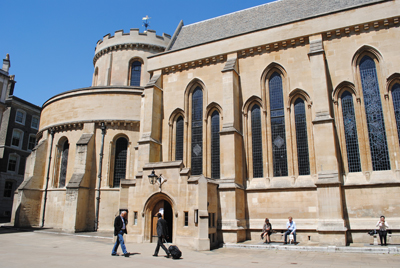
Located just outside the west end of the medieval city walls, the Temple Church is an anomaly in a city where, thanks to the Great Fire of 1666, few medieval churches remain.

First consecrated in 1185, the church – like all Templar churches – features a round nave – known as the Round Church – modelled on that of the Holy Sepulchre in Jerusalem. It adjoins a ‘Hall Church’ which features three bays dating from the 13th century.

While they have been moved several times, the Round Church contains a number of tomb effigies including those believed to be that of William Marshall, 1st Earl of Pembroke and one of the towering figures of the 12th and early 13th centuries.

It also features a series of faces around the outer wall (these were renewed and replaced in the 1820s), each of which shows a different and, at times, plain odd expression.

The church is located in the midst of what was once a large landholding – located between Fleet Street and the Thames – once owned by the Templar Knights which included quarters for the knights and serjeants. Following the disbanding of the order in early 1300s, the Temple Church passed into the hands of the Knights Hospitaller and then became the property of the Crown during the 16th century reformation.

In 1608, James I granted all the Templar’s land to the societies of the Inner and Middle Temple, two of London’s Inns of Court – the inns are still dedicated to housing those studying and practising law and it’s the inns which maintain the church today.

One of the most famous figures connected to the church is Richard Hooker, Master of the Temple between 1585-91, and author of Of The Laws of Ecclesiastical Polity, an important document in Anglican theological thought.

Christopher Wren also left his mark here – he refurbished the church’s interior in the 1670s although much of work was later removed – as did World War II – the roof of the Round Church was brought down during the Blitz.

Make sure you pop in for one of the free organ recitals which are held over lunchtimes each Wednesday.

WHERE: Off Fleet Street and down Inner Temple Lane (nearest tube station is Temple); WHEN: Check website for times; COST: £4 (free to under 18s and seniors); WEBSITE: www.templechurch.com