Around London: Talking rubbish; Conan Doyle’s lost manuscript; John Martin’s apocalypse; and, Postmodernism at the V&A…

Twenty-five talking rubbish bins will be installed in Westminster City Council area as part of a campaign to encourage people to use them more. The rubbish bins, which will look no different from normal bins, will start chatting from 13th October and will be in London for two months before embarking on a UK tour after which they may become permanent fixtures. Each bin will have a unique respond when used – from singing a part of the Hallelujah Chorus to a blast of the trombone and will be tailored to suit their location (Covent Garden’s, for example, will be operatic in nature). The talking bins, which are also being trialled in Liverpool, are being put on the streets as part of Keep Britain Tidy’s Love Where You Live initiative.

A hitherto unpublished novel by Arthur Conan Doyle – creator of Sherlock Holmes – was published by the British Library this week. The Narrative of John Smith was Conan Doyle’s first novel and was written between 1883 and 1884 but the manuscript was lost on the way to the publishers. Conan Doyle rewrote it from memory but never resubmitted the work for publication. It serves as a rare insight into his creative development prior to his writing of more famous works like those featuring Holmes (the new book and an audio CD featuring Robert Lindsay, are available from the library shop). The library is also hosting an exhibition of related items in the Treasures Gallery, including one of the four notebooks that comprise the manuscript of The Narrative of John Smith, letters Conan Doyle wrote to his mother, and a “scientific and monthly magazine” he created when he was just 16. The exhibition is open until 5th January. The library is also hosting an event in which author Anthony Horowitz – commissioned by the Conan Doyle Estate to write a new Sherlock Holmes novel, The House of Silk, which will be published in November – will talk about his work and the new novel. To be held on 27th November from 2.30pm to 4pm (admission charge applies). For more, see www.bl.uk.

On Now: John Martin: Apocalypse. The Tate Britain is hosting an exhibition featuring the works of nineteenth century British artist John Martin, in the first show dedicated to his works in more than 30 years. While something of an outsider, Martin was a key figure in the art world of his day, known for his “dramatic scenes of apocalyptic destruction and biblical disaster”. The exhibition brings together some of his most famous paintings as well as previously unseen and newly restored works. Admission charge applies. Runs until 15th January. For more, see www.tate.org.uk/britain/.

• On Now: Postmodernism: Style and Subversion 1970-1990. An “in-depth survey of art, design and architecture of the 1970s and 1980s”, this exhibition at the Victoria & Albert Museum shows how postmodernism evolved from being merely a provocative architectural movement in the 1970s through to ideas that went on to broadly influence popular culture – everything from art and film to music and fashion. The exhibition is divided into three broad chronological sections – the first focuses on architecture, the second on the “proliferation of postmodernism through design, art, music, fashion, performance, and club culture during the 1980s” and the third on the “hyper-inflated commodity culture of the 1980s”. Admission charge applies. Runs until 15th January, 2012. For more, see www.vam.ac.uk.

Around London – Open House London; Magna Carta on display; Fashion Week photography; and, Henry Moore returns to Greenwich…

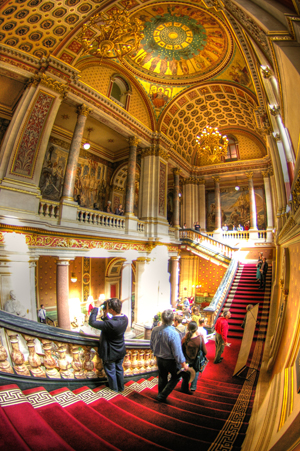
It’s Open House London weekend again and there’s scores of properties across the city which will be opening their doors to allow the curious a rare glimpse inside. The properties which will be open include architect’s homes and cutting edge housing as well as historic city landmarks, landscape projects and government buildings (including the Foreign Office & India Office – pictured). Other highlights of this year’s event – conducted under the theme of ‘The Liveable City’ –  include a night hike, a festival aimed at kids and families, talks, walks and cycle tours and competitions. Among the buildings flinging their doors wide are Lambeth Palace, home of the Archbishop of Canterbury, livery company halls, the newly reopened St Pancras Renaissance Hotel and the Bevis Marks Synagogue in the City. Most properties can simply be visited on a first come, first in basis but some do require advance booking so check before you go. Open House London was first started 19 years ago and has since spread to many other cities around the world including New York, Jerusalem and Helsinki. For more information and to purchase an online guide, see www.londonopenhouse.org. PICTURE: (c) Nick Woodford.

• King Edward I’s Magna Carta will go on show at the Guildhall Art Gallery in the City this weekend, presenting a rare opportunity to see this pivotal document. The City of London Corporations 1297 Magna Carta – regarded as one of the finest 13th century copies – will be on display in the Roman Amphitheatre during Open House London. The document features King Edward I’s seal and the original writ to the Sheriffs of London ordered that the charter be promulgated within the City. Admission over the weekend is free. For more see, www.guildhallartgallery.cityoflondon.gov.uk/gag/


The Museum of London has launched an online collection of early Twentieth century fashion photographs to coincide with London Fashion Week. The more than 3,000 glass negative plates come from the collection of Bassano Limited, founded by Italian-born Alexander B. Bassano, and were taken between 1912 and 1945. They record a wide range of fashions as well as designers and retailers and can be accessed via the Museum’s Collections online web portal. Meanwhile, the museum is hosting it’s first ever professional catwalk show on Friday night. It features the works of Christopher Raeburn. For more, see www.museumoflondon.org.uk.

A Henry Moore sculpture, Large Standing Figure: Knife Edge, has been returned to Greenwich Park, more than four years after it was removed. The almost five metres tall sculpture, made by Moore in 1976, was originally placed in the park in 1979 but was removed for conservation in early 2007 before joining a Moore exhibition at Kew Gardens and then forming part of the Henry Moore display at the Yorkshire Sculpture Park. The bronze, on loan from The Henry Moore Foundation for two years, has now been returned to its original location between The Avenue and Croom’s Hill Gate.

What’s in a name?…Whitechapel

An area of the East End of London which has become synonymous with the Jack the Ripper murders of the late 1880s, the origins of the name Whitechapel actually lie much further back in history.

The name dates back to the 14th century when the church of St Mary Matfelon (or Matfelun) was built on what is now the corner of Whitechapel High Street and Adler Street. The church, which was known as the “white chapel” apparently thanks to the white stone used in the walls, was apparently first constructed the mid 13th century and is said to have been named after a prominent local family. It became the parish church of Whitechapel in the 14th century.

Rebuilt and extended several times over the ensuing centuries – including in 1673 and the 1870s, it was bombed during the Blitz in 1940 and ultimately finally removed in 1952. The site where it once stood is now the Altab Ali Park, named after a young Bangladeshi man who was murdered in a racially motivated attack in Adler Street in 1978.

Whitechapel originally stood along the road, which from Roman times ran from London to Colchester. The fact it stood outside the city walls meant it to became home to some of the city’s more undesirable businesses including slaughterhouses, tanneries and breweries.

Greater numbers of poor came into the area from Middle Ages onwards and by the mid-1800s it was one of London’s most crowded, poorest and disease ridden areas, known for its immigrant population and for its rising levels of crime.

This reputation was only solidified in 1888 when the killings of the so-called murderer Jack the Ripper garnered worldwide attention for the brutal slayings of at least five women (some believe the figure should be much higher). Speculation still surrounds the Ripper’s identity.

These days, Whitechapel – along with many inner city areas – is undergoing a gentrification process and is now known as something of a hub for art and music as well as home to a street market in Brick Lane.

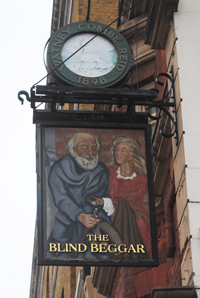
Ripperology aside, other notable landmarks include The Blind Beggar pub in Whitechapel Road (it was here gangster Ronnie Kray shot George Cornell in 1966; its sign is pictured above) and the Whitechapel Bell Foundry (described in the Guinness Book of Records as Britain’s oldest manufacturing company, it was founded in 1570 and among the most famous bells cast there are the US Liberty Bell (1752) Big Ben (1858) – stay tuned for our upcoming ‘London’s Oldest’ entry).

The area is also home to the internationally renowned Whitechapel Gallery on the corner of Brick Lane and Whitechapel High Street and the East London Mosque, one of the largest in the UK.

Around London – National Maritime Museum expands; new galleries proposed for British Museum; Festival of British Archaeology in London; and, the London Street Photography Festival…

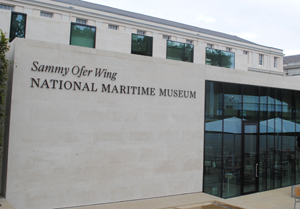
The National Maritime Museum in Greenwich opened the doors of its new £36.5 million Sammy Ofer Wing today. The new, architecturally slick extension – which is being touted as bringing with it a change of direction in the way the museum operates – features a new permanent gallery known as Voyages as well as a temporary exhibition space, library and archive. There’s also a lounge, cafe and brasserie – the latter boasting views out over Greenwich Park. The Voyages gallery has been designed as an introduction to the museum and features a 30 metre long thematic ‘object wall’ hosting more than 200 objects – everything from a letter written by Horatio Nelson to his mistress Emma Hamilton while he was on board the Victory in 1803 through to a watch belonging to Robert Douglas Norman – among those who perished on the Titanic, and a somewhat battered Punch puppet. The special exhibition space initially hosts High Arctic which uses technology to create an “immersive environment” exploring the Arctic world from the perspective of the future. The museum is also introducing the Compass Card scheme, a new initiative which will eventually be rolled out across the museum. Visitors are presented with a unique card with which, by inserting it into special units placed in galleries, they can flag their interest in receiving further information on a specified subject. The card can then be used to call up related archival information in the museum’s Compass Lounge or using the visitor’s home computer. For more information, see www.nmm.ac.uk.

The British Museum has announced funding has been secured for two new gallery spaces. These will include a new gallery looking at the history of world money from 2000 BC to present day. Known as the Citi Money Gallery, it will be opened in 2012. A donation from Paul and Jill Ruddock, meanwhile, means the museum will also be working on a major redisplay of Room 41 which covers the Mediterranean and Europe from 300 to 1,100 AD. The artefacts in the room include treasures taken from Sutton Hoo and the Vale of York Viking Hoard. The gallery will open in 2013/14. For more, see www.britishmuseum.org.

Now On: Festival of British Archaeology. Coordinated by the Council for British Archaeology, the 21st festival (formerly known as National Archaeology Week) kicks off this weekend and runs until the end of July. It boasts more than 800 events across Britain including in London where they include guided tours of the Rose Theatre, a range of Roman themed events and activities – including a gladiator show – at the Museum of London, gallery talks at the Bank of England Museum and British Museum, the chance to visit the Billingsgate Roman House and Baths, and a guided walk of Londinium (Roman London) organised by All Hallows by the Tower. For a complete events listing, see http://festival.britarch.ac.uk/.

Now OnThe London Street Photography Festival is running until the end of the month with a series of exhibitions, talks, walks and workshops, the majority of which are taking place in and around King’s Cross. Key events include Street Markets of London in the 1940s – Walter Joseph featuring never before seen images at the British Library, Vivien Maier: A Life Uncovered at the German Gymnasium, and Seen/Unseen – George Georgiou and Mimi Mollica at the Collective Gallery. For more information, see www.londonstreetphotographyfestival.org.

Around London – Ronald Reagan unveiled, two ways in Pall Mall, Hungarian photography at the RA, and a celebration of the Arab world…

A new statue of former US President Ronald Reagan was unveiled in Grosvenor Square near the US embassy on Monday, 4th July. The 10 foot tall bronze statue of the president, who died in 2004, was unveiled at a private ceremony by the Foreign Secretary William Hague – former US Secretary of State Condoleezza Rice were also among the more than 2,000 people who attended along with current US ambassador Louis Susman (a frail Margaret Thatcher was reportedly too frail to attend). Commissioned by the Ronald Reagan Presidential Foundation, the statue is the work of sculptor Chas Fagan. Its unveiling is one of a series of events marking the centenary of the birth of the former actor turned politician.

Pall Mall and St James Street in the West End were opened to two-way traffic this week for the first time in 50 years. The changeover came into effect last Sunday morning. The roads were made one-way in 1963 under a scheme to deal with increasing traffic in the area. But it has been reopened in the first stage of a £14 million overhaul of traffic around Piccadilly Circus – home to world-famous neon billboards and the Eros Statue. The area is visited by 200,000 every day.

Time to get your togs on. Scores of swimmers will be taking the plunge at the Hampstead Heath Lido tomorrow and Saturday to raise funds for the Lord Mayor’s Appeal, Bear Necessities. A 4,000 metre swim, the City Dip, will be swum by teams and individuals with every swimmer receiving a commemorative certificate and medal. The current Lord Mayor of London is Michael Bear. To sign up or for more information, see  www.lordmayorsappeal.org.uk/dip

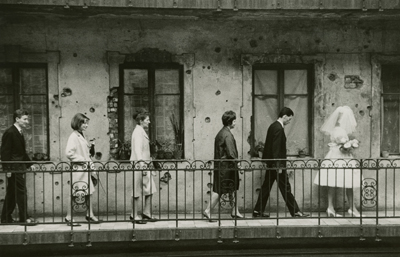
On Now: Eyewitness: Hungarian Photography in the 20th Century – Brassaï, Capa, Kertész, Moholy-Nagy, MunkácsiThis new exhibition at the Royal Academy of the Arts at Burlington House in Piccadilly, organised to mark the Hungarian Presidency of the EU, is dedicated to the birth of modern photography and features the work of Brassaï, Robert Capa, André Kertész, László Moholy-Nagy and Martin Munkácsi. It comprises more than 200 photographs, dating from 1914 to 1989, which usually form part of the collection of the Hungarian National Museum of Photography as well as the National Museum in Budapest and other public and private collections in both Hungary and the UK. Runs until 2nd October. For more information, see www.royalacademy.org.ukPICTURE: Laszlo Fejes, Wedding, Budapest, 1965, Copyright Hungarian Museum of Photography.

On Now: Shubbak: A Window on Contemporary Arab Culture. London’s first ever celebration of contemporary culture from across the Arab world will feature more than 100 artists involved in 70 events at some 30 venues over the weeks until 24th July. The program includes visual arts, film, music, theatre, dance, literature, architecture, lectures and discussions with many events boasting free admission. Highlights include A Girl in her Room, an exhibition of photo works by highly acclaimed Lebanese/American artist, Rania Matar, at the Mosaic Rooms, one of London’s leading centres for Arab contemporary arts (runs until 23rd July), Shopopolis, a series of collaborations with shoppers at Westfield Shopping Centre (runs until 24th July) and this weekend’s Interference, a series of free films, talks and workshops at the ICA curated by Mathaf: Arab Museum of Modern Art in Doha. For full details of all events, see www.london.gov.uk/shubbak.

Around London – Website to showcase UK’s oil paintings; Arctic explorer John Rae gets Blue Plaque; sharing experiences of kindness; and Toulouse-Lautrec and Jane Avril hit the Courtauld…

• A new website has been launched to showcase the UK’s vast national collection of oil paintings. While the website, which is a partnership between the BBC, the Public Catalogue Foundation, and participating collections and museums, currently hosts around 60,000 works, it is envisaged that by the end of 2012 it will carry digitised images of all 200,000 oil paintings in the UK (in an indicator of how many there are, the National Gallery currently has around 2,300 oil paintings, about one hundredth of all those in the nation). The works on the site will eventually include almost 40,000 by British artists. The 850 galleries and organisations participating so far include 11 in London – among them the National Gallery, the Tate Gallery, the Victoria and Albert Museum, the Bank of England, the Imperial War Museum and Dr Johnson’s House. For more, see www.bbc.co.uk/arts/yourpaintings/

• Arctic explorer John Rae has had a Blue Plaque unveiled in his honor at his former home in Holland Park. Although his feats were relatively unsung in his lifetime, the explorer’s expeditions in the Canadian Arctic saw him travel 13,000 miles by boat and foot and survey more than 1,700 miles of coastline. He is also credited with having “signposted” the only north-west passage around America that is navigable without icebreakers. Rae, who died in 1893, lived at the property at 4 Lower Addison Gardens in Holland Park for the last 24 years of his life.

Transport For London is calling on Londoners to share experiences of “kindness” that they have witnessed or participated in while travelling on the Underground. Artist Michael Landy has created a series of posters which are calling on people to submit their stories. Some of the stories will then be shown at Central Line stations (the first four posters go up on 23rd July at stations including Hollard Park, Holborn and Liverpool Street). For more, go to www.tfl.gov.uk/art.

On the Olympic front, the City of London Corporation has announced Tower Bridge will be bedecked with a set of giant Olympic Rings and the Paralympic Agitos during the 45 days of next year’s Games. Meanwhile, the Corporation has also unveiled it will host next week the launch of a London-wide campaign to get people involved in sport and activity in the lead-up to the Games. More to come on that.

On Now: Toulouse-Lautrec and Jane Avril Beyond the Moulin Rouge. The Courtauld Gallery, based at Somerset House, is running an exhibition celebrating the “remarkable creative partnership” between Jane Avril, a star of the Moulin Rouge in Paris during the 1890s, and artist Henri de Toulouse-Lautrec. Lautrec created a series of posters featuring Avril which ensured she became a symbol of Lautrec’s world of “dancers, cabaret singers, musicians and prostitutes”. Runs until 18th September. See www.courtauld.ac.uk for more.


King James I’s London – 6. The Queen’s House, Greenwich

Long an admired landmark of Greenwich, the origins of the Queen’s House go back to the reign of King James I.

It was the Queen, Anne of Denmark, who commissioned the building of The Queen’s House in 1616 and gave it the name by which it is still known. Sadly, however, she died before it was completed.

King James I was said to have been a frequent visitor to the Tudor Palace of Greenwich (the building had earlier been known as the Palace of Placentia and was the birthplace of King Henry VIII in 1491).

King James  is traditionally said to have awarded the Manor of Greenwich to Queen Anne as an apology after he had publicly sworn at her when she had accidentally shot one of his favorite hunting dogs.

In 1616, Queen Anne decided to build a new property on the site as both a private retreat and a place where she could entertain and it was to the rising star Inigo Jones that she turned to for the design (in recognition of his growing status, he was appointed Surveyor of the King’s Works the following year).

The house was Jones’ most important job to date and the design he came up – based on a H with the two sides joined by a bridge over the Greenwich to Woolwich road – with is said to be the first Classical building in England.

Among the original features which survive to this day are the striking black and white geometrically patterned marble floor of the Great Hall (the room having been designed as a perfect cube), the painted ceiling of the Queen’s Presence Chamber and the iron balustrade the Tulip Stairs – said to be the first “geometric self-supporting spiral stair in Britain”.

Queen Anne became ill in 1618 and died the following year without seeing the end result of her commission. The work subsequently was shelved and only restarted (and completed in 1638) after King Charles I gave it to his wife, Queen Henrietta Maria.

She only had possession for a short time before Parliamentary forces seized it during the Civil War. After the Restoration, the Queen’s House was returned briefly to her by her son King Charles II (it was at this time that the original H-shape of the house was altered to a square) before part of it as later used as studio for painters and then as grace and favor apartments.

With the Old Royal Naval College now occupying the surrounding site, in 1805, King George III gave the property to the Royal Naval Asylum – a charity caring for the orphan children of seamen – and it later became part of the Royal Hospital School.

The National Maritime Museum took possession in 1934 and the building now houses the National Martime Museum’s collection of fine art. As an interesting aside, there have been several reported sightings of ghosts in the house, the latest as recently as 2002.

WHERE: The Queen’s House, National Maritime Museum, Greenwich (nearest DLR station is Cutty Sark); WHEN: 10am to 5pm daily (check website for closures); COST: Free; WEBSITE: www.nmm.ac.uk/places/queens-house

Treasures of London – ‘The Ambassadors’

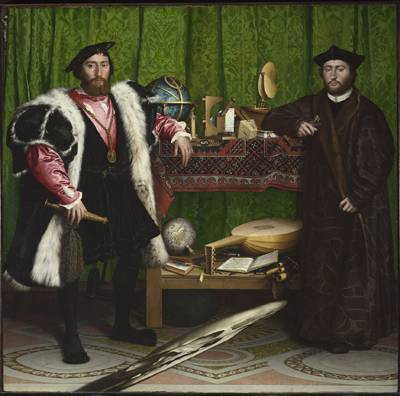
A stunning portrait on a grand scale, The Ambassadors depicts two influential figures from the 16th century – Jean de Dinteville, the then 29-year-old French ambassador to England and Georges de Selve, the then 25-year-old bishop of Lavaur and sometime French ambassador to the Emperor, the Venetian Republic and the Holy See.

The oil on oak work, which is housed in room four of the National Gallery and is also one of the images featured online as part of the Google Art Project, was painted by Hans Holbein the Younger in 1533 and is meant as a portrait to show the men’s power, learning and wealth – they are surrounded by objects which include celestial and terrestrial globes, a portable sundial, a lute (and its case), and books including one of hymns and another of arithmetic as well as richly decorated furnishings.

Yet there’s more to this painting than initially meets the eye – a closer look reveals a distorted skull in the foreground which, when viewed from the painting’s right-hand side comes into its proper perspective. A reflection on mortality perhaps?

And though no typically viewed as a religious work, there are also some striking religious overtones to this image including a broken string on the lyre – often seen as a Christian symbol of disharmony – and, partly hidden behind the curtain on the far left of the painting as you look at it, a crucifix hanging on the wall.

Holbein painted the work during his second stint in England while depicting life at the Tudor court. Among his most famous other images are one of King Henry VIII (held in the National Portrait Gallery) and another of Christina of Denmark (also in the National Gallery – painted to show Henry VIII the image of a potential future wife although the relationship never went any further than that).

PICTURE: Ng1314, Hans Holbein the Younger, Detail of Jean de Dinteville and George de Selve (‘The Ambassadors’), 1533 © The National Gallery, London.

WHERE: Room 4, National Gallery, Trafalgar Square (nearest tube stations Leicester Square and Charing Cross); WHEN: 10am to 6pm (Fridays 10am to 9pm); COST: Free; WEBSITE: www.nationalgallery.org.uk. The image is also available online as part of the Google Art Project here:www.googleartproject.com/museums/nationalgallery/the-ambassadors.

Around London – Happy St Patrick’s Day; 18th century workhouse saved; David Gestetner honored; and, Watteau’s drawings…

• First-up, we’d like to wish you all a happy St Patrick’s Day! And if you missed the St Patrick’s Day Parade and free festival in London last Sunday, don’t worry, there’s still plenty of Irish cheer on the city streets with the London Eye and Battersea Power Station both turning green to mark the occasion while the green beer is flowing at the city’s many Irish pubs.

The building some believe served as a model for the workhouse in Charles Dickens’ novel Oliver Twist has been saved from demolition with a Grade II listing. Completed in 1778, the Covent Garden Workhouse in Cleveland Street became the workhouse of The Strand Poor Law Union in 1836 and was later used as an infirmary before more recently serving as the outpatients department of the Middlesex Hospital. The workhouse is believed to the most well preserved of the three surviving 18th century workhouses in London. Announcing the listing this week, John Penrose, Minister for Heritage and Tourism, said that while it is unknown whether or not the building was the inspiration for the workhouse featured in Oliver Twist, “we know that it is the sole survivor of the workhouses  that were operating in the capital when Dickens wrote his famous novel and that as a young man he lived just nine doors along from it”. Simon Thurley, chief executive of English Heritage, said the listing also recognised the association between the workhouse and Dr Joseph Rogers, whose direct experience of the workhouse when working as Chief Medical Officer led him to launch important reforms of the system of healthcare provision for the poor.

David Gestetner, a key player in the development of office copying technology, has been commemorated with a blue plaque outside his former residence at 124 Highbury New Park in Islington. The Hungarian-born Gestetner lived at the property for 41 years until his death in 1939. The plaque was unveiled on Tuesday by two of his great grand-children.

On Now: Watteau: The Drawings. The first retrospective exhibition of the drawings of French artist Jean-Antoine Watteau opened last Saturday at the Royal Academy of Arts. Watteau is known for inventing the genre of fetes galantes (small pictures of social gatherings of elegant people in parkland settings) and for his mastery of the ‘three chalks’ or trois crayons technique using red, black and white. The exhibition features more than 80 works on paper. There is an admission charge. Runs until 5th June. See http://www.royalacademy.org.uk for more information.

Around London – Sir John Soane’s private apartments to be restored; Highland cattle to return to Richmond; and two new photographic exhibitions…

• An appeal has been launched to raise the final £500,000 of a £7 million project to restore Sir John Soane’s private apartments in his former home overlooking Lincoln’s Inn Fields in Holborn. Phase one of the three year restoration project, Opening up the Soane, is expected to be complete by late 2012 with the entire project – which will see all of the rooms open to the public – to be completed by 2o14. The eight rooms being restored in the project, all of which are located on the second floor of No. 13 Lincoln’s Inn Fields – one of three adjoining properties Soane owned , include the architect’s bedroom, bathroom, oratory and book passage as well as Mrs Soane’s morning room and a room containing Soane’s architectural models. The building  already contains the Sir John Soane Museum which features an eclectic and at time outright strange mix of artefacts Soane, designer of the Bank of England (although it has since been substantially altered), collected during his lifetime. For more information, see www.soane.org.

Highland cattle will return to Richmond Park in autumn to help create patches of bare ground for wildflowers to grow after the success of a recent grazing trial. Richmond Park has the most extensive area of natural grassland in London and the type of grassland – known as ‘acid grassland’ – is a nationally rare habitat. Richmond Park is already home to 650 red and fallow deer. For more information, see www.royalparks.org.uk.

On Now – A new exhibition of street photography in London has just opened at the Museum of London. London Street Photography showcases 200 candid images of everyday life in the city with images ranging from sepia-toned scenes of horse-drawn cabs captured by tripod mounted cameras through to the use of digital cameras in snapping images of 21st century residents. Among the 59 photographers whose work is on display is that of Paul Martin, who pioneered the idea of candid street photography in London in the early 1890s, freelance photojournalist Henry Grant who photographed London’s streets in the Fifties and Sixties, and Stephen McLaren, known for his contemporary “quirky and colorful” street images. Entry is free. The exhibition runs until 4th September. For more information, see www.museumoflondon.org.uk.

On Now – The first major exhibition in 30 years of the work of EO Hoppe has opened at the National Portrait Gallery. Hoppe, who lived from 1878 to 1972, is considered one of the most important photographers of the early 20th century and is described as the “prototypical celebrity photographer”, shooting among others Margot Fonteyn, George Bernard Shaw, King George V, David Lloyd George and Ezra Pound. He also published the Book of Fair Women – photographs of women he believed to be the most beautiful of earth – in 1922 and in the Twenties and Thirties increasinly spent time outside the studio photographing street life. Hoppe Portraits: Society, Studio and Street runs until 30th May. For more information, see www.npg.org.uk.

Around London – Year of the Rabbit celebrations; virtual art galleries; and, to the moon and back on ‘Boris bikes’

London will celebrate Chinese New Year this Sunday as it once again hosts the largest celebrations outside of Asia attracting some 250,000 people from around the globe. The event programme, which celebrates 2011 as the Year of the Rabbit, kicks off at 11am on the main stage in Trafalgar Square with firecrackers at noon, a Lion and Dragon performance at 1.10pm and dance and song during the afternoon culminating in a finale just before 6pm. There will also be a stage in Shaftesbury Avenue with performances throughout the day. Roads in the area will be closed for the event.

You no longer have to be in London to walk through the galleries of the Tate Britain or the National Gallery. Both institutions are among 17 around the world taking part in the Google Art Project which allows web surfers to virtually “walk” around the museum using the organisation’s Street View technology and turn 360 degrees to view the artworks in situ on the walls. The project also allows viewers to look through images of more than 1,000 artworks and, in addition, each institution has selected one artwork which then captured in “super high resolution” and then placed on line (Hans Holbein’s The Ambassadors‘ for the National Gallery, Chris Ofili’s No Woman, No Cry for the Tate). See www.googleartproject.com for more.

Cyclists have ridden the distance to the moon and back 13 times – 10 million kilometres – since the launch of Mayor Boris Johnson’s cycle scheme. Transport for London released figures this week showing riders have made more than 2.5 million journeys on the “Boris bikes” since the scheme was launched six months ago. The TfL has announced plans to expand the Barclays Cycle Hire scheme to new areas of east London including all of the Borough of Tower Hamlets, North Shoreditch, Bethnal Green, Bow, Canary Wharf, Mile End and Poplar by spring 2012. Almost 110,000 people are now signed up to the scheme. www.tfl.gov.uk.

The youngest Spitfire pilot in the Battle of Britain is to be granted the Freedom of the City of London in a special ceremony next month. Squadron Leader Geoffrey Wellum was awarded the Distinguished Flying Cross for his service in a front line squadron during the battle.

Around London – Dulwich celebrates 200 years, and Tube life captured on lens…

The Dulwich Picture Gallery  in south London is celebrating its bicentenary this year and to celebrate it’s holding a day of celebrations on Sunday (9th January). The gallery was founded in 1811 when art dealer Sir Francis Bourgeois bequeathed his collection of old masters for the “inspection of the public”. Interestingly, Sir Francis and his colleague Noel Desenfans had assembled the collection at the behest of the Polish King, Stanislaus Augustus, but when Poland was annexed by Russia and the king forced into exile, the two dealers were left with the goods. Sunday’s programme of events includes music, falconry displays and a family costume workshop as well as fireworks. For more information, see www.dulwichpicturegallery.org.uk.

Artist Belinda Dawley had captured life on the Underground with a series of photographs of people riding the escalators. Called, appropriately enough, Escalators, the work features portraits of travellers on 14 different escalators. To see the image, head to www.belindalawley.com.