10 sites from London at the time of the Magna Carta – 5. Lambeth Palace…

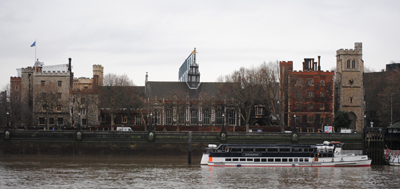
Lambeth-palaceThe London residence of the Archbishop of Canterbury, Lambeth Palace was first acquired by the archbishopric in around the year 1200 with Archbishop Stephen Langdon – an important figure in the whole Magna Carta saga – believed to be the first to have lived there.
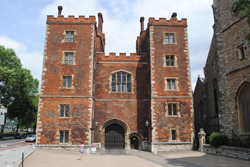
Lambeth-Palace2The complex built in the early 13th century included a chapel, a great hall, a ‘great chamber’ where the archbishop would receive guests, and private apartments for Archbishop Langdon, who was appointed to the archbishopric in 1207 and remained in the post until his death in 1228 (his appointment was a major point of contention between King John and Pope Innocent III and a key factor in the dispute which led to the creation of the Magna Carta).

Not much remains of the original palace but the sections that do include the originally free-standing Langdon’s Chapel (although now much altered and connected to the rest of the complex) and the crypt beneath it (described as one of the best preserved medieval stone vaults in London it is now a chapel but was originally used for the storage of wine and beer).

They are both believed to have been completed in about 1220 with the other buildings now present added later over the centuries.

These include the formidable red brick gatehouse that fronts the complex today – known as Morton’s Tower, it is named after Archbishop Cardinal John Morton and dates from 1490 – while the Guard Room, which has its origins in the archbishop’s ‘great chamber’, dates from the 14th century and the infamous Lollard’s Tower – used as a prison in the 17th century – from the 15th century.

The Great Hall – now used as a library, first established in 1610 – was rebuilt in the mid 17th century although it is believed to stand on the site of that first used by Langdon (we’ll deal more with the later history of Lambeth Palace in a later post).

WHERE: Lambeth Palace, corner of Lambeth Palace Road and Lambeth Road (nearest tube stations are Westminster, Waterloo, Vauxhall, and Lambeth North); WHEN: Guided tours (90 minutes) only – check website for details; COST: £12 a person plus £2.95 booking fee (under 17s are free); WEBSITE: www.archbishopofcanterbury.org/pages/about-lambeth-palace.html.
10 sites from London at the time of the Magna Carta – 4. Thorney Island…

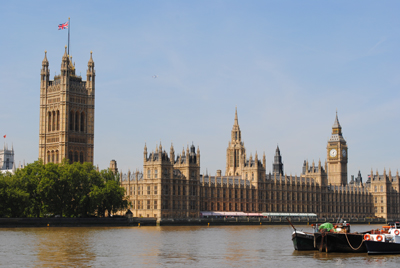
Houses-of-Parliament2 Both Westminster Abbey and the Palace of Westminster (these days better known as the Houses of Parliament – pictured) pre-date 1215 but unlike today in 1215 the upon which they stood was known as Thorney Island.

Formed by two branches of the Tyburn River as they ran down to the River Thames, Thorney Island (a small, marshy island apparently named for the thorny plants which once grew there) filled the space between them and the Thames (and remained so until the Tyburn’s branches were covered over).

One branch entered the Thames in what is now Whitehall, just to the north of where Westminster Bridge; another apparently to the south of the abbey, along the route of what is now Great College Street. (Yet another branch apparently entered the river near Vauxhall Bridge).

The abbey’s origins go back to Saxon times when what was initially a small church – apparently named after St Peter – was built on the site. By 960AD it had become a Benedictine monastery and, lying west of what was then the Saxon city in Lundenwic, it become known as the “west minster” (St Paul’s, in the city, was known as “east minster”) and a royal church.

The origins of the Palace of Westminster don’t go back quite as far but it was the Dane King Canute, who ruled from 1016 to 1035, who was the first king to build a palace here. It apparently burnt down but was subsequently rebuilt by King Edward the Confessor as part of a grand new palace-abbey complex.

For it was King Edward, of course, who also built the first grand version of Westminster Abbey, a project he started soon after his accession in 1042. It was consecrated in 1065, a year before his death and he was buried there the following year (his bones still lie inside the shrine which was created during the reign of King Henry III when he was undertaking a major rebuild of the minster).

Old Palace Yard dates from Edward’s rebuild – it connected his palace with his new abbey – while New Palace Yard, which lies at the north end of Westminster Hall, was named ‘new’ when it was constructed with the hall by King William II (William Rufus) in the late 11th century.

Westminster gained an important boost in becoming the pre-eminent seat of government in the kingdom when King Henry II established a secondary treasury here (the main treasury had traditionally been in Winchester, the old capital in Saxon times) and established the law courts in Westminster Hall.

King John, meanwhile, followed his father in helping to establish London as the centre of government and moved the Exchequer here. He also followed the tradition, by then well-established, by being crowned in Westminster Abbey in 1199 and it was also in the abbey that he married his second wife, Isabella, daughter of Count of Angouleme, the following year. 

10 sites from London at the time of the Magna Carta – 2. St Bartholomew the Great…

St Bartholomew the Great in Smithfield – the oldest parish church in London (see our earlier piece here) – is worth a revisit thanks to the fact that it would have been standing (at least partially) when the seal of King John was first affixed to the Magna Carta .

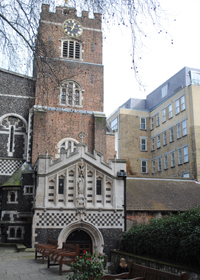
St-BartholomewsOnly half the size it once was, this church was founded in 1123 AD as the priory church for a community of Augustinian Canons and owes its origins to Rahere, a favored courtier of King Henry I who renounced his way of life and made a pilgrimage to Rome, returning to found both the church and nearby hospital for the poor.

Only the eastern part of the church was built by the time of the death of Rahere – the first prior – in 1145 and the building continued for some years afterward. While the interior walls now look somewhat plain, they would have been highly decorated when the building was originally constructed. At the time of the Magna Carta, the church would have only been partly completed.

The tomb of Rahere still lies within the church, on the left hand side of the altar – although the canopy over it dates from the 15th century. There were some healing miracles recorded at the tomb.

The church’s current configuration came about when the priory was dissolved in 1539 and the nave of the church was pulled down, leaving what’s there now – the quire, altar and lady chapel.

The brick tower at the church’s west end dates from the 1620s while the gateway through which you enter the church grounds features a restored 13th century arch topped by a late Tudor building.

The church was briefly used by some Dominican friars but since the reign of Queen Elizabeth I has fulfilled the role of parish church. A concerted restoration effort began in the mid-19th century by Sir Aston Webb (architect of the Victoria & Albert Museum), leaving the Lady Chapel with a very different feel to the Norman choir. The building is now Grade I-listed.

WHERE: Off Little Britain, West Smithfield (nearest tube station is Barbican); WHEN: 8.30am to 5pm Monday to Friday, 10.30am to 4pm Saturday, 8.30am to 8pm Sunday (except for services) ; COST: £4 an adult/£3.50 concession/£10 a family; WEBSITE: www.greatstbarts.com

10 sites from London at the time of the Magna Carta – 1. The Tower…

This week we’re starting a new series in honour of the 800th anniversary of the signing of the Magna Carta in which we look back at the London of 1215. First up we take a look at the Tower of London which was a smaller version of the complex of buildings which today exists on the site.

By 1215, the Tower of London – the fortress first constructed on the orders of William the Conqueror – had already existed for more than 100 years, nestled into a corner of the city’s walls which had existed since Roman times.

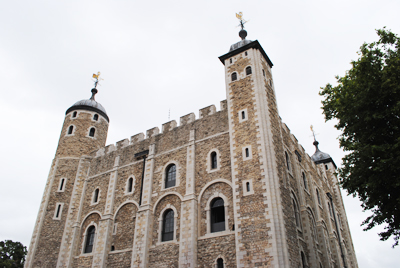
Then, as now, the White Tower – initially itself known as the Tower of London, it was later dubbed the White Tower thanks to the whitewash used to cover the Kentish limestone to protect it from the weather (and for its visual impact) – stood at the heart of the complex. Unlike today’s building, it lacked the large windows which date from the early 18th century, and while the towers were believed to be capped with cones, the present cupolas date from the reign of King Henry VIII.

White-Tower

While it had long been surrounded by a palisade and ditch, in 1189, King Richard I’s chancellor William Longchamp, the Bishop of Ely, had begun to extend the castle’s defences while the king was on crusade (in fact, the first siege of the Tower took place in 1191 when the then Prince John did so in opposition to Longchamp’s  regime – it only lasted three days before Longchamp surrendered).

This extension, which was completed by King John following his accession to the throne in 1199, saw the size of the bailey around the White Tower doubled and a new curtain wall and towers – including the Bell Tower – built around its outer perimeter with a ditch below (the ruins of the Wardrobe Tower, just to the east of the White Tower show where the original Roman-era wall ran).

But it wasn’t until the reign of King John’s son, King Henry III, that the royal palace which now stands on the river side of the White Tower was constructed. Until that point – and at the time of the signing of the Magna Carta – the royal apartments remained within the White Tower itself, located on the upper floor.

Like those of the garrison commander known as the constable (located on the entrance level), the king’s apartments would have consisted of a hall and a large chamber, which may have been divided into smaller chambers with wooden partitions as well as a chapel (on the upper level this was the still existing Chapel of St John the Evangelist, although it would have then been more more richly decorated). Unlike the lower levels, the king’s level was of double height with a gallery (this level now has its own full floor).

The royal apartments had a variety of uses – as well as a residence and refuge for the king, they were also at times a place to keep high profile prisoners such as the Bishop of Durham, Ranulf Flambard, who was imprisoned on the orders of King Henry I (and who escaped from an upper window on a rope which had been smuggled in to him and fled to Normandy).

It is also worth noting that while King John apparently kept exotic animals at the Tower, it is his son, King Henry III who is usually credited with founding the Royal Menagerie there.

And it was his son, King Edward I, who expanded the Tower to its current size of  about 18 acres by rebuilding the western section of the inner ward and adding the outer ward.

WHERE: Tower of London (nearest Tube station Tower Hill); WHEN: 9am to 5.30pm, Tuesday to Saturday, 10am to 5.30pm Sunday to Monday; COST: £24.50 adults; £11 children under 15; £18.70 concessions; £60.70 for a family (discounts for online purchases/memberships); WEBSITE: www.hrp.org.uk/toweroflondon/.  

Lost London – Baynard’s Castle (part 2)…

Having previously looked at the Norman fortification (razed by King John in 1213 – see our earlier post here), this time we’re taking a look at the later (medieval) fortification known as Baynard’s Castle.

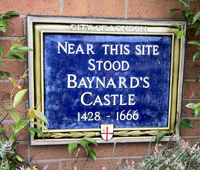
Baynard's-CastleIn the 1300s, a mansion was constructed about 100 metres east of where the castle had originally stood on a riverfront site which had been reclaimed from the Thames. This was apparently destroyed by fire before being rebuilt in the 1420s and it became the seat of the House of York during the Wars of the Roses. King Edward IV was proclaimed king here in 1461 and King Richard III was offered the crown here in 1483 (a moment famously captured by William Shakespeare).

King Henry VII transformed the fortified mansion into a royal palace at the start of the 16th century – adding a series of towers – and his son, King Henry VIII, gave it to the ill-fated Catherine of Aragon when they married. The Queen subsequently took up residence (Anne Boleyn and Anne of Cleves also resided here when queen – the latter was the last member of the royal family to use it as a permanent home).

After King Henry VIII’s death, the palace passed into the hands of the Earl of Pembroke (brother-in-law of Queen Catherine Parr, Henry’s surviving Queen) who substantially extended it, adding ranges around a second courtyard. In 1553, both Lady Jane Grey and Queen Mary I were proclaimed queen here. Queen Elizabeth I was another royal visitor to the palace, entertained with a fireworks display when she did.

It was left untouched during the Civil War (the Pembrokes were Parliamentarians) but following the Restoration, it was occupied by the Royalist Earl of Shrewsbury (among his visitors was King Charles II). It wasn’t to be for long however – the palace was largely destroyed in the Great Fire of 1666, although remnants of the building, including one or two of the towers, continued to be used for various purposes until the site was finally cleared in the 1800s to make way for warehouses.

The site in Queen Victoria Street in Blackfriars (the area is named for the monastery built on the site of the Norman castle) is now occupied by the Brutalist building named Baynard House. The castle is also commemorated in Castle Baynard Street and Castle Baynard Ward.

It was discovered in archaeological excavations in the 197os that the castle’s waterfront wall had been built on top of the Roman riverside city wall.

PICTURE: © Copyright Andrew Abbott