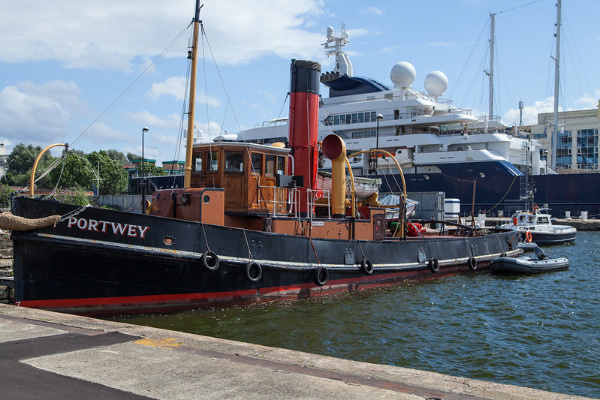
HMS Belfast is one of London’s star tourist sites. But what are some of the other vessels moored in the Thames? In this series, we’re taking a look at the history behind 10 other vessels, starting with PSTattershall Castle.
Now a floating restaurant moored off Victoria Embankment, the steam-driven, steel-hulled PS Tattershall Castle was constructed by the West Hartlepool-based company William Gray & Company as a ferry. Its name comes from a castle in Lincolnshire built in the first half of the 15th century/
Launched on 25th September, 1934, with a license to carry 1,000 people, the 209 foot-long ferry was one of three sister ships – the others being the PSWingfield Castle (now a museum ship in Hartlepool) and the PSLincoln Castle – which were built to transport passengers along the Humber between Kingston upon Hull, in Yorkshire, and New Holland, in Lincolnshire. It could make eight trips a day and could carry vehicles and livestock.
World War II broke out not long after her launch and the ferry was used to transport troops and supplies along the Humber. Due to the heavy fogs on the river, the Tattershall Castle became one of the first civilian vessels to be equipped with radar.
Following the war and the 1948 nationalisation of the railways, the PS Tattershall Castle became part of part of British Rail’s Sealink service. In 1973, the vessel, with repairs deemed too costly, was retired from service.
Subsequently towed to London, the PS Tattershall Castle was converted into a floating art gallery which was formally opened by the Lord Mayor of London on 27th February, 1975.
In 1981, the former ferry was acquired by the Chef & Brewer Group. After some repairs on the River Medway, she was opened in 1982 as a bar restaurant.
There have been several refits since, the most recent being in 2015, when the former ferry was returned to Hull for some £1.5 million work to be carried out. The former ferry is typically moored off Victoria Embankment opposite the London Eye.
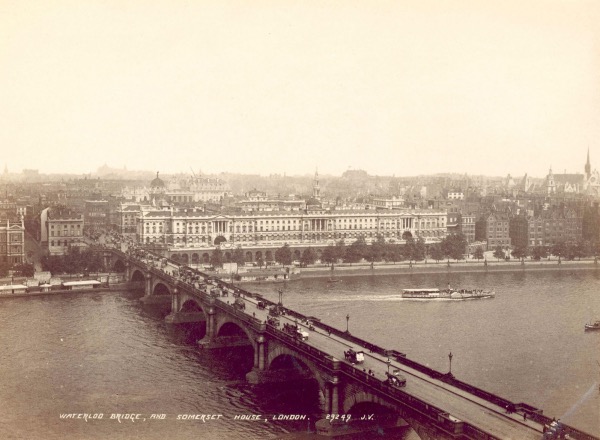
Waterloo Bridge between 1865-1875. PICTURE: Valentine, J, Universitaire Bibliotheken Leiden/licensed under CC BY 4.0)
Built between 1813 and 1817, the first Waterloo Bridge was designed by Scottish civil engineer John Rennie and featured nine elliptical arches, pairs of Doric columns at the piers and a flat roadway.
Originally known as The Strand Bridge, the name was changed by an Act of Parliament in 1816 and commemorated the victory over Napoleon Boneparte at the Battle of Waterloo in 1815.
It was opened by the Prince Regent, accompanied by the Duke of Wellington, on 18th June, 1817 – the second anniversary of the battle.
The bridge originally featured toll booths – the toll was removed in 1877.
In the early 20th century, piers from the bridge settled into the riverbed and created a dip, possibly due to the increasing traffic using it. A temporary steel bridge was placed alongside it and, despite opposition, it was eventually demolished in 1936.
The current bridge, designed by Sir Giles Gilbert Scott, was built over the years 1937 to 1942 (although it wasn’t fully completed until 1945).
Old Waterloo Bridge was famously depicted in a series of works by Claude Monet painted between 1900 and 1904 while he stayed at the Savoy Hotel and by John Constable who created a famous painting of its opening (it’s actually his largest work). The bridge also lends its name to the 1940 American film, Waterloo Bridge, which was adapted from a 1930 play.
Interestingly, granite blocks from the original bridge were sent to Australia and New Zealand while timbers from the bridge were used for shelves and wall panels in the library at Anglesey Abbey in Cambridgeshire (where the famous Constable painting hangs). Some of the original blocks were also incorporated into the foundations and approaches of the new bridge.
The keystone from the original bridge, recovered when it was demolished, is located at the Institution of Civil Engineers in Great George Street.
• Paintings and sculptures by artists including Cézanne, Van Gogh, Rodin, Picasso, Matisse, Klimt, Kandinsky and Mondrian opens at The National Gallery on Saturday.After Impressionism: Inventing Modern Art features more than 100 paintings and sculptures from museums and private collections around the world spanning the period between 1886 and 1914. Highlights include André Derain’s La Danse, Edgar Degas’s Dancers in the Foyer, Paul Cézanne’s Grandes Baigneuses, Edvard Munch’s The Death Bed, Paul Gauguin’s Vision of the Sermon, Camille Claudel’s Imploration / l’Implorante, and Lovis Corinth’s Nana, Female Nude. Admission charge applies. Runs until 13th August. For more, see www.nationalgallery.org.uk/exhibitions/after-impressionism-inventing-modern-art.
• Sir David Attenborough has planted an English oak tree to officially open the Platinum Jubilee Woodland, a new woodland in Richmond Park. The woodland has been created as part of The Queen’s Green Canopy initiative to celebrate and honour the late Queen Elizabeth II’s lifetime of service. Some 70 young trees have been planted in the woodland, including oak, Dutch elm-disease-resistant elm, small-leaved lime, and sweet chestnut trees, planted around a focal point which will later incorporate a seating area. Sir David’s tree is one of the last to be planted as part of The Queen’s Green Canopy initiative which concludes on 31st March. The project invited people from across the nation to plant trees in honour of Queen Elizabeth II to mark the Platinum Jubilee and benefit future generations. For more on the park, see www.royalparks.org.uk/parks/richmond-park.
• Illustrative works by William Heath Robinson, Charles Robinson and Thomas Health Robinson, many of which have not be exhibited before, are on show in a new exhibition at the Heath Robinson Museum in Pinner. The works, which come from the collection of Martin and Joanne Verden, include original drawings for Railway Ribaldry and William Heath Robinson’s How to… series of books. Admission charge applies. Runs until 21st May. For more, see www.heathrobinsonmuseum.org.
Send all items for inclusion to exploringlondon@gmail.com.
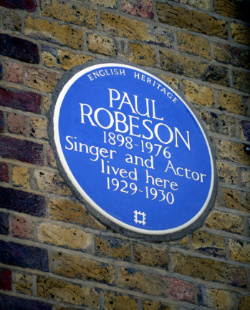
Walk the streets of London and chances are you’ll soon come across an English Heritage Blue Plaque commemorating someone famous.
There are now more than 990 Blue Plaques in London, commemorating everyone from diarist Samuel Pepys to writer Virginia Woolf and comedian Tony Hancock.
An English Heritage Blue Plaque commemorating singer and actor Paul Robson. PICTURE: Brett Jordan/Unsplash
The scheme was started in 1866 by the Society of Arts (later the Royal Society of Arts) having been proposed by MP William Ewart three years before. The first two plaques were erected in 1867 – one commemorating poet Lord Byron at his birthplace, 24 Holles Street in Cavendish Square (although this property was later demolished) and the other commemorating Napoleon III in King Street, Westminster (this is now the oldest survivor of the scheme).
Thirty-five years – and 35 plaques – later, the London County Council took over the scheme. It was this body that standardised the plaque’s appearance (early plaques come in various shapes and colours) and while ceramic blue plaques were standard by 1921, the modern simplified Blue Plaque didn’t appear until 1938 when an unnamed student at the Central School of Arts and Crafts, who was paid just four guineas for their troubles, came up with what is now an iconic design.
In 1965, the LCC, having created almost 250 new Blue Plaques, was abolished and its successor, the Greater London Council, took over the scheme, expanding its area of coverage to includes places like Richmond, Redbridge and Croydon. In 1984, the GLC appointed artisan ceramicists Frank and Sue Ashworth of London Plaques to make the Blue Plaques (and they continue to do so).
The GLC placed some 262 Blue Plaques before, in 1986, English Heritage took over management of the scheme. Since then it’s placed more than 360 plaques.
The plaques, which are 495mm (19½ inches) in diameter and 50mm (two inches) thick, are slightly domed in a bid to encourage self-cleaning in the rain.
Anyone can propose a subject for a new plaque – but generally only one plaque is erected per person (although there have been some exceptions to this), only a maximum of two plaques are allowed per building (there are 18 buildings with two), and proposals, if turned down, must wait 10 years before they are reconsidered.
In addition, new Blue Plaques are only erected a minimum of 20 years after the subject’s death, the building on which one is placed must “survive in a form that the commemorated person would have recognised, and be visible from a public highway”, and buildings which may have many different personal associations, such as churches, schools and theatres, are not normally considered.
The Blue Plaques panel meet three times a year to decide on proposals. Among those currently serving on the 12 person body are architectural historian Professor William Whyte, who chairs the panel, award-winning journalist and author Mihir Bose, Emily Gee, regional director for London and the South East at Historic England, and, Susie Thornberry, assistant director at Imperial War Museums.
The plaques don’t confer any legal protection to buildings but English Heritage says they can help preserve them through raising awareness.
Recently unveiled plaques have commemorated pioneering social research organisation Mass-Observation, lawyer Hersch Lauterpacht – who played a key role in prosecuting the Nazis at the Nuremberg trials, and, Dadabhai Naoroji, an Indian Nationalist and the first Indian to win a popular election to Parliament in the UK. Among those being unveiled this year are plaques commemorating anti-racist activist Claudia Jones, suffragette Emily Wilding Davison and Ada Salter, the first female mayor of a London borough.
English Heritage’s Blue Plaques scheme isn’t the only one commemorating people in London. Others include the City of London’s Blue Plaques scheme (there is only one English Heritage Blue Plaque in the City of London – it commemorates Dr Samuel Johnson), Westminster City Council’s Green Plaques and Heritage Foundation plaques which commemorate figures who worked in entertainment.
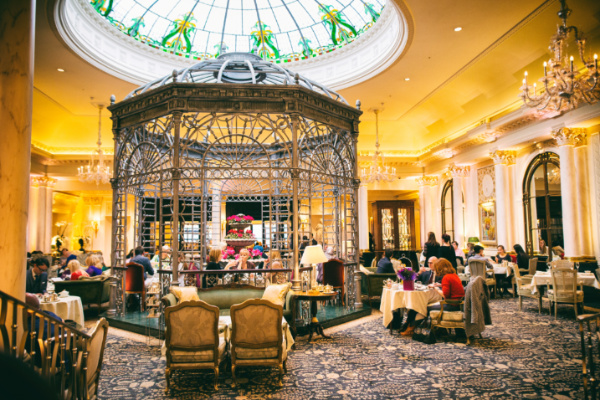
Afternoon tea is served under the glass-dome of The Savoy Hotel‘s Thames Foyer. Once an outdoor terrace, the covered-in foyer was opened in 1889. The custom of afternoon tea, which dates back to 1840, had become a tradition at the hotel by the 1920s and, as well as sandwiches and patisserie, included everything from English muffins to fruit salad, chocolates to sweet waffles known as gaufres. Entertainment included music played by a house band while professional dancers demonstrated the latest moves for guests. Guests at the famous London hotel have included everyone from Sir Winston Churchill to Marilyn Monroe. For more, see www.thesavoylondon.com/experience/afternoon-tea-london/.
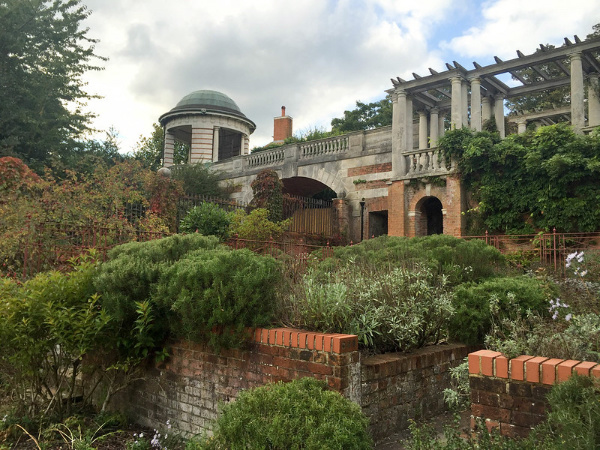
Tucked away in the north-west of Hampstead Heath is a Edwardian-era garden and extravagant pergola that were originally created for a mansion but are now open to the public.
The garden and pergola were created on the orders of the wealthy William H Lever, later Lord Leverhulme, who in 1904 purchased a sizeable Georgian townhouse on the Heath called “The Hill”. Remodelling the house extensively, Lever wanted to also create a garden where he could entertain and sought the help of renowned landscape architect Thomas Mawson to design one on what was steeply sloping land.
Mawson’s plan involved raising the level of the gardens by up to 30 feet and creating a series of terraces. This was made possible due in part to the close proximity of the Hampstead extension of the Northern Line of the Tube – Lever paid to have the spoil which had been dug out to make the Tube tunnels transported the short distance to his garden so it could be used to build it up.
An Italianate pergola was constructed on the boundary between 1905 and 1906, providing views over West Heath while at the same time preventing the general public from looking into the garden. The gardens and pergola were subsequently extended after he bought the neighbouring property in 1911 – the same year Lever was made a baronet – and again in with further works completed in 1925 just months before the now-Lord Leverhulme’s death.
The property was sold to Scots shipping magnate Lord Inverforth and, on his death in 1955, was bequeathed it to the private Manor House Hospital. Following a long period of neglect, London County Council bought the pergola and the gardens which had once been those of the neighbouring property, Heath Lodge, and opened them to the public in 1963 as the Hill Garden.
The City of London Corporation took over management with the abolition of the GLC in 1986 and restoration work was carried out. When the hospital closed in 1998 and the house was sold for luxury housing, further works were carried out and the public part of the gardens took on their current form.
• The Natural History Museum’s five acre site in South Kensington will be transformed into a free-to-visit green space under a new project. The Urban Nature Project will feature new outdoor galleries telling the story of life on Earth from 540 million years ago to the present day as it follows an immersive timeline of plants, trees, reptiles, birds and mammals. Children will come face-to-face with a giant bronze diplodocus surrounded by plants from the Jurassic period. The garden will also be home to scientific sensors gathering environmental DNA and acoustic data, to monitor, understand and protect urban nature. You can find out more and donate at www.nhm.ac.uk/support-us/urban-nature-project/donate.html.
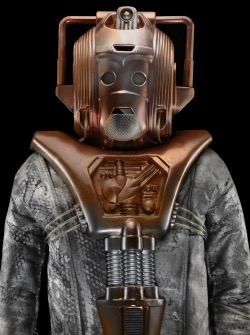
Cyberman costume as used in the T.V. series ‘Dr Who’ made by the BBC, London, c1988
• A new display exploring how the BBC developed and popularised new media has opened at the Science Museum in South Kensington.BBC at 100 features five iconic items from broadcast history that have influenced how we interact wth modern media platforms. They include a six foot tall 1988 Cyberman costume from Doctor Who, a World War II “Midget” Portable Disc Recorder developed to bring listeners close to the reality of conflict, and the BBC microcomputer developed during the Computer Literacy Project in the 1980s. The display, which is part of the Science Museum Group’s Broadcast 100 activities marking the 100th anniversary of the BBC and the 40th anniversary of Channel 4, to free to visit. For more, see www.sciencemuseum.org.uk/see-and-do/bbc-100.
• More than 36,000 sculptures on public display across the UK can be seen online. Art UK has photographed and digitised more than 13,500 outdoor sculptures as well as almost every sculpture inside public collections from the last 1,000 years. The project, which was funded with a £2.8million Heritage Fund grant and involved more than 500 photography and data volunteers, can be accessed at Art UK website.
Send all items for inclusion to exploringlondon@gmail.com.
The Admiral Vernon in Dagenham. PICTURE: Via Google Maps
This inter-war estate pub – which was recently added to the National Heritage List for England – is named for an 18th century British Navy admiral who is perhaps best remembered today for watering down his men’s ration rum to create what become known as ‘grog’ (apparently after his nickname).
Designed in the then-popular ‘Brewers’ Tudor-style, the pub was among several built by London’s Courage Brewery to serve the Beacontree Estate and the wood-panelled interior remains much as did when it first opened in 1939. The “almost intact” 1930s interior includes public and saloon bars, and publican’s offices behind the counter.
Admiral Edward Vernon had a long and distinguished naval career, first promoted to captain in 1706 and going on to serve as a vice-admiral during the War of Jenkin’s Ear between Britain and Spain (1739-48) – during which he famously captured the Spanish colonial possession of Porto Bello (after which the London district of Portobello is named). Promoted to the rank of admiral in 1745, he was appointed to command the North Sea Fleet during the Jacobite rebellion. Vernon, who also served as an MP, was cashiered out of the navy in 1746 in controversial circumstances after he published two pamphlets about his disagreements with the Admiralty.
Vernon’s nickname of “Old Grog” apparently came from his habit of wearing a grogram coat (grogram was coarse, loosely woven fabric of silk, silk and mohair, or silk and wool). In 1740 he ordered that his men’s rum be diluted with water and it duly became known as ‘grog’ after him.
The pub, which is located at 141 Broad Street, is Grade II heritage listed (the pub sign at the front is now empty – the name appears on the front facade). For more, see www.facebook.com/192074204220830.
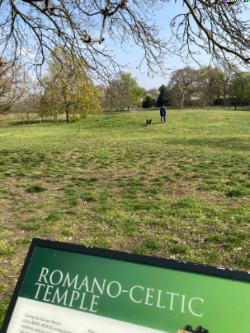
Although little now remains of it (and none to be seen above ground), a mound in Greenwich Park is thought to have once been the location of a Romano-Celtic temple.
Site of the temple remains in Greenwich Park. PICTURE: Matt Brown (licensed under CC BY 2.0)
Given its site close to Watling Street – the main Roman road linking London and the Kent ports, it’s believed that the temple may have served travellers as well as the local community. The Historic England listing for the ruins, which are a scheduled monument, suggests the temple was in use by 100AD and continued to be used until about 400AD.
The remains, which are now located on the eastern side of Greenwich Park on a site known as Queen Elizabeth’s Bower, was excavated in 1902 after they were stumbled across during works on the park. Three different floor surfaces were revealed, one of which was a tessellated pavement, along with the right arm of an almost life-sized statue, fragments of stone inscriptions and more than 300 coins dating between the 1st and 5th centuries.
A further excavation occurred in the early 1970s and another in 1999 – all of which provided further evidence of a temple.
Finds from the 1999 dig – which was undertaken by TV Channel Four’s ‘Time Team’, Birkbeck University of London and the Museum of London in the creation of a programme broadcast the following year – included part of an inscription to Jupiter and the spirits of the emperors and a stamped tile.
It is thought the temple precinct, known as a temenos, would have included a main temple building known as a cella as well as ancillary buildings and been surrounded by a stone wall.
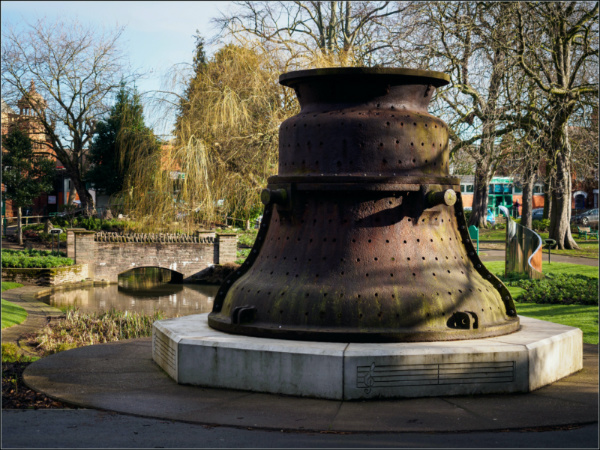
The bell casing used by Taylor’s Bell Foundry to cast Great Paul in Loughborough. PICTURE: Phil McIver (licensed under CC BY-NC 2.0)
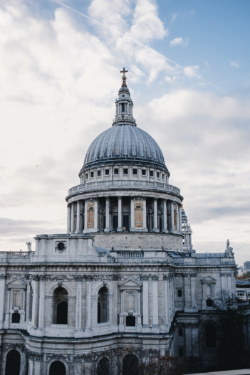
Not the name of a person, Great Paul is in fact the name of the largest of four bells in south-west tower of St Paul’s Cathedral.
The south-west tower at St Paul’s Cathedral which contains Great Paul. PICTURE: jan buchholtz (licensed under CC BY-NC-ND 2.0)
The bronze bell was cast in 1881 by JW Taylor of Taylor’s bell foundry in Loughborough. With a diameter of some 11 metres, it weighs an impressive 16.8 tons (in fact, untilthe casting of the Olympic Bell for the 2012 London Olympics, it was the largest bell in the UK).
Brought to London from Loughborough on a train over a period of 11 days, Great Paul was hung in the tower in May, 1882.
The bell was traditionally sounded at 1pm every day but was silent for more than 40 years after its ringing apparatus broke in the 1970s.
Following a restoration, Great Paul started being rung again last year when it was rung during a festival of church bells to mark the easing of COVID-19 restrictions. Earlier this year, it led a bell ringing tribute marking Queen Elizabeth II’s Platinum Jubilee.
Previous historic occasions on which the bell was rung included Queen Victoria’s Diamond Jubilee in 1897 and the marriage of Prince Charles and Lady Diana Spencer at the cathedral in 1981.
The south-east tower of the cathedral is also home to the storied bell known as Great Tom – but we’ll deal with that in a future post.
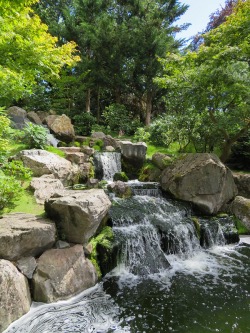
The garden was created in the summer of 1991 as a co-operative project between the Royal Borough of Kensington and Chelsea and the Kyoto Chamber of Commerce in Japan to coincide with the 1991 Japan Festival that marked the centenary of the Anglo-Japanese Society.
It was opened by the Prince Charles and, Naruhito, the Crown Prince of Japan, in September that year.
Designed by a renowned Japanese landscape architect Shoji Nakahara, it features a large pond complete with a tiered waterfall, a small bridge and stone lanterns. Among the plants are Japanese maple trees and Sakura trees while koi swim in the pond and peacocks roam the foliage.
The garden received a makeover in 2011.
Next to the garden is a second Japanese Garden, the Fukushima Memorial Garden, which was created in 2012 in recognition of the support the UK gave to the Prefecture of Fukushima following the 2011 tsunami.
WHERE: The Kyoto Garden, Holland Park (nearest Tube stations are Holland Park and Notting Hill Gate and nearest Overground is Kensington (Olympia)); WHEN: Daily, 7:30am until half an hour before dusk; COST: Free; WEBSITE: www.rbkc.gov.uk/leisure-and-culture/parks/holland-park.
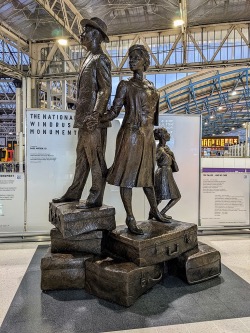
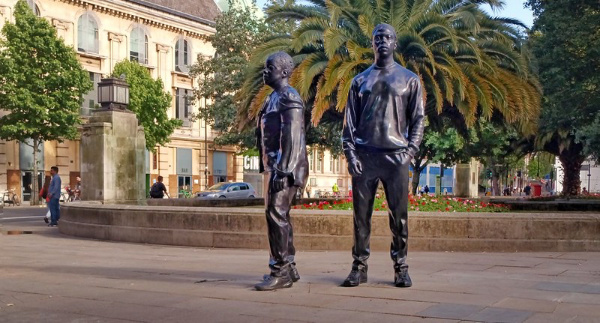
The National Windrush Monument (right) was unveiled at Waterloo Station on Windrush Day (23rd June). The bronze sculpture – the work of US-based Jamaican artist Basil Watson – memorialises the British West Indian immigrants who came to the UK on board HMT Empire Windrush in 1948 and later ships and who subsequently became known as the Windrush generation. Funded by a £1 million government grant, it depicts a man, woman and child who, dressed in their “Sunday best”, are climbing a pile of suitcases which represent all the possessions they brought with them. The memorial, which is located inside the station through which thousands of the Windrush Generation passed on their way to their new lives in the UK, was unveiled by the Duke and Duchess of Cambridge. Floella Benjamin, chair of the Windrush Commemoration Committee, reportedly said the monument will “act as a symbolic link to our past and a permanent reminder of our shared history and heritage for generations to come“. Meanwhile, a public bronze sculpture was unveiled outside Hackney Town Hall on the same day which also commemorates the Windrush generation. Warm Shores, the work of London artist Thomas J Price, depicts larger than life-sized a man and woman and was based on 3D scans of real-life residents.
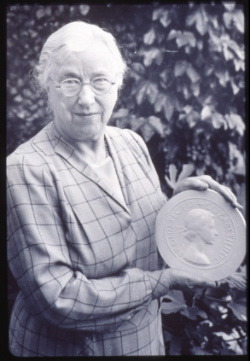
• A free display featuring the first coin bearing a portrait of Queen Elizabeth II has opened at the British Museum. Part of the celebrations marking the Queen’s Platinum Jubilee, The Asahi Shimbun Display Mary Gillick: modelling The Queen’s portrait showcases the production and reception of the coin which was designed in 1952 and released the following year. Gillick’s portrait – which remained in circulation on coins in the UK until the 1990s and was also adapted for use on commemorative stamps – combined modern design with Italian Renaissance influences. Can be seen until 31st July. For more, see www.britishmuseum.org.
• The UK’s first Stolperstein or “stumbling stone” has been installed in Soho as part of an initiative to remember the victims of the Nazis. The small brass plaque commemorates former resident Ada van Dantzig, a Dutch-Jewish paintings conservator for the National Gallery who came to London in the 1930s and worked and resided in Golden Square in Soho (where the plaque has been installed). She later re-joined her family in the Netherlands and was arrested in France in early 1943 along with her mother, father, sister and brother. Deported to Auschwitz, Ada, along with her parents, was murdered there on 14th February, 1943. Artist Gunter Demnig created the project almost 25 years ago to commemorate victims of Nazi Persecution during the Holocaust. More than 100,000 of stones have now been laid in 26 countries throughout Europe with the location of the stones the last address of those being remembered.
• A pioneering female landscape gardener has been honoured with an English Heritage Blue Plaque at her former flat in Shaftesbury Avenue. Fanny Wilkinson, who is believed to be Britain’s first professional female landscape gardener, was also a campaigner for the protection of open space in London. She lived and worked at the flat, which overlooks an open space she laid out herself, between 1885 and 1896. Wilkinson began her career as an honorary landscape gardener to the Metropolitan Public Boulevards, Gardens and Playgrounds Association – an organisation whose mission was the formation of gardens and public parks that would create playgrounds and green ‘lungs’, especially in poor districts of the capital. In June, 1885, it was agreed that she could charge five per cent on all her MPGA payments, leading her to drop the ‘honorary’ title and become Britain’s first professional female landscape gardener. For more, see www.english-heritage.org.uk/visit/blue-plaques/.
• A painting by Pablo Picasso – Woman with a Book (1932) from the Norton Simon Museum in Pasadena, California – and a painting by Jean-Auguste-Dominique Ingres – Madame Moitessier (1856) – are being shown together for the first time at The National Gallery. Picasso admired Ingres and referred to him throughout his career and this connection can be seen not only in his paintings but in drawings and studies he made during his ‘neoclassical’ phase in the 1920s. He encountered Madame Moitessie at an exhibition in Paris in 1921 and 11 years later painted Woman with a Book. The paintings, which are being show under a collaborative initiative between the two institutions, can be seen in Room 1 until 9th October. Admission is free. For more, see www.nationalgallery.org.uk.
Send all items for inclusion to exploringlondon@gmail.com
Another ‘oldest’ question that’s not as simple as it might seem.
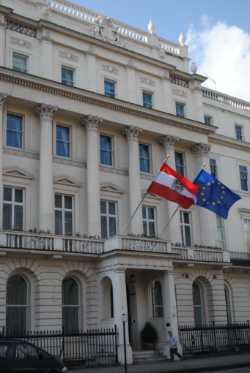
Austrian Embassy, Belgrave Square. PICTURE: David Adams
Austria has occupied a building at 18 Belgrave Square in Belgravia since it moved there from Chandos House in Queen Anne Street in 1866.
But the embassy was vacated with the outbreak of World War I and the building entrusted, firstly to the protection of the ambassador of the United States, and following the severing of their relations in 1917, to the Royal Swedish Legation.
The Austrians returned in 1920 but following Hitler’s incorporation of Austria into the German Reich in 1938, it was used as a department of the German Embassy.
Following the outbreak of World War II, the Swiss legation room over protection of the building and following the end of the war the damaged building fell under the care of Britain’s Ministry of Works.
The Austrians returned in September, 1948, with the new ambassador arriving in 1952. It continues today to serve as the residence of the Austrian Ambassador.
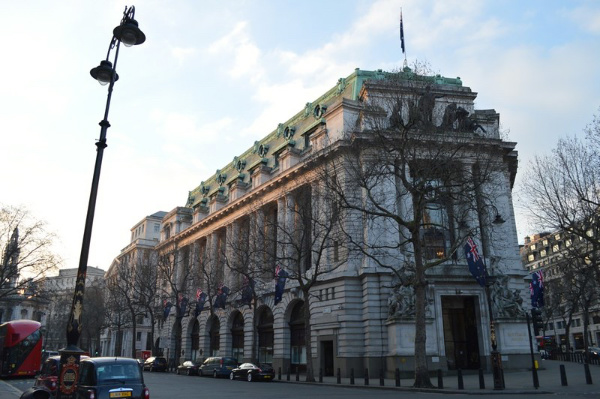
Not to be confused with the Austrians, the Australian High Commission resides in ‘Australia House’ which claims to be “the longest continuously occupied foreign mission in London”.
In 1912, the Australian Government bought the freehold of a site on the corner bounded by Strand, Aldwych and Melbourne Place. Following a design competition, Scottish architects A Marshal Mackenzie and Son were selected as the designers of the new Australia House with Commonwealth of Australia’s chief architect, Mr JS Murdoch, arriving in London to assist them.
Work began in 1913 – King George V laid the foundation stone – but was interrupted by World War I and in 1916, former Australian PM and now High Commissioner Andrew Fisher moved into temporary offices on the site even as the work continued around him. King George V officially opened Australia House on 3rd August, 1918, with then Australian Prime Minister, WM “Billy” Hughes, in attendance.
• Artworks from some of Beatrix Potter’s most famous storybooks and sketches of the real-life animals, places, art and literature that inspired them are at the heart of a new exhibition opening at the V&A in South Kensington on Saturday. Beatrix Potter: Drawn to Nature, which is being run in partnership with the National Trust, features more than 240 personal objects which also include rarely seen personal letters, family photographs, early sketchbooks, manuscripts and scientific drawings in a family friendly display exploring Potter’s passion for animals and the natural world. The display is spread across four sections: ‘Town and Country’ which provides the backdrop to her childhood in South Kensington in London; ‘Under the Microscope’ which highlights Potter’s interest in natural science; ‘A Natural Storyteller’ which reveals her “almost accidental journey to becoming a best-selling author”; and, ‘Living Nature’ which follows Potter to the Lake District and celebrates her profound impact on the natural landscape. The exhibition can be seen until 8th January next year. Admission charge applies. For more, see vam.ac.uk/exhibitions/beatrix-potter-drawn-to-nature.
• A rare copy of renowned theoretical physicist Stephen Hawking’s PhD thesis (one of only five known copies), his Permobil F3 modelwheelchair and a blackboard which hung on his office wall have gone on show at the Science Museum as part of a new exhibition on his working life.Stephen Hawking at Work also features his spectacles which were adapted to aid communication, a photograph from the set of Star Trek: The Next Generation where Hawking made a guest appearance, the insignia given to him on becoming a member of the Pontifical Academy of Sciences in 1986, and an invitation to a time travellers’ party Hawking hosted. The blackboard, one of Hawking’s most treasured possessions, came from a 1980 conference – Superspace and Supergravity – at which delegates covered it in equations, cartoons and jokes about each other. Hawking’s subsequently had the blackboard framed and hung in his office. The free display can be seen until 12th June. For more, see www.sciencemuseum.org.uk/stephen-hawking.
• Free immersive outdoor light installations and pop-up performances can be seen in the city’s centre over this half-term as part of the Mayor of London’s ongoing ‘Let’s Do London’ campaign. The events include ‘City Lights’ – an illuminated light trail in the City of London by internationally renowned artists including Colour by Light which invites people to use their smartphones to turn the city into a colourful canvas (11th to 20th February), free pop-up performances in the streets of central London including storytelling, puppetry, dance, and music (17th to 20th February) as well as discounts to West End shows and dining out. For other events and more information, head to www.visitlondon.com/things-to-do/lets-do-london.
Send all items for inclusion to exploringlondon@gmail.com.
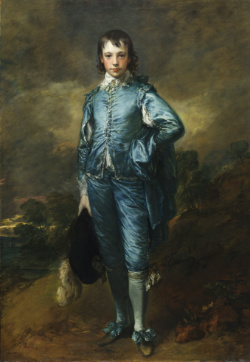
• A century after it last appeared in the UK, Thomas Gainsborough’s The Blue Boy returns to the National Gallery off Trafalgar Square from next Wednesday. The showing of the painting, which left for the United States in 1921 after it was purchased by rail and property businessman Henry E Huntington, marks the first (and possibly the last) time it has ever been lent out since that date. The full-length portrait, which was created in 1770 by Gainsborough during a period he spent in Bath, can usually be found at the Huntington Library, Art Museum, and Botanical Gardens in San Marino, California. The painting is being shown alongside four other works that, among other things, demonstrate Gainsborough’s interest in Flemish artist Sir Anthony van Dyck’s work from 100 years earlier. They include Van Dyck’s George Villiers, 2nd Duke of Buckingham and Lord Francis Villiers (1635) and Lord John Stuart and his Brother, Lord Bernard Stuart (about 1638) as Gainsborough’s works Elizabeth and Mary Linley (about 1772) and Mrs Siddons (1785). The display can be seen for free in Room 46 from 25th January until 15th May. For more, see nationalgallery.org.uk.
• An exhibition showcasing artwork from Heath Robinson’s children’s stories opened at the Heath Robinson Museum in Pinner last Saturday. Heath Robinson’s Children’s Stories features works from books including The Adventures of Uncle Lubin (1902), The Child’s Arabian Nights (1903), Bill the Minder (1912) and Peter Quip in Search of a Friend (1922). Entry is included in general admission charge. Runs until 15th May. For more, see www.heathrobinsonmuseum.org.
• Shortlisted and winning entries from The Architecture Drawing Prize 2020 and 2021 have gone on show at Sir John Soane’s Museum in Lincoln’s Inn Fields. The competition, run in partnership with Make Architects and the World Architecture Festival, is now in its fifth year with awards made across three categories – digital, hand-drawn and hybrid. Entry is free (pre booking required). Runs until 20th February. For more, see www.soane.org/exhibitions/architecture-drawing-prize-2021.
Send all items for inclusion to exploringlondon@gmail.com.
• The largest collection of Spitfires gathered under one roof can be seen at the Imperial War Museum Duxford’s AirSpace hall. Twelve of the iconic planes have been gathered at the airfield, often referred to as the “home of the Spitfire”. Spitfire: Evolution of an Icon, which is being accompanied by a programme of tours, talks, events and family activities, shows how the plane evolved throughout World War II in order to keep pace with German aircraft development. As well as the IWM’s iconic Mk Ia Spitfire, the display also features Mk V, Mk IX and Mk XIV models. The Spitfires be seen until 20th February. Admission charge applies. For more including details of events, head to www.iwm.org.uk/events/spitfire-evolution-of-an-icon.
• A new exhibition focused on photographs of iconic 70s and early 80s band The Jam opens at the City of London Corporation’s Barbican Music Library tomorrow.True is the Dream features the photography of Derek D’Souza who has captured the band and frontman Paul Weller, who went on to found The Style Council, on film over several decades. D’Souza’s work include a career-defining shoot of the band at Chiswick House. The display is free to see until 16th May. For more, see www.barbican.org.uk/whats-on/2022/event/true-is-the-dream.
• The Waterloo & City line has reopened following a brief closure over Christmas. The London Underground line, which connects Waterloo to Bank, was temporarily closed by Transport for London in late December following increasing COVID cases in the capital and the impact on staff absence. Meanwhile, the Bank branch of the Northern line (between Moorgate and Kennington) for 17 weeks from 15th January to allow for upgrade works.
Christmas is fast arriving so we went in search of some related monuments in London and found one depicting two famous characters from an iconic Yuletide text.
Located on the site of a house where 19th century writer Charles Dickens wrote six of his famous books, including A Christmas Carol, is a stone relief featuring several characters from them including Scrooge and Marley’s Ghost (represented as a door knocker in the top left).
The bas-relief is the work of Estcourt J “Jim” Clack and features a large portrait of Dickens as well as the characters who, alongside the characters from A Christmas Carol.
They apparently include Barnaby Rudge with his raven ‘Grip’ (from the book of the same name), Little Nell and Granddad (The Old Curiosity Shop), Dombey and his daughter Florence (Dombey and Son), Sairey Gamp (Martin Chuzzlewit), David Copperfield and Wikins Micawber (David Copperfield).
Correction: The name of Barnaby Rudge’s raven has been corrected.
• The largest collection of Faberge’s Imperial Easter eggs to be displayed together in a generation go on show at the V&A from Saturday. Fabergé in London: Romance to Revolution is the first major exhibition devoted to the international prominence of Russian goldsmith, Carl Fabergé, and his little-known London branch. Divided into three sections which cover everything from the techniques and detailing synonymous with the Faberge name to his time in London, the royal patronage he received, and the impact of the Great War and Russian Revolution on the business. The display features more than 200 objects with highlights including a prayer book gifted by Emperor Nicholas II to Empress Alexandra Feodorovna on his Coronation Day, the only known example of solid gold tea service crafted by Fabergé, a rare figurine of a veteran English soldier commissioned by King Edward VII, and a “kaleidoscopic display” of 15 of the Imperial Easter Eggs. The latter include several that have never before been shown in the UK including the largest Imperial Egg – the Moscow Kremlin Egg – which was inspired by the architecture of the Dormition Cathedral, the Alexander Palace Egg – which features watercolour portraits of the children of Nicholas II and Empress Alexandra and contains a model of the palace inside (pictured), the recently rediscovered Third Imperial Egg of 1887 (found by a scrap dealer in 2011) and Empress Alexandra Feodorovna’s Basket of Flowers Egg. Runs until 8th May. Admission charge applies. For more, see www.vam.ac.uk.
• The Royal Family’s relationship with the jeweller Garrard is the subject of a new exhibition which has opened in Kensington Palace’s ‘Jewel Room’. Going on display for the first time are examples of the firm’s ledgers which document royal commissions dating back to 1735 while other highlights include Queen Mary’s fringe tiara which was made in 1919 using diamonds taken from Queen Victoria’s wedding gift to Queen Mary and which was subsequently worn by Queen Elizabeth II on her wedding day. Admission charge applies. For more, see www.hrp.org.uk/kensington-palace.
• Botanical illustrations from the archives at Kew Gardens are brought to life on a canvas consisting of a selection of spectacular trees from the arboretum as part of this year’s Christmas display. Christmas at Kew also includes Spheric – a 15-metre-wide dome of light covered in more than 2,000 individually controlled LED pixels which sits on a reflective water pool and allows visitors to fully immerse themselves in a unique mirrored illusion as they cross the lake, a new installation for Holly Walk which will illuminate the night sky for over 200 metres overhead as it replicates the enchanting visual phenomenon of the Aurora Borealis, a vibrant rainbow tree illumination which brings to life the 12 Days of Christmas, and the ever-popular Fire Garden. The display can be seen until 9th January. Admission charge applies. For more, see www.kew.org.
Send all items for inclusion to exploringlondon@gmail.com.
Standing with Giants, a thought-provoking art installation at Hampton Court Palace, commemorates the lives lost in World War I and II and, in particular, the Indian soldiers who resided on the palace’s estate prior to the coronation of King Edward VII in 1902, and again for the World War I Victory Parade in London. The work of Oxfordshire artist Dan Barton and a dedicated group of volunteers, the work – located in the East Front gardens – features 100 almost life-sized silhouettes of soldiers and 75 screen-printed poppy wreaths along with an additional 25 specially commissioned silhouettes which represent the Indian soldiers. Almost 1,800 Indian Army officers, soldiers, and civilian workers sailed from India for the World War I Victory Parade and a camp was specially created to house them in the palace grounds in what was at the time one of the largest gatherings of people from India and South-East Asia ever assembled the UK. During their stay in London, the soldiers were treated to excursions in London and across the country which included trips to the Tower of London and a Chelsea football match. Alongside the display, a special trail map has been created to allow visitors to explore other aspects of the palace’s World War I history and former residents who took on roles ranging from frontline nurses to campaigners for improved care for injured veterans. One of the most poignant contributions the palace made to the war effort was the use of wood, supplied from an oak tree felled in Hampton Court’s Home Park, for the making of the coffin for the Unknown Soldier. Can be seen until 28th November. Admission charge applies. For more, see www.hrp.org.uk.