This Week in London – Spitfires at Duxford; The Jam in photos; and, Waterloo & City line reopens…

A Spitfire at IWM Duxford. PICTURE: Peter Bromley/Unsplash

The largest collection of Spitfires gathered under one roof can be seen at the Imperial War Museum Duxford’s AirSpace hall. Twelve of the iconic planes have been gathered at the airfield, often referred to as the “home of the Spitfire”. Spitfire: Evolution of an Icon, which is being accompanied by a programme of tours, talks, events and family activities, shows how the plane evolved throughout World War II in order to keep pace with German aircraft development. As well as the IWM’s iconic Mk Ia Spitfire, the display also features Mk V, Mk IX and Mk XIV models. The Spitfires be seen until 20th February. Admission charge applies. For more including details of events, head to www.iwm.org.uk/events/spitfire-evolution-of-an-icon.

A new exhibition focused on photographs of iconic 70s and early 80s band The Jam opens at the City of London Corporation’s Barbican Music Library tomorrow. True is the Dream features the photography of Derek D’Souza who has captured the band and frontman Paul Weller, who went on to found The Style Council, on film over several decades. D’Souza’s work include a career-defining shoot of the band at Chiswick House. The display is free to see until 16th May. For more, see www.barbican.org.uk/whats-on/2022/event/true-is-the-dream.

The Waterloo & City line has reopened following a brief closure over Christmas. The London Underground line, which connects Waterloo to Bank, was temporarily closed by Transport for London in late December following increasing COVID cases in the capital and the impact on staff absence. Meanwhile, the Bank branch of the Northern line (between Moorgate and Kennington) for 17 weeks from 15th January to allow for upgrade works.

Send all items to exploringlondon@gmail.com.
Treasures of London – Bas-relief of Charles Dickens (and some famous friends)…

PICTURE: Eden, Janine and Jim (licensed under CC BY 2.0).

Christmas is fast arriving so we went in search of some related monuments in London and found one depicting two famous characters from an iconic Yuletide text.

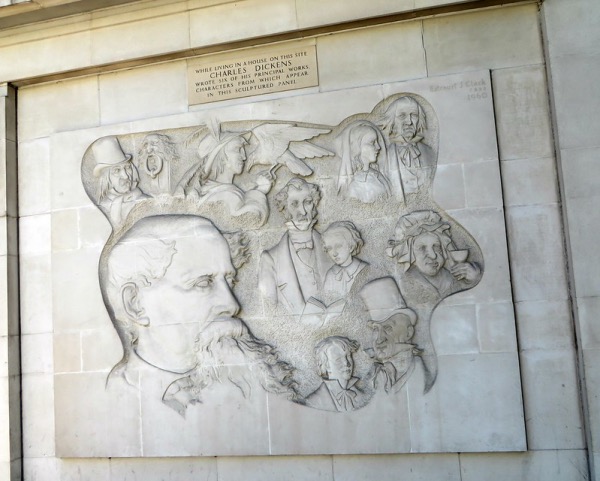
Located on the site of a house where 19th century writer Charles Dickens wrote six of his famous books, including A Christmas Carol, is a stone relief featuring several characters from them including Scrooge and Marley’s Ghost (represented as a door knocker in the top left).

Dickens lived at the property at what was then 1 Devonshire Terrace, Marylebone, between 1839 and 1851. It was demolished in the late 1950s and replaced with an office block upon which was incorporated the stone relief.

The bas-relief is the work of Estcourt J “Jim” Clack and features a large portrait of Dickens as well as the characters who, alongside the characters from A Christmas Carol.

They apparently include Barnaby Rudge with his raven ‘Grip’ (from the book of the same name), Little Nell and Granddad (The Old Curiosity Shop), Dombey and his daughter Florence (Dombey and Son), Sairey Gamp (Martin Chuzzlewit), David Copperfield and Wikins Micawber (David Copperfield).

Correction: The name of Barnaby Rudge’s raven has been corrected.

This Week in London – Faberge eggs; Royal jeweller Garrard; and, Christmas at Kew…

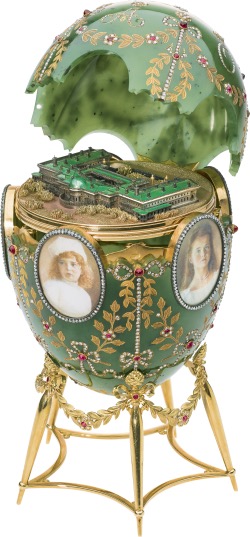
The Alexander Palace Egg, Fabergé. Chief Workmaster Henrik Wigström (1862-1923), gold, silver, enamel, diamonds, rubies, nephrite, rock crystal, glass, wood, velvet, bone, 1908 © The Moscow Kremlin Museums

• The largest collection of Faberge’s Imperial Easter eggs to be displayed together in a generation go on show at the V&A from Saturday. Fabergé in London: Romance to Revolution is the first major exhibition devoted to the international prominence of Russian goldsmith, Carl Fabergé, and his little-known London branch. Divided into three sections which cover everything from the techniques and detailing synonymous with the Faberge name to his time in London, the royal patronage he received, and the impact of the Great War and Russian Revolution on the business. The display features more than 200 objects with highlights including a prayer book gifted by Emperor Nicholas II to Empress Alexandra Feodorovna on his Coronation Day, the only known example of solid gold tea service crafted by Fabergé, a rare figurine of a veteran English soldier commissioned by King Edward VII, and a “kaleidoscopic display” of 15 of the Imperial Easter Eggs. The latter include several that have never before been shown in the UK including the largest Imperial Egg – the Moscow Kremlin Egg – which was inspired by the architecture of the Dormition Cathedral, the Alexander Palace Egg – which features watercolour portraits of the children of Nicholas II and Empress Alexandra and contains a model of the palace inside (pictured), the recently rediscovered Third Imperial Egg of 1887 (found by a scrap dealer in 2011) and Empress Alexandra Feodorovna’s Basket of Flowers Egg. Runs until 8th May. Admission charge applies. For more, see www.vam.ac.uk.

The Royal Family’s relationship with the jeweller Garrard is the subject of a new exhibition which has opened in Kensington Palace’s ‘Jewel Room’. Going on display for the first time are examples of the firm’s ledgers which document royal commissions dating back to 1735 while other highlights include Queen Mary’s fringe tiara which was made in 1919 using diamonds taken from Queen Victoria’s wedding gift to Queen Mary and which was subsequently worn by Queen Elizabeth II on her wedding day. Admission charge applies. For more, see www.hrp.org.uk/kensington-palace.

Botanical illustrations from the archives at Kew Gardens are brought to life on a canvas consisting of a selection of spectacular trees from the arboretum as part of this year’s Christmas display. Christmas at Kew also includes Spheric – a 15-metre-wide dome of light covered in more than 2,000 individually controlled LED pixels which sits on a reflective water pool and allows visitors to fully immerse themselves in a unique mirrored illusion as they cross the lake, a new installation for Holly Walk which will illuminate the night sky for over 200 metres overhead as it replicates the enchanting visual phenomenon of the Aurora Borealis, a vibrant rainbow tree illumination which brings to life the 12 Days of Christmas, and the ever-popular Fire Garden. The display can be seen until 9th January. Admission charge applies. For more, see www.kew.org.

Send all items for inclusion to exploringlondon@gmail.com.

LondonLife – Commemorating World War I at Hampton Court Palace…

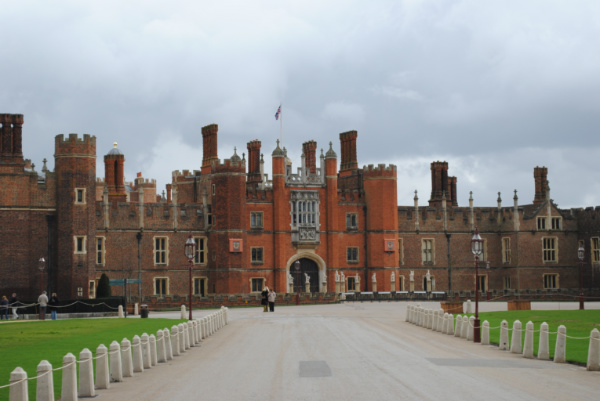
Hampton Court Palace. PICTURE: David Adams

Standing with Giants, a thought-provoking art installation at Hampton Court Palace, commemorates the lives lost in World War I and II and, in particular, the Indian soldiers who resided on the palace’s estate prior to the coronation of King Edward VII in 1902, and again for the World War I Victory Parade in London. The work of Oxfordshire artist Dan Barton and a dedicated group of volunteers, the work – located in the East Front gardens – features 100 almost life-sized silhouettes of soldiers and 75 screen-printed poppy wreaths along with an additional 25 specially commissioned silhouettes which represent the Indian soldiers. Almost 1,800 Indian Army officers, soldiers, and civilian workers sailed from India for the World War I Victory Parade and a camp was specially created to house them in the palace grounds in what was at the time one of the largest gatherings of people from India and South-East Asia ever assembled the UK. During their stay in London, the soldiers were treated to excursions in London and across the country which included trips to the Tower of London and a Chelsea football match. Alongside the display, a special trail map has been created to allow visitors to explore other aspects of the palace’s World War I history and former residents who took on roles ranging from frontline nurses to campaigners for improved care for injured veterans. One of the most poignant contributions the palace made to the war effort was the use of wood, supplied from an oak tree felled in Hampton Court’s Home Park, for the making of the coffin for the Unknown Soldier. Can be seen until 28th November. Admission charge applies. For more, see www.hrp.org.uk.

10 sites of (historic) musical significance in London – 6. Royal Albert Hall… 

PICTURE: Raphael Tomi-Tricot/Unsplash

Arguably the grandest music venue in London, the Royal Albert Hall, named in memory of Queen Victoria’s husband Prince Albert, has been hosting musical events since it first hosted a concert in 1871.

The Grade I-listed hall, which has a seating capacity of more than 5,000 and which did suffer from acoustic problems for many years (until mushroom-shaped fibreglass acoustic diffusers were hung from the ceiling following tests in the late 1960s), has been the setting for some of the most important – and, in some cases, poignant – music events of the past 150 years, not just in London but the world at large.

Among some of the most memorable are the Titanic Band Memorial Concert – held on 24th May, 1912, just six weeks after the sinking of the iconic ship to remember the 1514 people who died with a particular focus on the eight musicians who played on as the stricken vessal sank, the ‘Great Pop Prom’ of 15th September, 1963 – only one of a handful of occasions when The Beatles and Rolling Stones played on the same stage, and Pink Floyd’s gig of 26th June, 1969 – coming at the end of a UK tour, the on-stage antics saw the band banned (it was short-lived, however, they returned just a few years later in 1973).

Other musical figures to have taken to the stage here include everyone from composers Richard Wagner, John Philip Sousa, and Benjamin Britten to the Von Trapp family, jazz greats Billie Holiday and Ella Fitzgerald, and the likes of Shirley Bassey, Bob Dylan and Elton John – a veritable musical who’s who of the past 150 years. The venue also hosted the 13th Eurovision Song Contest in 1968.

Of course, Royal Albert Hall is famous for The Proms, an annual festival of classical music which was first performed here in 1941 after the venue where it had been held since 1895 – the Queen’s Hall on Langham Place – was lost to an incendiary bomb during World War II.

Prom stands for ‘Promenade Concert’,  a phrase which originally referred to the outdoor concerts in London’s pleasure gardens during which the audience was free to walk around while the orchestra was playing (there are still standing areas during performances). The most famous night of the season is the ‘Last Night of the Proms’ which, broadcast by the BBC, features popular classics and ends with a series of patriotic tunes to stir the blood.

A Moment in London’s History – Crystal Palace burns…

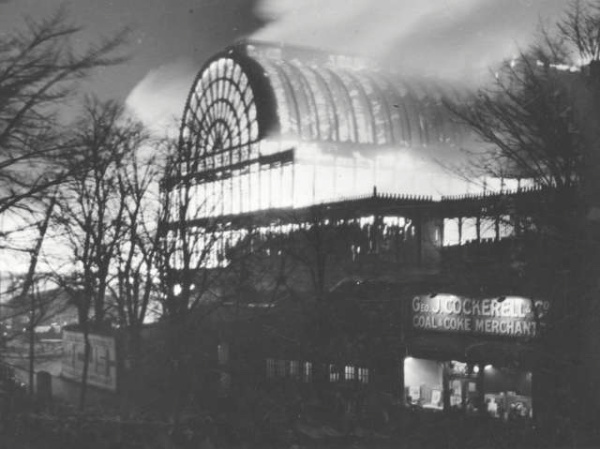
The Crystal Palace fire in 1936. PICTURE: Unknown author (via Wikipedia)

This month marks 85 years since the Crystal Palace in London’s south was destroyed in a fire.

The Joseph Paxton-designed building had originally been located in what is now Hyde Park for the Great Exhibition of 1851 and, following the end of the exhibition, had been dismantled and relocated to Sydenham.

When the fire in broke out on the night of 30th November, 1936, two night watchmen tried to put it out. Sir Henry Buckland, the building’s general manager, was out walking his dog with his daughter Crystal (named, apparently after the building) when he spotted the flames and called the fire brigade.

They arrived at about 8pm but the fire, fanned by a wind, was soon out of control and so further aid as summoned with hundreds of firefighters and some 88 engines attending the scene. It has been said the blaze could be seen across eight counties.

A crowd of spectators – said to number as high as 100,000 – arrived to watch what was apparently a rather spectacular sight (special trains were apparently put on to transport people from towns in Kent and private airplanes were spotted overhead). Police, some on horseback, did their best to keep the crowds away but had limited success given the numbers who turned out (Winston Churchill, among those watching the building burn, is said to have remarked: “This is the end of an age” while Sir Henry told reporters later that the palace would “live in the memories not only of Englishmen, but the whole world”).

By morning, the building was reduced to bits of twisted metal and ash but thankfully no lives were lost in the conflagration. The cause, however, remained a mystery – there was speculation it had been started by a stray cigarette butt or had been deliberately lit by a disgruntled worker. Television pioneer John Logie Baird, who had a workshop in the building, believed it could have been started by a leaking gas cylinder in his workshop.

Two water towers, located at either end of the building, survived the blaze but were later demolished. Among the few remains of the building which did survive the blaze is the subway located under Crystal Palace Parade. The park which surrounded the building remains home to the famous ‘Crystal Palace dinosaurs’.

Where’s London’s oldest…(continuously operating) film studio?

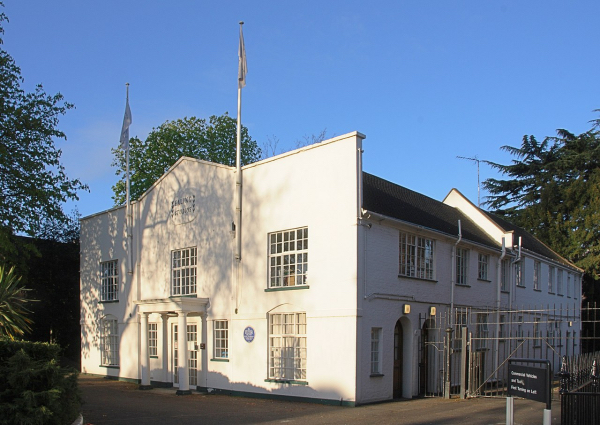
The White Lodge at Ealing Studios. PICTURE: P.g.champion (licensed under CC BY 2.0 UK)

The oldest continuously operating film studio in London also happens to be the oldest in the world, according to Guinness World Records.

Ealing Studios in West London has been operating at the same site – the White Lodge on Ealing Green – since 1902.

Originally founded by silent film pioneer Will Barker (and so originally known as the Will Barker Studios), the studios were further developed by Associated Talking Pictures who opened the sound stages in 1931.

In 1938, film producer Michael Balcon took over and it was he who named them Ealing Studios. Later owners included the BBC and then in 2000 the studios were bought by a consortium including independent production company Fragile Films and the Manhattan Loft Corporation.

Among the famous films made there was one of first screen versions of Hamlet in 1910, as well as classics such as The LadyKillers, The Lavender Hill Mob, and Passport to Pimlico. More recent films and TV shows have included the St Trinian’s franchise, The Importance of Being Earnest (2002), Shaun of the Dead (2005), and The Theory of Everything (2014), as well as recent TV series The Durrells and Downton Abbey.

The White Lodge bears an English Heritage Blue Plaque commemorating Sir Michael Balcon’s time working here between 1938 and 1956.

This Week in London – Japan at Kew; Young V&A; a Blue Plaque for Diana’s flat; and, a new Lord Mayor of London…

Visitors to Kew Gardens are being invited to immerse themselves in the art, plants and culture of Japan in a month long celebration of the Asian nation. The Japan Festival kicks off this Saturday in Kew’s Temperate House and features at its heart a large-scale artistic installation by Japanese artist Chiharu Shiota entitled One Thousand Springs which is constructed of 5,000 haikus submitted by members of the public. There will also be a specially commissioned Chalk Garden – a contemporary response to a Japanese garden showcasing native plants including grasses, shrubs and trees – as well as a display showcasing six different chrysanthemums, Japan’s national flower, and an immersive soundscape by sound artist Yosi Horikawa featuring the natural sounds of the rivers and waterfalls of Kagoshima, atmospheric soundscapes from the Cedar mountains of Gifu and bird calls set across the waves of the Philippine Sea. The Temperate House will also be illuminated for Japan: After hours featuring a varied programme of dance, theatre, and live music performances as well as traditional flower arranging and sake sipping. The festival, supported by Daikin UK, runs to 31st October. Admission charge applies. For more, see www.kew.org.

Sky Brown from Great Britain during women’s park skateboard at the Olympics at Ariake Urban Park, Tokyo, Japan on August 4, 2021. PICTURE: Ulrik Pedersen/NurPhoto via Getty Images.

Thirteen-year-old Olympian Sky Brown’s skateboard, children’s garments created by sustainable fashion designer, humanitarian and artist Bethany Williams, and Open Bionics’ 3D printed prosthetic, The Hero Arm, are among new acquisitions to be displayed at what was the former V&A Museum of Childhood. Now renamed the Young V&A, the Grade II* Bethnal Green institution is undergoing a £13m transformation ahead of reopening in 2023. The new interior fit-out, by firm AOC Architecture, will include three new galleries –  Play, Imagine and Design – as well as interactive collection displays, a suite of dedicated learning workshops, an in-gallery design studio for visitors, and a new café and shop.

• The late Princess Diana has been honoured with an English Heritage Blue Plaque at her former flat in Kensington. Flat 60, Coleherne Court, Old Brompton Road, was her home between 1979 and 1981 during her courtship with Prince Charles. She shared it with three friends including Virginia Clarke who was at the unveiling ceremony this week. Diana, who died aged 36 in a Paris car crash in 1997, described her years at the property as “the happiest time of her life”, according to biographer Andrew Morton’s book Diana, In Her Own Words.

Vincent Keaveny was this week elected as the 693rd Lord Mayor of the City of London. Alderman Keaveny succeeds Lord Mayor William Russell, who served a second year in office after his term was extended to ensure continuity of leadership during the current COVID-19 pandemic (the last time a Lord Mayor served a second year in office was in 1861 when William Cubitt was re-elected). The annual Lord Mayor’s Show is scheduled for Saturday, 13th November, and will be followed by Lord Mayor’s Banquet at Guildhall on 15th November.

Send all items to exploringlondon@gmail.com.
10 sites of (historic) musical significance in London – 1. 25 (and 23) Brook Street, Mayfair…

OK, so we all know about the Abbey Road crossing and its connection with the Beatles, but where are some other sites of historic musical significance in London?

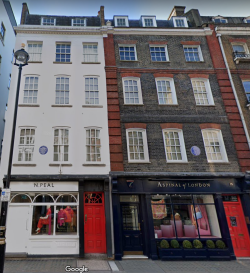
23 and 25 Brook Street, Mayfair. PICTURE: Google Maps.

First up, it’s the Mayfair home where 18th century composer George Frideric Handel lived from 1723 until his death in 1759 – and where he composed much of his best known work including masterpieces such as Zadok the Priest (1727, it was composed for the coronation of King George II), Israel in Egypt (1739), Messiah (1741), and Music for the Royal Fireworks (1749).

The German-born Handel, who settled permanently in London in 1712 (and who became a naturalised British citizen in 1727), was the first occupant of the terraced house located at what is now 25 Brook Street (but previously known as 57) which is now a museum dedicated to his life and work.

The property, which is today decorated as it would have been during early Georgian times, is thought to have been convenient for its proximity to be the theatres where his works works were performed and St James’s Palace, where he served as Composer of Music for the Chapel Royal.

A small room on the first floor is believed to be where Handel did most of his composing. He is also understood to have used the larger adjoining music room for rehearsing his works from the 1730s (possibly due to a lack of space at the venue where he mainly performed, the Covent Garden Theatre).

Handel died in the house on 14th April, 1759. The property, which subsequently was lived in by various people, became a museum dedicated to the composer in 2001.

Known for the first 15 years of its existence as the Handel House Museum, in 2016 it was expanded to include the upper floors of the adjoining home, 23 Brook Street, a flat which served as home to another musical great, Jimi Hendrix, in 1968-1969. The museum is now known as Handel & Hendrix in London.

Both properties have English Heritage Blue Plaques upon them. The first plaque were erected on Handel House in about 1870 by the Society of Arts and was replaced in 1952 and again in 2001, when his middle name was corrected to Frideric from Frederick. The plaque commemorating Hendrix’s residence in Number 23 was erected in 1997.

The museum is closed, with limited exceptions, until March, 2023, for a refurbishment project called the The Hallelujah Project. But you can head to the website to take a 3D virtual tour: https://handelhendrix.org.

Famous Londoners – Charles Cruft…

His surname now synonymous with the famous annual dog show, Charles Cruft is credited as taking the concept of dog shows to a whole new level.

Charles Cruft (picture from From Dog shows and doggy people (1902) by Charles Henry Lane).

Cruft was born, thought to have been in Bloomsbury, on 28th June, 1852, and attended Ardingly College in Sussex, before initially following on in his father’s footsteps and working in the family jewellery business (while taking evening classes briefly at Birkbeck College).

But it was his next move, taking on the role of office boy in the Holborn shop of “dog cake” manufacturer James Spratt that brought him into the world of canines.

Cruft quickly moved into sales and then management at the firm and it was while on a trip to Europe that he was given the opportunity to run the dog show at the third World’s Fair in 1878 (he married Charlotte Hutchinson, with whom he had four children, the same year). Further offers to run shows followed and in 1886, he was approached to run a dog show for terriers in London by the Duchess of Newcastle.

The show – billed as the “the first great show of all kinds of terriers” – opened at the Royal Aquarium in Westminster on 10th March that year and further annual shows, expanding into other breeds, followed. In 1891, his name was added to the event with the “Cruft’s Greatest Dog Show” held at the Royal Agricultural Hall in Islington with 2,437 entries and 36 breeds.

So popular had the shows become that Queen Victoria and Russian Tsar were among the exhibitors (Cruft did also try his hand at cat shows in 1894 and 1895 but it was a short-lived venture).

By 1914, Cruft’s show had become the largest in the world and in 1936, when it celebrated its ‘Golden Jubilee’ (or 50th anniversary), there were more than 10,000 dogs entered.

Cruft, who had married his second wife Emma Isabel Hartshorn in 1894 following Charlotte’s death (they had no children together), died of a heart attack on 10th September, 1938. He was buried 11 days later in the western area of Highgate Cemetery (the tomb is now Grade II-listed). Tributes flowed in and apparently included comparisons to American showman PT Barnum.

Emma took over the running of the show following his death and since 1948, the show has been run by the Kennel Club. 

There’s a plaque on the home where he died in Highbury Grove in Highbury (other London residences included 325 Holloway Road).

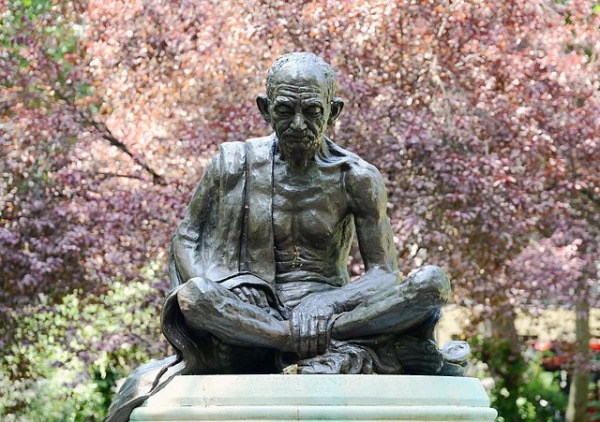
10 London memorials commemorating foreign leaders – 7. Mahatma Gandhi…

PICTURE: Alvesgaspar (licensed under CC BY-SA 4.0)

There’s a couple of statues commemorating Mahatma Gandhi in London with the most recent one was unveiled in Parliament Square in 2015.

But this week we head Bloomsbury where we find an older one in the centre of the gardens in Tavistock Square.

The work of Fredda Brilliant, it was unveiled by then Prime Minister Harold Wilson in May, 1968. Also present was the first High Commissioner of India to the UK after independence, VK Krishna Menon, and the then-current High Commissioner of India to the United Kingdom, Shanti Swaroop Dhavan.

Menon apparently chose the location for the statue – Gandhi had studied at the nearby University College London between 1888 and 1891.

Gandhi, who was assassinated in 1948 after having playing an instrumental role in the push for India’s independence, is depicted sitting in a cross-legged in the lotus position wearing a loincloth with a shawl over his right shoulder. The statue sits atop a rounded Portland stone plinth.

The memorial was erected by the Mahatma Gandhi Memorial Committee, with the support of the India League. It was Grade II-listed in 1974.

A further plaque was added beneath the statue in 1996 commemorating the 125th anniversary of the birth of Gandhi.

A Moment in London’s History – The last execution at the Tower of London…

The Tower of London. PICTURE: Nick Fewings/Unsplash

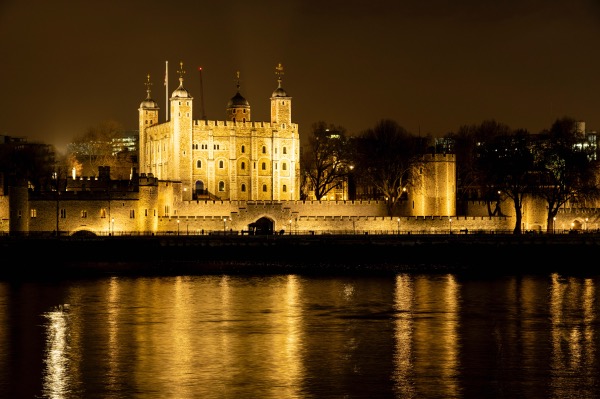
This month marks the 80th anniversary of the last person to be executed at the Tower of London for treason.

Injured when he was shot in the chest while serving as a conscript in the German army during World War I, Josef Jakobs worked as a dentist after the war (and was briefly imprisoned in Switzerland for selling counterfeit gold). Following the Nazi Party rose to power in Germany during the 1930s, he was arrested in 1938 by the Gestapo for selling black market passports to Jewish people fleeing the country and sent to the Sachsenhausen concentration camp.

After two years, Jakobs was released after he agreed to work as a spy in England for the German military intelligence.

Having flown from Holland, Jakobs parachuted into England at a located near Ramsey in what was then Huntingdonshire, in late January, 1941. Breaking his ankle during the landing and in pain, he fired his pistol into the air early on February 1st and was subsequently apprehended by members of the Home Guard.

Among the items he was found with were a wireless transmitter, a small torch with a flashing device, a map marking positions of nearby RAF airfields and a German sausage.

Jakobs was taken to a local police station before being transferred to London where he was subsequently interrogated by MI5 during which he claimed he had escaped to England with the intent of securing passage to America. He was later taken to a hospital and treated for his injuries.

His court martial before a military tribunal was held at the Duke of York’s headquarters in Chelsea on 4th and 5th August. After hearing from eight witnesses in a closed court (due to intelligence sensitivities), he was convicted of spying and sentenced to death.

Jakobs’ execution was carried out at the miniature rifle range at the Tower of London – the same place where death sentences had been carried out on 11 spies executed during World War I – on 15th August.

Jakobs was blindfolded and tied to a chair (which can still be viewed in the White Tower) with a white target pinned over his heart. A firing squad of eight – all members of the Scots Guards – carried out the sentence at 7.12am (five of those in the squad had live rounds). He is said to have died instantly.

Jakobs was subsequently buried in an unmarked grave at St Mary’s Catholic Cemetery in Kensal Green.

Jakobs was the only spy executed at the Tower in World War II and the last person to suffer such a sentence there.

10 London memorials commemorating foreign leaders – 6. Nelson Mandela…

Back to Parliament Square this week where we look at a bronze statue of anti-apartheid activist and former President of South Africa, Nelson Mandela.

PICTURE: Prioryman (licensed under CC BY-SA 4.0)

Unveiled on 29th August, 2007, this larger-than-life statue is the work of English sculpture Ian Walters (he completed a clay sculpture of the Parliament Square statue before his death in 2006 but sadly didn’t live to see it cast in bronze in London.)

The statue was proposed by South African journalist and anti-apartheid activist Donald Woods but after his death in 2001, the fundraising effort, officially launched in 2003, was led by his wife Wendy and Sir Richard Attenborough.

It depicts Mandela standing on a low plinth with his arms outstretched as though making a speech. He is shown wearing a flowery shirt.

It was originally proposed the statue be located outside of the South African High Commission in Trafalgar Square but after planning approval was refused, the alternative site of Parliament Square was eventually decided upon.

The unveiling in the south-west corner of the square was attended by Mandela himself along with his wife Graça Machel and then Mayor of London Ken Livingstone while then PM Gordon Brown did the official duties.

Interestingly it’s not the only work of Walters depicting Mandela – he was also the sculptor behind the bust of Mandela which stands outside Royal Festival Hall in South Bank.

It’s also not the only South African who has a statue in Parliament Square – there’s also one of Jan Smuts, twice Prime Minister of the Union of South Africa in the early 20th century (in fact Mandela recalled at the unveiling that he and his friend Oliver Tambo, who went on to become president of the ANC, had once joked about seeing the statue of a Black man one day erected in the square – Tambo never lived to see it, but Mandela, at age 89, did).

This Week in London – Royal portraits in Greenwich; Sir Roger Bannister to be honoured; and, drawing on the Tate’s Turbine Hall floor…

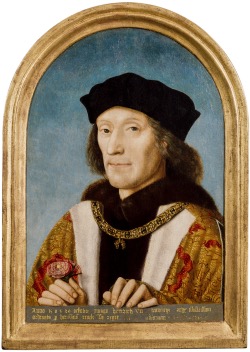
King Henry VII by unknown Netherlandish artist, 1505 (oil on panel) © National Portrait Gallery, London

More than 150 of the finest portraits of royal families over five dynasties are on show at the National Maritime Museum in Greenwich. Tudors to Windsors: British Royal Portraits, which is being run in conjunction with the National Portrait Gallery, features famous paintings, miniatures, sculpture, photographs, medals and stamps from the Tudor, Stuart, Georgian, Victorian and Windsor dynasties. Highlights include the earliest known portrait of Henry VII (also the oldest artwork in the exhibition) which was painted in 1505 by an unknown artist, Flemish artist Marcus Gheeraerts the Younger’s famous ‘Ditchley Portrait’ of Elizabeth I, portraits of Charles II and his mistresses, early 19th century domestic photographs of Queen Victoria and her family, and a selection of paintings and photographs of Queen Elizabeth II by Cecil Beaton and Annie Leibovitz. Runs until 31st October. Admission charge applies. For more, see www.rmg.co.uk/TudorsWindsors.

Westminster Abbey has announced a new memorial to Sir Roger Bannister, the first man to run under a mile in four minutes. The abbey said the memorial ledger stone to Bannister, who later became a neurologist, will be placed in what is known as ‘Scientists’ Corner’ in the building’s nave, close to the graves of scientists Sir Isaac Newton and Charles Darwin as well as the ashes of Stephen Hawking. “Throughout his life Sir Roger Bannister reached out for that which lay beyond,” said the Dean of Westminster, the Very Reverend Dr David Hoyle, in a statement. “As a sportsman, pushing himself towards a prize some considered beyond human reach, as a scientist ever eager for deeper understanding of neurology. We are delighted that his memory and his achievement will be set in stone in the Abbey. He ran the race set before us all.” Bannister is famous for having run a mile in three minutes, 59.4 second at Oxford on 6th May, 1954 – a record which stood for almost nine years.

Be among those transforming the Tate Modern’s Turbine Hall into an “ever changing work of art”. Visitors are invited to join in covering the hall’s floor with their own jottings using coloured drawing materials as part of artist Ei Arakawa’s interactive installation, Mega Please Draw Freely. The installation, which can be contributed to until 29th August, kicks off UNIQLO Tate Play – a new free programme of playful art-inspired activities for families, being in partnership with UNIQLO, at the Tate Modern. The project, which has seen the Turbine Hall floor covered with a temporary surface allowing it to be drawn upon, is inspired by the Gutai group, radical Japanese artists who wanted to change the world through painting, performance and children’s play and, in particular, the group’s ‘Outdoor Gutai Art Exhibition of 1956’ in which Yoshihara Jirō created the groundbreaking work Please Draw Freely, a large board on which people were free to draw and paint. Visitors can access Mega Please Draw Freely by booking a free collection display ticket online at www.tate.org.uk.

Send all items for inclusion to exploringlondon@gmail.com.
10 London memorials to foreign leaders…4. Charles de Gaulle…

PICTURE: Metro Centric (licensed under CC BY 2.0)

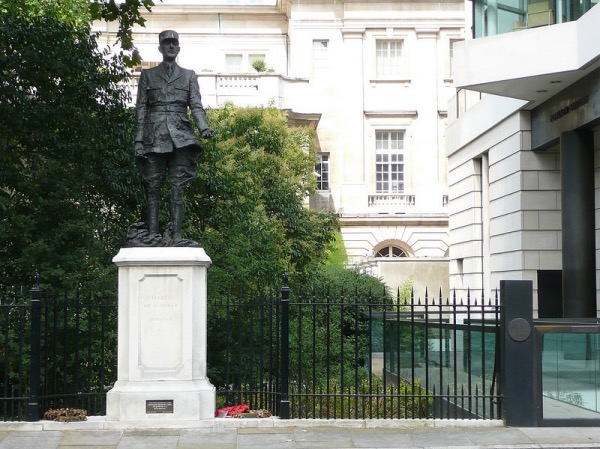
Unveiled in the early 1990s, this statue of the French leader Charles de Gaulle (1890-1970) is located in St James’s, close to the headquarters where de Gaulle headed the government-in-exile following the fall of France in 1940.

The life-sized statue is the work of sculptor Angela Conner and architect Bernard Wiehahn and was erected in Carlton Gardens following a campaign by Lady Soames, daughter of Winston Churchill. De Gaulle is depicted standing in the uniform of a General de Brigade.

The was unveiled by Queen Elizabeth, The Queen Mother, in June 1993. Nearby are an English Heritage Blue Plaque as well as another plaque, both commemorating the location of the headquarters.

A commemorative ceremony takes place each year at the statue organised by the French Embassy.

De Gaulle flew to England in June, 1940, and was subsequently recognised by Britain as the leader of the Free French. He established his headquarter at 4 Carlton Gardens on 22nd July that year, initially living at the Connaught Hotel and, from 1942 to 1944, in Hampstead. He returned to France following the D-Day invasion in 1944.

Lost London – The Maharajah’s Fountain…

Former site of The Maharajah’s Fountain, looking into Hyde Park from Bayswater Road (you can see the plaque to the left of the path). PICTURE: Google Maps.

Once located in Hyde Park, this drinking fountain was a gift from Maharajah Meerza Vijiaram Gajapati Raj Manea Sooltan Bahadoor of Vijianagram (a small princely state once located in what is now the Indian state of Andhra Pradesh).

Installed in 1867 by the Metropolitan Drinking Fountain and Cattle Trough Association, the towering structure in the neo-Gothic style was apparently designed by the architect Robert Keirle (also the designer of the Readymoney Fountain in The Regent’s Park).

It was installed close to the park’s north-east corner (between North Carriage Drive and Bayswater Road, not far west of Marble Arch).

The fountain was eventually removed in 1964 (apparently due to the prohibitive cost of repairing it). A plaque these days marks its location.

10 London memorials to foreign leaders…3. Simón Bolívar…

PICTURE: Rept0n1x (licensed under CC BY-SA 1.0/image cropped)
PICTURE: Another Believer (licensed under CC BY-SA 4.0)

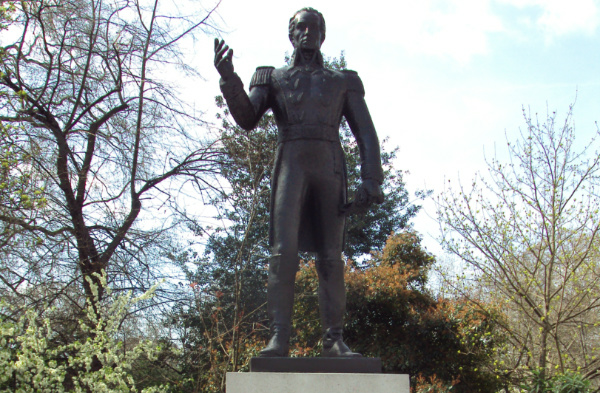
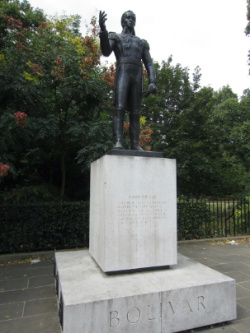
One of a cluster of statues depicting foreign leaders around Belgravia Square (thanks to the presence of so many foreign embassies in the area), this work depicting Simón Bolívar, a towering figure in the early 19th century liberation of South America from colonial powers, was erected in 1974.

The bronze, by Hugo Daini, shows Bolívar standing as though about to make a speech

The inscription describes Bolívar as the liberator of Venezuela, Colombia, Ecuador, Peru, and Panama and the founder of Bolivia and also mentions the details of his birth – Caracas, Venezuela, 24th July, 1783 – and death – Santa Maria, Colombia, 17th December, 1830.

It is accompanied by a quote on the side of the pedestal, featuring words attributed to Bolívar: “I am convinced that England alone is capable of protecting the world’s precious rights as she is great, glorious and wise”.

The statue was erected by the aforementioned nations (the coats-of-arms of which are on the plinth) and unveiled in by James Callaghan, then Foreign Secretary (and later PM).

Treasures of London – War posters from the National Archives…

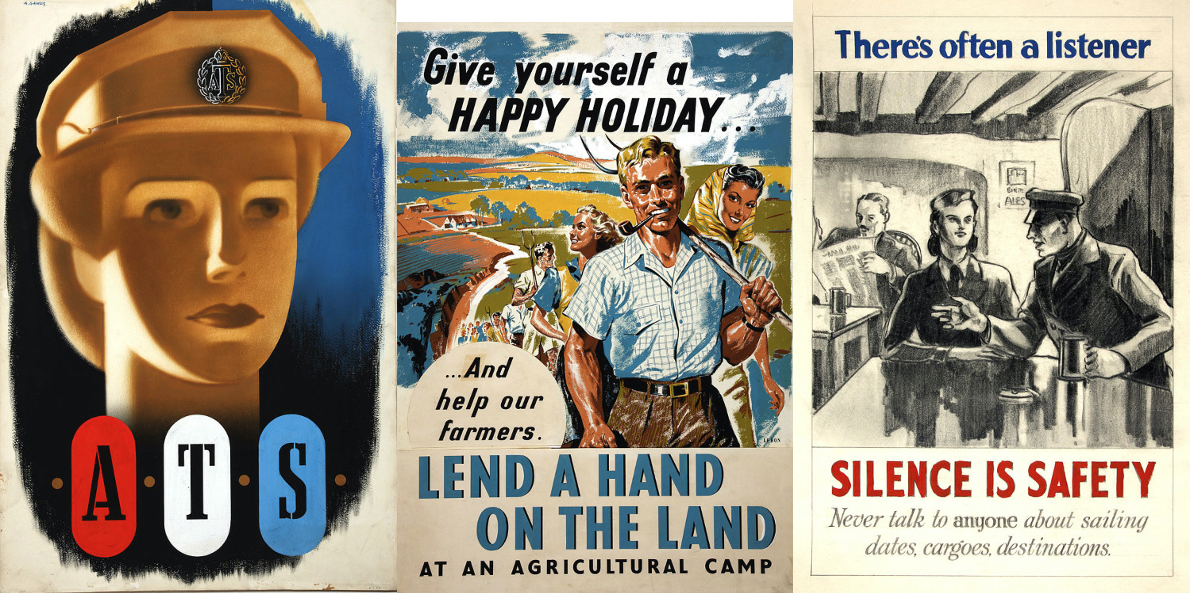
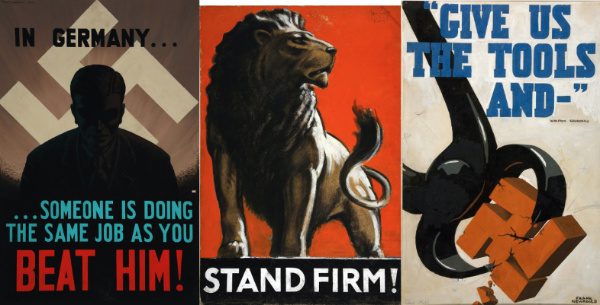
Left to right: Abraham Gomes, Forces Recruitment ATS (girl’s head) (between 1939 and 1946); Mary Le Bon, Give yourself a happy holiday…and help our farmers. Lend a hand on the land at an agricultural camp (between 1939 and 1946); Unknown author, There’s often a listener. Silence is safety. Never talk to anyone about sailing dates, cargoes, destinations (between 1939 and 1946).

These posters are among almost 2,000 original works created by artists working for the Ministry of Information during World War II now in the collection of The National Archives based in Kew.

The posters tackle a range of issues – from saving on fuel at home to warnings about spies, posters to inspire effort on the homefront and those to recruit new men and women to the service.

Under a partnership with Wikimedia UK, in 2013 The National Archives digitised and released more than 350 images of the posters into the public domain. Here are some those released.

The originals are held at The National Archives.

Left to right: Roy Nockolds, “In Germany…someone is doing the same job as you. Beat him!” (1942); Tom Purvis, “Stand Firm!” (between 1939 and 1946); and, Frank Newbould,  “Give us the tools and-” – Winston Churchill (between 1939 and 1946).

This Week in London – New statue of Princess Diana; V&A’s new Design 1900 gallery; a Blue Plaque for Jean Muir; and, police boxes reimagined…

A new statue of the late Princess Diana is being unveiled today at Kensington Palace. The statue will be unveiled in the Sunken Garden at Diana’s former home. The garden – originally created on the orders of King Edward VII in 1908 – has been redesigned by designer Pip Morrison to provide a more reflective setting for the memorial. This included planting more than 4,000 of Diana’s favourite flowers including forget-me-nots and tulips. The statue, which is the work of sculptor Ian Rank-Broadley, is expected to be unveiled by Diana’s two sons, William and Harry, who commissioned it in 2017.

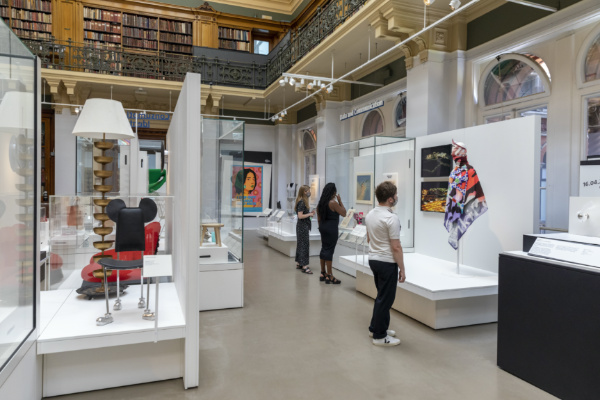
The V&A’s new gallery, Design 1900. PICTURE: Courtesy of the V&A

A new permanent gallery has opened at the V&A which explores the role design plays in shaping, and being shaped by, how we live, work, travel and communicate. Design 1900 is housed within the museum’s former 20th Century Gallery and, among the displays are new acquisitions including Margaret Calvert and Jock Kinneir’s iconic British road signage system, Kim Kardashian’s Selfish book, Nike’s Nigeria football shirt for the 2018 World Cup and a one-of-a-kind desk designed by Future Systems for Condé Nast Chairman Jonathan Newhouse. The display also includes items from the Rapid Response Collecting programme such as 3D-printed door openers, designed to limit the spread of the COVID-19 virus, and the I Believe in Our City bus shelter posters that highlighted increased anti-Asian bias. For more, see www.vam.ac.uk.

Twentieth century dressmaker and fashion designer Jean Muir has been honoured with an English Heritage Blue Plaque at the Mayfair address she worked for 30 years. The plaque was unveiled at 22 Bruton Street, the location of the showroom and office she operated out of from 1966 to 1995, by her house model, friend and client Joanna Lumley. Others among Muir’s clientele included actress Patricia Hodge and writer Lady Antonia Fraser. For more, see www.english-heritage.org.uk/visit/blue-plaques/.

The City of London Corporation has unveiled the design for new ‘Digital Service Points’ which will reimagine the concept of the traditional police boxes. ‘The London Stones’, the work of architecture and design studio Unknown Works, will include information screens, life saving emergency equipment and serve as hubs for City of London Police officers and community events. Details from buildings, stories and images of the Square Mile will be collected and ‘digitally carved’ into the exterior of the ‘stones’ which will also be home to a vast array of lichen colonies and species expected to evolve in their colour and appearance as they grow.

Send all items for inclusion to exploringlondon@gmail.com

LondonLife – Museum of London marks Windrush Day…

Tihara Smith outfit PICTURE: © Tihara Smith

Marking this year’s Windrush Day, the Museum of London has made two new acquisitions – an ensemble from London fashion designer Tihara Smith’s ‘Windrush collection’ and a suit owned by her grandfather – available to explore on the Museum of London website. Tihara’s outfit, which was designed as part of Smith’s UCA Epsom graduate collection in 2018 and selected for display at Graduate Fashion Week, references the story of her grandfather, Lazare Sylvestre, who arrived in the UK from St Lucia in 1958 as part of the Windrush generation. Details including a raffia vest hand embroidered with the words ‘Black and British’ which is accompanied by a Black Power fist and the red lion symbol of England as well as a shirt made from a tablecloth purchased in Peckham Market and flared 1970s style denim culottes – all of which are representative of her grandfather’s experience and that of so many other Black British Londoners at that time. Her grandfather’s suit, meanwhile, was designed and made for him by a close friend, Winceslas ‘Winston’ Giscombe, a tailor who originally from Kingston, Jamaica, who came to the UK in 1947 on a ship called the Ormonde, a year before the Windrush arrived in 1948. Photographs of the items, along with oral histories recorded by Tihara, her mother and her grandfather, can be explored on the Museum of London website. For more on Windrush, see the Windrush Stories page on the Museum of London Docklands website