This district in the Borough of Lambeth in south London was formerly a rural manor located on the southern edge of London.
The name, variants of which date back to at least the late 12th century, is said to relate to the Old English words for a tree trunk – ‘stoc’ – and a well or spring, ‘wella’, and has been interpreted as meaning the well or spring by a tree stump, tree truck or perhaps a wood (there was apparently a Stockwell Wood which has long since disappeared).
The manor of Stockwell was formed at the end of the 13th century when King Edward I acquired the manor of South Lambeth and divided it into two, creating the manors of Stockwell and Vauxhall (the manor house itself, parts of which survived until the 19th century, stood on the north side of Stockwell Road).
The area become known for its market gardens and was transformed into an urban landscape until the mid-19th century. Remnants of the 19th century housing stock can still be found in areas including the Stockwell Park Conservation Area in the west of the district.
The area around Stockwell Tube station, which first opened in 1890 and has since been rebuilt a couple times, was heavily bombed during World War II and rebuilt following the war. New developments included a number of social housing estates.
Today, Stockwell and nearby South Lambeth host the district known as Little Portugal which, centred on South Lambeth Road, is home to one of the UK’s largest Portuguese communities. The area is also home to several other immigrant communities.
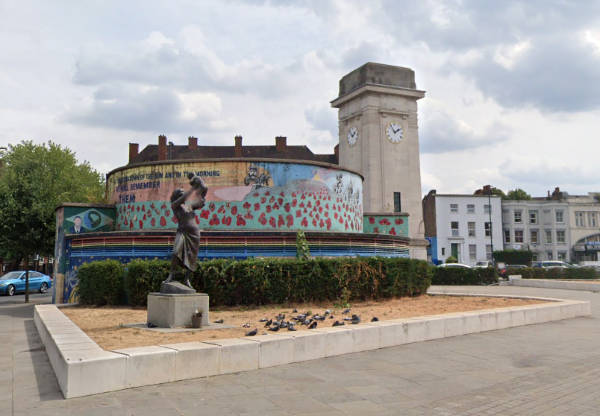
Local landmarks include the oldest surviving building in the area – St Andrew’s Church, Stockwell Green (built in 1767), the Stockwell Congregational Church (1798) and the Stockwell War Memorial.
The latter – a white stone tower – is located on a site first laid out in the 1920s and features a mural on an adjoining ventilation shelter commemorating French Resistance fighter Violette Szabo (there’s a Blue Plaque on her former home in Burnley Road) and other Stockwell residents who died in war. There is also the ‘Bronze Woman’ statue which was unveiled in 2008 as a tribute to Black Caribbean women.
Residents of Stockwell have included artist Arthur Rackham and pioneering theatre director Joan Littlewood as well as musician David Bowie (born in Stansfield Road), actors Joanna Lumley (who still lives there) and Roger Moore (born in Aldebert Terrace).
Tragically, Stockwell Tube station was where Brazilian man Jean Charles de Menezes was fatally shot by police on 22nd July, 2005, after being misidentified as one of four suicide bombers who were on the run after their devices had failed to detonate the previous day (the attempts had come just two weeks after the 7th July bombings in which more than 50 people had been killed).





 Exploring London