10 atmospheric ruins in London – 5. All Hallows Staining…

Located in at the junction of Mark Lane and Dunster Court in the City of London, All Hallows Staining was a medieval church which was mostly demolished in the late 19th century.

All Hallows Staining church tower as seen in July, 2022. PICTURE: Courtesy of Google Maps

These days only the lonely tower remains (above ground at least) as testament to building that once stood there and the lives that were impacted by it.

All Hallows Staining was originally built in the late 12th century and while the origins of its name are somewhat shrouded in mystery, there are a couple of theories.

One says it takes its name from the fact it was built in stone when other churches at the time were wooden (“staining” meaning “stone”) while another says it takes it names from the fact it was built on land belonging to the Manor of Staines.

Princess Elizabeth (later Elizabeth I) is said to have presented the church with new bell ropes after she was released after two months in the Tower of London in 1554 during the reign of her half-sister Queen Mary I (paying tribute to the sound they provided while she was in the Tower).

The church survived the Great Fire of London in 1666 but collapsed just five years later, its foundations apparently weakened by too many graves in the adjoining churchyard.

It was rebuilt in 1674-75 but largely demolished in 1870 when the parish was combined with St Olave Hart Street (and the proceeds were used to fund construction of All Hallows, Bow, in the East End).

Just the tower, parts of which date from the 12th century, remained. The property was bought by the Worshipful Company of Clothworkers. Underneath the adjacent yard they installed the remains of the 12th century crypt of the hermitage chapel of St James in the Wall (later known as Lambe’s Chapel) following the demolition of the chapel in the 1870s.

During World War II, when St Olave Hart Street was badly damaged in the Blitz, a temporary prefabricated church was erected on the site of All Hallows Staining which used the tower as its chancel. It was known as St Olave Mark Lane.

The church was Grade I listed in 1950. In 1957, Clothworkers had a hall for St Olave Hart Street constructed on part of the site of the former church.

The tower is usually able to be seen across a small yard from Mark Lane.

Where’s London’s oldest…roundabout?

PICTURE: Matt Brown (licensed under CC BY 2.0)

London’s oldest roundabout is said to be located in Southwark at the intersection of Borough, Westminster Bridge, Waterloo, London and Blackfriars Roads.

St George’s Circus was built in 1771 (during the reign of King George III) and designed by Robert Mylne as a grand southern entrance to London with radiating roads leading to three bridges over the Thames: London Bridge, Westminster Bridge and Blackfriars Bridge.

Mylne also designed the obelisk which still stands in the centre of the circus. As well as showing the date on which it was erected, the obelisk also records distances to Palace Yard in Westminster, Fleet Street, and London Bridge. Gas lamps were placed at each corner to illuminate the intersection.

The now Grade II*-listed obelisk has a rather interesting history in itself. Having stood at the roundabout for more than a century, in about 1897 it was relocated to Geraldine Mary Harmsworth Park outside the Imperial War Museum on Lambeth Road to make way for a clocktower designed to mark Queen Victoria’s Diamond Jubilee.

The clocktower itself, however, was removed in the 1930s to help with traffic flow. It wasn’t until 1998 that the obelisk was moved back to its original site (now minus the oil lamps).

Interestingly, an Act of Parliament passed in 1812 specifies that all buildings on the intersection must be located 240 feet from the obelisk (the reason, apparently, for curved facades on some of the surrounding buildings).

This Week in London – Impressionists on paper; Vanessa Bell and Duncan Grant honoured with a Blue Plaque; new Burnham Beeches history app; and, young artists celebrated on London billboards…

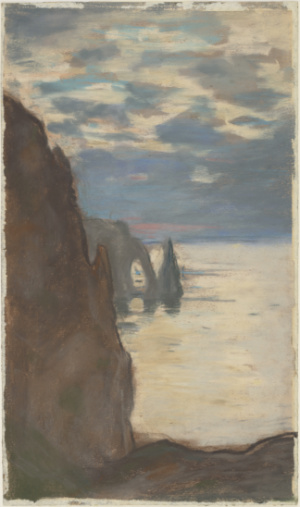
Claude Monet, ‘Cliffs at Etretat: The Needle Rock and Porte d’Aval’, c 1885. National Galleries of Scotland.

A new exhibition exploring how Impressionist and Post-Impressionist artists in late 19th-century France radically transformed the status of works on paper opens at the Royal Academy on Friday. Impressionists on Paper: Degas to Toulouse-Lautrec features around 80 works on paper by artists including Mary Cassatt, Paul Cézanne, Edgar Degas, Paul Gauguin, Eva Gonzalès, Claude Monet, Berthe Morisot, Odilon Redon, Pierre-Auguste Renoir, Georges Seurat, Henri de Toulouse-Lautrec and Vincent van Gogh. Among the highlights are Degas’ Woman at a Window (1870-71), van Gogh’s The Fortifications of Paris with Houses (1887), Monet’s Cliffs at Etretat: The Needle Rock and Porte d’Aval (c1885) and Toulouse-Lautrec’s images of the urban underworld of Montmartre. The display can be seen in The Gabrielle Jungels-Winkler Galleries until 10th March. Admission charges apply. For more, see royalacademy.org.uk.

English Heritage have unveiled their final Blue Plaque for 2023 and it celebrates two of the most influential painters of the early-to-mid 20th century, Vanessa Bell and Duncan Grant. The plaque was unveiled at number 46 Gordon Square in Bloomsbury, from where the Bloomsbury Group – of which Bell and Grant were leading members – drew its name. Bell first lived at number 46 with her siblings, including Virginia Stephen (later Woolf), and, in 1914, Grant moved in with Vanessa and her husband, Clive Bell. Paintings the pair made at number 46 include Grant’s Interior at Gordon Square (c1915) and Bell’s Apples: 46 Gordon Square (c1909-10), a still-recognisable view from the drawing-room balcony to the square. For more on the English Heritage Blue Plaques scheme, head to www.english-heritage.org.uk/visit/blue-plaques/.

The history of Burnham Beeches has been brought to life with a new augmented reality app. The app allows users to superimpose periods of Burnham Beeches’ history – from the Iron Age, Middle Ages and World War II – over what they see when visiting the site and incorporates sounds from selected era as well. It can be accessed via a QR code which is being published on signs at Burnham Beeches. Burnham Beeches, located near the village of Burnham in Buckinghamshire, was acquired by the City of London in 1880 when the area was threatened by development and is managed as a free open space. For more, head here.

The work of 30 young artists celebrating African community and culture is being showcased on billboards across the city in conjunction with Tate Modern’s current exhibition, A World in Common. The photographs have been selected following a call from the Tate Collective for 16-to-25-year-olds to submit images responding to the exhibition. More than 100 entries were submitted by young people based across the UK and beyond and Londoners will be able to view the 30 shortlisted works on billboards in Haringey, Lambeth, Southwark and Tower Hamlets over the next two weeks.

Send all items to exploringlondon@gmail.com.

London pub signs – The Sir John Hawkshaw…

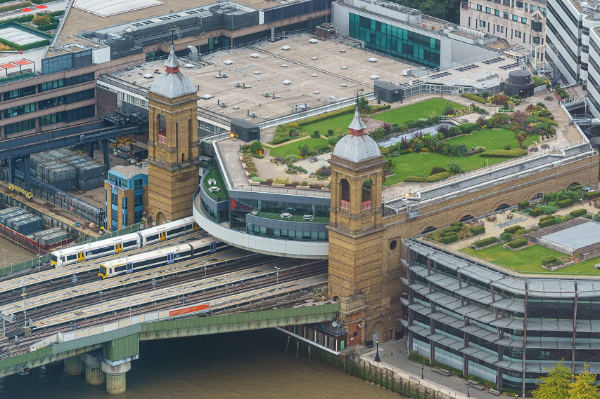
The Sir John Hawkshaw is located inside the Cannon Street Station (with good reason). PICTURE:© User:Colin / Wikimedia Commons / CC BY-SA 4.0.

This establishment in the Cannon Street Station in the City of London is a modern take on the pub but thanks to the name and location comes with built-in history.

Sir John Hawkshaw (1811-1891) was a railway engineer who, importantly given this pub’s location, is recognised for his work on the original Cannon Street railway station – which he designed with JW Barry – as well as the adjoining Cannon Street Railway Bridge over the Thames (it was originally named ‘Alexandra Bridge’ in honour of Princess Alexandra of Denmark, wife of Edward, the Prince of Wales)

The original Cannon Street station, which opened on 1st September, 1866, featured two “Wren-style” towers which stand 135 feet high and faced the Thames (these two towers, now Grade II listed, are still there today). They helped support the station’s single arched iron and glass roof which stretched some 700 feet in length to cover the railway platforms (an adjoining Italianate-style hotel and forecourt designed by Barry opened the following year).

While Hawkshaw’s two towers remain (and it should be noted that the engineer was also famous for his work on other projects including, among others, the Severn Tunnel and Suez Canal), the current Cannon Street Station is a much more modern structure dating originally from the 1980s with some works being completed in the last decade or so.

The site’s known history, meanwhile, goes back much further, however. Prior to Hawkshaw’s station, since 1690 the site had been occupied by the livery hall of the Worshipful Company of Plumbers. Prior to that it was the site of the Steelyard and, much further back in time, the remains of a Roman palace have been found beneath the site which date from the 1st century.

The modern pub, located in the station, is part of the JD Wetherspoon chain.

For more on the pub, see https://www.jdwetherspoon.com/pub-histories/england/london/the-sir-john-hawkshaw-cannon-street.

Where’s London’s oldest…florist?

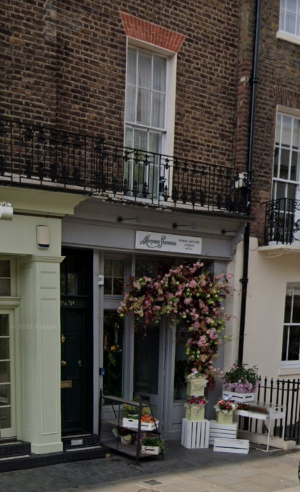
Moyses Stevens premises at 53 Elizabeth Street in Belgravia. PICTURE: Google Maps

While flowers have been sold in London for centuries, the oldest surviving family florist is said to be Moyses Stevens.

The original shop was opened by Miss Moyses (who became Mrs Stevens) in Victoria Street, Belgravia. It was extended in the 1930s and a branch in Berkeley Square, Mayfair, followed in 1936.

The firm, a regular at the Chelsea Flower Show, held the royal warrant for Queen Elizabeth The Queen Mother and that for then-Prince Charles (we’re not clear on what this means now he’s King).

Known for their wedding arrangements, Moyses Stevens now operates out of locations across the city including one in the Selfridges Food Hall and, since 2019, a flower school in the former Battersea Power Station.

For more, see www.moysesflowers.co.uk

A Moment in London’s History…The opening (and subsequent burning) of Alexandra Palace…

This month marks the 150th anniversary of the fire which destroyed the first Alexandra Palace in the north of London, only two weeks after it was opened.

Conceived by British architect Owen Jones as a “palace of the people”, the palace at Muswell Hill was created to serve as a public centre of recreation, entertainment and education for the people of north London as something of a counterpart to the Crystal Palace in the city’s south.

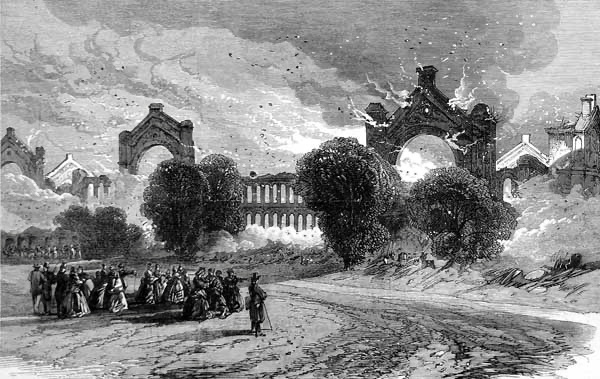
The 1873 fire as depicted in the Illustrated London News.

Designed by Alfred Meeson and John Johnson, the massive glass, iron and brick building covered some 250,000 square feet. It was constructed using recycled materials from the vast temporary building built for the 1862 International Exhibition in South Kensington. Building works commenced in September, 1865, and it was completed in early 1873.

Officially named Alexandra Palace after the popular Princess of Wales, Alexandra of Denmark (although the name Palace of the People – which had originally been given to the project – remained an alternative as did, later, the shortened “Ally Pally”), it featured a vast 900 foot long central nave capped with a 220 foot high dome as well as first floor galleries and terraces.

The palace and surrounding park were officially opened on 24th May, 1873, the 54th birthday of Queen Victoria. The grand celebration, which was attended by tens of thousands of people, featured concerts, recitals and ended with fireworks.

It was only 16 days after the opening, at lunchtime on 9th June, that the palace was destroyed by a fire believed to have started when a burning ember from a brazier being used by plumbers working on the roof set fire to the building’s timber. Numerous horse drawn and manual fire engines were dispatched to the scene along with some 120 firefighters but to no avail.

Tragically three staff members died as a result of the blaze which left only the outer walls of the palace standing. Among the items destroyed was a collection of English pottery and porcelain which, comprising some 4,700 items, had been on loan.

Plans to rebuild the palace were quickly acted upon and a new and improved palace opened on 1st May, 1875. This building survived a fire in 1980 but about a third of the building was destroyed.

The now Grade II-listed building has since been rebuilt(but that’s a story for a another time).

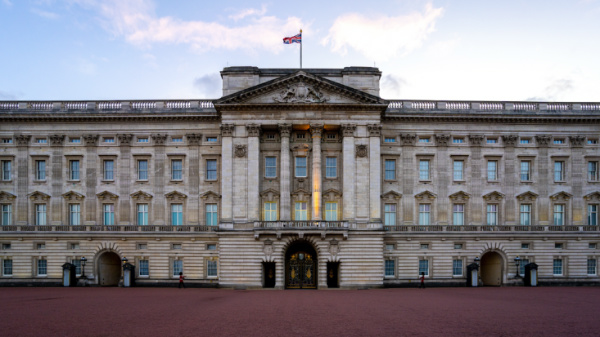
Four sites related to royal coronations in London – 4. Buckingham Palace…

Buckingham Palace. PICTURE: Mike Marrah/Unsplash

Buckingham Palace will play an important role in this weekend’s coronation of King Charles III – not only as the location from which he and Queen Camilla will leave for the ceremony, but also for the famous balcony appearance.

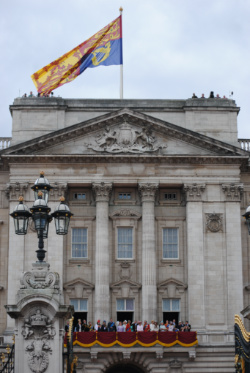
Not just for coronations – the Royal Family on the Buckingham Palace balcony at Trooping the Colour in 2010. PICTURE: David Adams

Monarchs have only been living at the palace since 1837 when Queen Victoria moved in and it has been the official London residence of kings and queens ever since (although it should be noted that since becoming King, Charles has reportedly continued to reside at Clarence House and apparently intends continuing to do so following the coronation).

The palace has been in royal hands since 1761 when King George III bought what was then Buckingham House for the use of his wife Queen Charlotte, given, in particular, its proximity to St James’s Palace where court was held. Hence it become known as the Queen’s House.

King George IV intended using it the same way but in the 1820s had a change of heart and decided, with the aid of architect John Nash, to transform it into a palace. The ballooning work was unfinished when he died, and his successor and younger brother, King William IV, replaced Nash with Edward Blore to complete the work (thanks, apparently, to Nash’s budget blow-outs).

But William didn’t move into the property (in fact, he offered it up as a new home for parliament after much of the old Houses of Parliament were consumed by fire in 1834 – an offer which was not taken up).

Queen Victoria, however, decided to make it her home and she became the first monarch to leave the palace headed to a coronation when she did so in June, 1838.

Victoria also made the first balcony appearance by a monarch at the palace, doing so during celebrations to make the opening of the Great Exhibition in 1851.

But the first balcony appearance by a monarch immediately after their coronation was her son King Edward VII, who appeared on the balcony with his wife Queen Alexandra, to the joy of onlookers following his coronation on 9th August, 1901. Every monarch since has done so after their coronation (King Edward VIII, of course, never having had a coronation).

The King’s mother, Queen Elizabeth II, was the first monarch to watch a flypast on the balcony after her coronation, a tradition the King is expected to continue.

Buckingham Palace has also been the site of Coronation Banquets since the coronation of Queen Victoria (when it replaced Westminster Hall as the location). Queen Elizabeth held two Coronation Banquets in the palace following her coronation on 3rd and 4th June, each attended by 400 guests.

Few details have yet been released about King Charles III’s Coronation Banquet.

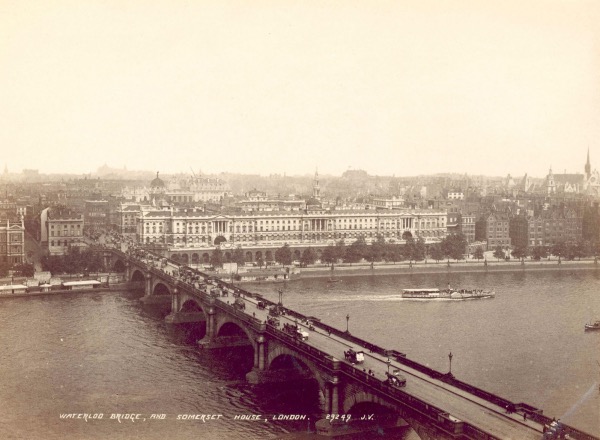
Lost London – Old Waterloo Bridge…

Waterloo Bridge between 1865-1875. PICTURE: Valentine, J, Universitaire Bibliotheken Leiden/licensed under CC BY 4.0)

Built between 1813 and 1817, the first Waterloo Bridge was designed by Scottish civil engineer John Rennie and featured nine elliptical arches, pairs of Doric columns at the piers and a flat roadway.

Originally known as The Strand Bridge, the name was changed by an Act of Parliament in 1816 and commemorated the victory over Napoleon Boneparte at the Battle of Waterloo in 1815.

It was opened by the Prince Regent, accompanied by the Duke of Wellington, on 18th June, 1817 – the second anniversary of the battle.

The bridge originally featured toll booths – the toll was removed in 1877.

In the early 20th century, piers from the bridge settled into the riverbed and created a dip, possibly due to the increasing traffic using it. A temporary steel bridge was placed alongside it and, despite opposition, it was eventually demolished in 1936.

The current bridge, designed by Sir Giles Gilbert Scott, was built over the years 1937 to 1942 (although it wasn’t fully completed until 1945).

Old Waterloo Bridge was famously depicted in a series of works by Claude Monet painted between 1900 and 1904 while he stayed at the Savoy Hotel and by John Constable who created a famous painting of its opening (it’s actually his largest work). The bridge also lends its name to the 1940 American film, Waterloo Bridge, which was adapted from a 1930 play.

Interestingly, granite blocks from the original bridge were sent to Australia and New Zealand while timbers from the bridge were used for shelves and wall panels in the library at Anglesey Abbey in Cambridgeshire (where the famous Constable painting hangs). Some of the original blocks were also incorporated into the foundations and approaches of the new bridge.

The keystone from the original bridge, recovered when it was demolished, is located at the Institution of Civil Engineers in Great George Street.

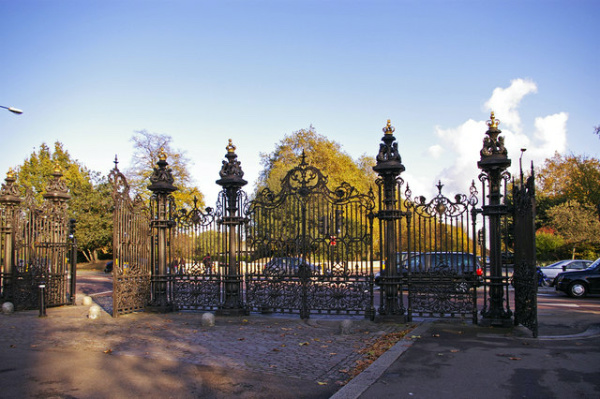
Treasures of London – Coalbrookdale Gates…

Christine Matthews (licensed under CC BY-SA 2.0)

Located at the southern end of West Carriage Drive – the road which divides Kensington Gardens and Hyde Park – are bronze-painted cast iron gates which were made for the Great Exhibition of 1851.

The gates are named for their manufacturer, the Coalbrookdale Company in Shropshire, and were designed by Charles Crookes.

Each of the gates were cast in one piece and feature cherubs or mer-children below gold crowns atop the finials. There are stags head urns sitting atop Portland stone pillars bearing Queen Victoria’s monograms at either end.

The gates were originally positioned as an entrance to the Great Exhibition and were known as the Queen’s Gate (due to their being through which Queen Victoria entered).

The gates were moved here from their original position during the construction of the Albert Memorial in 1871.

The now Grade II-listed gates were damaged by a bomb during World War II. They were restored in 2000.

10 historic London homes that are now museums…7. Sambourne House…

The former home of famed Victorian illustrator and photographer Edward Linley Sambourne, this property at 18 Stafford Terrace in Kensington has been preserved as a museum.

Sambourne, famed for, among other things, the cartoons he produced for Punch magazine, moved into the property in 1875, shortly after his marriage to Marion Herapath in 1874, and the couple, who would have two children – Roy and Maud – lived there for the rest of their lives.

PICTURE: Jhsteel (licensed under CC BY-SA 3.0)

After moving in, Linley, inspired by the grand houses of his artistic friends in the so-called Holland Park circle such as Nick Fildes, Marcus Stone and Colin Hunter, set about redecorating the property in what was then the popular Aesthetic style. He installed stained glass windows, Morris & Co wallpapers and Chinese ceramic vases and over the next 35 years purchased ceramics and furnishings specifically for the property.

While Sambourne adopted many of Aesthetic elements in his decorative scheme such as the stylised motifs inspired by nature and the muted colour palette, he didn’t particularly follow the style’s call for restraint and the house quickly became home to a growing collection of furnishings and objects (in fact an inventory take in 1877, just two years after the couple moved in, shows the home already contained more than 50 vases, 70 chairs and around 700 framed pictures). 

Sambourne, who was said to have been “skilled at making a great show on a limited budget”, couldn’t afford to create a purpose-built studio and worked in various parts of the house, initially in the morning room, which he had extended to meet his needs, and later in the upstairs drawing room. After their daughter Maud married and left the property, he converted the former nursery on the top floor into a studio.

After the deaths of Linley in 1910 and Marion in 1914, their bachelor son Roy moved in and lived there until his own death in 1946. The house then passed to Maud (now Maud Messel), although she didn’t live there, and on her death passed to her daughter Anne Messel.

Anne had married Ronald Armstrong Jones in 1925 and then, following a divorce, Michael Parsons, sixth Earl of Rosse in 1935, giving her the title of Countess of Rosse. She inherited the house in 1960 – the same year her son Antony married Princess Margaret and received the title of Earl of Snowdon.

Lady Rosse, who had proposed the house be preserved as it had been in Linley’s day, subsequently negotiated the sale of the property to the Greater London Council in 1980 and in turn it was leased to the Victorian Society, which she had co-founded in 1957. It was subsequently opened as a museum.

In 1989, after the Greater London Council was abolished, ownership of the house transferred to the Royal Borough of Kensington and Chelsea (the lease to the Victorian Society meanwhile, ended in 2000). In 2022, the house, now Grade II*-listed, was re-opened to the public after a significant renovation and refurbishment project.

Alongside the decor, furnishings and ceramics, the house displays a number of the cartoons Sambourne drew for Punch as well as drawings he did for other projects, such as Charles Kingsley’s The Water Babies, and some of his collection of more than 30,000 photographs used to aid his production of cartoons (not all of which apparently are suitable for public consumption). Sambourne’s “detective camera” which allowed him to photograph subjects surreptitiously is also there.

WHERE: Sambourne House, 18 Stafford Terrace (nearest Tube stations are Kensington (Olympia) and High Street Kensington); WHEN: 10am to 5:30pm, Wednesday to Sunday; COST: £11 adult/£9 concession/£5 child (six to 18-years-old/five and under free); WEBSITE: www.rbkc.gov.uk/museums/sambourne-house

London Explained – English Heritage’s Blue Plaques…

Walk the streets of London and chances are you’ll soon come across an English Heritage Blue Plaque commemorating someone famous.

There are now more than 990 Blue Plaques in London, commemorating everyone from diarist Samuel Pepys to writer Virginia Woolf and comedian Tony Hancock.

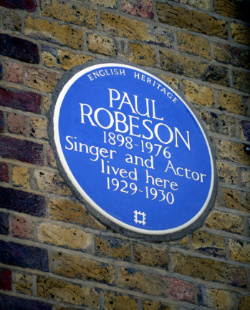
An English Heritage Blue Plaque commemorating singer and actor Paul Robson. PICTURE: Brett Jordan/Unsplash

The scheme was started in 1866 by the Society of Arts (later the Royal Society of Arts) having been proposed by MP William Ewart three years before. The first two plaques were erected in 1867 – one commemorating poet Lord Byron at his birthplace, 24 Holles Street in Cavendish Square (although this property was later demolished) and the other commemorating Napoleon III in King Street, Westminster (this is now the oldest survivor of the scheme).

Thirty-five years – and 35 plaques – later, the London County Council took over the scheme. It was this body that standardised the plaque’s appearance (early plaques come in various shapes and colours) and while ceramic blue plaques were standard by 1921, the modern simplified Blue Plaque didn’t appear until 1938 when an unnamed student at the Central School of Arts and Crafts, who was paid just four guineas for their troubles, came up with what is now an iconic design.

In 1965, the LCC, having created almost 250 new Blue Plaques, was abolished and its successor, the Greater London Council, took over the scheme, expanding its area of coverage to includes places like Richmond, Redbridge and Croydon. In 1984, the GLC appointed artisan ceramicists Frank and Sue Ashworth of London Plaques to make the Blue Plaques (and they continue to do so).

The GLC placed some 262 Blue Plaques before, in 1986, English Heritage took over management of the scheme. Since then it’s placed more than 360 plaques.

The plaques, which are 495mm (19½ inches) in diameter and 50mm (two inches) thick, are slightly domed in a bid to encourage self-cleaning in the rain.

Anyone can propose a subject for a new plaque – but generally only one plaque is erected per person (although there have been some exceptions to this), only a maximum of two plaques are allowed per building (there are 18 buildings with two), and proposals, if turned down, must wait 10 years before they are reconsidered.

In addition, new Blue Plaques are only erected a minimum of 20 years after the subject’s death, the building on which one is placed must “survive in a form that the commemorated person would have recognised, and be visible from a public highway”, and buildings which may have many different personal associations, such as churches, schools and theatres, are not normally considered.

The Blue Plaques panel meet three times a year to decide on proposals. Among those currently serving on the 12 person body are architectural historian Professor William Whyte, who chairs the panel, award-winning journalist and author Mihir Bose, Emily Gee, regional director for London and the South East at Historic England, and, Susie Thornberry, assistant director at Imperial War Museums.

The plaques don’t confer any legal protection to buildings but English Heritage says they can help preserve them through raising awareness.

Recently unveiled plaques have commemorated pioneering social research organisation Mass-Observation, lawyer Hersch Lauterpacht – who played a key role in prosecuting the Nazis at the Nuremberg trials, and, Dadabhai Naoroji, an Indian Nationalist and the first Indian to win a popular election to Parliament in the UK. Among those being unveiled this year are plaques commemorating anti-racist activist Claudia Jones, suffragette Emily Wilding Davison and Ada Salter, the first female mayor of a London borough.

English Heritage’s Blue Plaques scheme isn’t the only one commemorating people in London. Others include the City of London’s Blue Plaques scheme (there is only one English Heritage Blue Plaque in the City of London – it commemorates Dr Samuel Johnson), Westminster City Council’s Green Plaques and Heritage Foundation plaques which commemorate figures who worked in entertainment.

For more, head to www.english-heritage.org.uk/visit/blue-plaques/.

10 historic London homes that are now museums…2. Carlyle’s House…

Carlyle’s House frontage. PICTURE: Kotomi_ (licensed under CC BY-NC 2.0)

This Chelsea terraced house, now owned by the National Trust, was once the home of the Victorian literary couple, essayist and historian Thomas Carlyle and his wife (and skilled letter writer) Jane.

The Carlyles moved into the red brick property at 24 Cheyne Row (formerly number 5) in 1834, having left rural Scotland to see what they could make of themselves in London.

As their stars rose – by mid 19th century Thomas, the “sage of Chelsea”, had become an influential social commentator, the home became something of a hub for Victorian literati with the likes of Charles Dickens, Alfred, Lord Tennyson, George Eliot and William Thackeray all visiting them here.

When Thomas died at the property on 5th February, 1881 (Jane had died in 1866), the home reverted to the landlord but a group of admirers decided it needed to be preserved as a memorial to their friend. They raised funds through a public subscription and in 1895 opened it as a shrine to the writer.

The National Trust took over the running of the house, which was built in around 1708, in 1936 with the enthusiastic support of founder Octavia Hill who herself was a Carlyle fan.

The property, which still retains many of its original fixtures and fittings, features a recreation of the couple’s parlour based on Robert Tait’s painting A Chelsea Interior which depicts the Carlyles in the room in 1857.

The property also boasts the attic study that Thomas had constructed in August, 1853, and where he wrote The French Revolution, Latter Day Pamphlets and Fredrick the Great. His attempts at sound-proofing it had failed.

Meanwhile, Jane’s dressing room features a pair of original chintz curtains which she made in the late 1840s.

Inside the parlour at Carlyle’s House. PICTURE: Kotomi_ (licensed under CC BY-NC 2.0)

Among the items on show in the property is a necklace given to Jane by German writer and stateman Johann Wolfgang von Goethe which features a pendant containing a portrait of him. There’s also a a decoupage screen made by Jane using prints in 1849 and wallpapers by William Morris.

The property, which also features a small walled garden and a bust of Thomas Carlyle on the facade, is currently undergoing restoration work and will reopen in March.

WHERE: Carlyle’s House, 24 Cheyne Row, Chelsea (nearest Tube stations are Sloane Square and South Kensington); WHEN: Check website when it reopens; COST: £9 adults/£4.50 children; WEBSITE: www.nationaltrust.org.uk/carlyles-house.

Five locations located to Charles Dickens’ ‘A Christmas Carol’…

Charles Dickens’ A Christmas Carol is forever linked to Christmas in London. So, with Christmas almost upon us, here’s a quick look at five locations mentioned or alluded to in the famous book…

1. 16 Bayham Street, Camden Town. Bob Cratchit’s house is described as being in Camden Town but what’s interesting is that as a child Dickins’ himself lived here at this property. So whether or not it’s the actual address Dickens had in mind for Cratchit’s property, it’s certainly in the vicinity.

The Royal Exchange today. PICTURE: Klaudia Piaskowska/Unsplash

2. The Royal Exchange. Referenced in regard to Ebenezer Scrooge who did business there. The current building was still being completed when Dickens wrote A Christmas Carol in 1843 following a fire at the premises several years before. It was opened in 1844.

3. Simpsons Tavern. Scrooge is said to have taken his “melancholy dinner in his usual melancholy tavern” which has been suggested could refers to Simpsons. Located in Ball Court, the current premises opened in 1757. The George & Vulture in Michael’s Alley is also mentioned as a possibility.

4. Newman’s Court. Located near Cornhill (which is mentioned in the book as the site where Bob Cratchit goes on a slide after leaving Scrooge’s office), it’s been suggested more than once that while the location of Scrooge’s counting house is not specified in the text, a location in Newman’s Court would fit the bill.

5. Leadenhall Market. Following Scrooge’s transformation, he sends a boy out to buy a turkey- commentators suggest the poulterer the boy attends was located in Leadenhall Market which would have been a predecessor to the current building which dates from 1881.

8 locations for royal burials in London…8. Kensal Green Cemetery…

Princess Sophia’s grave at Kensal Green Cemetery. PICTURE: Stephencdickson (licensed under CC BY-SA 4.0)

The oldest of London’s so-called ‘Magnificent Seven’ cemeteries established in the 19th century, Kensal Green is the burial place of a few members of the royal family dating from the Georgian and Victorian eras.

The ninth child and sixth son of King George III, Prince Augustus Frederick, the Duke of Sussex, died at Kensington Palace at the age of 70. In his will, he specifically requested he not have a state funeral and so was buried at Kensal Green on 4th May, 1843. His rather plain grey monument which is surrounded by concrete bollards, is located in front of the cemetery’s main chapel.

Opposite his grave is the tomb of his sister Princess Sophia, the 12th child of King George III. She, too, died at Kensington Palace – on 27th May, 1848 – and wished to be buried near her brother instead of at Windsor.

King George III’s grandson, Prince George, Duke of Cambridge, was also buried at Kensal Green. A military man (and ally of Queen Victoria), he served as commander-in-chief for 39 years before being forced to resign in 1895. He died in 1904 at Gloucester House, Piccadilly, in 1904 and was buried at Kensal Green with his wife the following day.

WHERE: Kensal Green Cemetery, Harrow Road, Queen’s Park (nearest Tube station is Kensal Green); WHEN: Monday to Saturday 9am to 5pm, Sundays 10am to 5pm; COST: Free: WEBSITE: www.kensalgreencemetery.com.

LondonLife – Afternoon tea at The Savoy…

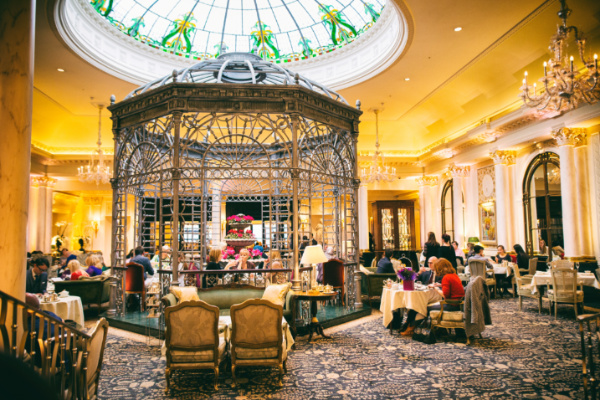
PICTURE: Christian Lendl/Unsplash

Afternoon tea is served under the glass-dome of The Savoy Hotel‘s Thames Foyer. Once an outdoor terrace, the covered-in foyer was opened in 1889. The custom of afternoon tea, which dates back to 1840, had become a tradition at the hotel by the 1920s and, as well as sandwiches and patisserie, included everything from English muffins to fruit salad, chocolates to sweet waffles known as gaufres. Entertainment included music played by a house band while professional dancers demonstrated the latest moves for guests. Guests at the famous London hotel have included everyone from Sir Winston Churchill to Marilyn Monroe. For more, see www.thesavoylondon.com/experience/afternoon-tea-london/.

Lost London – Northumberland House…

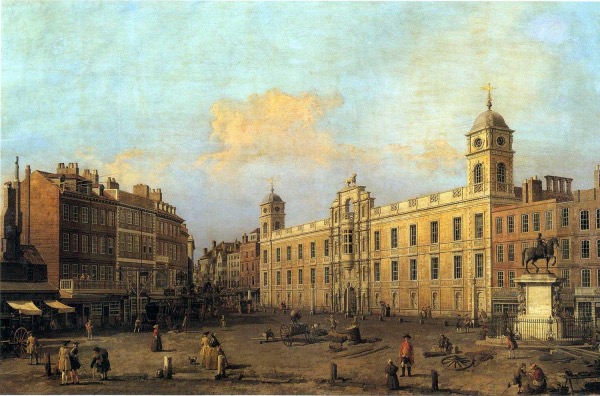
London: Northumberland House painted by Canaletto in 1752.

Among a number of mansions built between the Strand and the River Thames, the property was built for Henry Howard, first Earl of Northampton, in about 1605.

Then known as Northampton House, the Jacobean mansion at Charing Cross was built on the site of a former convent (roughly located on the corner of the modern-day Northumberland Avenue and The Strand).

The property was built around a courtyard with turrets at each corners and had a great hall and apartments for the various members of the household. It featured a four-storey high stone gateway opening onto the Strand and a large garden at the rear but it didn’t apparently reach all the way down to the river unlike many of the neighbouring properties.

The house passed to the Earls of Suffolk and then in the 1640s was sold to Henry Percy, the 9th Earl of Northumberland, at the discounted price of £15,000, as part of a marriage settlement (hence the name change).

Various improvements were made over the years – including relocating the principal living rooms from the Strand side of the building to that facing onto the gardens and adding extra wings which protruded into the gardens.

In the 1770s, Robert Adam was commissioned to redecorate the state rooms on the garden front – the ‘Glass Drawing Room’ at Northumberland House was one of his most celebrated interiors. Shortly after this, part of the Strand front had to be rebuilt after a fire in 1780.

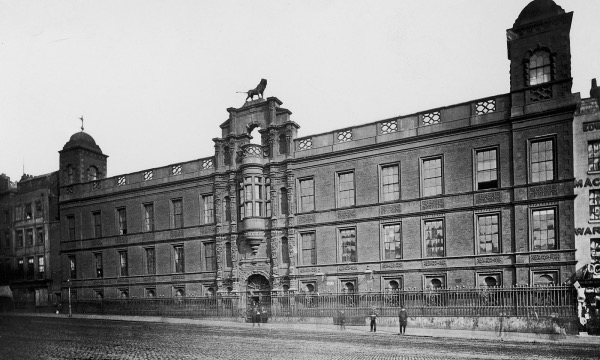
Northumberland House on the Strand, shortly before it was demolished in 1874. PICTURE: London Stereoscopic Company/Hulton Archive/Getty

By the mid-19th century, the mansions on The Strand had all been demolished and the Metropolitan Board of Works wished to acquire Northumberland House to construct a road across the site connecting The Strand to the Embankment.

The Duke of Northumberland resisted but after a fire substantially damaged the property, he agreed to sell which he did for £500,000 in 1874. The house was subsequently demolished and Northumberland Avenue built across the site.

A remnant from the property – a stone lion, known as the ‘Percy Lion’ – was taken from the property by the Duke in 1874 and placed atop Syon House, the Duke’s seat in London’s west. An archway from the property, designed by William Kent, is now the principal entrance to the Bromley by Bow Centre.

Lost London – Greenwich’s Romano-Celtic temple…

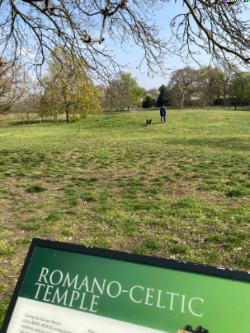
Although little now remains of it (and none to be seen above ground), a mound in Greenwich Park is thought to have once been the location of a Romano-Celtic temple.

Site of the temple remains in Greenwich Park. PICTURE: Matt Brown (licensed under CC BY 2.0)

Given its site close to Watling Street – the main Roman road linking London and the Kent ports, it’s believed that the temple may have served travellers as well as the local community. The Historic England listing for the ruins, which are a scheduled monument, suggests the temple was in use by 100AD and continued to be used until about 400AD.

The remains, which are now located on the eastern side of Greenwich Park on a site known as Queen Elizabeth’s Bower, was excavated in 1902 after they were stumbled across during works on the park. Three different floor surfaces were revealed, one of which was a tessellated pavement, along with the right arm of an almost life-sized statue, fragments of stone inscriptions and more than 300 coins dating between the 1st and 5th centuries.

A further excavation occurred in the early 1970s and another in 1999 – all of which provided further evidence of a temple.

Finds from the 1999 dig – which was undertaken by TV Channel Four’s ‘Time Team’, Birkbeck University of London and the Museum of London in the creation of a programme broadcast the following year – included part of an inscription to Jupiter and the spirits of the emperors and a stamped tile.

It is thought the temple precinct, known as a temenos, would have included a main temple building known as a cella as well as ancillary buildings and been surrounded by a stone wall.

Famous Londoners – Great Paul…

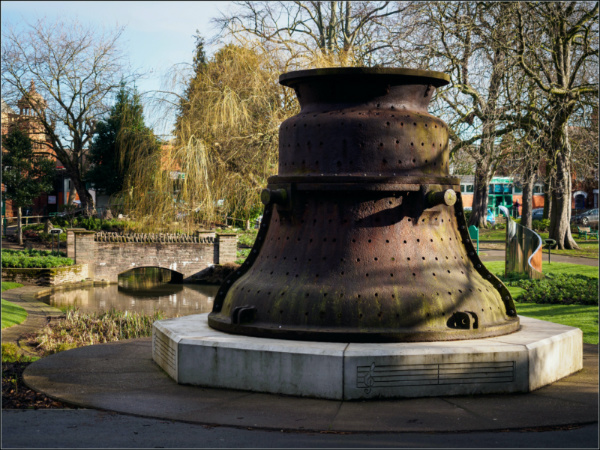
The bell casing used by Taylor’s Bell Foundry to cast Great Paul in Loughborough. PICTURE: Phil McIver (licensed under CC BY-NC 2.0)

Not the name of a person, Great Paul is in fact the name of the largest of four bells in south-west tower of St Paul’s Cathedral.

The south-west tower at St Paul’s Cathedral which contains Great Paul. PICTURE: jan buchholtz (licensed under CC BY-NC-ND 2.0)

The bronze bell was cast in 1881 by JW Taylor of Taylor’s bell foundry in Loughborough. With a diameter of some 11 metres, it weighs an impressive 16.8 tons (in fact, until the casting of the Olympic Bell for the 2012 London Olympics, it was the largest bell in the UK).

Brought to London from Loughborough on a train over a period of 11 days, Great Paul was hung in the tower in May, 1882.

The bell was traditionally sounded at 1pm every day but was silent for more than 40 years after its ringing apparatus broke in the 1970s.

Following a restoration, Great Paul started being rung again last year when it was rung during a festival of church bells to mark the easing of COVID-19 restrictions. Earlier this year, it led a bell ringing tribute marking Queen Elizabeth II’s Platinum Jubilee.

Previous historic occasions on which the bell was rung included Queen Victoria’s Diamond Jubilee in 1897 and the marriage of Prince Charles and Lady Diana Spencer at the cathedral in 1981.

The south-east tower of the cathedral is also home to the storied bell known as Great Tom – but we’ll deal with that in a future post.

A Moment in London’s History – The opening of the Bethnal Green Museum…

This month marks 150 years since the opening of the Bethnal Green Museum, the first public museum located in London’s east.

The museum had at its core a pre-fabricated building which had earlier been erected as part of the first phase of the South Kensington Museum. It was brought to the Bethnal Green site and encased in a red brick exterior designed by James Wild.

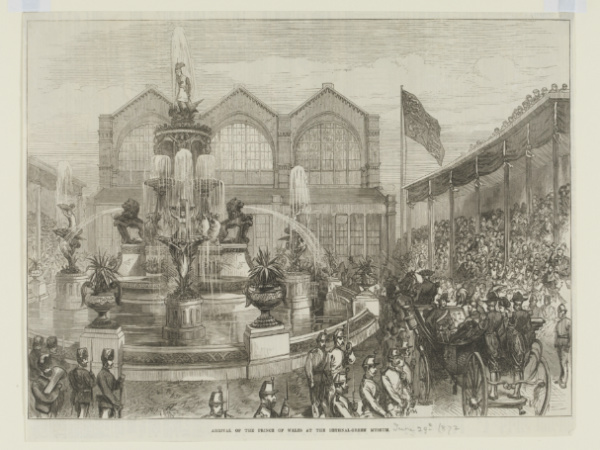
Black and white print of the Prince and Princess of Wales arriving at the official opening of the Bethnal Green Museum (now Young V&A) on 24th June, 1872. Originally printed in the London Illustrated News. PICTURE: Courtesy of Young V&A

Formally known as the East London Museum of Science and Art, it was opened on 24th June, 1872, by the Prince of Wales, later King Edward VII, amid considerable pomp and great crowds.

The museum, a branch of what became the Victoria & Albert Museum in South Kensington, was built to house and display many of the collections which had been exhibited at the Great Exhibition of 1851. Among the art collections on show was that of Sir Richard Wallace (now housed in the Wallace Museum).

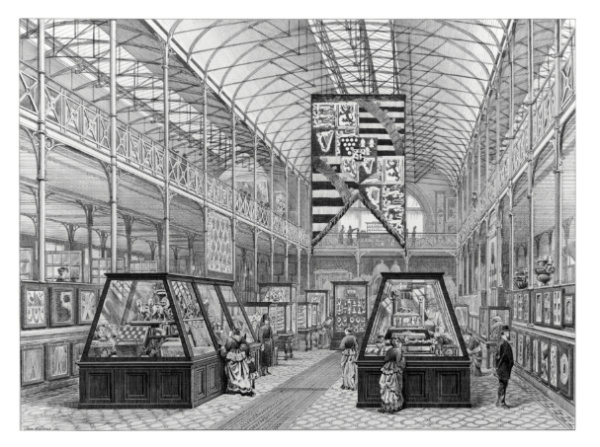
An interior view of the Bethnal Green Museum (now Young V&A). PICTURE: Courtesy of Young V&A.

After World War II, the museum was remodelled as an art museum and included a children’s section. Then, in 1974, the museum became the Museum of Childhood with displays focusing on everything from toys and dolls houses to children’s dress and books.

It underwent an extensive renovation in the mid 2000s and reopened in December, 2006, as the Victoria & Albert Museum of Childhood.

The now Grade II*-listed museum, located on Cambridge Heath Road, is currently undergoing a £13 million redevelopment and will reopen in mid-2023 as Young V&A, a new museum dedicated to 0 to 14-year-olds, their families and carers.

The V&A marked a year to the opening of the new museum with the launch of a year-long Reinvent Festival, “celebrating 150 years with 150 waysto be creative”. For more, see www.vam.ac.uk/blog/museum-life/young-va-reinvent-festival-reinventing-a-museum-for-the-young.

This Week in London – Coining the Queen’s portrait; the UK’s first Stolperstein; pioneering female landscape gardener honoured; and Picasso and Ingres…

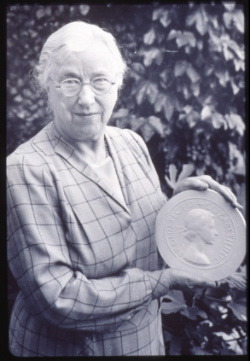
Plaster model for the obverse of a coin.  Mary Gillick, 1952.  Bust of Queen Elizabeth II r., wearing laurel wreath. © The Trustees of the British Mu

A free display featuring the first coin bearing a portrait of Queen Elizabeth II has opened at the British Museum. Part of the celebrations marking the Queen’s Platinum Jubilee, The Asahi Shimbun Display Mary Gillick: modelling The Queen’s portrait showcases the production and reception of the coin which was designed in 1952 and released the following year. Gillick’s portrait – which remained in circulation on coins in the UK until the 1990s and was also adapted for use on commemorative stamps – combined modern design with Italian Renaissance influences. Can be seen until 31st July. For more, see www.britishmuseum.org.

The UK’s first Stolperstein or “stumbling stone” has been installed in Soho as part of an initiative to remember the victims of the Nazis. The small brass plaque commemorates former resident Ada van Dantzig, a Dutch-Jewish paintings conservator for the National Gallery who came to London in the 1930s and worked and resided in Golden Square in Soho (where the plaque has been installed). She later re-joined her family in the Netherlands and was arrested in France in early 1943 along with her mother, father, sister and brother. Deported to Auschwitz, Ada, along with her parents, was murdered there on 14th February, 1943. Artist Gunter Demnig created the project almost 25 years ago to commemorate victims of Nazi Persecution during the Holocaust. More than 100,000 of stones have now been laid in 26 countries throughout Europe with the location of the stones the last address of those being remembered.

A pioneering female landscape gardener has been honoured with an English Heritage Blue Plaque at her former flat in Shaftesbury Avenue. Fanny Wilkinson, who is believed to be Britain’s first professional female landscape gardener, was also a campaigner for the protection of open space in London. She lived and worked at the flat, which overlooks an open space she laid out herself, between 1885 and 1896. Wilkinson began her career as an honorary landscape gardener to the Metropolitan Public Boulevards, Gardens and Playgrounds Association – an organisation whose mission was the formation of gardens and public parks that would create playgrounds and green ‘lungs’, especially in poor districts of the capital. In June, 1885, it was agreed that she could charge five per cent on all her MPGA payments, leading her to drop the ‘honorary’ title and become Britain’s first professional female landscape gardener. For more, see www.english-heritage.org.uk/visit/blue-plaques/.

A painting by Pablo Picasso – Woman with a Book (1932) from the Norton Simon Museum in Pasadena, California – and a painting by Jean-Auguste-Dominique Ingres – Madame Moitessier (1856) – are being shown together for the first time at The National Gallery. Picasso admired Ingres and referred to him throughout his career and this connection can be seen not only in his paintings but in drawings and studies he made during his ‘neoclassical’ phase in the 1920s. He encountered Madame Moitessie at an exhibition in Paris in 1921 and 11 years later painted Woman with a Book. The paintings, which are being show under a collaborative initiative between the two institutions, can be seen in Room 1 until 9th October. Admission is free. For more, see www.nationalgallery.org.uk.

Send all items for inclusion to exploringlondon@gmail.com