LondonLife Special – Long-serving royals…

Today marks 60 years since Queen Elizabeth II ascended to the throne, making her Britain’s second-longest serving monarch. While the celebrations are yet to kick off in earnest (the Diamond Jubilee weekend will be officially held over the 2nd to 5th June), we thought we’d take a quick look at the top 10 longest-serving monarchs who were crowned at Westminster Abbey in London:

1. Queen Victoria – 63 years (20th June, 1837-22nd January, 1901)

2. Queen Elizabeth II – 60 years (6th February, 1952-current)

3. King George III – 59 years (25th October, 1760-29th January, 1820)

4. King James I (VI of Scotland) – 57 years (24th July, 1567-27th March, 1625)

5. King Henry III – 56 years (18th October, 1216-16th November, 1272)

6. King Edward III – 50 years (25th January, 1327-21st June, 1377)

7. Queen Elizabeth I – 44 years (17th November, 1558-24th March, 1603)

8. King Henry VI – 38 years (31st August, 1422-4th March,1461, and, 31st October, 1470-11th April, 1471)

9. King Henry VIII – 37 years (22nd April, 1509-28th January, 1547)

10. King Henry I – 35 years (3rd August, 1100-1st December, 1135)

Famous Londoners – Sarah Siddons

The most acclaimed tragic actress of the 18th and early 19th centuries, Sarah Siddons is best remembered for her iconic role as Shakespeare’s Lady Macbeth.

Born in 1755 into the theatrical Kemble family (her father was an actor and theatre manager and many of her 11 younger siblings, including John Philip Kemble, also went on to be actors) in Brecon, Wales, Siddons first began appearing with Kemble’s company while still at school. Still only a young teenager, she also began a romance with one of the company’s actors, William Siddons.

The liaison was discouraged by her parents (as was the idea of her acting) and in 1770 she was sent into service with a family in Warwick. She had kept up correspondence with Siddons, however, and, after her parents withdrew their opposition to the match, they were married on 26th November, 1773.

The couple rejoined Kemble’s company initially but were soon working for another, Chamberlain and Crump, and it was while doing so in the spa town of Cheltenham that Siddons’ abilities came to the notice of famed actor, playwright and theatre manager David Garrick.

Invited to London, her initial foray into acting there, however, fell flat and, following a short-lived season at Drury Lane Theatre which resulted in her services no longer being required (it is believed the fact she had two very young children at the time, having only just given birth to the second, didn’t help her performances), Siddons instead headed to the country and worked in places like York, Manchester and Bath, rebuilding her somewhat battered reputation.

It proved a successful move for when she was invited back to London in 1782, her now not just restored but blossoming reputation preceded her. To much acclaim she performed in the title role in David Garrick’s play, Isabella, or, the Fatal Marriage.

It was to be the first of many high profile roles – the most famous of which was to play Lady Macbeth – and Siddons soon rose to become the most sought-after actress in the city, a position which allowed her to mix among the elite of society (among her friends were counted lexicographer Dr Samuel Johnson and philosopher Edmund Burke and she even appeared before King George III and Queen Charlotte). Venerated as a “cultural icon”, her star continued to climb in the 1780s and it was in 1783-84 that she sat for a portrait, The Tragic Muse, by Sir Joshua Reynolds (pictured).

Her personal life, meantime, was another matter and in 1804, Siddons and her husband – who had increasingly spent time apart during the preceding years, formally separated (William died in Bath four years later). She had also experienced the deaths of many of her children – in fact, only two of her seven children were to outlive her.

Siddons retired from the stage in 1812 – her final moving performance was, you guessed it, as Lady Macbeth – but continued to appear on special occasions until 1819.

She died in June, 1831, and, following a huge funeral, was buried at St Mary’s Cemetery at Paddington Green. There is a statue of her at the grave. Siddons is among those actresses currently featured in the National Portrait Gallery exhibition The First Actresses – Nell Gwyn to Sarah Siddons. The exhibition runs until 8th January (an admission charge applies). For more information visit www.npg.org.uk.

For further reading – Robyn Asleson’s A Passion for Performance: Sarah Siddons and Her Portraitists

PICTURE: Sarah Siddons as the Tragic Muse by the Studio of Sir Joshua Reynolds, 1784  © National Portrait Gallery, London

Around London – Illuminating manuscripts at the BL; Capability Brown and Richard Burton blue plaqued; and, Grayson Perry at the British Museum…

Opened to the public last week, Royal Manuscripts: The Genius of Illumination – a landmark exhibition at the British Library – features a “treasure trove” of illuminated manuscripts collected by the kings and queens of England between the 9th and 16th century. Highlights include 16 illuminated manuscripts of King Edward IV, what the library calls the first “coherent collection” of royal books; the Psalter of King Henry VIII, A History of England by Matthew Paris, a 13th century monk, scholar and advisor to King Henry III; Thomas Hoccleve’s Regement of Princes – a early 15th century instruction book on how to be an effective ruler; a 14th century Genealogical Chronicle of the English Kings; and, The Shrewsbury Book, created in Rouen in 1445 and presented to Margaret of Anjou on her marriage to King Henry VI by the renowned military commander John Talbot, 1st Earl of Shrewsbury. An impressive series of public events featuring well known writers and historians – including Eamon Duffy, Michael Wood, and Andrew Marr –  is taking place alongside the exhibition. Runs until 13th March. An admission charge applies. For more, see www.bl.uk.

PICTURE: The Coronation of Henry III, Images of English Kings, from Edward the Confessor to Edward I, England, c. 1280-1300, Cotton Vitellius, A. xiii, f. 6 © British Library Board

• Leading 18th century landscape gardener Lancelot ‘Capability’ Brown has been honored with a blue plaque at his former home in Hampton Court Palace. Brown, who designed more than 120 landscapes during his lifetime, lived at Wilderness House after King George III appointed him Chief Gardener at the palace – he lived there from 1764 until his death in 1783. Brown’s legacy can still be seen at country houses around England – including at Petworth House in West Sussex, Alnwick Castle in Northumberland, Chatsworth House in Derbyshire and Blenheim Palace in Oxfordshire. He had earned the name ‘Capability’ by the 1760s – apparently he often spoke of a property’s capabilities when speaking of it. English Heritage unveiled the plaque last week. For more, see www.english-heritage.org.uk.

A second blue plaque worth mentioning this week is that marking the former home of actor Richard Burton. Michael Sheen – currently playing Hamlet at the Young Vic – was among those who last week attended the unveiling on the plaque at the home Burton and his wife actress Sybil Williams lived in from 1949 to 1956, the period during which he rose to international fame. While living at the house 6 Lyndhurst Road in Hampstead, Burton was a member of the Old Vic theatre company – performing, to the acclaim of critics, roles including that of Hamlet, Othello, Coriolanus and Henry V – and in 1952 made his Hollywood debut with My Cousin Rachel. Other films he appeared in during the period include The Robe (1953), The Desert Rats (1953), and Alexander the Great (1956). Following the close of the Old Vic season in 1956, Burton moved to Switzerland and went on to even greater public fame following his role in the 1963 film Cleopatra alongside his then lover (and later wife) Elizabeth Taylor. For more, see www.english-heritage.org.uk.

• On Now: Grayson Perry – The Tomb of the Unknown Craftsman. This exhibition at the British Museum explores a range of themes connected with the ideas of craftsmanship and sacred journeys and includes 190 objects from the museum’s collection selected by the artist along with a works by Grayson himself, many of which will be on public view for the first time. They include everything from Polynesian fetishes to Buddhist votive offerings, a prehistoric hand axe to 20th century badges and a re-engraved coin from 1882 featuring a bust of Queen Victoria with a beard and boating hat. At the heart of the exhibition sits Grayson’s own work, The Tomb of the Unknown Craftsman, a richly decorated cast-iron “coffin-ship”. Runs until 19th February. An admission charge applies. For more, visit www.britishmuseum.org.

London Pub Signs – The Queen’s Larder

In the first of an occasional series looking at the story behind some of London’s pub signs, we take a look at The Queen’s Larder in Queen Square, Bloomsbury.

The origins of the pub go back to the early 18th century – around 1710 – when there was known to be an alehouse on the site now occupied by the tavern. The story goes that as King George III (aka the ‘Mad King George’ depicted in the film of the same name) began to be affected by mental illness he was brought to a house in Queen Square where he stayed and was treated by a Dr Willis.

While he was undergoing this treatment – which was apparently initially successful, his wife Queen Charlotte rented an underground cellar below the alehouse and there stored some of the king’s favorite delicacies.

When a tavern was later built on the site, it was named The Queen’s Larder in honor of the role it had played in providing a storehouse for his treats.

The square itself contains a statue which was believed to be of Queen Anne – after whom the square was renamed (it had previously been known as Devonshire Square) – but it is now thought that the statue may in fact be of Queen Charlotte.

Treasures of London – Harrison’s timekeepers

A series of four marine timekeepers which eventually solved the ‘problem’ of longitude – revolutionising sea travel by allowing mariners to accurately locate their position – are housed at the Royal Observatory in Greenwich.

The three clocks and one watch were designed by John Harrison, a working class joiner from Lincolnshire who made it his life’s mission to design a device which would keep accurate time at sea.

Calculating longitude – an east-west position on the earth – is relatively simple. Because time moves forward one hour for every 15 degrees one travels in an eastward direction (or back an hour for every 15 degrees one travels westward), it’s possible to calculate a position by simply knowing the local time at two different places on earth.

The problem was that the pendulum clocks of the 1600s were affected by changes in temperature and humidity  and couldn’t keep accurate time on board a ship meaning that while a mariner might know the local time, he could not get an accurate measurement of time elsewhere to compare it to.

While mariners could use the ‘lunar distance method’ to measure longitude – this involved measuring the motion of the moon relative to the stars – it relied on clear skies and was not very accurate. So in 1714 the British Government announced it would award a prize of £20,000 to anyone who could come up with a solution to longitude which was accurate to within half a degree (or two minutes).

Clockmaker John Harrison was among those who took up the challenge (his somewhat tragic story is told in great detail in Dava Sobel’s terrific 1995 book Longitude: The True Story of a Lone Genius Who Solved the Greatest Scientific Problem of His Time). His first effort, known simply as H1, was constructed between 1730 to 1735 and, using a counterbalanced spring mechanism making it independent of gravity, was successfully tested on a voyage to Lisbon.

But Harrison wasn’t satisfied and began work on H2 in 1737 before, after realising its shortcomings three years later, starting work on another clock, H3, in 1740. He worked on this for 19 years but it failed to meet the accuracy requirements of the Board of Longitude which was charged with looking overseeing the awarding of the £20,000.

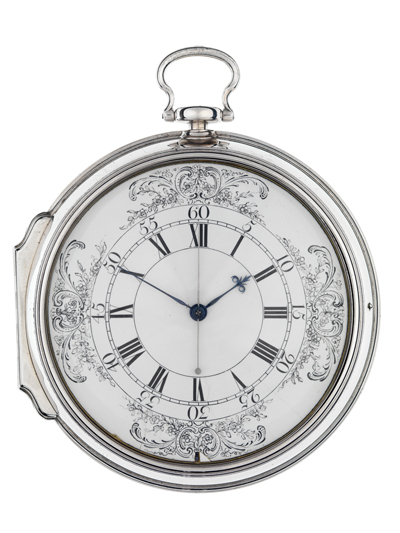
In 1753, Harrison asked a London watchmaker John Jefferys to create a watch to his designs, initially for his own personal use. But he soon discovered that with a few improvements, H4 – which looks like a large pocketwatch (see picture), could be the answer he was looking for.

In 1761 and 1764, Harrison’s son William took the watch on two voyages to the West Indies, yet, despite the fact that its accuracy was well within the requirements of the Board of Longitude, the board initially refused to pay up. After much wrangling Harrison was finally paid £10,000 but told that to obtain the other half of the money, he would have to create at least two more copies of H4.

Harrison went on to make one copy – H5 – while watchmaker Larcum Kendall, made another, K1, at the direction of the Longitude Board. When Harrison suggested that Kendall’s K1 could be considered the second of the two copies he was required to make, the board rejected the idea. Harrison then appealed directly to the king, George III, and finally to parliament before he was eventually awarded a further £8,750 in 1773.

Kendall’s watch, meanwhile, was taken by Captain James Cook on a three year voyage as far afield as Antarctica. It was a test which proved beyond all doubt the accuracy of the timekeepers. A year after Cook’s return in 1775, John Harrison died in his house in Red Lion Square on 24th March, 1776. It is not known whether he knew of the success of the timekeeper taken on Cook’s voyage.

Harrison’s four timekeepers are now housed at the Royal Observatory where the intriguing story of their creation is told.

WHERE: Royal Observatory, Blackheath Avenue, Greenwich (nearest DLR stations are that of Greenwich and Cutty Sark and it can also be reached by river – stop at Greenwich Pier); WHEN: 10am to 5pm (last admission 4.30pm) daily; COST: £7 adult/£5 concessions/free for children 15 and under (annual passes available – £10 an adult/£7.50 concessions) ; WEBSITE: www.nmm.ac.uk/places/royal-observatory/

PICTURE: Courtesy of the Royal Observatory, Greenwich

Where is London’s oldest…tailor?

Founded in 1689, Ede & Ravenscroft is thought to be not only the oldest tailor in London but the world.

The origins of the business can be traced back to William and Martha Shudall, tailors who set up shop in Aldwych in London that year. Their work had soon caught the eye of royalty with the company winning the contract to create robes for the coronation of King William III and Queen Mary II after what is known as the Glorious Revolution.

As well as making robes for the clergy, government officials and those working in the legal and academic professions, the company’s relationship with the Royal Family continued and they have provided robes and tailoring for as many as 12 coronations including that of King George III.

Wig-making was added to the business in the 1800s when Joseph Ede (robe maker to Queen Victoria) married into the Ravenscroft family – already known for their wig-making (the business was renamed from Ede & Son to include the Ravenscroft name in 1902).

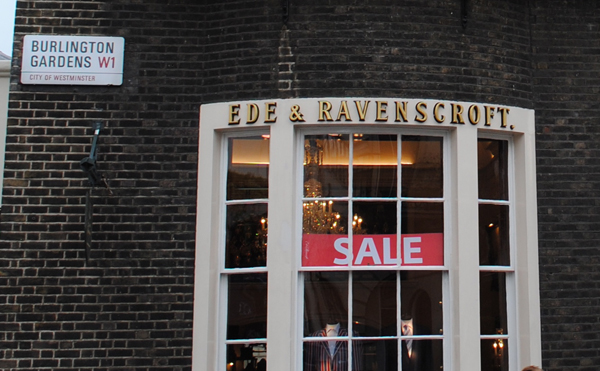
The company, headquartered at 93 Chancery Lane (they also have several other shopfronts including one at Burlington Gardens near Savile Row – see picture), currently holds three Royal Warrants, being official robe-makers to the Queen, Prince Philip and Prince Charles.

Around London – The Tower hosts Royal Beasts; take a ride on a 1938 tube train; Lambeth Palace Library celebrates the King James Bible; and, see model cathedrals at Sir John Soane’s house…

• The history of the Royal Menagerie is the focus of a new exhibition on now at the Tower of London. Royal Beasts explores the history of the Tower menagerie which, founded during the reign of King John in the early 1200s, remained there for more than 600 years. Among the animals were lions (the first record of which dates from 1210), a grizzly bear (a gift from the Hudson Bay Company to King George III), elephants, tigers, ostriches and kangaroos. Highlights of the exhibition include modern animal sculptures by artist Kendra Haste and interactive sensory displays. The recently restored north wall walk and the never before opened Brick Tower will host some of the displays, including sights, sounds and smells of some of the animals. See www.hrp.org.uk/TowerofLondon.

A 1938 tube train will run along the western end of the Piccadilly Line this Sunday (that’s Father’s Day in case you’ve forgotten) as part of the London Transport Museum’s Heritage Vehicles on the Move 2011 programme. Leaving Northfields, the train will travel to High Street Kensington via Earl’s Court (crossing from the Piccadilly to the District Line in a move not normally experienced by the general public) before heading back down the District Line to Acton Town where it will change back onto the Piccadilly Line. The train will then undertake the “fishhook move”, visiting Heathrow Terminal 4 before going to Terminals 1,2,3 and 5. The entire journey is expected to last about two hours. Tickets, which can be purchased at the museum ticket desk or by calling 020 7565 7298, will need to be collected at Northfields Station. For more, see www.ltmuseum.co.uk/whats-on/events/vehicles-on-the-move.

• Lambeth Palace Library is celebrating the 400th anniversary of the King James Bible with a new exhibition. The exhibits include a 1611 edition of the Bible as well as Medieval Bible translations, landmark editions of the Bible which drew on the textual scholarship of the Renaissance and Reformation and early printed vernacular versions. Runs until 29th July. Admission is by pre-booking only. For information on buying tickets and more, see www.lambethpalacelibrary.org/content/2011exhibition.

On Now: Time is running out to see Sir Herbert Oakley’s collection of 27 models of European and English cathedrals at the Sir John Soane Museum. The models were made in the 1850s by William Gorringe, who was a modelmaker by appointment to Queen Victoria. Runs until 25th June. For more, see www.soane.org/exhibitions/

Where’s London’s oldest…bookshop?

Hatchards on Piccadilly (right next to Fortnum & Mason) is generally accepted as being London’s oldest surviving bookshop.

It was founded in 1797 by John Hatchard in Piccadilly (there seems some dispute over whether it still stands on exactly the same site).

The shop currently holds three royal warrants for the supply of books to the Royal Household.

Among high profile past customers have been Queen Charlotte (wife of King George III), former PMs Benjamin Disraeli and  Arthur Wellesley, the Duke of Wellington, and literary figures such as Rudyard Kipling, Oscar Wilde and Lord Byron.

It remains popular with lovers of literature and is noted for hosting book-signings by prominent authors with many signed book on the shelves.

For more, see www.hatchards.co.uk.

The Royal Wedding – Royal residences…

Word is that Prince William and his soon-to-be wife, Catherine Middleton, have yet to formally decide where they will live when in London (they are expected to spend much of their first two-and-a-half years of marriage in North Wales). 

Their initial London base, however, will reportedly be Clarence House. Located in The Mall, just down the road from Buckingham Palace and beside St James’s Palace, the grand building is currently the home of William’s father Charles, the Prince of Wales, his wife Camilla, Duchess of Cornwall, and, William’s brother, Prince Harry (it is also the home of William himself).

In years gone past, Clarence House served as the home of the newly married Queen Elizabeth II (then Princess Elizabeth) and her husband, Prince Philip, the Duke of Edinburgh. Prince Charles, who lived there with his parents until the age of three, returned to the property in August 2003 after the death of his grandmother Queen Elizabeth, the Queen Mother, who had lived in the building from 1953.

Clarence House was built between 1825 and 1827 to the designs of architect John Nash on the orders of Prince William Henry, the Duke of Clarence and later King William IV.

Choices for a permanent home in London for the soon-to-be married couple reportedly include Buckingham Palace (see yesterday’s entry), as well as Kensington Palace.

It was converted from a Jacobean mansion for King William III and Queen Mary II and has since been the home of many royals including, most famously, Diana, Princess of Wales. She and her then husband, Prince Charles, moved in following their wedding in 1981, and Princess Diana continued to live there after her divorce in 1996.

Other notable royal residents have included Queen Anne and Princess Margaret, sister of Queen Elizabeth II.

Another option – St James’s Palace – was built in 1531 on the site of a medieval leper hospital by King Henry VIII. Used initially for state occasions and to house royal relatives (Tudor monarchs actually lived at Whitehall Palace), it became the official royal residence in 1702, when Whitehall Palace burnt down, and remained so until the 1830s when King George III moved to Buckingham Palace.

The Royal Wedding – London’s royal reception venue

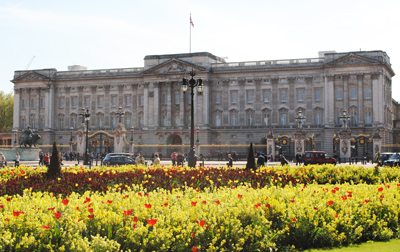
Following the wedding ceremony at Westminster Abbey on Friday, the now married happy couple will head in a carriage via a processional route down The Mall to Buckingham Palace.

There, they will enjoy a champagne reception with 600 guests hosted by the Queen before, at 1.30pm, appearing on the balcony of the palace to wave to the crowds and watch an aircraft flypast expected to include a Lancaster, Spitfire, Hurricane, two Typhoons and two Tornados.

Buckingham Palace, which has served as the official London residence of the reigning monarch since 1837, has a long tradition of hosting royal events. Then much smaller and known as Buckingham House, the property was built for the Duke of Buckingham in 1705.

It passed into royal hands when it was bought by King George III in 1761 for his wife, Queen Charlotte, to use as a family home located conveniently close to St James’s Palace where many court functions were held.

The house was extensively remodelled in 1762 and again, this time on the orders of King George IV, in the 1820s (after initially wanting to use it, like his father, as a family home, the king decided after the works had started to instead transform it into a palace, created to the designs of architect John Nash).

When King George IV died in 1830, his brother King William IV ordered the works to be continued albeit with a new architect, Edward Blore (the spiralling costs of Nash’s work are said to have cost him the contract). The king himself never lived in the house – even offering at at one stage as a seat for Parliament after the Houses of Parliament were destroyed by fire in 1834 – and it wasn’t until the accession of Queen Victoria in 1837 that the palace became the sovereign’s official residence.

Further works were subsequently needed to ensure there was adequate accommodations for the Queen’s family and it was during these works that the monumental Marble Arch – designed as the centrepiece of the palace’s courtyard – was moved away to its present location on the north-eastern corner of Hyde Park.

The palace, which now boasts 775 rooms including 19 staterooms, has since been the site of numerous royal wedding receptions – it was on the balcony  where Queen Elizabeth II and Philip, the Duke of Edinburgh, greeted crowds on 20th November, 1947, after their wedding in Westminster Abbey and, similarly, where Prince William’s parents, Prince Charles and Princess Diana, held a reception before greeting crowds on 29th July, 1981, after their ceremony at St Paul’s Cathedral.

Buckingham Palace was also the location for Queen Victoria’s wedding breakfast following the ceremony in the Chapel Royal at St James’s Palace on 10th February, 1840.

Treasures of London – The ‘Old Lion’ Maidenhair Tree, Kew Gardens

Celebrated in the 2002 list of 50 “Great British Trees”, the Maidenhair Tree is one of a number at Kew Gardens known as an “Old Lion” – the name collectively given to the few remaining trees with a planting date of 1762.

The Gingko biloba or Maidenhair Tree was one of the first of its species to be planted in Britain and, along with the other ‘Old Lions’, was brought from the Twickenham estate of the Duke of Argyll in 1762.

It was planted in what was then a new five acre arboretum laid out by William Aiton, employed as the gardener at the first botanic garden at Kew (this was established in 1759 at the behest of Princess Augusta, wife of Frederick, Prince of Wales – who had died in 1751 – and mother of King George III, and John Stuart, 3rd Earl of Bute).

Originally located against the wall of the ‘Great Stove’ glasshouse to provide it with protection, the tree has stood alone since 1861 when the glasshouse was demolished. It can now be found adjacent to the Wisteria arch close to the Secluded Garden Conservatory. Several further Gingko trees were planted in the garden in 1773 under the direction of botanist Sir Joseph Banks.

The other four ‘Old Lions’ at Kew are a False Acacia (Robinia pseudoacacia), an Oriental Plane (Platanus orientalis), a Caucasian Elm (Zelkova carpinifolia), and a Pagoda Tree (Sophora japonica).

WHERE: Kew Gardens (nearest tube station is Kew Gardens); WHEN: 9.30am to 4.15pm daily (check closing times for glasshouses); COST: £13.90 adults; £11.90 concessions; children under 17 free; WEBSITE: www.kew.org.

Wren’s London – 7. Kensington Palace

A once favored residence of British monarchs, Kensington Palace’s connections with royalty date back to 1689 when, then a private country home known as Nottingham House, the building was purchased by King William III and Queen Mary II.

The royal couple turned to Sir Christopher Wren, then Surveyor of the King’s Works, who was charged with adapting the property into a suitably regal residence.

Wren’s work included the addition of four new pavilions – one at each corner – to provide extra accommodation for the king and queen. The King’s Apartments, approached by a Grand Staircase, were located in the south east, and the Queen Apartment’s in the north west. While many later additions were made, the basic layout of these buildings remains true to Wren’s original design.

Among the many spectacular original rooms is the King’s Gallery, built for William in 1695. It features an 1694 wind dial connected to a weather vane which turns according to the direction of the prevailing wind.

The property’s subsequent royal residents have included Queen Anne, King George I and King George II (it was King George III who made Buckingham Palace his primary London residence). Princess (later Queen) Victoria was born here in 1819 (it was she who first opened the State Apartments to visitors in 1899) while more recent residents in the palace’s private areas have included Princess Margaret and, of course, Diana, Princess of Wales.

WHERE: The Broad Walk, Kensington Gardens, Kensington (nearest tube stations are High Street Kensington or Queensway); WHEN: Daily 10am to 5pm (last admission 4pm); COST: £12.50 adult/£11 concession/£6.25 child/£34 family (online booking discounts available, Historic Royal Palaces members free); WEBSITE: www.hrp.org.uk/KensingtonPalace

PICTURE: Historic Royal Palaces/newsteam.co.uk

Famous Londoners: Samuel Johnson

The man behind what is perhaps the most famous quote about London – “When a man is tired of London, he is tired of life” – Samuel Johnson was a noted writer, critic and raconteur of the 18th century whose work included a then unparalleled English language dictionary.

Often simply referred to as “Dr Johnson”, Johnson was also the subject of one of the most famous biographies ever written – that of his friend James Boswell’s aptly named Life of Samuel Johnson.

Born in 1709 in Lichfield, Staffordshire (the home is now a museum), Johnson – who often struggled with poor health and depression – was the son of a bookseller who managed to help fund his brief time at Pembroke College in Oxford before lack of funds meant he had to leave without a degree (he was later awarded an honorary degree).

He worked with his father and as a tutor before eventually, in 1737, heading to London with his friend and former pupil, actor David Garrick, and there worked for the rest of his life as a writer producing works including magazine articles and essays, poetry, sermons, and biographies.

In 1746, he was commissioned to produce the dictionary and rented  a property at 17 Gough Square, not far from Fleet Street, where he would spend the nine years working in it. Published in 1755, the dictionary was a remarkable work which not only won him acclaim ever since but also resulted in King George III granting Johnson a modest pension for the rest of his life (he had previously been arrested for debt).

The Gough Square house is these days open to the public and includes an exhibition on Johnson’s life, particularly with regard to his time there (there’s a statue of his cat Hodge in the square itself). Other sites which Johnson is known to have frequented include Ye Olde Cheshire Cheese in Fleet Street, the Anchor Inn in Bankside, the Theatre Royal Covent Garden (now the Royal Opera House) in Bow Street where the Beefsteak Club met, and St John’s Gate in Clerkenwell where he once had an office.

Johnson married an older widow, Elizabeth Porter, in 1735, but she died in 1752 and it was following her death that Francis Barber, a former Jamaican slave, moved in as his servant, eventually becoming Johnson’s heir.

Johnson’s friends included some of the great luminaries of the time, including artist Joshua Reynolds, philosopher Edmund Burke, poet Oliver Goldsmith, and, of course, Boswell.

Following a series of illnesses, Johnson died in 1784 and was buried in Westminster Abbey. The 300th anniversary of his death was marked with a series of events last year including a re-enactment of the walk Johnson and Garrick made from Lichfield to London.

Dr Johnson’s House (17 Gough Square, nearest tube is Temple, Holborn or Chancery Lane) is open Monday to Saturday, 11am-5.30pm (5pm from October to April). Entry costs £4.50 an adult, £3.50 for concessions, £1.50 for children and family tickets are available for £10. For more information, see www.drjohnsonshouse.org.