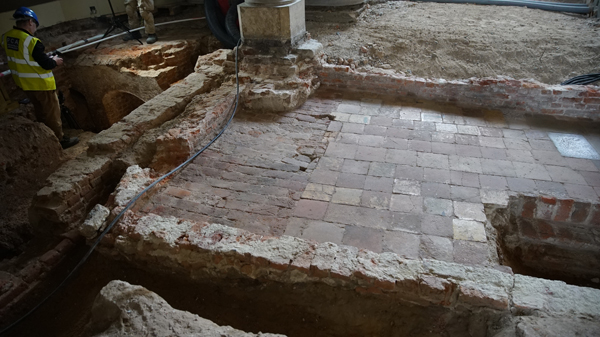
A former summer residence of the Archbishops of Canterbury for centuries, Croydon Palace has in more recent times been used as a school.
Henry VII
Lost London – The Whitehall Mural…
Known through its many surviving copies, the Whitehall Mural was a dynastic portrait understood to have been created to decorate a privy chamber of King Henry VIII at the Palace of Whitehall.
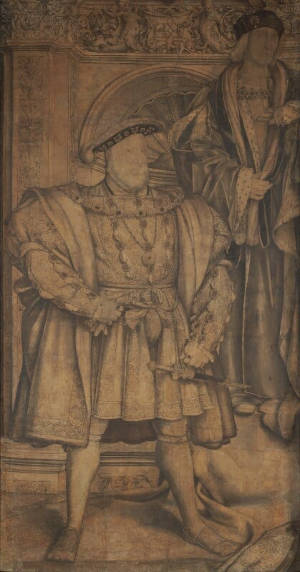
by Hans Holbein the Younger
ink and watercolour, circa 1536-1537
NPG 4027 © National Portrait Gallery, London (licensed under CC BY-NC-ND 3.0)
The mural, which was the work of Hans Holbein the Younger, featured four figures standing around a central plinth. They include King Henry VIII and his wife Jane Seymour at the front with the King’s parents King Henry VII and Queen Elizabeth of York at the back.
It is believed the portrait, commissioned during the King’s brief marriage to Jane Seymour (between 30th May 1536 and 24th October 1537), may have been created to celebrate the birth of Prince Edward (later King Edward VI) in 1537 and may have been commissioned before or after the prince’s birth.
The iconic image of the bearded King Henry VIII – which was created for the purposes of propaganda – shows him as something of an idealised powerful monarch with feet firmly planted apart and his arms out with a dagger hanging at his waist.
The mural was lost when a fire consumed much of the palace on 4th January, 1698. But copies – both of the mural as a whole and of the individual figure of King Henry VIII – survive including one by Flemish artist Remigius van Leemput commissioned by King Charles II the year before the fire.
There’s also a full-sized cartoon (pictured) showing the left-hand section of the mural which was created by Holbein in preparing to create the mural. Depicting King Henry VIII – his head turned in a slightly different aspect to the final version – and King Henry VII, it would been used to mark out the mural on the wall where it stood.
London Explained – The Changing of the Guard…
It’s one of the most iconic London traditions – the ceremonial changing of the guard outside Buckingham Palace.
Elite guards have served the monarch since the reign of King Henry VII – he made the Royal Body Guard a permanent institution – and Guards Regiments, among the oldest units in the British Army, were first raised in 1656 to protect King Charles II who was then living in exile in Bruges in modern Belgium.
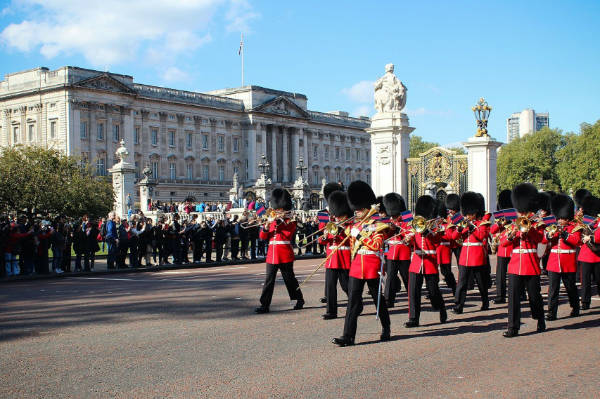
The Changing of the Guard ceremony originally took place at the (now long-gone) Palace of Whitehall. But when the court moved to St James’s Palace in 1698, the ceremony went with them. And then, when Queen Victoria moved to Buckingham Palace in 1837, a detachment of guards was sent to guard the palace (with the Queen’s Guard also still guarding St James’s, a situation which continues today).
The main ceremonial Changing of the Guard today takes place at Buckingham Palace. It involves the Old Guard (those currently on duty, including the detachment from St James’s Palace) forming up in front of the palace and being relieved by the New Guard which has marched from Wellington Barracks, off Birdcage Walk, with a band which plays New Guard’s Regimental Slow March as it advances towards the Old Guard.
Both the Old and New Guard carry regimental flags, known as “Colours”. The guard duties are traditionally served by one of the five regiments of foot guards (part of the Household Division) which include the Welsh Guards, Grenadier Guards, Coldstream Guards, Scots Guards, Irish Guards.
But regiments from Commonwealth nations and those from the Royal Navy or Royal Air Force also perform the duty from time to time.
The Changing of the Guard currently takes place on Monday, Wednesday and Friday from 11am. The ceremony lasts about 45 minutes.
On days when the ceremony isn’t performed, the guard is still inspected by the Captain at 3pm except on Sunday when the flag (Colour) is incorporated into the ceremony, then known as the Sunday Parade, which takes place at 11am.
For more, see www.householddivision.org.uk/changing-the-guard-overview.
10 London mysteries – 6. The disappearance of Edward V and his brother Richard…
The disappearance of King Edward V and his brother, Richard, Duke of York, after being last seen in the Tower of London is one of London’s most famous mysteries. And while it’s one we’ve written about before, we thought we’d take a look at the recent announcement that new evidence had been found in the matter.
Subscribe to Exploring London for just £3 a month to access all of our articles…
London pub signs – Aragon House…
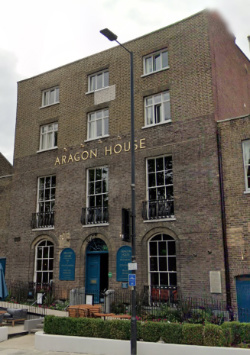
This brown brick pub (and boutique hotel) in Parson’s Green, west London, was built just after the start of the 19th century. But its name comes from a much earlier historic connection.
The site where the four storey pub now stands was once a dower house which belonged to Queen Catherine of Aragon, the first wife of King Henry VIII.
It’s believed that the property was given to Catherine by King Henry VII, father of her first husband, Prince Arthur – who died in April, 1502 – and her second husband and his younger brother, King Henry VIII, whom she married in 1509.
The site was later part of a parcel of land upon which was located the home of novelist Samuel Richardson. Richardson, famed for his works Pamela and Clarissa, lived there from 1756 until his death in 1761. The property was subsequently known as ‘Richardson’s Villa’.
The Grade II-listed pub is located at 247 New King’s Road. For more, see www.aragonhousesw6.com.
8 locations for royal burials in London…A recap…
Before kicking off a new series, here’s a recap of our last…
3. St Edward’s Chapel, Westminster Abbey…
5. Henry VII’s Lady Chapel, Westminster Abbey…
8 locations for royal burials in London…5. Henry VII’s Lady Chapel, Westminster Abbey…
Located just to the east of St Edward the Confessor’s Chapel in Westminster Abbey is the lavishly ornate Lady Chapel built on the orders of King Henry VII.
Described as the “last masterpiece of English medieval architecture”, the chapel is the resting place of King Henry VII and his wife Queen Elizabeth of York.

The couple were the first to be buried in a vault under the floor rather than a tomb but still features an elaborate monument above the floor.
The monument was designed in the Renaissance style by Italian sculptor Pietro Torrigiano and features gilt bronze effigies of the King and Queen lying side-by-side above a black marble base decorated with six medallions representing the Virgin Mary and Henry’s patron saints (who included St Edward the Confessor). At either end of the base are coats of arms supported by cherubs.
A fine grille, designed by Thomas Ducheman, surrounds the monument – once gilded, it featured 30 statues in niches but only six – depicting saints – now remain. The lengthy Latin inscription written on the grille lauds King Henry as “a wise and watchful monarch, a courteous lover of virtue” among other superlatives. There are further inscriptions on the monument.
They’re not the only kings and queen’s buried in the chapel. King James I is buried in the vault under the King Henry VII’s tomb and his wife Queen Anne of Denmark is buried nearby.
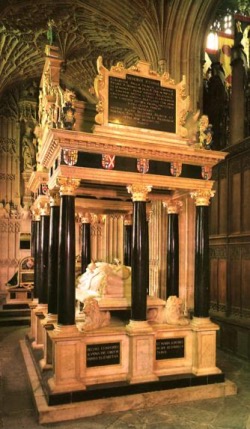
Queen Elizabeth I is buried in the chapel’s north aisle with a monument above depicting her effigy. Her coffin was placed on top of her half-sister Queen Mary I whose body had been placed there after her death in 1558. The monument was installed on the orders of King James I who, while commissioning a depiction of Queen Elizabeth, didn’t order an effigy of Mary to be made. Instead, she is commemorated with an inscription translated as “Partners both in throne and grave, here rest we two sisters, Elizabeth and Mary, in the hope of the Resurrection.”
The religious differences of the two Queens – Elizabeth being a Protestant and Mary a Catholic – are meanwhile commemorated in an inscription on the floor which reads: “Remember before God all those who divided at the Reformation by different convictions laid down their lives for Christ and conscience sake.”
Buried in a vault beneath the south aisle of the chapel – with just simple inscriptions on stones above (no monuments were erected due to the lack of space apparently – are the remains of the Stuart monarchs King Charles II, Queen Anne (and her husband Prince George), Queen Mary II and King William III.
The rather flamboyant tomb of Mary, Queen of Scots, is also in this aisle. King James I had her remains brought to the abbey from Peterborough Cathedral in 1612 and laid to rest in a marble tomb featuring an elaborate canopy and a white marble effigy at the feet of which stands a crowned Scottish lion. The eldest son of King James I, Henry Frederick, Prince of Wales, was also buried in the Queen’s vault (she was his grandmother), probably due to lack of space.
The young king Edward VI is buried beneath the floor in front of the altar and the last monarch to be buried in the abbey – King George II – lies in a vault under the central aisle along with his wife Queen Caroline and some of their children as well as other family members. On the King’s orders, the sides of the coffins of King George II and that of Queen Caroline were removed so their remains could mingle.
Several other royals – including Princess Mary of Orange, eldest daughter of Charles I and Henrietta Maria, and Prince Rupert of the Rhine – are also buried in the chapel.
HERE: Lady Chapel, Westminster Abbey (nearest Tube stations are Westminster and St James’s Park); WHEN: Times vary – see the website for details; COST: £27 adults/£24 concession/£12 children (discounts for buying online; family rates available); WEBSITE: www.westminster-abbey.org
Lost London – The Holbein portrait of King Henry VIII’s family…

by Hans Holbein the Younger
(ink and watercolour, circa 1536-1537
NPG 4027)
© National Portrait Gallery, London
Thankfully much copied (at least in part), this full length portrait of King Henry VIII, his third wife and parents was the work of Hans Holbein the Younger.
Holbein, appointed the king’s painter in 1536, was commissioned to create the work following the King’s marriage to Jane Seymour on 30th May, 1536, and completed it in 1537 (there’s some speculation it may have been commissioned in celebration of the birth of King Henry’s son, King Edward VI).
The mural featured the King standing in full splendour, although without typical symbols of royalty such as a crown or sceptre, as well as his wife Jane Seymour, and his parents, King Henry VII and Queen Elizabeth of York. They were all standing around a central pillar upon which are inscribed verses in Latin extolling the Tudor dynasty.
The work is understood to have been commissioned for one of the King’s more private chambers in the Palace of Whitehall which Henry had seized after the downfall of Cardinal Thomas Wolsey.
The portrait survived the reign of King Henry VIII but was destroyed in the fire which devastated the palace in 1698.
A full-sized cartoon of the left-hand side of the work which was completed by Holbein in preparation for its creation is held in the collection of the National Portrait Gallery (pictured right).
While there are numerous copies of the figure of King Henry VIII, the only complete copy of the mural is attributed to Remigius van Leemput who created it in 1667 – it can be seen at Hampton Court Palace.
This Week in London – Royal portraits in Greenwich; Sir Roger Bannister to be honoured; and, drawing on the Tate’s Turbine Hall floor…
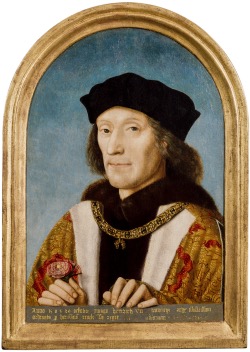
• More than 150 of the finest portraits of royal families over five dynasties are on show at the National Maritime Museum in Greenwich. Tudors to Windsors: British Royal Portraits, which is being run in conjunction with the National Portrait Gallery, features famous paintings, miniatures, sculpture, photographs, medals and stamps from the Tudor, Stuart, Georgian, Victorian and Windsor dynasties. Highlights include the earliest known portrait of Henry VII (also the oldest artwork in the exhibition) which was painted in 1505 by an unknown artist, Flemish artist Marcus Gheeraerts the Younger’s famous ‘Ditchley Portrait’ of Elizabeth I, portraits of Charles II and his mistresses, early 19th century domestic photographs of Queen Victoria and her family, and a selection of paintings and photographs of Queen Elizabeth II by Cecil Beaton and Annie Leibovitz. Runs until 31st October. Admission charge applies. For more, see www.rmg.co.uk/TudorsWindsors.
• Westminster Abbey has announced a new memorial to Sir Roger Bannister, the first man to run under a mile in four minutes. The abbey said the memorial ledger stone to Bannister, who later became a neurologist, will be placed in what is known as ‘Scientists’ Corner’ in the building’s nave, close to the graves of scientists Sir Isaac Newton and Charles Darwin as well as the ashes of Stephen Hawking. “Throughout his life Sir Roger Bannister reached out for that which lay beyond,” said the Dean of Westminster, the Very Reverend Dr David Hoyle, in a statement. “As a sportsman, pushing himself towards a prize some considered beyond human reach, as a scientist ever eager for deeper understanding of neurology. We are delighted that his memory and his achievement will be set in stone in the Abbey. He ran the race set before us all.” Bannister is famous for having run a mile in three minutes, 59.4 second at Oxford on 6th May, 1954 – a record which stood for almost nine years.
• Be among those transforming the Tate Modern’s Turbine Hall into an “ever changing work of art”. Visitors are invited to join in covering the hall’s floor with their own jottings using coloured drawing materials as part of artist Ei Arakawa’s interactive installation, Mega Please Draw Freely. The installation, which can be contributed to until 29th August, kicks off UNIQLO Tate Play – a new free programme of playful art-inspired activities for families, being in partnership with UNIQLO, at the Tate Modern. The project, which has seen the Turbine Hall floor covered with a temporary surface allowing it to be drawn upon, is inspired by the Gutai group, radical Japanese artists who wanted to change the world through painting, performance and children’s play and, in particular, the group’s ‘Outdoor Gutai Art Exhibition of 1956’ in which Yoshihara Jirō created the groundbreaking work Please Draw Freely, a large board on which people were free to draw and paint. Visitors can access Mega Please Draw Freely by booking a free collection display ticket online at www.tate.org.uk.
• Send all items for inclusion to exploringlondon@gmail.com.
10 London hills – 10. Richmond Hill…
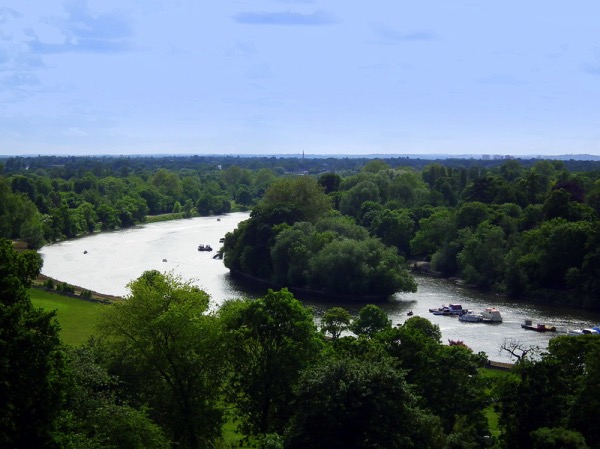
For the final in this series we head out west to Richmond Hill which takes its name from the palace which once stood nearby.
At the summit of the hill, which stands about 50 metres (165 feet) high, stands the gate to Richmond Park while the steeper western slopes drop down to Petersham Meadows by the River Thames.
What was the village of Richmond – now incorporated into greater London – sits partly on the slopes of the hill. It and the hill take their names from a palace, established here in the early 16th century by King Henry VII as a replacement for Sheen (Shene) Palace which had been destroyed in a fire in 1499. The King named the new building Richmond Palace, in honour of the earldom of Richmond in Yorkshire, one of his titles.
Richmond Hill is famed for its views – they include the only view in England protected by an Act of Parliament (passed in 1902). It looks to the south-west over Petersham to the Thames, taking in Glover’s Island, and reaching as far as Windsor and has been immortalised in works by the likes of artists JMW Turner and Sir Joshua Reynolds as well as by author Sir Walter Scott.
Richmond Hill features many fine 18th century homes including Wick House (built for Joshua Reynolds in 1771) and the westward slopes boast the Terrace Walk and Terrace Gardens, both of which are Grade II* listed, while the massive bulk of the former Royal Star and Garter Home for disabled ex-servicemen (now apartments) can be seen close to the summit.
Other famous residents on the hill have included Rolling Stones’ guitarist Ronnie Wood and actress Celia Johnson while scenes for the film, The Hours, were shot on The Terrace.

Treasures of London – King Henry’s Mound…
Having recently been granted protection as a scheduled monument, the landscape feature known as King Henry’s Mound is located in Richmond Park in south-west London.
It is believed to be a prehistoric round barrow, possibly dating from between 2,400 and 1,500 BC – a period spanning the Late Neolithic to the Late Bronze Age.
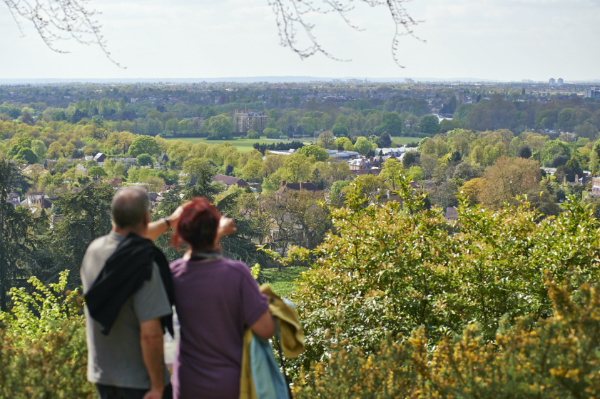
Its name, however, comes from the legend that King Henry VIII waited on top of the mound on 19th May, 1536, watching for a rocket to be launched from the Tower of London that would confirm his wife Anne Boleyn had been executed for treason (and so allow him to marry Jane Seymour).
The truth of that is unlikely – although it is possible to see St Paul’s Cathedral from the mound (it’s a view that is protected, as well as, to the west Windsor Castle and the Thames Valley), King Henry VIII was apparently in Wiltshire at the time.
The mound, however, was linked to kings as far back as 1630 when a map was published listing it as ‘Kings Standinge’, ‘standinge’ being a reference to a platform on which those not involved in a hunt could stand and watch.
Both King Henry VIII and his daughter Queen Elizabeth I are known to have hunted here – in fact, it was King Henry VIII’s father, King Henry VII, who built a royal palace at Richmond and named it after his estate in Yorkshire.
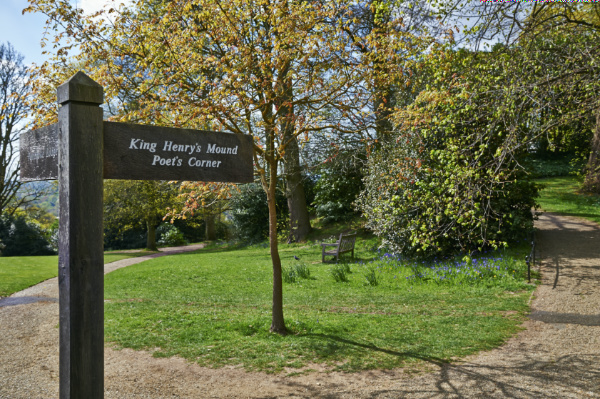
The mound was later incorporated into the gardens of Pembroke Lodge in the 19th century, during much of the latter half of which the property was home to Prime Minister Lord John Russell.
Today the Grade I-listed Richmond Park is managed by the Royal Parks.
For more on Richmond Park, head to www.royalparks.org.uk/parks/richmond-park.
PICTURES: The Royal Parks
LondonLife – Remains of Greenwich Palace unearthed…

The remains of two rooms, which once formed part of the splendid Greenwich Palace – birthplace of King Henry VIII and his daughters Queen Mary I and Queen Elizabeth I, were discovered during works being undertaken ahead of the construction of a new visitor centre under the Old Royal Naval College’s famed Painted Hall, it was revealed last week.
The rooms, set well back from the river Thames, are believed to have formed part of the service range, believed to be the location of kitchens, a bakehouse, brewhouse and laundry.
As well as the discovery of a lead-glazed tiled floor, one of the rooms, which was clearly subterranean, featured a series of unusual niches where archaeologists believe may have been ‘bee boles’ – where ‘skeps’ (hive baskets) were stored during winter when the bee colonies were hibernating and where, when the bees were outside during summer, food and drink may have been stored to keep cool.
Discussions are reportedly now underway over the possibility of displaying the Tudor finds in situ. Duncan Wilson, chief executive of Historic England, hailed the find as “remarkable”.
“To find a trace of Greenwich Palace, arguably the most important of all the Tudor palaces, is hugely exciting,” he said. “The unusual and enigmatic nature of the structure has given us something to scratch our heads over and research, but it does seem to shine a light on a very poorly known function of the gardens and the royal bees. The most exciting aspect is that the Old Royal Naval College is able and willing to incorporate this into the new visitor centre, so everyone can see a small part of the palace, for the first time in hundreds of years.”
Greenwich Palace was built by King Henry V’s brother, Humphrey, Duke of Gloucester, in 1426 and rebuilt by King Henry VII between about 1500 and 1506.
Substantially demolished at the end of the 17th century (and with plans to build a new Stuart palace on the site never realised), it was replaced with the Greenwich Hospital which became the Royal Naval College designed by Sir Christopher Wren and Nicholas Hawksmoor between 1692 and 1728.
The Painted Hall, located in the Old Royal Naval College, is currently undergoing an 18 month transformation which includes the creation of a new visitor centre, Sackler Gallery and café. Visitors to the hall currently have the unique opportunity to get up close to the famous ceiling of the hall, described as the “Sistine Chapel of the UK”, on special tours. Visit www.ornc.org/painted-hall-ceiling-tours-tickets for more.
PICTURES: © Old Royal Naval College

This Week in London – Skating on Ice; Christmas trees worth seeing; and, Westminster Abbey’s new galleries…
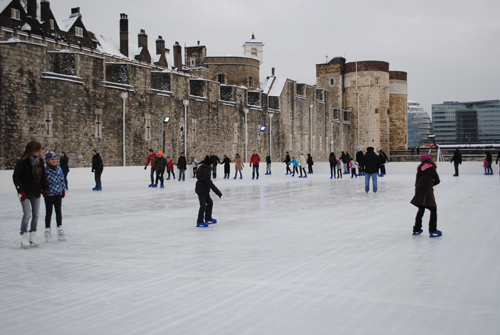 • London’s obsession with ice-skating is the subject of an exhibition which opened at the Museum of London earlier this month. Skating on Ice looks at the history of the popular pastime, from the 12th century – when locals are described strapping animals bones to their feet to skate on ice at Moorfields – across the centuries (and the developments that went with them) to today. Among the artefacts on show is an 1839 oil painting by J Baber depicting skaters on the Serpentine in Hyde Park, sketches from the London Illustrated News showing a rescue operation to recover the 40 of some 40 skaters who plunged beneath the ice in Regent’s Park on 15th January, 1867, a navy blue gabardine skirt suit from Fortnum & Mason dating from the 1930s and a series of skates, ranging from some made of animal bones through to a pair of Victorian racing skates known as Fen Runners and a pair of ice skates used from the late 1930s by Londoner Christina Greenberry at Streatham Ice Arena. Runs until 8th February. Entry is free. See www.museumoflondon.org.uk for more. (Pictured – ice-skating in the Tower of London moat).
• Christmas is looming and so, if you haven’t been out and about already, here’s five Christmas trees worth seeing over the coming few days (excluding the obvious one in Trafalgar Square):
- Covent Garden. Always a glittering treat (this year complete with virtual prizes!).
- St Pancras International. A rather odd design this year, this 100 foot tall tree is inspired by the Cirque du Soleil show Amaluna and lights up every time a donation is made to Oxfam.
- Granary Square, Kings Cross. Looking like a Christmas tree frozen inside an ice-cube, this seven metre high installation – Fighting fire with ice cream – by British artist Alex Chinneck features some 1,200 lights.
- Tate Britain, Millbank. An upside down tree, designed by Iranian artist Shirazeh Houshiary.
- Connaught Hotel, Mount Street, Mayfair. Designed by British sculptor Antony Gormley, this 57 foot tall tree features a trunk transformed into a pillar of light.
• Prince Charles last week unveiled the foundation stone for a tower that will take visitors to Westminster Abbey into the institution’s new museum and galleries. The tower is being built outside Poet’s Corner – between the 13th century Chapter House and 16th-century Henry VII’s Lady Chapel – and will be the principal entrance to the medieval triforium, which has never before been opened to the public and which house the proposed The Queen’s Diamond Jubilee Galleries. The tower and galleries, costing almost £23 million, will be the most significant addition to the abbey since Nicholas Hawksmoor’s west towers were completed in 1745. The galleries, which will be located 70 feet above the abbey’s floor, are due to open in summer 2018, and will display treasures from the abbey’s history as well as offering magnificent views of Parliament Square and the Palace of Westminster. To help meet the cost of the new galleries, the abbey has launched a #makehistory campaign asking for public donations to the project. For more, see www.westminster-abbey-galleries.org/Content/Filler.
Send all items for inclusion to exploringlondon@gmail.com.
10 sites commemorating the Great Fire of London – 1. Thomas Farriner’s plaque
This year marks 350 years since the Great Fire of London destroyed much of the City of London and to mark the anniversary, we’re today launching a new special series looking at some of the lesser known – and, in some cases, more unusual – memorials and plaques commemorating the event.
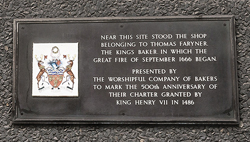 Sure, everyone knows about The Monument near London Bridge erected to commemorate the event (see our earlier post on it here). But often overlooked is the plaque located in nearby Pudding Lane commemorating the site where the fire began in the early hours of 2nd September, 1666 – the bakery of Thomas Farriner (also variously spelt Faryner or Farynor).
The plaque, located close to the corner of Pudding Lane and Monument Street, was erected in 1986 by the Worshipful Company of Bakers to mark the anniversary of their Royal Charter being granted by King Henry VII some 500 years earlier. It reads (in part): “Near this site stood the shop belonging to Thomas Faryner, the King’s baker, in which the Great Fire of September 1666 began.”
While that fits with the long-held idea that the location of the bakery was 202 feet (61 metres) from the where the Monument stands, the same height of the memorial column itself, new research claims that the site of the bakery was not actually where Pudding Lane now stands but in nearby Monument Street instead.
Drawing on a planning document dating from 1679 and found within the London Metropolitan Archives, academic Dorian Gerhold reportedly cross-referenced the document with later maps and concluded that the baker’s oven was actually located on what is now Monument Street, 60 feet to the east of the intersection with Pudding Lane.
Farriner, meanwhile, was, as a king’s baker, a supplier to the Royal Navy. During the fire, the widower managed to escape the flames along with his three children (although their housemaid, unable or unwilling to escape out a window, perished). He was later able to rebuild the bakery and his home and when he died only a few years after the fire, left considerable sums to his children.
Incidentally, Farriner, his daughter Hanna and his son Thomas were all in the jury which convicted Frenchman Robert Hubert of starting the fire in their bakery by tossing a grenade in through the window (Hubert had confessed and, despite the fact that it’s believed few thought him actually guilty, he was convicted and hanged at Tyburn on 27th October, 1666, for the crime of arson.)
PICTURE: Steve James/Flickr/CC BY_NC-ND 2.0 (cropped and straightened)
Daytripper – Lavenham, Suffolk…
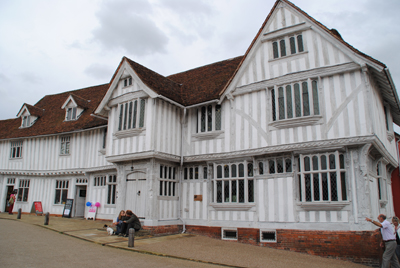 It’s a Bank Holiday weekend and thoughts are turning to a day out, so we thought it a good time to take a look at the beautiful village of Lavenham in Suffolk, one of the finest “medieval villages” remaining in England.
While settlement of the village, which is about an hour and 45 minutes north-east of London by car, goes back to before Saxon times (indeed the village apparently takes its name from a Saxon thegn called Lafa) it was in the medieval period that it attained the charming character which is still so evident today.
 The village was awarded its market charter in 1257 and it was from this period until about 1530 that its ‘golden years’ occurred, based on its prominent role in the wool trade (in particular the production of sought-after blue broad cloth – ‘Lavenham Blue’) and its location between London and the key ports like Kings Lynn.
It was during this period that its several guildhall were constructed and it was recorded as one of the richest parts of England with some of its most prominent families becoming extremely wealthy, like the De Vere family headed by the Earl of Oxford, and the Spring and Branch families who used their wealth to raise themselves to the nobility.
Lavenham’s decline began in the later 1500s and followed a sharp downturn in the wool trade amid greater competition from Europe. Its fortunes reached a low in the late 18th century before industrialisation in the 19th century revitalised the village somewhat (although nowhere close to the prominence and affluence it once boasted).
Today Lavenham is something of a tourist mecca, boasting an amazing collection of timber-framed buildings – more than 320 of which are listed – mostly dating from between 1450 and 1500.
Central among them is the Guildhall (pictured top), located on the market place, which dates from about 1530, and as well as hosting religious guild activities (its formal name was the Guild of Corpus Christi), has also served as a prison, workhouse, almshouse, and wool store and now houses a National Trust-run museum.
One of the most famous photographed buildings in the town is the Crooked House on High Street (pictured above right), so-called because of the dramatic lean its upper story is on.
There’s also the Little Hall, which, dating from the 14th century, was the wool hall of clothier William Causation and is now home to the Suffolk Preservation Society (open to the public over the warmer months). And among other notable homes is De Vere House, a grade I-listed property (now available to stay in) which still had elements dating back to the Middle Ages (and was the last home in the village to be owned by the Earls of Oxford).
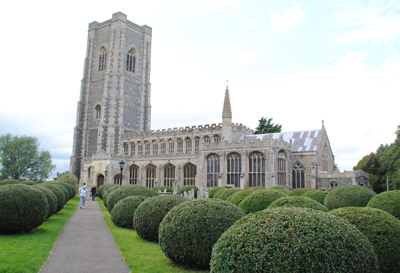
The Church of St Peter and St Paul (pictured below) is also notable – described as “one of the finest parish churches in England”. The current version (there has apparently been a church here since Saxon times) was apparently funded by the 13th Earl of Oxford and wealthy cloth merchants including Thomas Spring III (whose coat of arms appears 32 times on the parapet) to celebrate their safe return from Battle of Bosworth Field where King Henry VII was victorious in 1485.
A couple of interesting notes to finish on. Among the residents in the late 18th century was the London-born Jane Taylor who lived in Shilling Street with her family. Jane and her sister Ann published a collection of poetry which included the poem, The Star, from which the lyrics for Twinkle, Twinkle Little Star are taken.
There’s also a John Constable connection – the landscape painter was a student at the Grammar School which opened in Barn Street in 1647.
And, as you might expect in such a well-preserved location, Lavenham has also appeared on the big screen, notably De Vere House as the birthplace of Harry Potter and his mentor Albus Dumbledore.
A charming village to pass a few hours walking around (and, relax in, there’s plenty of pubs and cafes to refresh yourself at afterwards).
For more, check out www.discoverlavenham.co.uk and www.visit-lavenham.co.uk.
This Week in London – Exploring flight and space; ‘Horrible’ Tudors at Hampton Court; BioBlitz at Brompton Cemetery; and sleeping with the lions…
 • A “ground-breaking” hands-on exhibition exploring the concept and future of flight and space travel opens at the National Maritime Museum in Greenwich this week. Above and Beyond, produced by Evergreen Exhibitions in association with Boeing (and created in collaboration with NASA), features more than 10 interactive displays, allowing visitors to learn to fly like a bird, take an elevator to space, enjoy a view of Earth from above or go on a marathon mission to Mars and see how your body would cope. Runs until 29th August. Admission charge applies. For more, see www.rmg.co.uk/see-do/exhibitions-events/above-and-beyond-exhibition.
• Horrible Histories is bringing the world of the ‘Terrible Tudors’ to life at Hampton Court Palace this half-term break. The Birmingham Stage Company is offering the chance for visitors to dip into 100 years of Tudor history, spanning the reigns of the “horrible” Henries to that of the crowning of King James I in 1603. Get behind the dry facts and discover what the role of the Groom of the Stool was, which queen lost her wig as she was executed and decide whether to join in punishing the ‘whipping boy’ or the monarch and which side you’ll be on as the Spanish Armada set sail. The hour long performances will take place on the palace’s historic East Front Gardens (unreserved seating on the grass). Admission charge applies. Runs from today until 2nd June. For more see, www.hrp.org.uk/hampton-court-palace/.
• The Royal Parks is hosting its first ever BioBlitz at Brompton Cemetery this Bank Holiday weekend. For 24 for hours from 5pm on Friday, people are invited to join in the hunt to track down as many species of plants, animals and fungi as possible with events including tree and nature walks, earthworm hunts, bee and wasp counts and lichen recording. There will also be a range of stalls for people to visit with representatives from a range of nature and wildlife organisations present. The BioBlitz is one of several projects linked to the £6.2 million National Lottery-funded facelift of the cemetery. For more, head to www.royalparks.org.uk/events/whats-on/bioblitz.
• Sleep with the lions at ZSL London Zoo next to Regent’s Park from this week. The zoo new overnight experience at the Gir Lion Lodge, in which guests can stay in one of nine cabins at the heart of the new Land of the Lions exhibit, opened on Wednesday. Guests will also be taken on exclusive evening and morning tours in which they’ll find out more about how ZSL is working with local communities and rangers in India’s Gir Forest to protect these endangered cats. The private lodges will be available six nights a week until December with designated adults-only and family nights available. For more, see www.zsl.org/zsl-london-zoo/gir-lion-lodge.
Send all items for inclusion to exploringlondon@gmail.com.
A Moment in London’s History – Westminster Abbey is consecrated – and a king dies…
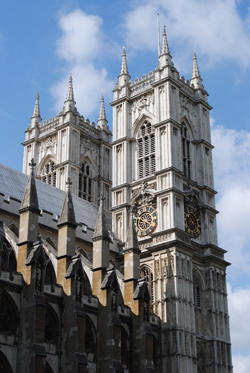 It was 950 years ago as of 28th December – Holy Innocents Day – that Westminster Abbey was consecrated following its construction on the orders of King Edward the Confessor.
The minster – popularly named ‘west’ minster to distinguish it from St Paul’s Cathedral (the ‘east’ minster) – was rebuilt when King Edward refounded the abbey between 1042-52, ostensibly to provide himself with a royal church in which he could be buried.
An abbey had apparently originally been founded on the site in the 7th century during the time of Bishop Mellitus, first Bishop of London (see our earlier post here).
The abbey church isn’t believed to have been completed when it was consecrated – this it’s suggested didn’t take place until 1090, well after the Norman Conquest. Unfortunately Edward was too ill to attend the consecration – he died on the 5th January and was buried a week later in the church (his wife Edith followed nine years later).
King Harold Godwinson – King Harold II – was apparently crowned in the church the day after Edward’s death but the first recorded coronation is that of King William the Conqueror on Christmas Day, 1066.
Very little survives of Edward’s church – most of what was see now is the Gothic masterpiece constructed in the mid 13th century by King Henry III with later additions such as King Henry VII’s Lady Chapel.
LondonLife – A rare glimpse inside King Henry V’s chantry chapel…
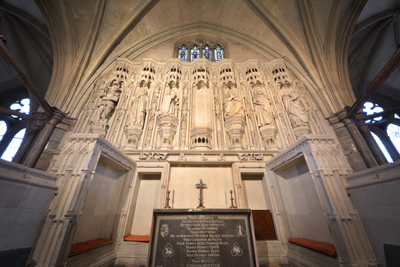 A fortunate few last weekend had the chance to have a look inside King Henry V’s elaborately carved chantry chapel in Westminster Abbey as part of commemorations marking the 600th anniversary of the Battle of Agincourt.
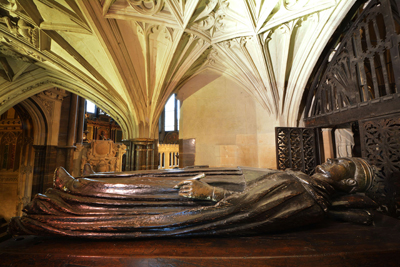
The chapel, which is located on a sort of mezzanine level above the king’s tomb at the east end of the Shrine of Edward the Confessor, is one of the smallest of the abbey’s chapels. It was constructed on the orders of the king – who died Vincennes in August, 1422, and was buried in the abbey on 7th November that year – so prayers could be said in perpetuity for his soul.
The tomb was completed in 1431 and the chantry chapel was built above between 1437 and 1450. The latter is entered via narrow stairways of worn steps hidden inside a pair of stone turrets which flank the tomb.
For centuries the Henry V’s funeral ‘achievements’ – the king’s saddle, helm and shield – were displayed on a wooden beam above the chantry chapel but these were restored and moved to the abbey museum in 1972.
Henry V’s wife, Catherine de Valois, who survived her husband by 15 years was eventually – in the Victorian age – buried under the chantry chapel altar (originally buried in the old Lady Chapel, King Henry VII had her removed and placed in an open coffin in the open air next to the tomb of King Henry V, when building his new chapel – among visitors to her mummified body was diarist Samuel Pepys who even kissed her. In 1778 she was buried in a vault before being relocated to her current position in 1878).
An inscription on the altar in the chantry chapel reads: “Under this slab (once the altar of this chapel) for long cast down and broken up by fire, rest at last, after various vicissitudes, finally deposited here by command of Queen Victoria, the bones of Catherine de Valois, daughter of Charles VI, King of France, wife of Henry V, mother of Henry VI, grandmother of Henry VII, born 1400, crowned 1421, died 1438”.
The chantry chapel is still occasionally used for services but, measuring just seven by three metres, is not usually open to the public because of size and access issues.
Westminster Abbey will hold a special service of commemoration on 29th October in partnership with charity Agincourt600. The day before, 28th October, it will host a one day conference for Henry V enthusiasts entitled ‘Beyond Agincourt: The Funerary Achievements of Henry V’. For more, see www.westminster-abbey.org/events/agincourt.
Above – King Henry V’s chantry chapel; Below – King Henry V’s tomb which sits below the chantry chapel. PICTURE: Jim Dyson/Dean & Chapter of Westminster
Famous Londoners – Hans Holbein the Younger…
Famed as the court painter of King Henry VIII, Hans Holbein the Younger was one of the greatest portrait painters of the sixteenth century.
Born in Augsburg, in southern Germany, in 1497-98, Holbein was the son of painter and draughtsman Hans Holbein the Elder. Hans, like his brother Ambrosius, followed the family trade which he apparently learnt under the tutelage of his father and uncle until breaking away to make his own mark.
 Journeying with Ambrosius to Basel in what is now Switzerland, the two brothers became apprenticed to the city’s leading painter Hans Herbster. In 1517, Holbein went with father to Lucerne where they worked painting murals for a leading merchant. It is thought while there, that he visited northern Italy where he studied Italian frescos.
Returning to Basel in 1519, he quickly re-established his business there, becoming a member of the artists’ guild, and married Elsbeth Schmid, their first son arriving in the first year of their marriage (the couple apparently had four children, two of whom are depicted in a portrait with his wife he painted in the late 1520s).
He was soon completing numerous major projects for the city – including painting internal murals for the Town Hall’s council chamber – and was also involved in creating illustrations for books – the most famous being the series of images known as the Dance of Death – and painting portraits, including his first portraits of the Renaissance scholar, Erasmus. It was these and other portraits that ensured his fame across Europe.
The decline in the production of religious art, thanks to the Reformation which was then sweeping over the continent, apparently led Holbein to look further afield for work and, having first gone to France, in 1526 he went to England.
There he was welcomed by Sir Thomas More, then a key figure in the regime of King Henry VIII, who soon found him some commissions. His works during this period included portraits of More, William Warham, Archbishop of Canterbury, astronomer Nicholas Kratzer and courtiers like Sir Henry Guildford.
He returned to Basel a wealthy and successful man in 1528 and remained there for four years before once again leaving his family and heading to England, this time finding favour with the Boleyn family and Thomas Cromwell.
It was early during this period – he remained in England until his death in 1543 – that he painted portraits of Hanseatic League merchants of the Steelyard (see our earlier post here) as well as The Ambassadors (see our earlier post here).
In 1536, he was employed as painter to King Henry VIII and the following year he painted what is arguably his most famous image – that of King Henry VIII in all his glory in the image known as the Whitehall Mural which pictured the king with his the wife, Queen Jane Seymour, his father, King Henry VII and his mother, Queen Elizabeth of York (the image was lost in the fire which destroyed Whitehall Palace in 1698 but copies were made and a copy is now at Hampton Court Palace).
King Henry VIII was to be his subject on numerous occasions as were other members of the Royal Family, courtiers and prospective wives including, famously, a portrait of Anne of Cleves which may have oversold her beauty to the king who was unimpressed with her in person (there is apparently no evidence the king blamed Holbein himself for this).
While he had successfully navigated his way past the downfall of Sir Thomas More and then the Boleyn family, the fall of Sir Thomas Cromwell did cause significant damage to his standing. Nonetheless he retained his official position at court and it was during this time that he painted some of his finest miniatures including those of the sons of Henry VIII’s friend, Charles Brandon, 1st Duke of Suffolk.
It is believed Holbein may have returned to visit his family in late 1540 before returning to London where he died sometime in October or November, 1543, having made his will on 7th October at his home in Aldgate (plague has been suggested as the cause of his death). The site of his grave is unknown.
Holbein’s legacy is such that the portraits he created in his two stints in London have become a key component in how we view Tudor England – and in particular, the Tudor court – today.
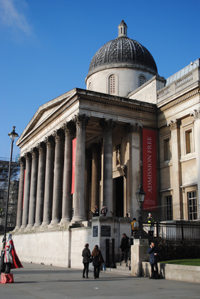
His works can be seen in key locations across London including the National Gallery (pictured above), the National Portrait Gallery (where his bust is one of a series of artists on the exterior) and Hampton Court Palace.
What’s in a name?…Kew…
 Famed as the location of the Royal Botanic Gardens, Kew is a Thames-side suburb in London’s west.
It’s the riverside location which gives the area its name – Kew is apparently a corrupted form of Cayho, a word first recorded in the early 14th century which is itself made of two words referring to a landing place (the ‘Cay’ part) and a spur of land (the ‘ho’ part). The latter may refer in this case to the large “spur” of land upon which Kew is located, created by a dramatic bend in the Thames. The former may refer to a ford which crossed the river here (explaining the name of Brentford on the other side).
While the area had long been the home of a small hamlet for the local farming and fishing community, more substantial houses began to be developed in Kew in the late 15th and early 16th centuries thanks to the demand for homes for courtiers attending the King Henry VII and his successors at nearby Richmond Palace (the royal connections of the area in fact go back much further to the early Middle Ages).
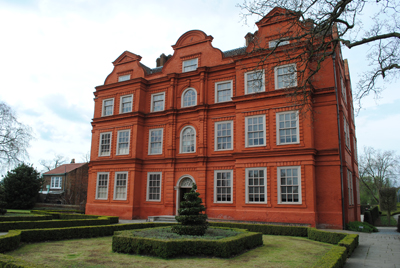
But it was during the Georgian era, when the Royal Botanic Gardens were founded and Kew Palace, formerly known as the Dutch House, became a royal residence (it is pictured above), that Kew really kicked off (and by the way, Kew Palace is not the only surviving 17th century building in the area – West Hall, once home of painter William Harriot, is also still here).
While King George II and his wife Queen Caroline used Richmond Lodge, now demolished but then located at the south end of what is now the gardens, as their summer residence, they thought Kew Palace would make a good home for their three daughters (their heir, Frederick, Prince of Wales, lived opposite his sisters at the now long-gone White House). Kew Palace, meanwhile, would later be a residence of other members of the Royal Family as well, including King George III during his bouts of madness.
Other buildings of note from the Georgian era in Kew include Queen Charlotte’s Cottage, a thatched property built between 1754 and 1771 and granted to Queen Charlotte by her husband, King George III (like the palace, it now lies within the grounds of Kew Gardens). St Anne’s Church, located on Kew Green, dates from 1714 and hosts the tombs of artists Johann Zoffany and Thomas Gainsborough.
In 1840, the gardens which surrounded the palace were opened to the public as a national botanic garden and the area further developed with the opening of the railway station in 1869, transforming what was formerly a small village into the leafy largely residential suburb which we find there today (although you can still find the village at its heart).
As well as Kew Gardens (and Kew Palace), Kew is today also the home of the National Archives, featuring government records dating back as far as 1086.
 Exploring London