Now a few scant ruins located in Southwark, this was once the opulent palace of one of the most powerful clergymen in the country.
We’ve written about Winchester Palace before but we thought it was worth a second look in our current series.
Now a few scant ruins located in Southwark, this was once the opulent palace of one of the most powerful clergymen in the country.
We’ve written about Winchester Palace before but we thought it was worth a second look in our current series.
The precursor to Whitehall Palace, York Place was the London residence of the Archbishops of York between the 13th and 16th centuries.

• Christmas has come to Hampton Court Palace with the one-time home of King Henry VIII decorated with traditional decorations and hosting a range of Christmas-related activities. Musicians located throughout the palace are playing a mixture of classical tunes and familiar Christmas melodies while in the Wine Cellar “intriguing history” of Christmas is being brought to life in story-telling sessions. The culinary Christmas traditions of the Tudors, meanwhile, are on display in the historic kitchens with, between 20th December and 4th January, the Historic Kitchens team recreating recipes from the Tudor court. The Magic Garden is hosting a special playful outdoor adventure for younger ones between 17th December and 4th January. The Hampton Court Palace Ice Rink has also returned (until 4th January) and there’s a Christmas market being held in the Great Fountain Garden on 5th to 7th December and again on 12th to 14th December. The Festive Fayre will feature more than 100 independent exhibitors offering artisan food and drink, unique gifts and stocking fillers while there will be live music on the East Front bandstand and horse and cart rides in the grounds. Admission charge applies. For more on Christmas activties at the palace head to www.hrp.org.uk/hampton-court-palace/whats-on/christmas-festivities/.
• Caravaggio’s Victorious Cupid – never-before seen in public in the UK – is at the centre of a new exhibition which has opened at the Wallace Collection. The sculpture is presented with two Roman sculptures that along with the Caravaggio were all once part of the portfolio of Marchese Vincenzo Giustiniani (1564–1637), one of the most celebrated collectors of his day. The life-sized Cupid was once displayed along with works by the likes of Raphael, Titian and Giorgione in his grand palazzo located near the Pantheon in Rome along with an extensive gallery of classical sculpture. Caravaggio’s Cupid, which is free to enter, can be seen in the Exhibition Galleries until 12th April. For more, see www.wallacecollection.org/whats-on/exhibitions-displays/caravaggios-cupid/.
• A new display honouring the livelihoods, creativity and craft of Romani communities and their contribution to British society has opened at the London Museum Docklands. By Appointment Only: Romani art, culture and heritage centres on three works, Sugar Coated (2025) by Corrina Eastwood, Tap Your Heels Together Three Times (2025) by Delaine Le Bas and What Makes a Home? (2025) by Dan Turner. There’s also timeline by John-Henry Phillips which illustrates the history of Romani communities from 500-1000 up to 2022. This is displayed along with the Historic England film Searching for Romani Gypsy Heritage with John Henry Phillips (2024) and an oral history piece both of which contextualise the timeline. The exhibition in the Reflections Room is free. For more, see www.londonmuseum.org.uk/whats-on/by-appointment-only/.
Send all items for inclusion to exploringlondon@gmail.com.
Dame Sarah Mullally, Bishop of London since 2018, was named as the 106th Archbishop of Canterbury in October so we thought it a good time to explore some of the grand palaces which served as bishop’s palaces, some of them still standing and others not.
And what more appropriate place to start than Lambeth Palace, the official Thames-side residence of the Archbishop of Canterbury.
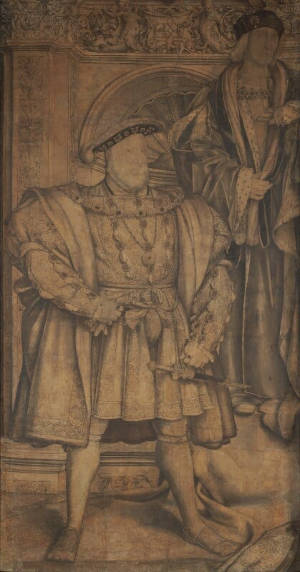
Known through its many surviving copies, the Whitehall Mural was a dynastic portrait understood to have been created to decorate a privy chamber of King Henry VIII at the Palace of Whitehall.

The mural, which was the work of Hans Holbein the Younger, featured four figures standing around a central plinth. They include King Henry VIII and his wife Jane Seymour at the front with the King’s parents King Henry VII and Queen Elizabeth of York at the back.
It is believed the portrait, commissioned during the King’s brief marriage to Jane Seymour (between 30th May 1536 and 24th October 1537), may have been created to celebrate the birth of Prince Edward (later King Edward VI) in 1537 and may have been commissioned before or after the prince’s birth.
The iconic image of the bearded King Henry VIII – which was created for the purposes of propaganda – shows him as something of an idealised powerful monarch with feet firmly planted apart and his arms out with a dagger hanging at his waist.
The mural was lost when a fire consumed much of the palace on 4th January, 1698. But copies – both of the mural as a whole and of the individual figure of King Henry VIII – survive including one by Flemish artist Remigius van Leemput commissioned by King Charles II the year before the fire.
There’s also a full-sized cartoon (pictured) showing the left-hand section of the mural which was created by Holbein in preparing to create the mural. Depicting King Henry VIII – his head turned in a slightly different aspect to the final version – and King Henry VII, it would been used to mark out the mural on the wall where it stood.

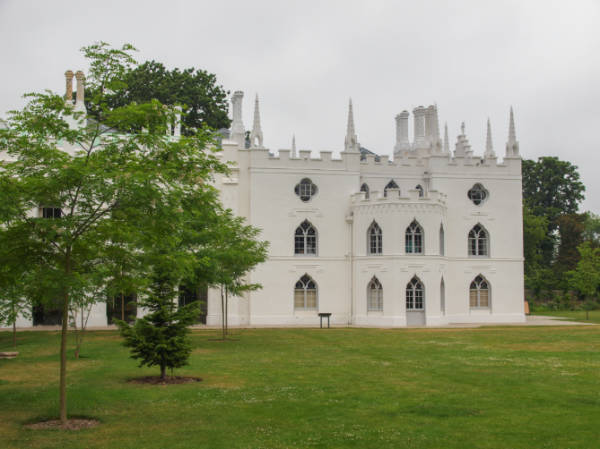
• The disappearance of a jewelled Ottoman dagger which is believed to have once belonged to King Henry VIII has inspired a new exhibition at Strawberry Hill House, Horace Walpole’s former home in Twickenham in London’s west. Henry VIII’s Lost Dagger: From the Tudor Court to the Victorian Stage looks at the history of the 16th century dagger which, said to have been richly decorated with “a profusion of rubies and diamonds”, was once part of Horace Walpole’s collection. When the collection was sold in 1842, the dagger passed into ownership of the Shakespearean actor Charles John Kean who directed private theatricals for Queen Victoria at Windsor Castle. Kean (1811-1868) pioneered what critics dubbed “living museums” on the Victorian stage by using real artifacts, including the dagger, during performances. But after Kean’s death the dagger vanished without a trace. Dr Silvia Davoli, the principal curator at Strawberry Hill House, launched an investigation to find the dagger and instead found six almost identical daggers scattered around the globe. Two of these daggers – known as the Vienna and Welbeck Abbey examples – are featured in the exhibition alongside reproductions of 18th century materials which related to Walpole’s lost dagger from Yale University’s Lewis Walpole Library. The exhibition can be seen from Saturday until 16th February. Admission charge applies. For more, see www.strawberryhillhouse.org.uk.
• The role maps have played in preserving secrets for the benefit of their creators from the 14th century to the present day is the subject of a new exhibition at the British Library. Secret Maps features more than 100 items ranging from hand-drawn naval charts given to Henry VIII to maps of cable networks used to intercept messages between the world wars; and the satellite tracking technology used by apps today. Among highlights are a map from 1596 attributed to Sir Walter Raleigh on an expedition in search of the mythical city of El Dorado in what is now Guyana in South America; a map produced in 1946 of British India (modern-day India, Pakistan and Bangladesh) with a ‘top secret’ report investigating the potential economic and military impact of partition for the proposed state of Pakistan; one of only two known existing copies of a secret map produced by Ordnance Survey during the General Strike of 1926 amid fears of a public uprising; and a 1927 Cable Map of the world which reveals a global network of censorship stations and was used by the British government to intercept messages sent via submarine and overland cables. Runs until 18th January (and accompanied by a programme of events). Admission charge applies. For more, see https://events.bl.uk/exhibitions/secretmaps.
• Staffordshire-based artist Peter Walker’s large scale interactive artworks, Connection and Identity, can be seen in the Painted Hall at the Old Royal Naval College in Greenwich from Friday. Identity features eight columns suspended within the hall which shift in colour and light while Connection showcases “a dramatic and modern reinterpretation of Michelangelo’s Creation of Adam“. The installation, which is located in the hall sometimes described as “Britain’s Sistine Chapel”, is accompanied by music specially composed by David Harper. Runs until 25th January. Admission charge applies. For more, see https://ornc.org/whats-on/connection-and-identity/.
Send all items for inclusion to exploringlondon@gmail.com.
Famous for its herd of Red and Fallow deer, the expansive Bushy Park in south-west London is also a haven for many other kinds of wildlife – from birds and fish to insects and small mammals.
• One of only two surviving choirbooks from the reign of King Henry VIII is on display in a new exhibition at the Lambeth Palace Library. Sing Joyfully: Exploring Music in Lambeth Palace Library displays the ‘Arundel’ or ‘Lambeth’ Choirbook (Arundel, Sussex, c. 1525) – this year marking its 500th birthday – along with other items from the library’s collection such as two leaves of a 14th century polyphony recently discovered in the binding of an early printed book. The exhibition, which is free, can be seen until 6th November. For more, see www.lambethpalacelibrary.info/sing-joyfully/.

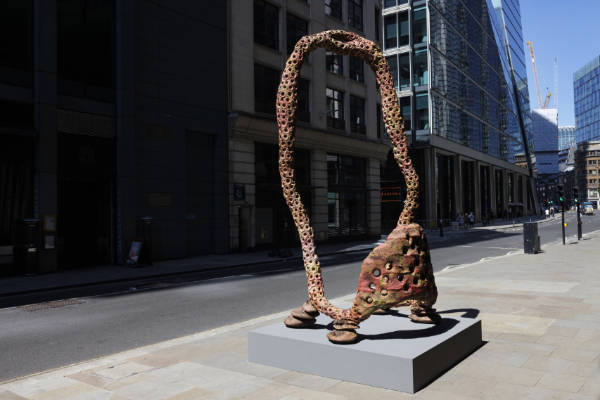
• On Now: Sculpture in the City. The 14th edition of the annual sculpture exhibition in the City of London features 11 pieces including three new works as well as six works which have been retained from previous iterations of the exhibition and two permanent acquisitions. The new works include: Ai Weiwei’s Roots: Palace, a cast-iron tree root sculpture located outside St Botolph without Bishopsgate which, as part of a series created in collaboration with Brazilian artists and communities, explores the concept of unrootedness; Jane and Louise Wilson’s Dendrophiles which, located beneath the escalators of The Leadenhall Building, combines ink drawings based on images of DNA with 3D scans of ancient oak wooden samples; and, Andrew Sabin’s Looping Loop which, located outside 70 St Mary Axe, which forms a continuous loop creating what’s described as a “lively, pulsating sensation”. Runs until April. For more – including a map of the locations – see https://www.sculptureinthecity.org.uk/.
• Rare, behind the scenes images of US band Blondie have gone on show at the Barbican Music Library from today. Taken by photographer Martyn Goddard during the group’s breakthrough year of 1978, the 50 images show the band in concert, backstage, in the studio and during photo shoots. The display of photographs is complemented by poster prints, album covers, tour and concert memorabilia, period cameras, and photographic equipment. There are also items lent by Alan Edwards, who has handled Blondie’s publicity since 1978, from his private collection. Blondie in Camera 1978 runs until 5th January. Admission is free. For more see, www.cityoflondon.gov.uk/services/libraries/barbican-music-library.
Send all items for inclusion to exploringlondon@gmail.com.
The only woman prisoner recorded as having escaped from the Tower of London, Alice Tankerville was accused, along with her common-law husband John Wolfe, of committing piracy in 1533.

It was alleged that Tankerville had lured two wealthy Italian merchants into a wherry out in the Thames where her accomplices – including Wolfe and two men disguised as watermen – had robbed and murdered them. They were also accused of burgling a home near St Benet Gracechurch where the two men had been staying.
Despite apparently having attempted to seek sanctuary in a special precinct near Westminster Abbey, the couple were arrested, charged with piracy and murder among other things, and, following a trial neither apparently attended, found guilty.
Taken to the Tower of London in 1534 (Wolfe had done a previous stint there for the theft of 366 gold crowns from a ship berthed at the Hanseatic League’s Steelyard but had eventually been released due to a lack of evidence), Alice is said to have been imprisoned in Coldharbour Gate.
Alice wasn’t done yet, however. On 23rd March that year, she managed to escape, apparently with the aid of gaoler John Bawde who provided her with ropes and a key.
It was a short-lived liberation – believed to have been wearing man’s clothes, she and Bawde were arrested trying to reach waiting horses on a road just outside the Tower (it’s worth noting that not only was Alice the only women prisoner to ever escape the Tower of London, she was also the only escapee during the reign of King Henry VIII).
Both she and Wolfe were subsequently executed and due to the nature of their crime, their execution took place on the Thames.
They were hanged in chains in the Thames near the site of their crime and, before a small flotilla of boats filled with sight-seers come to witness the event, were slowly drowned as the tide rose. Their bodies were then left hanging on the spot as a warning to others.

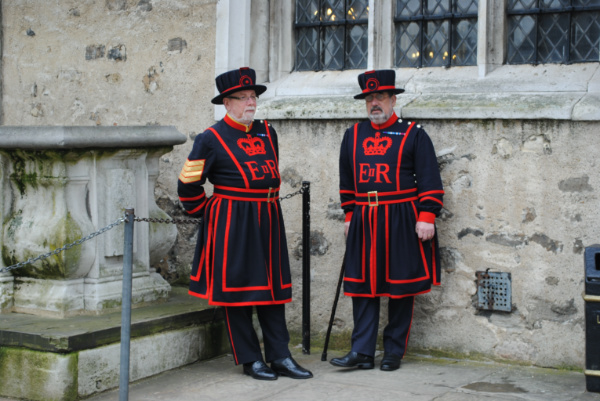
• Almost 200 garments from the Royal Ceremonial Dress Collection are able to be explored online thanks to a new collaboration between Historic Royal Palaces, which looks after six royal palaces including Hampton Court Palace and the Tower of London, and Google Arts & Culture. Drawing on ultra-high-resolution photography and 3D scanning, the garments – which include everything from ceremonial uniforms such as those worn by Yeoman Warders and a rare Bristow hat which may have been worn by King Henry VIII to Queen Victoria’s silk shoes, a waistcoat worn by King George III and a dress worn by the future Queen Elizabeth II in 1927 when she was just 18-months-old – can now be viewed in unprecedented detail (a billion pixels per image) without the risk of the damage which can occur thanks to light, humidity, and handling. The Royal Ceremonial Dress Collection comprises over 10,000 pieces of historic dress and related materials spanning the period from the 16th century to the present day and features garments worn by monarchs and key historical figures, including, as well as the aforementioned, Prince Albert, Princess Margaret, and Diana, Princess of Wales. To see the items, head to goo.gle/royalwardrobe.
• Author, politician and artist Victor Hugo’s rarely seen works on paper have gone on show at the Royal Academy of Arts. Astonishing Things: The Drawings of Victor Hugo features around 70 works drawn from European collections and follows his preoccupation with drawing from early caricatures and travel drawings to later landscapes and abstract works. Arranged across four sections, the works on show include everything from Mushroom (1850) – which depicts a giant anthropomorphic toadstool, some of his many works depicting castles such as The cheerful castle (c 1847), and drawings that Hugo created in tandem with writing his 1866 novel The Toilers of the Sea, set in Guernsey in the years following the Napoleonic Wars, as well some relating to his most famous work, Les Misérables. The exhibition, being held in the Jillian and Arthur M Sackler Wing of Galleries, can be seen until 19th June. Admission charge applies. For more, see royalacademy.org.uk.
• A “ground-breaking” exhibition showing the outsized impact British Black music has had on the world stage over the past 100 years has opened at the Barbican Music Library. Black Sound London highlights artists who created their own platforms, audiences, and spaces, often without mainstream support and spans genres including jazz, lovers’ rock, jungle, grime, and drill. Among the objects on show are vintage mixtapes, iconic magazine covers, and fly-posted walls. Runs until 19th July. For more, see www.cityoflondon.gov.uk/services/libraries/barbican-music-library.
Send all items for inclusion to exploringlondon@gmail.com.
This 15th century tower can be found at the north-west corner of Lambeth Palace, London residence of the Archbishop of Canterbury.
Subscribe for just £3 a month to gain access to all our stories – that’s less than the price of a cup of coffee!
This tower – said to be the oldest building in Hackney – is all that remains of a 16th century church and, as a local symbol, appears on the London Borough of Hackney’s coat-of-arms.
Support our work and subscribe for just £3 a month – less than the price of a cup of coffee – to see all of Exploring London’s content.
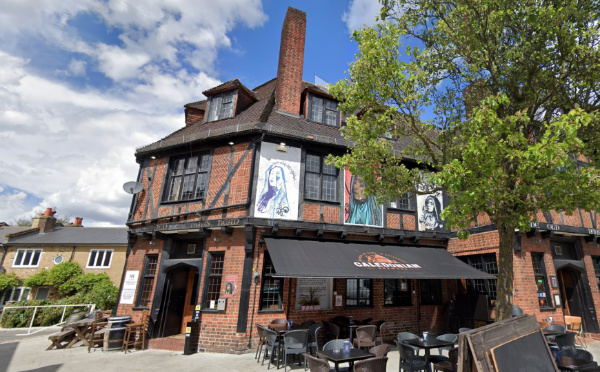
This district of London, which lies to the south-east of Peckham in the London Borough of Southwark, is believed to owe its name to a local tavern named, you guessed it, the Nun’s Head on the linear Nunhead Green (there’s still a pub there, called The Old Nun’s Head, in a building dating from 1905).

There may well have been actual nuns here (from which the tavern took its name) – it’s suggested that there was a nunnery here which may have been connected to the Augustinian Priory of St John the Baptist founded in the 12th century at Holywell (in what is now Shoreditch).
A local legend gets more specific. It says that when the nunnery was dissolved during the Dissolution, the Mother Superior was executed for her opposition to King Henry VIII’s policies and her head was placed in a spike on the site near the green where the inn was built.
While the use of the name for the area goes back to at least the 16th century, the area remained something of a rural idyll until the 1840s when the Nunhead Cemetery, one of the “Magnificent Seven” cemeteries of Victorian London, was laid out and the area began to urbanise.

A fireworks manufactory – Brocks Fireworks – was built here in 1868 (evidenced by the current pub, The Pyrotechnists Arms). The railway arrived in 1871.
St Antholin’s Church was built in 1877 using funds from the sale of the City of London church, St Antholin’s, Budge Row, which was demolished in 1875. St Antholin’s in Nunhead was destroyed during the Blitz and later rebuilt and renamed St Antony’s (the building is now a Pentecostal church while the Anglican parish has been united with that of St Silas).
There’s also a Dickens connection – he rented a property known as Windsor Lodge for his long-term mistress, actress Ellen Ternan, at 31 Lindon Grove and frequently visited her there (in fact, it has even been claimed that he died at the property and his body was subsequently moved to his home at Gad’s Hill to avoid a scandal).
Nunhead became part of the Metropolitan Borough of Camberwell in 1900. These days, it’s described by Foxtons real estate agency as “a quiet suburb with pretty roads and period appeal”.
Hanging in the Tudor Great Hall at Hampton Court Palace, this series of 10 huge tapestries are believed to have been commissioned by King Henry VIII and were first hung in the hall in 1546.
• West Ham Park celebrates its 150th anniversary this weekend with a festival of music, food, sport, and other activities. On Saturday there will be a free, family-friendly festival with music – including appearances by Australian-born singer-songwriter Celina Sharma and singer-songwriter, Fiaa Hamilton, as well as a DJ set from Ellis – along with arts and crafts, a children’s fun fair and local food stalls. On Sunday, activities are based around the theme of ‘give it a go’ with visitors able try out various sports and health activities, including football, cricket, tennis, athletics, Tai Chi, and long-boarding. There will also be free taster sessions and opportunities to meet local sporting legends. An outdoor exhibition about the park’s history can be seen in Guildhall Yard in the City leading-up to the event after which it will be moved to Aldgate Square. West Ham Park is the largest green space in the London Borough of Newham and has been managed by the City of London Corporation since 1874. Activities on both days start at 12pm. For more, see www.cityoflondon.gov.uk/westhampark150.

• The oldest surviving rooms at Hampton Court Palace – the Wolsey Rooms which King Henry VIII and Thomas Wolsey once used – are the location of a new display opening today exploring the early years of Henry VIII’s reign and the lives of the ‘ordinary’ men and women who shaped the Tudor dynasty. The Tudor World has, at its centre, rare surviving paintings from the Royal Collection including The Embarkation of Dover – depicting the Tudor navy – and The Field of Cloth of Gold which details Henry VIII’s summit with King Francis I of France in 1520. Also on show is a gold ring believed to have belonged to the Boleyn family, a brightly coloured silk hat linked to King Henry VIII, Wolsey’s portable sundial, a wooden chest used to hide religious contraband by Catholic priests during the reign of Queen Elizabeth I, and, an original Tudor chain pump used to help empty the Hampton Court cesspool. Among the stories of “ordinary” Tudor people being shared is that of Anne Harris, Henry VIII’s personal laundry woman who washed the bandages for his leg ulcers and, Jacques Francis, a free-diver from West Africa who was involved in the expedition to salvage guns from the sunken Mary Rose and who later became one of the first Black African voices heard in an English court, when he was called to testify in a case concerning his employer, Paulo Corsi. Included in palace admission. For more, see www.hrp.org.uk/hampton-court-palace/.
• Crossing Borders, a day of free activities, performances and workshops run by local newly arrived people, will be held at the Horniman Museum Gardens in Forest Hill this Saturday. The day will feature arts and crafts workshops led by IRMO, dance performances by Miski Ayllu and the Honduran Folkloric Pride Group, the chance to learn circus skills with young people from Da’aro Youth Project and South London Refugee Association, and the opportunity to make kites with Southwark Day Centre for Asylum Seekers. The free event runs from 11am to 4pm. For more, see https://www.horniman.ac.uk/event/crossing-borders/.
• Transport for London customers can save 30 per cent on entry to the Painted Hall at the Old Royal Naval College when using the TfL network until 17th November. Simply show customers show your TfL journey on the day of your visit via the TfL Oyster and Contactless app and receive the discount, taking the adult entry price, when booked online to just £11.55. For bookings, head to https://londonblog.tfl.gov.uk/2022/07/27/in-the-city/.
Send all items for inclusion to exploringlondon@gmail.com.

Estimated to be more than 750-years-old, the tree known as the Royal Oak is located near Pen Ponds and Richmond Gate.
This massive English oak (Quercus robur), which is hollow, doesn’t have any direct connections to royalty but it did survive the felling of trees which took place in Richmond Park and across the south-east of England so King Henry VIII’s navy could be built.
That may have been thanks to the King himself, who wisely passed a law to spare every 10th tree in the park for future seed.
While the park had been used by King Henry VIII as a hunting ground, it wasn’t until 1637 – during the reign of King Charles I – that it was first enclosed.
The tree, which is said to be one of 1,400 “veteran trees” in the park, was pollarded for several hundred years which helped create its shape – this is a method of pruning which removes the top-most branches to form a denser head (and creates wood which can be used for a variety of purposes).
WHERE: Near Pen Ponds, Richmond Park; WHEN: 24/7 pedestrian access; COST: Free; WEBSITE: www.royalparks.org.uk/visit/parks/richmond-park
Spring is upon us, so we thought it an appropriate time to consider some of London’s greatest natural assets – its trees. But, as well as being significant for their environmental impact, each of these trees (or, in some cases, the remains of them), are significant for historic reasons (we’ve previously mentioned a couple including what’s believed to be the oldest tree and the unusual – and sadly now deceased – Hardy Tree).

First up, it’s the tree known as Queen Elizabeth’s Oak in Greenwich. Thought to date from possibly as far back as the late 13th century, this tree survived until the 19th century before its carcass finally fell to the ground during a storm in 1991. It has lain in Greenwich Park ever since.
The tree, which is located at the end of what is now Lover’s Walk close to the Maze Hill Gate, was located in the grounds of Greenwich Palace (also known as the Palace of Placentia) and was there when King Henry VIII resided at the palace.
In fact, it’s said that he and Anne Boleyn danced around the oak while courting, and (and here’s where the name comes from) that Elizabeth, their daughter (and later Queen Elizabeth I), picnicked under its canopy (some accounts suggest she actually picnicked in the tree’s hollow – but still then upright – trunk).
Following the creation of what is now Greenwich Park, the hollow tree was apparently used as a prison for those caught illicitly on the grounds. They were secured behind a heavy wooden door fitted to the trunk (a park keeper’s lodge was built nearby in the 17th century; it was demolished in the 1850s).
The tree, one of 3,000 in the park, had died in the 19th century and was reduced to an eight metre high stump, partly supported by ivy, when it was blown over by the storm in June, 1991.
A replacement oak, which was donated by the Greenwich Historical Society was planted nearby by the Duke of Edinburgh on 3rd December, 1992, to mark Queen Elizabeth II’s 40 years on the throne.
A ring analysis carried out on the tree found in 2014 it dated back to at least 1569 but with the core missing a precise date of germination couldn’t be found. Estimates, however, place the date of germination to the last 13th or early 14th century. The analysis placed the tree’s death to between 1827 and 1842.
The tree is marked with a plaque and both it and the new tree are surrounded by an iron railing.
WHERE: Queen Elizabeth Oak, Greenwich Park (nearest DLR station is Greenwich); WHEN: 6am to 8pm daily; COST: Free; WEBSITE: https://www.royalparks.org.uk/visit/parks/greenwich-park.
This is an expanded version of a post first made in 2017.

Once one of the most important nunneries in the country, Barking Abbey was originally established in the 7th century and existed for almost 900 years before its closure in 1539 during King Henry VIII’s Dissolution.
The abbey was founded by St Erkenwald (the Bishop of London between 675 and 693) for his sister St Ethelburga who was the first abbess.

In the late 900s, St Dunstan, the Archbishop of Canterbury introduced the Rule of St Benedict at the nunnery.
King William the Conqueror stayed here after his coronation while famous abbesses included Mary Becket, the sister of St Thomas Becket, Archbishop of Canterbury, who was given the title in 1173 in reparation for the murder of her brother, as well as several royals including Queen Maud, wife of King Henry I, and Matilda, wife of King Stephen.
The nunnery gained wealth and prestige but this suffered somewhat as a result of floods in 1377 with some 720 acres of land permanently lost. It nonetheless remained one of the wealthiest in England and it’s said the abbess had precedence over all other abbesses in the country.
After the abbey was dissolved, some of the building materials were reused elsewhere and the site was later used as a farm and quarry.
Most of the buildings were demolished – today only the Curfew Tower, which dates from around 1460, remains. The Grade II*-listed tower contains the Chapel of the Holy Rood and now serves at the gateway to the nearby St Margaret’s Church.
Building footings also remain buried under the ground in what is known today as Abbey Green (the layout is marked today by modern additions). There’s a model of how the abbey once appeared inside the gateway.
Barking Abbey ruins, Abbey Road, Barking (nearest Tube Station is Barking); WHEN: Daily: COST: Free; WEBSITE: https://www.lbbd.gov.uk/find-your-nearest/barking-abbey-ruins
Once located at the southern end of London Bridge, Nonsuch House is the earliest documented prefabricated building.

Originally constructed in what is now The Netherlands, it was shipped to London in pieces – each individually marked – in 1578 with the reassembly completed the following year.
The four storey building, which was said to have been constructed using wooden pegs and no nails, featured an arched tunnel through the middle through which bridge traffic would pass.
The main facade faced toward Southwark and there were towers at each of the four corners, topped with onion domes. The east and west sides of the building, which protruded beyond the bridge out over the Thames were elaborately carved.
The northern facade of the building abutted other properties while the southern side had a clear space in front over which a drawbridge is believed to have been located (it could be raised to allow larger ships through).
The name may have referenced King Henry VIII’s Nonsuch Palace, located near Ewell in Surrey, and was said to refer to the fact there was no such building as splendid.
The property was demolished along with the other buildings on the bridge in about 1757.