This Week in London – After 80 years, NHM gallery reopens to the public; Britain’s first Black schoolteacher, Francis Barber, honoured with a Blue Plaque; and, London Sculpture Week…

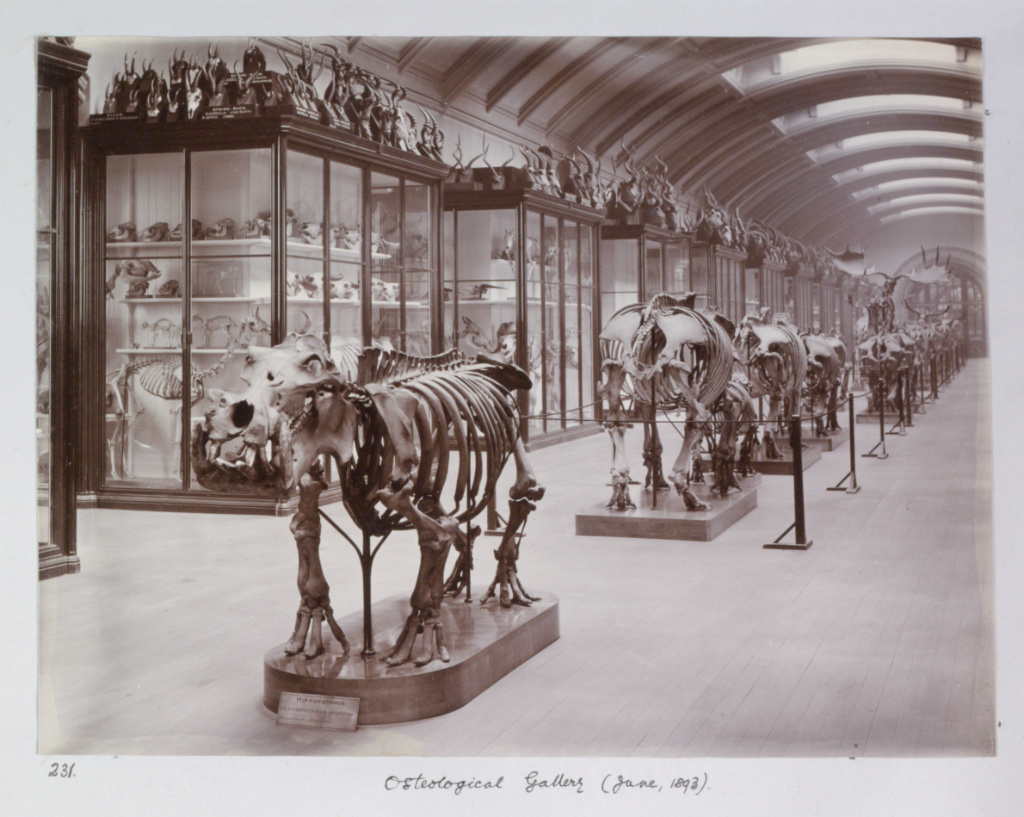
The gallery when it was used as the Osteology gallery in 1893. PICTURE: The Trustees of the Natural History Museum London

• A gallery at the Natural History Museum which has been sealed off to the public for 80 years has reopened with a new display exploring our relationship with the natural world through 50 objects. Among the objects on show in the Nature and Us exhibition are a miniature model of a Crystal Palace dinosaur; Jenny, a Victorian skeleton of a monk seal; a bryozoan-encrusted Star Wars toy from the 1980s; and a 400,000-year-old handaxe whose discovery transformed our understanding of when humans first existed. Visitors will also be able to touch a replica jaw of one of Britain’s earliest known domesticated dogs, dating to around 14,300 years ago. The gallery is open for an initial 18 months and visitors can have their say on what appears in the permanent gallery when it opens in 2029. Located on the second floor of the main Museum’s Waterhouse building, the gallery historically served as both an osteology (skeleton) gallery and a mammals gallery and, after the herbarium was damaged in World War II, was repurposed to house the botanical collection. It has been closed to the public until now. For more on the new gallery, visit www.nhm.ac.uk.
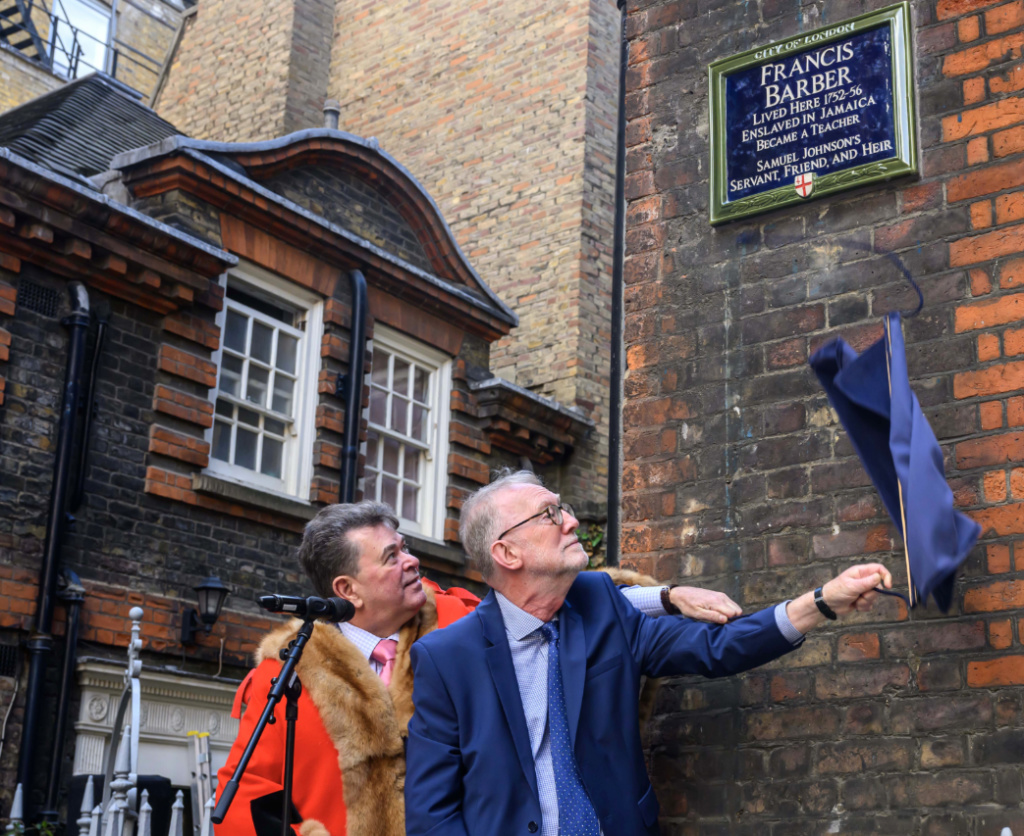
The City of London Corporation relaunches its Blue Plaques Scheme with a plaque honouring Francis Barber, the first known Black schoolteacher in British history, at Dr Johnson’s House in Fleet Street Quarter. PICTURE: Paul Grover/ Fleet Street Quarter BID

• Britain’s first Black schoolteacher, Francis Barber, has been commemorated by a Blue Plaque at the writer’s townhouse in the heart of the City of London’s Fleet Street Quarter. The plaque commemorating Dr Samuel Johnson’s former servant, friend, and heir was unveiled on Dr Johnson’s House in Gough Square as the City launches a redesigned “modern, transparent, inclusive” City of London Blue Plaques Scheme and marks 150 years since the City’s oldest Blue Plaque was unveiled honouring Dr Johnson at same historic site. Barber, a West African man born into slavery in Jamaica, came to London as a child and lived at Dr Johnson’s house from 1752 to 1756 where he worked as his servant. Dr Johnson, who compiled the Dictionary of the English Language (1755), supported him and his family throughout his life, and helped secure his financial future. Dr Johnson also named Barber as the sole heir and beneficiary of a Trust established in his will. Barber later became the first known Black schoolteacher in British history. The 17th century townhouse known as Dr Johnson’s House is now a museum and believed to be the only surviving property in the City that was home to a formerly enslaved person who later lived there as a free man. The plaque was unveiled by Alderman Tim Hailes and Michael Bundock, director of Dr Johnson’s House Trust and author of The Fortunes of Francis Barber. 

• London Sculpture Week kicks off on Saturday in a citywide celebration of London’s public art. The week – which brings together sculptures in the Fourth Plinth, East Bank, Frieze Sculpture, Sculpture in the City and The Line – includes the chance to gain new insights into London’s outdoor artworks through talks, walking tours, film screenings and other activities. Highlights include the 16th Fourth Plinth commission, Lady in Blue, Frieze Sculpture’s 14th edition which features the work of 11 leading international artists sited throughout the historic English Gardens of The Regent’s Park, and a walking tour organised by East Bank featuring works commissioned for the London 2012 Olympic and Paralympic Games as well as recent East Bank commissions such as Larry Achiampong and David Blandy’s Trēow of Time and Thomas J Price’s A Place Beyond. There’s also a walking tour taking in the eight works in Sculpture in the City followed by the chance to sample canapés inspired by a selection of the sculptures, and a free wellbeing walk along The Line, East London’s public art trail. For the full programme, head to https://tinyurl.com/london-sculpture-week-2026.

Send all items to exploringlondon@gmail.com
This Week in London – Rare Tudor choirbook at Lambeth; Sculpture in the City returns; and, picturing Blondie…

• One of only two surviving choirbooks from the reign of King Henry VIII is on display in a new exhibition at the Lambeth Palace Library. Sing Joyfully: Exploring Music in Lambeth Palace Library displays the ‘Arundel’ or ‘Lambeth’ Choirbook (Arundel, Sussex, c. 1525) – this year marking its 500th birthday – along with other items from the library’s collection such as two leaves of a 14th century polyphony recently discovered in the binding of an early printed book. The exhibition, which is free, can be seen until 6th November. For more, see www.lambethpalacelibrary.info/sing-joyfully/.

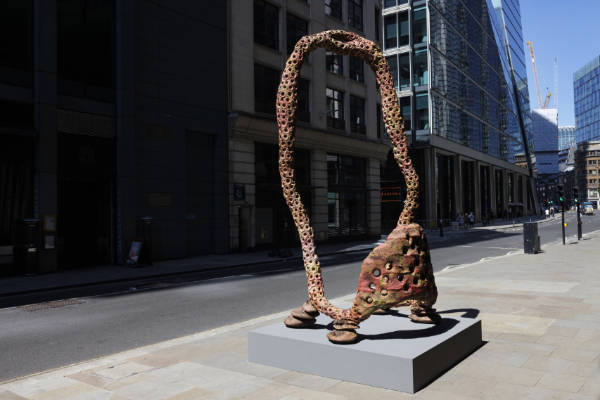
Looping Loop, © Andrew Sabin, Courtesy of the artist and Brooke Benington. PICTURE © Nick Turpin

• On Now: Sculpture in the City. The 14th edition of the annual sculpture exhibition in the City of London features 11 pieces including three new works as well as six works which have been retained from previous iterations of the exhibition and two permanent acquisitions. The new works include: Ai Weiwei’s Roots: Palace, a cast-iron tree root sculpture located outside St Botolph without Bishopsgate which, as part of a series created in collaboration with Brazilian artists and communities, explores the concept of unrootedness; Jane and Louise Wilson’s Dendrophiles which, located beneath the escalators of The Leadenhall Building, combines ink drawings based on images of DNA with 3D scans of ancient oak wooden samples; and, Andrew Sabin’s Looping Loop which, located outside 70 St Mary Axe, which forms a continuous loop creating what’s described as a “lively, pulsating sensation”. Runs until April. For more – including a map of the locations – see https://www.sculptureinthecity.org.uk/.

• Rare, behind the scenes images of US band Blondie have gone on show at the Barbican Music Library from today. Taken by photographer Martyn Goddard during the group’s breakthrough year of 1978, the 50 images show the band in concert, backstage, in the studio and during photo shoots. The display of photographs is complemented by poster prints, album covers, tour and concert memorabilia, period cameras, and photographic equipment. There are also items lent by Alan Edwards, who has handled Blondie’s publicity since 1978, from his private collection. Blondie in Camera 1978 runs until 5th January. Admission is free. For more see, www.cityoflondon.gov.uk/services/libraries/barbican-music-library.

Send all items for inclusion to exploringlondon@gmail.com.

LondonLife – Sculpture in the City (Vol 8)…

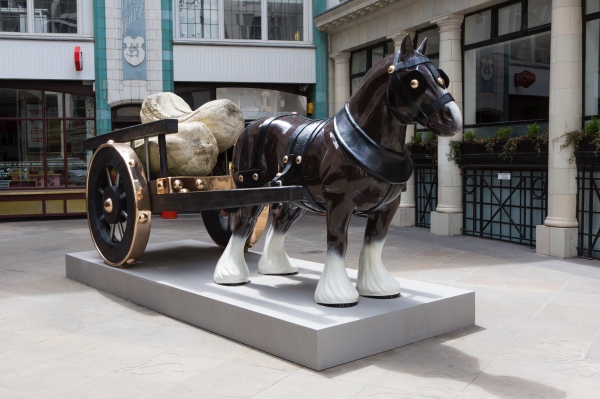
Sculpture in the City is back in the Square Mile, this year featuring 18 artworks ranging from Jean-Luc Moulène’s Body, an aerodynamic tribute to the automobile as sculpture (located in Undershaft – pictured above), to Thomas J Price’s Numen (Shifting Votive) One & Two, an exploration of the ancient Greek, Roman and Egyptian traditions of monumental sculpture (located under The Leadenhall Building – pictured below). Other sculptural works included in this, the 8th edition of the annual event, include Juliana Cerceira Leite’s Climb, a three metre tall obelisk made from the inside out (located in Mitre Square – pictured second below), Sarah Lucas’ Perceval, a life-size horse and cart evocative of the traditional china ornaments that once took pride of place on British mantlepieces (located in Cullum Street – pictured third below), and Karen Tang’s Synapsid, a vivid globular sculpture which brings to mind sci-fi invasion scenarios (outside Fenchurch Street station – pictured fourth below). And, for the first time, the event also includes two sound projects: Marina Abramovic’s Tree, which those passing near a tree at 99 Bishopsgate with insistent, repetitive and distorted birdsong, and Miroslaw Balka’s The Great Escape which, located in Hartsthorn Alley, features the film of the same name’s theme song being whistled repeatedly in a series of slightly different renditions. The display can be seen until April next year – for a map of all the locations, head to www.sculptureinthecity.org.uk. ALL PICTURES: Nick Turpin.

LondonLife – Sculpture returns to the City…

Sculpture1
Sculpture in the City has returned to the Square Mile for summer with 17 contemporary artworks by internationally renowned artists located in public spaces across the City of London.
 With the event now in its sixth year, this year’s sculptures include Jaume Plensa’s seven metre high cast iron work Laura (located at 30 St Mary Axe (aka The Gherkin), it’s pictured above), Matt Collishaw’s work, Magic Lantern Small – a grand scale “zoetrope”, one of the earliest moving image machines (located in Bury Court, it’s pictured below), and Huma Bhabha’s work, The Orientalist (located in Fenchurch Avenue, it’s pictured far below). Other works can be found in locations including St Botolph-without-Bishopsgate Gardens, The Leadenhall Building and St Helen’s Bishopsgate Churchyard. A map of the SITC trail and extra commentary on the individual artworks can be accessed by downloading the SMARTIFY app for Apple and Android devices and then scanning any of the sculptures. There’s also a map and information available at www.cityoflondon.gov.uk/sculptureinthecity. PICTURES: Nick Turpin

Sculpture2

Sculpture3

LondonLife – London’s celebration of sculpture…

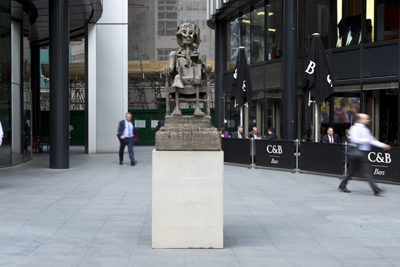
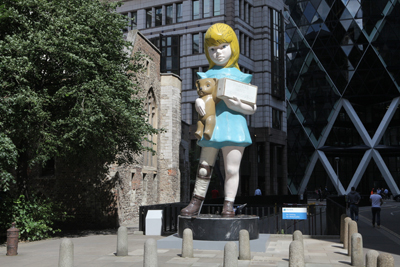
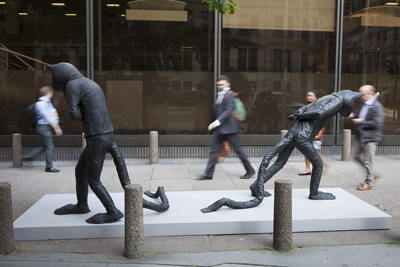
(i)-Damien-Hirst,-Charity.-Sculpture-in-the-City-2015Damien Hirst’s seven foot tall statue Charity (2002-2003) stands in the shadow of the Gherkin as a highlight of this year’s Sculpture in the City event. Kicking off last month, the exhibition – the fifth of its kind – features 14 works by a series of internationally renowned artists. Other sculptures (pictured below) include Adam Chodzko’s 2010 work Ghost (on show at Leadenhall Market), Laura Ford’s 2012 work Day of Judgement – Cats 1 & 2 (150 Leadenhall Street), Sigalit Laudau’s 2011 work ‘O my friends, there are no friends’ (St Helen’s Square), and Kris Martin’s 2012 work Bells II (on the corner of Bishopsgate and Wormwood Street). The works can be seen until May next year. For more (including a map of locations), see www.cityoflondon.gov.uk/sculptureinthecity. PICTURES: Nick Turpin.

Adam-Chodzko's-'Ghost',-Leadenhall-Market.-Sculpture-in-the-City-2015,-Photograph-by-Nick-Turpin

(i)-Laura-Ford's-'Days-of-Judgement---Cats-1-&-2'.-Sculpture-in-the-City-2015,-Photograph-by-Nick-Turpin

(iii)-Sigalit-Landau.-O-my-friends,-there-are-no-friends.-Sculpture-in-the-City-2015.

Kris-Martin--Bells-II_landscape