LondonLife – ‘The Last Days of Anne Boleyn’ at the Tower…


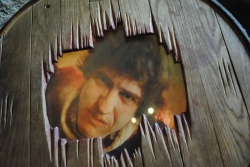
The final days of Anne Boleyn are being brought to life in a new play running at the Tower of London. Written and directed by Michael Fentiman, The Last Days of Anne Boleyn tells the story of the last 17 days of the Queen’s life before her execution in 1536 following her spectacular fall from grace. The performance is staged on the site of the lost Tudor palace at the Tower where Anne spent her final days and is based on contemporary sources including letters to her husband, King Henry VIII, and her final speech on the scaffold in the moments before she was beheaded. The outdoor show (suitable for all ages) runs for 35 minutes with two performances a day – 11am and 2pm, from Friday to Tuesday until 28th August (weather permitting). Admission is included in the entry price. For more information, head here. PICTURES: Courtesy of Historic Royal Palaces.

London Pub Signs – The Queen’s Head and Artichoke…

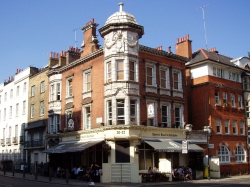
This corner pub was originally located in a former royal hunting lodge in what became The Regent’s Park.

It was one of several inns which were in the park which were demolished when it was created.

But unlike others, The Queen’s Head and Artichoke was rebuilt on its current site at 30-32 Albany Street in 1811. The existing building apparently dates from around 1900.

The licence for the pub is said to date back to the time of Queen Elizabeth I. The story goes that the establishment received its rather odd name thanks to Daniel Clarke, head gardener and master cook to the Queen and her successor, King James I – and, later, the pub’s proprietor.

For more, see www.theartichoke.net.

PICTURE: Ewan Munro (licensed under CC BY-SA 2.0)

Lost London – Merton Priory…

Little remains of this priory which once stood on the banks of the River Wandle in Surrey (and is now encompassed in Greater London).

The priory, which was founded as an Augustinian house in the early 12th century, rose to become one of the most influential in all of southern Britain.

The institution was created thanks to Gilbert, the Sheriff of Surrey, Huntington and Cambridge, who was granted the village of Merton by King Henry I. Gilbert came to live in Merton and there established a priory, building a church and small huts on land thought to be located just to the west of where the priory was later located.

Gilbert had been impressed with what he’d seen of the Augustinians, also known as the Austin friars, at Huntington and so gave control of the new church to their sub-prior, Robert Bayle, along with the land and a mill.

It was based on Bayle’s advice that the site of the priory was then moved to its second location and a new, larger wooden chapel built with William Gifford, Bishop of Winchester, coming to bless the cemetery. The canons – there were now 17 – moved in on 3rd May, 1117.

Among the high profile people to visit the new priory was Queen Matilda, who brought her son William with her. In the early 1100s, a certain Thomas Becket (later the ill-fated Archbishop of Canterbury) received an education here as did Nicolas Breakspeare (later the first English Pope, Adrian IV).

The priory expanded considerably over the next century and in 1217 its chapter house was the location of a peace conference between King Henry III and Louis, the Dauphin of France. The Statutes of Merton – a series of legal codes relating to wills – were formulated here in 1236.

The connection with royalty continued – in the mid-1340s, King Edward III is thought to have passed the Feast of the Epiphany here while King Henry VI apparently had a crowning ceremony here – the first outside of Westminster Abbey for more than 300 years – in 1437.

The priory remained in use until the Dissolution of King Henry VIII. The demolition of the buildings apparently started even before the priory had been formally surrendered to the commissioners – stones from its building was used in the construction of Henry’s new palace – Nonsuch – as well as, later, in the construction of local buildings.

The site came to be referred to as ‘Merton Abbey’ and, passing through various hands, was used to garrison Parliamentarian troops during the Civil War. It later became a manufacturing facility, works for the dying and printing of textiles, one of which became the workshops of William Morris.

Some of the priory buildings survived for some years after but the only remains now left as sections of the perimeter wall (the arch which now stands over the entrance to Merton parish church is reconstructed – there’s another ornamental gateway in the outer court wall which was also replaced with a replica in the 1980s).

The foundations of the unusually large chapter house, meanwhile, have been excavated and are now preserved in a specially constructed enclosure under a roadway. Construction is now underway to build better public access to the remains.

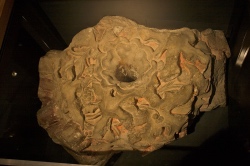
PICTURE: A ceiling boss from Merton Priory which still bears traces of its original red paint and guilding. It was found during excavations at Nonsuch Palace in 1959-60 is now on display in the Museum of London. Photograph by Mike Peel (www.mikepeel.net) (licensed under CC-BY-SA-4.0).

This Week in London – Hampton Court Palace breathes new life into Tudor kitchens; Kew’s Temperate House to reopen; and, World War I commemorated in Guildhall Yard…

Hampton Court Palace will on Saturday launch a major representation of its Tudor kitchens with a new display designed to give visitors a ringside seat to preparations for a royal feast. Visitors will be immersed in the sights, sounds and smells of King Henry VIII’s kitchens as they explore the stories of everyone from cooks to liveried pages who made the great court feasts possible and meet the likes of Thomas Cromwell, right-hand man to the king, master cook John Dale and Michael Wentworth, clerk of the kitchen. A specially commissioned play will be launched for the summer and during holiday periods there will be workshops, games and competitions. Admission to the kitchens is included in the palace admission. For more information, head to www.hrp.org.uk/hampton-court-palace/.

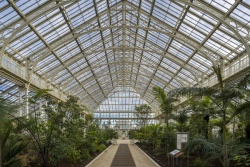
Kew’s iconic Temperate House – the world’s largest Victorian glasshouse – will reopen on Saturday after the biggest renovation project in its history. The five year restoration project has seen its entire framework repaired and thousands of panes of glass replaced. Some 500 plants were taken out and housed in a temporary nursery and some 10,000 plants, consisting of 1,500 species, have gone back in. A programme of events will take place involving the Temperate House, which dates from 1863, over the summer and there are special preview openings on Friday and Saturday night. For more, see www.kew.org. PICTURE: Gareth Gardner/Kew.

The City of London Corporation is marking the centenary of the end of World War I with a new open-air exhibition highlighting the global nature of conflict. Fields of Battle, Lands of Peace: 1918-2018, which opened on Monday, is the third and final display by photographer Michael St Maur Sheil to go on show in Guildhall Yard. The display can be seen until 28th May. Accompanying the exhibition is a free guided walk – The City’s Great War Heroes – which enables people to walk in the footsteps of City men and women who went off to the Great War. It departs from Bishopsgate every Monday and Saturday at 11am and 2pm until 28th May with an extra walk at 1.30pm on the final day. For more, follow this link.

Send all items for inclusion to exploringlondon@gmail.com.

What’s in a name?…Horseferry Road…

There’s no prizes for guessing that this Westminster road, which runs from Greycoat Place to Millbank and Lambeth Bridge, in pre-bridge days led down to a horse ferry across the Thames.

The ferry was, in fact, the only licensed horse ferry along the river and did quite a trade in conveying horses and their riders as well as carriages across the river. Mentions of the ferry date back to medieval times but it’s suggested there may have been a ford here back as far as the Roman era.

The income from the ferry went to the Archbishop of Canterbury (his official London residence lay across the river at Lambeth). So lucrative were the ferry rights that when Westminster Bridge was built in the mid 18th-century, the archbishop was paid £3,000 in compensation.

There are a number of famous figures associated with the ferry – Princess Augusta, later the mother of King George III, reportedly used it on the way to her wedding in 1736, and almost 50 years before that, the ferry pier is said to have been the starting point for King James II’s flight from England in 1689.

There are also a couple of high profile disasters associated with the horse ferry – Archbishop Laud’s belongings apparently sank to the bottom when the ferry overturned in 1633 and  Oliver Cromwell’s coach was apparently lost during a similar incident in 1656 – both events were apparently seen as bad omens (not to mention expensive).

Horseferry Road, meanwhile, is these days home to government buildings including Horseferry House and the City of Westminster Magistrate’s Court, as well as the Royal College of Veterinary Surgeons and, since the mid 1990s, Channel 4’s HQ.

Horseferry Road was also the location of the Australian Imperial Force’s administrative HQ during World War I and it was in this thoroughfare that Phyllis Pearsall was living when she conceived the London A to Z.

PICTURE: Top – Lambeth Bridge, site of the horse ferry which gives Horseferry Road its name/Right – Horseferry Road (Tagishsimon, licensed under CC BY-SA 4.0)


A Moment in London’s History – The execution of George, Duke of Clarence…

Among the gruesome deaths said to have taken place at the Tower of London is that of George, the Duke of Clarence, who, so the story goes, was drowned in a butt of Malmsey wine on 18th February, 1478 – 540 years ago this year.

George, who was born on 21st October, 1449, was the younger brother of King Edward IV and older brother of (although he was only king after George’s death) King Richard III.

George, who was made Duke of Clarence and Lord Lieutenant of Ireland soon after the House of York’s King Edward IV’s ascendancy to the throne in 1461 during the volatile period known as the Wars of the Roses, had betrayed his brother King Edward IV at least twice before his death.

The first time came in the late 1460s when he joined with Richard Neville, Earl of Warwick, in helping the previously deposed Lancastrian King Henry VI back onto the throne. The second time came after his brother Edward has retaken the throne in March, 1471, and the two of them had reconciled. George had sought to wed Mary of Burgundy, but Edward had objected – one of a series of events which apparently led George, whose mental state was said to be deteriorating fast by this point, to once again scheme against the king and eventually saw King Edward IV have him thrown in prison in June, 1477.

The King brought charges – including that he had slandered the King and prepared for rebellion – against George in Parliament in January, 1478, and both houses subsequently passed a bill of attainder with the sentence of death carried out in private (thus perhaps sparing him the humiliation of a public execution?) in the Tower soon after.

The story that he had been drowned in a butt of his favourite malmsey (a sweet wine) in the Bowyer Tower apparently circulated soon after his death – among proponents of the story was William Shakespeare who in Richard III has the duke stabbed and then drowned in a butt of malmsey – and to this day it remains something of a mystery as to whether it actually occurred (although, interestingly, his body when exhumed was not beheaded which was the common means of executing members of the nobility).

It has been suggested that sawn down wine butts were used for baths at the time – which may mean George was drowned in a wine butt, but one he was using to take a bath rather than one which had wine stored in it. It has also been suggested that the reference to a butt of wine refers to a barrel used for storing his body for removal to Tewkesbury where he was buried alongside his wife rather than his actual execution.

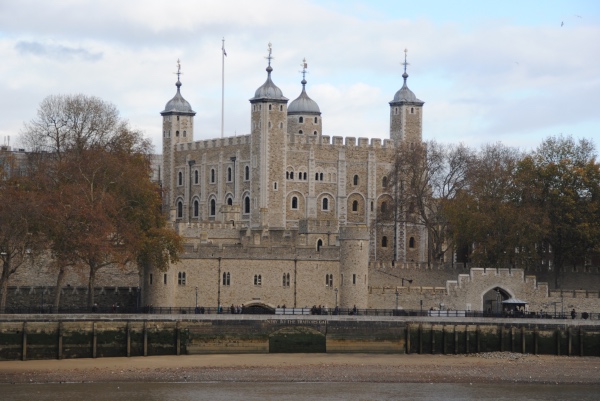
PICTURES: Top – The Tower of London where the Duke was executed; Right – A virtual re-enactment of George’s death at the Tower.


This Week in London – Charles I’s ‘Royal Collection’ on show; John Constable; and, 18th century satire…

Anthony van Dyck, Charles I, 1635-6, Oil on canvas, 84.4 x 99.4 cm, RCIN 404420 Royal Collection Trust/© Her Majesty Queen Elizabeth II 2017

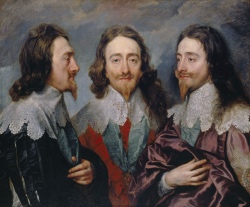
A landmark exhibition which reunites one of the most extraordinary art collections ever assembled opens in the main galleries of the Royal Academy of Arts in Piccadilly this Saturday. Presented in partnership with the Royal Collection Trust, Charles I: King and Collector features about 150 of the most important of the works collected by King Charles I during his reign, spanning the period from 1600 to 1649. They are among 1,500 paintings and 500 sculptures he collected  prior to his execution in 1649, after which the collection was offered for sale and dispersed across Europe. Many of the works were retrieved by King Charles II during the Restoration but others now form the core of collections at institutions such as the Musée du Louvre and the Museo Nacional del Prado. Among those on show in this exhibition, which includes more than 90 works borrowed from the Royal Collection, are several monumental portraits of the king and his family by Anthony van Dyck as well as the artist’s most celebrated portrait of the king, Charles I (‘Le Roi a la chasse’) (pictured), which returns to England for the first time since the 17th century. Other works include Peter Paul Rubens’ Minerva Protects Pax From Mars (‘Peace and War’) – this was commissioned by Charles and painted between 1629-30, Andrea Mantegna’s series, The Triumph of Caesar (c1484-92), and Titian’s Supper at Emmaus (c1530) while artists including Correggio, Tintoretto, Paolo Veronese, Albrecht Durer, Hans Holbein the Younger and Pieter Bruegel the Elder are also represented. The exhibition also shows off the celebrated Mortlake tapestries depicting Raphael’s Acts of the Apostles (c1631-40) and paintings, statuettes, miniatures and drawings once kept in the Cabinet at Whitehall Palace. Runs until 15th April. Admission charge applies. For more, see www.royalacademy.org.uk.

• John Constable’s oil sketch, Salisbury Cathedral from the Meadows, 1829–31, is one of 10 works which have gone on display at the Guildhall Art Gallery as part of its Victorian Landscapes exhibition. The painting takes centre-stage in the display in the gallery’s Temple Room; other works on show include John Brett’s Echoes of a Far-Off Storm (1890); Edward William Cooke’s Triassic Cliffs, Blue Anchor, North Somerset (1866), and Benjamin Williams Leader’s The Church at Betwys-y-Coed (1863). The paintings can be seen until early May. For more, follow this link.

Eighteenth century satire portrayed on ceramics and prints is the subject of a new free display at the British Museum. Pots with Attitude: British Satire on Ceramics, 1760-1830 features some 80 objects, some of which have not been on show for decades, including mugs and jugs (which make up the bulk of the items on show) as well as items like a cotton handkerchief printed with the “Peterloo Massacre” of 1819 and a rather grisly folding fan showing hidden profiles of executed French sovereigns (1794). Other objects show off copies of prints by satirists such as James Gillray and Charles Williams, with one of the latter’s showing a colossal Napoleon about to cross the Channel into England but prevented from doing so by a pint-sized, sword-carrying John Bull, who has sliced off his toes and is telling him, ‘Paws off, Pompey’ – the comment a reference to a lap-dog known as Pompey the Little who was the hero of a popular novel at the time. The display can be seen in Room 90a, Prints and Drawings Gallery, until 13th March. For more, see www.britishmuseum.org.

Send all items for inclusion to exploringlondon@gmail.com.

This Week in London – The Royal Collection and Charles II; convicts lives explored; and, ‘Gold’ at the National Gallery…

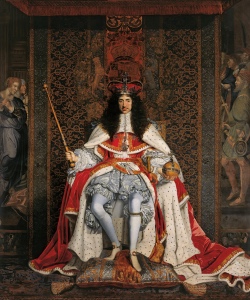
A new exhibition celebrating the role of the court of King Charles II in promoting the arts in England has opened at The Queen’s Gallery in Buckingham Palace. Charles II: Art and Power highlights the key role Charles II played in developing the Royal Collection following the Restoration in 1660 as a means of decorating royal apartments and, perhaps more importantly, of glorifying the restored monarchy and helping it to take its place back on the European stage. The display features works ranging from John Michael Wright’s monumental portrait of the king in coronation robes (pictured) to Henry Greenway’s silver-gilt dish that adorned the high altar of Westminster Abbey and Wenceslaus Hollar’s The Coronation of King Charles the II in Westminster Abby the 23 of April 1661. Other paintings on show include Titian’s Madonna and Child in a Landscape with Tobias and the Angel (c1535-40), Antonio Verrio’s The Sea Triumph of Charles II (c1674), Pieter Brugel the Elder’s The Massacre of the Innocents (c1565-67), and Sir Peter Lely’s Barbara Villiers, Duchess of Cleveland (c 1665) as well as tapestries and silver-gilt furnishings. The exhibition, which will be accompanied by a major exhibition in the Royal Academy of Arts in January and a series of documentaries on various BBC channels under the banner of a BBC Royal Collection Season, runs until 13th May. Admission charge applies. For more, see www.royalcollection.org.uk. PICTURE: John Michael Wright, Charles II, c.1676 Royal Collection Trust/© Her Majesty Queen Elizabeth II 2017.

The lives of convicts in 18th and 19th century London are the subject of a new exhibition opening at the London Metropolitan Archives. Criminal Lives, 1780-1925: Punishing Old Bailey Convicts includes original documents from the Old Bailey archives and items such as a policeman’s truncheon, a reproduction Millbank Prison uniform and convicts’ photographs drawn from collections in Britain and Australia to provide insights into the lives of offenders, from the time of the Gordan Riots in 1760 to the early 20th century. Among those whose lives are featured are prostitute and pickpocket Charlotte Walker, notorious receiver of stolen goods Ikey Solomons and serial thief Thomas Limpus. The exhibition, created in collaboration with the Arts and Humanities Research Council Digital Panopticon Project, opens on Monday and runs until 16th May. Admission is free. There is an accompanying programme of events. For more, see www.cityoflondon.gov.uk/lma.

The National Gallery is running a season of events aimed at exploring the theme of ‘gold’ in its collection in the run-up to Christmas. Running until 1st January, the programme includes free lunchtime talks, a life drawing session this Friday, a workshop on the traditional intaglio printmaking technique of drypoint, drawing sessions and a series of films. For the full season of events, check out www.nationalgallery.org.uk/whats-on/christmas-at-the-gallery/christmas-events.

Send all items for inclusion to exploringlondon@gmail.com.

10 subterranean sites in London – 6. Guildhall crypts…

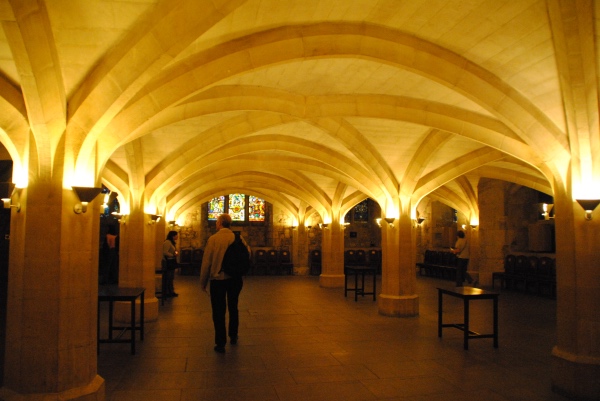
Located beneath Guildhall’s Great Hall is the oldest surviving part of the structure, the largest of London’s medieval crypts.

Dating from the reign of King Edward the Confessor in the 11th century, the vaulted East Crypt is considered to be one of the finest examples of its kind in England with a ceiling featuring a series of carved bosses depicting heads, shields and flowers.

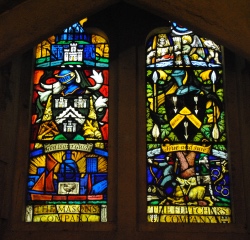
It features a series of stained glass windows depicting five famous Londoners – Geoffrey Chaucer, William Caxton, Sir Thomas More, Sir Christopher Wren and Samuel Pepys.

The pillars holding up the roof, meanwhile – once located at ground level – show signs of where horses were once tied up while their riders went about their business.

The West Crypt, which is believed to date from the 13th century, was sealed off after collapsing under the weight of the roof of the Great Hall which fell down during the Great Fire of London in 1666. It was reopened in 1973.

The windows of the West Crypt represent some of the City of London’s livery companies (pictured above, right).

One of the most famous incidents took place in the crypts on 9th July, 1851, when Queen Victoria attended a banquet here during a state visit.

The crypts today are available to hire for atmospheric events.

WHERE: Guildhall, Guildhall Yard, City of London (nearest Tube stations are Bank, Mansion House and Moorgate); WHEN: 10am to 4.30pm daily (when not being used for events); COST: Free; WEBSITE: www.cityoflondon.gov.uk/things-to-do/visit-the-city/attractions/guildhall-galleries/Pages/guildhall.aspx.

10 subterranean sites in London – 5. Whitefriars Priory crypt…

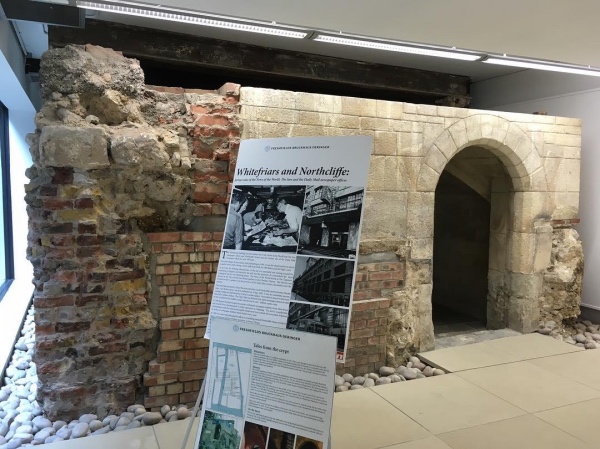
Located in the basement of a modern office building (and visible through glass) are the remains of a 700-year-old crypt that once lay beneath Whitefriars Priory.

Reached via Magpie Alley (off Bouverie Street which runs south from Fleet Street), the remains are all that is visibly left of the priory, founded here in the 13th century.

Known as ‘White Friars’ because of the white mantle they wore over their brown habits, the Carmelites (their proper name) were founded in what is now Israel in the mid-12th century. After the region fell to the Saracens in the mid-13th century, some members of the order made their way to England with the aid of Richard, Earl of Cornwall, brother of King Henry III. In  1241, Sir Richard Grey of Codnor founded the Priory of Our Lady of Mount Carmel on this site.

The priory – which counted towering medieval figure John of Gaunt among its patrons – once stretched from Fleet Street to the Thames and to the Temple in the west and what is now Whitefriars Street in the east. It included a church – enlarged in the 14th century – as well as cloisters, a garden and cemetery.

The priory survived until the Dissolution after which King Henry VIII granted various buildings to the King’s Physician and the King’s Armourer and the great hall become the famous Whitefriars Playhouse.

Whitefriars became part of the rather infamous slum known as Alsatia, a ‘liberty’ seen as a place of sanctuary for those fleeing the law. The priory was gradually subsumed into the slum – there’s a suggestion that the crypt may have been used as a coal cellar.

The remains of the 14th century vaulted crypt, which had been located beneath the prior’s house on the east side of the former priory site, were apparently found in the late 19th century and restored in the 1920s when the now defunct newspaper News of the World was expanding. During a redevelopment in the 1980s (which came after News International moved out to Wapping), the remains were moved to their current location.

WHERE: Whitefriars Crypt, Ashentree Court, City of London (nearest Tube stations are Temple and Blackfriars); WHEN: Daily; COST: Free; WEBSITE: None.

PICTURE: The crypt at seen at this year’s Open House London event. (Andrea Vail licensed under CC BY-ND 2.0.)

Treasures of London – The Yeomen Warders…

Commonly known as Beefeaters (more on that in a moment), the Yeoman Warders have long been a presence at the Tower of London.

The Yeomen Warders, more properly known as the ‘Yeomen Warders of Her Majesty’s Royal Palace and Fortress the Tower of London, and Members of the Queen’s Body Guard of the Yeoman Guard Extraordinary’, are a distinct detachment of the Yeomen of the Guard.

With a history stretching back to at least the reign of King Edward IV (1461-83), they have formed the Royal Bodyguard since at least 1509.

The Warders are nicknamed ‘Beefeaters’, it is thought, due to the fact their privileged position meant they could eat as much beef as they liked from the King’s table.

These days, Yeoman Warders, most of whom live in the Tower with their families (part of their job has always been to guard the Tower at night), must have served in the armed forces for at least 22 years, have reached the rank of warrant officer, and been awarded the Long Service and Good Conduct Medal (the current warders have served in Northern Ireland, during the Falklands War, in Bosnia, in the first and second Gulf conflicts and in Afghanistan).

There are usually around 40 Yeoman Warders at any one time under the command of four Yeoman Serjeants and a Chief Yeoman Warder (currently Alan Kingshott). They wear age dark blue and red undress uniform for everyday duties but also have a state dress uniform featuring the familiar heavy red coat (pictured above).

The first female to be appointed to the role of Yeoman Warder was Moira Cameron in 2007. The most recent person to join the Yeoman Warders is Gary Burridge who did so in August following 32 years in the Royal Navy.

One of the Yeoman Warders – currently Chris Skaife – serves in the role of Ravenmaster of the Tower of London and has the responsibility of caring for the tower’s famous ravens (important because, so they story goes, should the ravens ever leave the tower, the White Tower will fall and disaster will befall the kingdom). Other specialist roles include that of Yeoman Clerk.

Upon joining the Yeoman Warders, the new warders take an oath of allegiance (believed to date back to 1337) after which they drink a toast of port served in an 18th century pewter bowl.

Tradition holds that the Chief Yeoman Warder toasts all new recruits with the words “May you never die a Yeoman Warder”. The origins of this apparently lie in the fact that the positions of Yeoman Warder were in the past purchased from the Constable of the Tower for 250 guineas with most of the money returned to the warder when they retired and the Constable keeping the rest. But if the Yeoman Warder died in office, the Constable would keep all the money – hence the toast. The practice was apparently abolished by the Duke of Wellington in 1826.

Yeoman Warders, as well as participating in ceremonial duties like the daily Ceremony of the Keys and the annual Ceremony of the Constable’s Dues, they also take tours of the Tower of London.

WHERE: Tower of London (nearest Tube is Tower Hill); WHEN: 9am to 4.30pm Tuesday to Saturday/10am to 4.30pm Sunday to Monday; COST: £21.50 adult/£9.70 child (Historic Royal Palaces members free); WEBSITE: www.hrp.org.uk/tower-of-london/

PICTURE: Yeoman Warders at the Ceremony of the Constable’s Dues, 2014 (Peter Rowley/Flickr/CC BY 2.0)

10 subterranean sites in London – 3. The Banqueting House undercroft…

Located beneath the Banqueting House – a remnant of the Palace of Whitehall, the undercroft was originally designed by Inigo Jones (who designed the building as a whole) as a private drinking den for King James I.

French landscaper and architect Isaac de Caus was commissioned to decorate one end of the vaulted undercroft as a shell grotto where the king could relax with his friends. In 1623, it received a dedication from Ben Jonson:

“Since Bacchus, thou art father
Of wines, to thee the rather
We dedicate this Cellar
Where now, thou art made Dweller.”

Following the Restoration, during the reign of King Charles II, the basement was used to hold lotteries – John Evelyn describes one such event taking place in 1664 in his famed diary, although soon after this was moved into a purpose-built facility nearby.

The undercroft was subsequently used for storage including during the reign of King James II when it was apparently used to store furnishings from the Privy and Council Chambers of Whitehall Palace while they were being rebuilt.

From the late 1890s until the 1960s, it became part of the museum of the Royal United Services Institute (which also used the hall upstairs) but following a restoration in 1992, is now open to the public and also used for special events at the building.

WHERE: Undercroft, Banqueting House, Whitehall (nearest Tube is Westminster or Charing Cross); WHEN: 10am to 5pm daily (check if there is a private function); COST: £5.50 adults (16+)/children under 16 free/Historic Royal Palaces members free; WEBSITE: www.hrp.org.uk/banqueting-house/

PICTURE: alh1/Licensed under CC BY-NC-ND 2.0

Famous Londoners – Henry Jermyn…

Seventeenth century politician, diplomat and royal courtier, Henry Jermyn’s influence can still be seen in London’s West End today.

Jermyn was born as the fourth, but second surviving, son of courtier Sir Thomas Jermyn, of Rushbrook, Suffolk, and his wife Catherine, in early 1605. He was baptised soon after at St Margaret’s Lothbury in London in late March of that year.
Having already been among several diplomatic missions, he entered the political world at about the age of 20 in 1625, when he was elected member for Bodmin in Cornwall – the first of several seats he (and his brother Thomas) would hold around the country.

He joined the household of Queen Henrietta Maria, wife of King Charles I, in 1627, becoming her vice-chamberlain in 1628, and Master of the Horse to the Queen in 1639 (although he apparently spent a couple of years in exile in France during this period when he refused to obey the King and marry another courtier).

An ardent royalist, in 1641, he participated in a plot against Parliament and was forced to flee to France. In 1642, he joined the Queen in The Hague and returned to England with her in 1643 as the Civil War raged.

His loyalty was rewarded on 6th September that year when he was raised to the peerage as Baron Jermyn of St Edmundsbury (he was apparently wounded just 10 days later at the Battle of Aldbourne Chase). He was made the Queen’s Lord Chamberlain in early 1644 and in April that year accompanied the Queen to France where he helped her raise money for the Royalist cause.

He was made Governor of Jersey in 1645 (a post in which he succeeded his father), although it was a role he apparently had little interest in, at one point proposing selling the island to France.

In 1649, it was apparently Jermyn who had to give the Queen the news of King Charles I’s execution. Her closest advisor, it was subsequently falsely rumoured that he had secretly married the Queen – some even went so far to suggest he had fathered her children.

Jermyn became a member of King Charles II’s Privy Council in 1652 and, in 1659, just before the Restoration, he was created the Earl of St Albans. Created ambassador to France in 1661, he would go on to play a key role in helping King Charles II negotiate the secret 1670 Treaty of Dover with the French King Louis XIV.

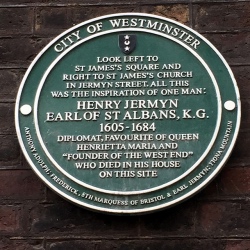
In the early 1660s he was rewarded with land grants including land located to the north of St James’s Palace in London. He encouraged the development of the area, centred on St James’s Square and surrounding streets including Jermyn Street – such was his impact on the area that he became known as the “Father of the West End”.

He returned to France with Queen Henrietta Maria in 1665 and was present when the Queen died on 31st August, 1669, at Colombe in France. He subsequently returned to England and served as Lord Chamberlain to King Charles II between 1672-74 as well as, in 1672, being invested as a Knight of the Garter.

Jermyn, who never married, was generally said to have been a prolific gambler (and, some said, a glutton) and while he attempted to retire more than once to Rushbrook, the lure of London’s gaming tables proved too strong.

He died in his house in St James’s Square on 2nd January, 1684, and was buried at Rushbrook. While his earldom became extinct, his barony passed to his nephew Thomas Jermyn.

PICTURE: A City of Westminster Green Plaque located at the site of Henry Jermyn’s former home in St James’s Square.  (Simon Harriyott/licenced under CC BY 2.0

Lost London – The Chelsea Bun House…

Still a favourite at tea rooms across the world, the Chelsea bun – a squarish, sticky spiced fruit bun – owes its origins to Richard Hand’s establishment in what was Jew’s Road and is now Pimlico Road in what is now Pimlico, on the border with Chelsea.

The single storey premises opened early in the 18th century and in the interior Mr Hand, apparently known as “Captain Bun”, kept a curious collection of clocks, models, paintings, statues and other curiosities.

The bun house, known variously as the Old Chelsea Bun House and the Original Chelsea Bun House, was a huge hit, attracting a clientele which included royalty – King George II and Queen Caroline visited with their daughters as did King George III and Queen Charlotte – and also, famously, the political figure and Jonathan Swift, who bought a stale one for a penny in 1711 and recorded that he didn’t like it.

The tradition of eating a hot cross bun on Good Friday lead to huge crowds at the bun house on that day in particular – said to number more than 50,000 some years – and such were that crowds that in 1793, Mrs Hand, following complaints from her neighbours, declared in a public notice that she would only be selling Chelsea buns, and not cross buns, on Good Friday that year.

The house did, however, return to selling hot cross buns on Good Friday – it is said to have sold an enormous 24,000 on Good Friday in 1839 (some sources have out the figure as high as 240,000 but that may have been a misprint).

Despite the success of Good Fridays, according to The London Encyclopaedia, the closure of the nearby Ranelagh Pleasure Gardens in 1804 had impacted the business.

In 1839, following the death of the Hands’ two sons and with no further family member to take over the business, it was closed and the bakery reverted to the Crown. The building was subsequently demolished.

PICTURE: Chelsea buns today. Duncan Hull under licence CC BY 2.0.

Treasures of London – Queen Elizabeth’s Oak, Greenwich Park…

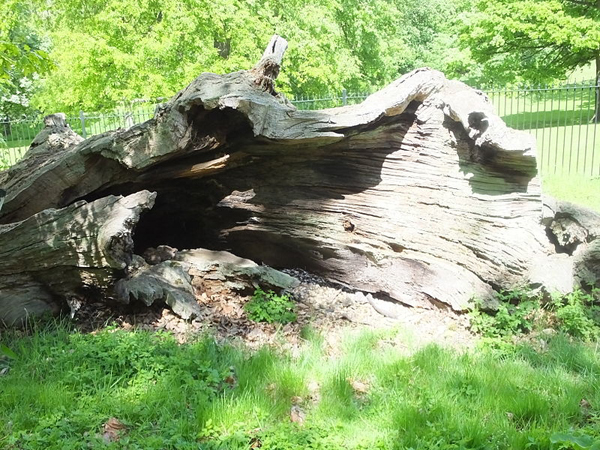
Only the remains of this once mighty tree can now be seen in Greenwich Park. Thought to have been planted in the 12th century, the tree died in the late 1800s but, thanks to the support of the ivy that clung to it, remained standing until it finally collapsed in June, 1991. 

The tree, located to the east of the Royal Observatory, has several links to the Tudors – tradition says King Henry VIII danced around it with Anne Boleyn while their daughter, Queen Elizabeth I, is said to have picnicked beneath its leafy canopy. The proximity of Greenwich Palace may explain the connection.

There was apparently in Victorian times, a large seat placed around the tree and there has been a suggestion that the hollow truck was big enough to make a small prison where people who misbehaved in the park were locked up.

Planted alongside is another English Oak – it was officially dug into the soil on 3rd December, 1992, by Prince Philip, the Duke of Edinburgh, to mark 40 years of the reign of Queen Elizabeth II.

WHERE: Queen Elizabeth’s Oak, Greenwich Park (nearest DLR is Cutty Sark Station and Greenwich Station); WHEN: 6am to 7pm (6pm from end of British Summer Time) daily; COST: free; WEBSITE: www.royalparks.org.uk/parks/greenwich-park

PICTURE: Clem Rutter, Rochester, Kent/www.clemrutter.net/CC BY-SA 3.0


LondonLife – Looking toward The Orangery, Kensington Palace…

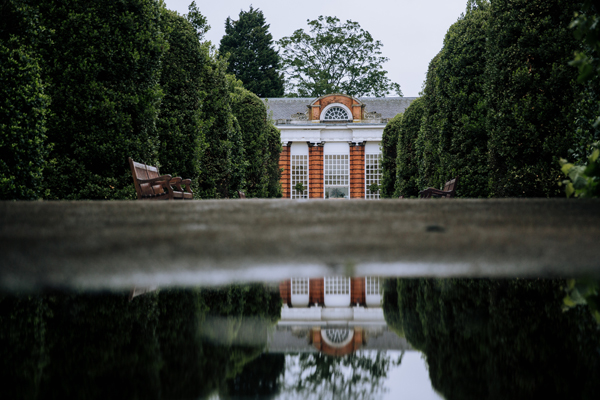
Now an elegant place to have lunch or afternoon tea, The Orangery was originally built in 1704-05. Its construction came at the behest of Queen Anne – the younger sister of Queen Mary II, she had ascended to the throne after the death of Mary’s husband King William III in 1702 following a fall from a horse (Mary had died of smallpox at Kensington Palace in 1694). Queen Anne used the building for parties in summer and in winter, thanks to underfloor heating, as a conservatory for plants (two engines were later fitted to the building to lift the orange trees kept there in colder months). The building’s architect is thought to have been the renowned Nicholas Hawksmoor, clerk of works for Kensington Palace, but it was extensively modified by Sir John Vanbrugh. The building also contains carvings by Grinling Gibbons. For more, see www.orangerykensingtonpalace.co.ukPICTURE: Vapor Kopeny/Unsplash

10 sites of significance in Jane Austen’s London…6. Carlton House…

It’s perhaps the most famous of the visits that Jane Austen made during her London stays and while the property no longer exists, we thought it was worth mentioning. 

But first, let’s explain. The Prince Regent (later King George IV) was an admirer of Jane’s novels, so much so that when he was aware of the author’s presence in London, he issued – via his librarian and chaplain Rev James Stanier Clarke – an invitation for her to visit the library and tour his palatial London property, Carlton House.

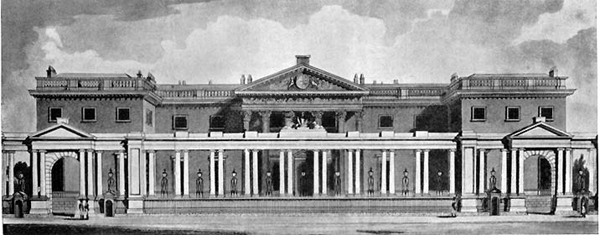
The grand, lavishly decorated property, created from an existing property between 1783 and 1812 by the architect Henry Holland, was among the grandest in London at the time. Facing on to the south side of Pall Mall, the building sat across what is now Waterloo Place while its gardens abutted St James’s Park.

Jane visited on 13th November, 1815, and in the company of Rev Clarke toured the library. During her visit, it was suggested she could dedicate her next novel to the Prince Regent, an idea which didn’t sit that well with Jane who was a supporter of his estranged wife, Princess Caroline.

After her initial equivocation, her publisher John Murray apparently managed to prevail upon Jane to do so and she eventually capitulated, dedicating her novel Emma to him (a special copy of the novel was sent to the Prince at Carlton House).

Carlton House, meanwhile, didn’t last for much longer. King George IV, on his accession to the throne, decided to create a property more fitting for a king and ordered works to be carried out on Buckingham House so it could be his main London residence (as Buckingham Palace).

Carlton House, despite the exorbitant sums the Prince had spent transforming it, was demolished in 1825 and the John Nash-designed Carlton House Terrace built upon the site. Columns from the Carlton House were reused in creating the portico of the National Gallery on Trafalgar Square.

PICTURE: Carlton House (via Wikipedia).

LondonLife – Remains of Greenwich Palace unearthed…


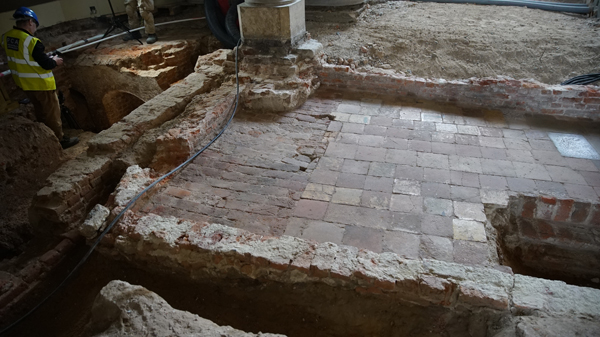
The remains of two rooms, which once formed part of the splendid Greenwich Palace – birthplace of King Henry VIII and his daughters Queen Mary I and Queen Elizabeth I, were discovered during works being undertaken ahead of the construction of a new visitor centre under the Old Royal Naval College’s famed Painted Hall, it was revealed last week.

The rooms, set well back from the river Thames, are believed to have formed part of the service range, believed to be the location of kitchens, a bakehouse, brewhouse and laundry.

As well as the discovery of a lead-glazed tiled floor, one of the rooms, which was clearly subterranean, featured a series of unusual niches where archaeologists believe may have been ‘bee boles’ – where ‘skeps’  (hive baskets) were stored during winter when the bee colonies were hibernating and where, when the bees were outside during summer, food and drink may have been stored to keep cool.

Discussions are reportedly now underway over the possibility of displaying the Tudor finds in situ. Duncan Wilson, chief executive of Historic England, hailed the find as “remarkable”.

“To find a trace of Greenwich Palace, arguably the most important of all the Tudor palaces, is hugely exciting,” he said. “The unusual and enigmatic nature of the structure has given us something to scratch our heads over and research, but it does seem to shine a light on a very poorly known function of the gardens and the royal bees. The most exciting aspect is that the Old Royal Naval College is able and willing to incorporate this into the new visitor centre, so everyone can see a small part of the palace, for the first time in hundreds of years.”

Greenwich Palace was built by King Henry V’s brother, Humphrey, Duke of Gloucester, in 1426 and rebuilt by King Henry VII between about 1500 and 1506.

Substantially demolished at the end of the 17th century (and with plans to build a new Stuart palace on the site never realised), it was replaced with the Greenwich Hospital which became the Royal Naval College designed by Sir Christopher Wren and Nicholas Hawksmoor between 1692 and 1728.

The Painted Hall, located in the Old Royal Naval College, is currently undergoing an 18 month transformation which includes the creation of a new visitor centre, Sackler Gallery and café. Visitors to the hall currently have the unique opportunity to get up close to the famous ceiling of the hall, described as the “Sistine Chapel of the UK”, on special tours. Visit www.ornc.org/painted-hall-ceiling-tours-tickets for more.

PICTURES: © Old Royal Naval College

10 sites of significance in Jane Austen’s London…2. 23 Hans Place (and 64 Sloane Street), Belgravia…

Another of the places Jane Austen stayed when visiting London, the terraced house at 23 Hans Place was the address her brother Henry moved to from his flat in Covent Garden (see last week’s entry)

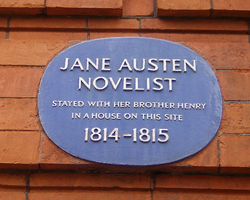
Jane stayed at the premises for almost two years over 1814 and 1815 (it was her last known visit to London). Austen, who stayed in a bedchamber at the front of the house on the top floor (a plaque commemorating Jane’s occupancy is located on the building), described the home as “delightful” and expressed her love of the garden.

The house has been considerably altered since although the original property still is said to lie underneath the brick skin now upon it.

It was while Jane was staying there that she was invited by the Prince Regent (later King George IV) – a fan of her writing – to Carlton House on 13th November, 1815, where she was permitted to dedicate one of her future works to him (Emma was duly dedicated the following year).

Henry, meanwhile, lived here until 1816 – the complete collapse of the bank in which he was partner had come in March of that year after which Henry was declared bankrupt. Following the financial disaster, he took up a post as curate at Chawton in Hampshire where the family were based.

While we’re in the area, we should also mention another property around the corner – 64 Sloane Street. It was here that Henry lived before moving to Covent Garden and here that, in April and May 1813, Jane stayed with Henry as his wife Eliza was dying (she passed away on 25th April).

Henry and Eliza had moved into the the Sloane Street property in 1809 (from Brompton) and Jane had visited several times (among the books she worked on while there was Sense and Sensibility).

Both properties were part of the Hans Town development which dated from the late 1770s.

PICTURE: Gwynhafyr/CC BY-NC 2.0


A Moment in London’s History – The premiere of Handel’s ‘Water Music’…

This month marks 300 years since composer George Frideric Handel premiered his composition (and one of the most famous pieces of classical music in the world) Water Music – and it was in a rather fitting setting.

The first performance of the composition – which was deliberately created for
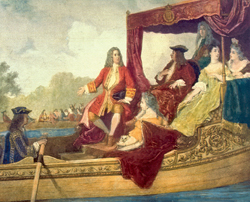
playing outdoors (and carrying across water) – took place at about 8pm on 17th July, 1717, aboard a City of London barge in the River Thames.

Some 50 musicians played the piece – using everything from flutes and recorders to trumpets, horns, violins and basses – with Handel himself fulfilling the role of conductor.

The barge was part of a rather grand flotilla which made its way up the river from the Palace of Whitehall to Chelsea, at the centre of which was a royal barge upon which King George I and members of the nobility, including various duchesses, rode.

Numerous other Londoners also turned out to hear the performance aboard all manner of watercraft and the king was apparently so impressed with what he heard that he requested several encores both on the trip to Chelsea and on the return journey.

The story goes that the somewhat unpopular king had apparently requested the concert on the river to upstage his son, the Prince of Wales (and future King George II), who was stealing the limelight by throwing lavish parties (the king and his son were famously at odds and it was therefore no shock when the prince didn’t attend the performance).

There’s another story, meanwhile, that suggested Handel composed the piece to regain the favour of the King which he had apparently lost when, seeking to capitalise on his growing fame, he left his employment as conductor at the court of the then Elector of Hanover (a position George held before he was king) and moved from Germany to London during the reign of Queen Anne (although some claim the future king knew he would one day follow Handel to London and actually approved of his decision to move there).

Water Music, meanwhile, has since become part of popular culture – it’s generally said that most people will recognise at least one part of it – but interestingly, no-one is said to be exactly sure how the music, which is generally broken into three separate suites, should be performed, given that the original score has been lost.

PICTURE: Edouard Hamman’s painting showing Handel (on the left) with King George I aboard a barge on 17th July, 1717. Via Wikipedia