PICTURE: Kamran Chaudhry/Unsplash

PICTURE: Kamran Chaudhry/Unsplash
Marking this year’s Windrush Day, the Museum of London has made two new acquisitions – an ensemble from London fashion designer Tihara Smith’s ‘Windrush collection’ and a suit owned by her grandfather – available to explore on the Museum of London website. Tihara’s outfit, which was designed as part of Smith’s UCA Epsom graduate collection in 2018 and selected for display at Graduate Fashion Week, references the story of her grandfather, Lazare Sylvestre, who arrived in the UK from St Lucia in 1958 as part of the Windrush generation. Details including a raffia vest hand embroidered with the words ‘Black and British’ which is accompanied by a Black Power fist and the red lion symbol of England as well as a shirt made from a tablecloth purchased in Peckham Market and flared 1970s style denim culottes – all of which are representative of her grandfather’s experience and that of so many other Black British Londoners at that time. Her grandfather’s suit, meanwhile, was designed and made for him by a close friend, Winceslas ‘Winston’ Giscombe, a tailor who originally from Kingston, Jamaica, who came to the UK in 1947 on a ship called the Ormonde, a year before the Windrush arrived in 1948. Photographs of the items, along with oral histories recorded by Tihara, her mother and her grandfather, can be explored on the Museum of London website. For more on Windrush, see the Windrush Stories page on the Museum of London Docklands website.

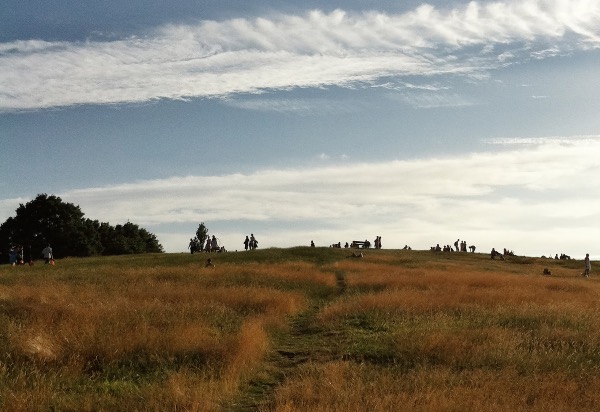
This month marks 150 years since the passing of the Hampstead Heath Act, which confirmed the heath as a public open space, and, to celebrate, the City of London Corporation, the Heath & Hampstead Society and other partners have launched a year of commemorations. Upcoming planned highlights include an outdoor exhibition showcasing the heath’s history and the significance of the 1871 Act which will be launched on the heath (on the main path leading onto the heath from the Hampstead Heath Overground Station) on 23rd June, a community fun day (27th June), an outdoor cinema screening (8th September), a summer music event (tentatively scheduled for 5th September) and historic walks as well as an Historic Postcard Project featuring an interactive online map with historic images of the heath. For more, see www.cityoflondon.gov.uk/things-to-do/green-spaces/hampstead-heath.

The courtyard at Somerset House has been transformed into a forest as part of the London Design Biennale. Forest for Change – The Global Goals Pavilion features some 400 trees with clearing in the middle containing an installation aimed at raising awareness of the United Nations’ Global Goals for Sustainable Development. The biennale also features a series of more than 30 pavilions from across all six continents – created in response to the theme ‘resonance’ – which have been placed in rooms and outdoor areas throughout the property. Among the countries represented with pavilions are Antarctica, Argentina, Austria, Canada, Chile, the Czech Republic, Finland, Germany, Ghana, Greece, Guatemala, Hong Kong, India, Indonesia, Ireland, Israel, Japan, Latvia, Poland, Taiwan, and Venezuela. Others, including Italy, Nile Region, Norway, New York City and Pakistan, are taking part digitally. There’s also an exhibition – Design in an Age of Crisis – showcasing radical design thinking from the world’s design community, the public, and young people, as well as a series of installations by a selected group of universities and galleries in which they demonstrate their contribution to global issues through design under the banner of ‘Sustainability and Innovation’. The biennale runs all month. Admission charge applies. For more and to book tickets, head to www.somersethouse.org.uk/whats-on/london-design-biennale-2021.

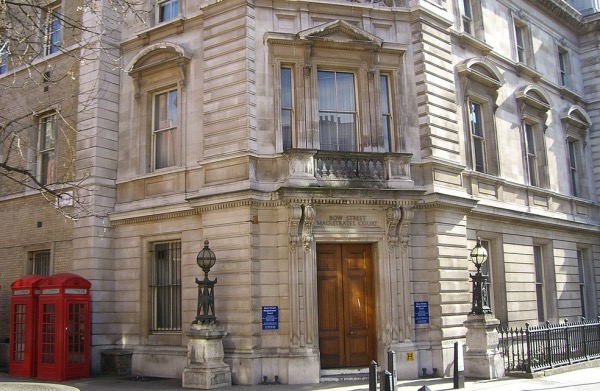
The Bow Street Police Museum, located on the site of the 1881 Bow Street Magistrates’ Court and Police Station, has opened its doors in Covent Garden. The museum tells the story of the early Bow Street Runners, the first official law enforcement service in the city, and the Metropolitan Police officers who came after. Visitors can explore the former cells and hear the stories of those who once worked in the building. The connections between Bow Street and the constabulary dates back to 1740 when Thomas de Veil opened a Magistrates’ Court in his family home at number four Bow Street in the 18th century and continued until the closure of the Bow Street Magistrates’ Court in 2006. Among the famous faces who passed through Bow Street’s police station and court over that time were Oscar Wilde, Suffragettes Sylvia Pankhurst, Christabel Pankhurst and Mrs Drummond, and the Kray twins. For more, head to https://bowstreetpolicemuseum.org.uk.

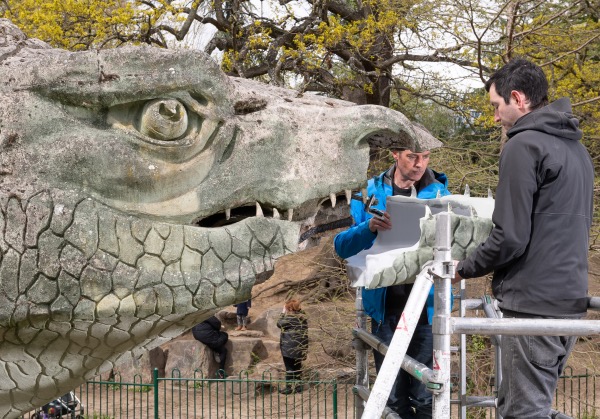
The Megalosaurus dinosaur at Crystal Palace Park recently underwent an emergency face-lift to ensure it’s still looking its best for visitors following the lifting of lockdowns. The 167-year-old, Grade I-listed statue is said to be a favourite among the 30 sculptures in the collection at the park. Skilled craftsmen had to make and fit 22 new teeth on the 3.5 metre high and 10 metre long sculpture as well as a new nose and light-weight ‘prosthetic’ jaw. The work – which was supported by a grant from the Culture Recovery Fund (awarded by Historic England), the Friends of Crystal Palace Dinosaurs and Bromley Council – was carried out by conservation company Taylor Pearce. It was needed after the jaw on the beast collapsed last May and comes after all 30 of the life-sized sculptures were added to Historic England’s Heritage at Risk Register early last year. First unveiled in 1854 (just 10 years after the term ‘dinosaur’ had been coined), the sculptures were made by renowned artist Benjamin Waterhouse Hawkins. For more on the dinosaurs and the 80 hectare park in which they stand, see www.bromley.gov.uk/crystalpalacepark.

Swans on Barnes Pond, West London. PICTURE: John Cameron/Unsplash

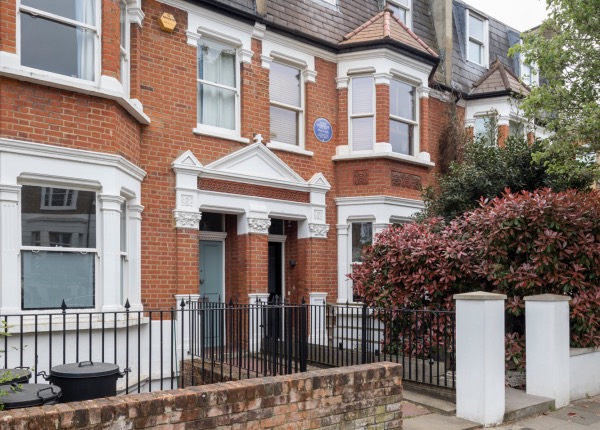
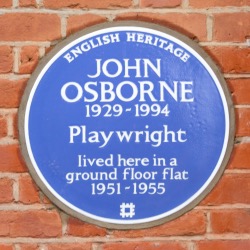
Post-war playwright John Osborne (1929-1994) was honoured with an English Heritage Blue Plaque last week at his former Hammersmith home. The announcement came 65 years after his seminal play, Look Back in Anger, was first performed at the Royal Court Theatre on 8th May, 1956. The terraced red brick property at 53 Caithness Road was his London base when he wrote Look Back in Anger, arguably his best known work. Playwright and director Sir David Hare said Osborne “had the most sensational London debut of any playwright in the English language in the 20th century”. “It was John’s brilliance and originality which led so many to help relocate the theatre at the centre of Britain’s cultural and intellectual life. Everyone who followed owes him a debt.” For more on Blue Plaques, see www.english-heritage.org.uk/visit/blue-plaques.
Spotted in Sloane Square Tube station. PICTURE: John Cameron/Unsplash
PICTURE: Kevin Grieve/Unsplash

PICTURE: Bex Walton/licensed under CC BY 2.0)

Piccadilly Circus. PICTURE: duncan c (licensed under CC BY-NC 2.0)
PICTURE: Samuel Regan-Asante/Unsplash

A memorial wall for the victims of the COVID-19 pandemic has been established on The Queen’s Walk outside St Thomas’ Hospital. Bereaved family and friends on Monday began to paint the first of tens of thousands of love hearts – representing those who have died of COVID-19 – on the wall which faces the Houses of Parliament across the Thames. The memorial, which is expected to stretch for hundreds of metres, is the work of the COVID-19 Bereaved Families for Justice group which has called for a public inquiry into how the government has handled the pandemic. Co-founder Matt Fowler, whose 56-year-old father, Ian, died last April, was the first to paint a heart on the wall on Monday. “This is an outpouring of love,” he reportedly said. “Each heart is individually hand-painted; utterly unique, just like the loved ones we’ve lost. And, like the scale of our collective loss, this memorial is going to be enormous.”


Adams Plaza Bridge, Canary Wharf, Docklands. The colourful crossing, which links Crossrail Place and One Canada Square, was created by artist Camille Walala as part of last year’s London Mural Festival. PICTURE: Samuel Regan-Assante/Unsplash
The world observed International Women’s Day on Monday and to mark the occasion, the Museum of London has launched an original video series featuring five female comedians performing short original pieces inspired by objects in the museum’s women’s history archives. The first of the videos features comedian Thanyia Moore responding to a Henry Grant photograph of a female bus conductor from the mid-1970s when London Underground first officially employed women as bus drivers (pictured right). Further videos – which will be rolled out over Women’s History Month – feature comedians Samantha Baines, Jenny Bede, Jen Ives and Leila Navabi responding to objects ranging from a commemorative toilet roll created by First 100 Years to mark a century since the Sex Disqualification (Removal) Act made it illegal to ban people from jobs based on their sex in 1919 (pictured below) to a recruitment letter from Sainsbury’s seeking female staff to work in their shops during World War I. To watch the first of the series head here.

PICTURE: Samuel Regan-Asante/Unsplash.
Crossing the Thames on a cold winter’s day. PICTURE: Lubo Minar/Unsplash

Cabot Square, Docklands. PICTURE: Tom Podmore/Unsplash