Where’s London’s oldest…lived in house?

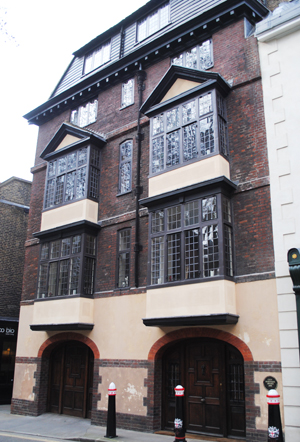
Like many in our series on London’s oldest, this one is a little subjective. But based on our survey of the data out there, we’re opting for 41-42 Cloth Fair, right beside St Bartholowmew the Great, in the City.

The only house to have survived the Great Fire of London in 1666, this five bedroom property – which we can confirm is still up for sale with a guide price of more than £5.9 million following a major restoration – was apparently completed around 1614.

It was originally constructed as part of a development initiated by Robert, Baron Rich, which featured 11 houses around a courtyard and was known as Launders Green (being located on what was the former laundry ground of the monastery at St Barts).

The red brick house, which was awarded a City Heritage award in 2000 for the sensitive restoration work, retains many of its original features.

Interestingly, windows on the second floor contain autographs of some of the famous people who have been to the property over the years including Queen Elizabeth, the Queen Mother, former PM Winston Churchill and Poet Laureate John Betjeman.

Where’s London’s oldest…underground line?

The city’s first underground line – and the first underground line in the world – was the Metropolitan Line, which opened in 1863 with the aim of helping to reduce London’s growing traffic congestion problem.

Running for three miles, the new railway, constructed by the Metropolitan Railway Company, ran for three miles under New Road, from Paddington to Farrington Street and took three years to build.

It was constructed using a technique known as “cut and cover” which involved digging a trench and building a tunnel inside before covering it back up.

Almost 40,000 passengers journeyed between Paddington and Farringdon on the day it opened, with the journey taking about 18 minutes.

The success of the new railway sparked a flurry of interest and in 1868, the first section of the District Line was opened, the same year the St John’s Wood Railway Company opened a line from Baker Street to Swiss Cottage.

Having grown substantially since it’s earliest days, today only six miles (9.7 kilometres) of the Metropolitan Line’s 41.5 miles (66.7) kilometres actually run underground.

The line now carries about 53 million passengers annually and 49 trains operate on it during peak periods.

Around London – City’s history goes online; London’s oldest structure discovered?; and, my, how prices have changed…

• Four hundred years of London’s history is being put online as part of a new project on the City of Westminster’s website. The council is publishing a new picture depicting a different historical event from the city’s tumultuous history every day throughout 2011 under its A date with history project. The images, taken from the council’s archives, include photographs, engravings and sketchings. They include a black and white photo of queues of people waiting on Vauxhall Bridge to pay their final respects to King George V lying in state at Westminster Hall after his death on 20th January, 1936, another photograph showing the King and Queen with PM Winston Churchill inspecting damage to Buckingham Palace’s swimming pool following a raid during the Blitz in September, 1940, a hand-colored print depicting the execution of King Charles I on 30th January, 1649, and an engraving showing a comet passing by the spire of St Martin in the Field in 1744. It is the first time the images have been made freely available online. To see the images, head to www.westminster.gov.uk/archives/day-by-day.

What could be London’s oldest structure has been unearthed on the Thames foreshore. Six timber piles up to 0.3 metres in diameter have been discovered only metres from the MI6 headquarters in Vauxhall, part of what archaeologists believe is part of a prehistoric structure which stood on the river bank more than 6,000 years ago during the Mesolithic period when the river was lower. The find, made by a Thames Discovery Programme team, is only 600 metres away from a Bronze Age timber bridge or jetty dating from 1,500 BC which was discovered in 1993. The piles may be able to be seen from Vauxhall bridge during low tides between 10.25am on 22nd January and 11.15am on 23rd January.

Homes in London were purchased for an average price of £14,000 back in 1910, according to land tax valuations documents released online this week. Ancestry.co.uk has placed the London, England Land Tax Valuations 1910 – compiled as part of David Lloyd George’s 1910 Finance Act, known as the Domesday Survey – online to help people discover more about the financial situations of their ancestors. The documents put the value of the Bank of England at £110,000, the Old Bailey at £6,600, and Mansion House at a more impressive £992,000. The average value of property on Fleet Street was £25,000 (compared with £1.2 million today) while in Cannon Street, the average value was £20,000 (£2.2 million) and in Chancery Lane, the average value was just £11,000 (£1.1 million).

Where’s London’s oldest…church?

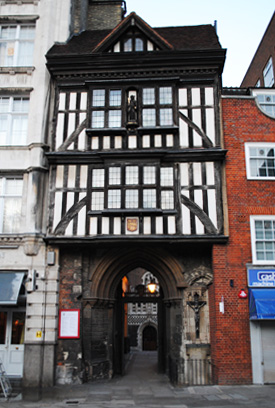
Like many of London’s oldest questions, this depends on what you mean – the oldest site of worship, the oldest continuous site of worship, or the oldest building are but a few possibilities. For our purposes, it’s generally accepted that London’s oldest surviving parish church is St Bartholomew the Great in West Smithfield.

This atmospheric church is now only half the size of what it once was but that part which remains – the original quire, altar, side aisles and lady chapel – was founded in 1123 AD as the priory church for a community of Augustinian Canons.

The church owes its origins to Rahere, a favored courtier of King Henry I, who after the death of King Henry’s wife Queen Matilda and then heir, Prince William, along with some other family members, renounced his way of life and decided to make a pilgrimage to Rome.

In Rome, he sickened, and fearful for his life, vowed to found a hospital for the poor on his return to London. Subsequently recovering, he was about to head home when a vision of St Bartholomew appeared to him and told him that he had helped him to recover and now desired him to found a church in Smithfield.

On his return to London, Rahere did just that – founding the priory with its church and a hospital for the poor. He died 1145. Amazingly, his tomb still lies within the church, on the left hand side of the altar.

The priory grew in importance with income coming not only from offerings and rents but from tolls at St Bartholomew’s Fair which was held on grounds to the north of the the church (as an interesting aside, it’s also known that the church had a low wall built in front of its western facade to separate it from Smithfield. Known as the Cheyne, this could be closed with a chain on market days to stop cattle wandering inside).

The church’s current configuration came about in the Great Dissolution – the priory was dissolved in 1539 and the nave of the church was pulled down, leaving the quire, altar and lady chapel. The church was briefly used by some Dominican friars but since the reign of Queen Elizabeth I has fulfilled the role of parish church. A concerted restoration effort began in the mid-19th century.

Livery companies associated with the church include The Butchers’ Company which still hold a special service here in September prior to electing a new Master. These days, St Bartholomew the Great is a welcome refuge from the hustle and bustle of the City and still gives a strong sense of the life it has known.

WHERE: Off Little Britain, West Smithfield (nearest tube station is Barbican); WHEN: 8.30am to 5pm Monday to Friday (until 14th February), 10.30am to 4pm Saturday, 8.30am to 8pm Sunday (except for services) ; COST: £4 an adult/£3.50 concession/£10 a family; WEBSITE: www.greatstbarts.com

PICTURE: Gatehouse leading into St Bartholomew the Great

Where’s London’s oldest…surviving building?

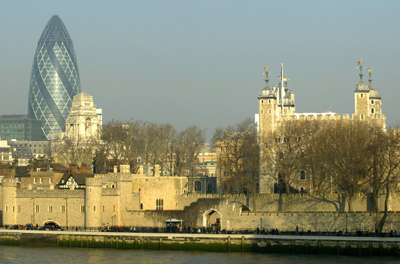
The oldest intact building in London is generally believed to be the White Tower, which stands in the heart of the Tower of London.

Construction on the White Tower (which stands to the right in the picture) was started on the orders of William the Conqueror some time prior to 1070 and was completed by 1100. The newly appointed Bishop of Rochester, Gundulf, was placed in charge of the project which used stone imported from Normandy (much of this was replaced in later centuries).

Built as a towering stronghold and fortress for the English kings, the walls of the tower at 15 feet (4.5 metres) thick and 90 feet (27 metres) high. It was later enclosed by a curtain wall and moat, taking the shape of the Tower of London as we now know it by about 1350.

The White Tower, also known as the Great Tower, has been the scene of many dramatic events in British history – from the deposition of Richard II in 1399 to the disappearance (and possible murder) or the Princes in the Tower – Edward V and his brother Richard, Duke of York, around 1483 (two skeletons, which some believed to be theirs, were unearthed here in 1674).

The White Tower, which is now part of a World Heritage Site, contains the splendid 11th century Chapel of St John the Evangelist. While three of the turrets at the corners of the tower are square, the fourth – the north-east turret, is round and once contained the first royal observatory.

The onion-shaped domes and weathervanes on the turrets were added in the 1520s.

These days the tower contains an exhibition of royal armour – including that worn by King Henry VIII – as well as exhibits on the tower’s history.

WHERE: Tower of London (nearest tube station is Tower Hill); WHEN: Tuesday to Saturday 9am to 4.30pm; Sunday to Monday 10pm to 4.30pm (closing times are 5.30pm between March and October); COST £18.70 an adult/£15.95 concessions/£10.45 a child (children under five free)/£51.70 for a family of two adults and up to six children; WEBSITE: www.hrp.org.uk/TowerOfLondon/

PICTURE: Stephen Pond/Historic Royal Palaces

Where’s London’s oldest…restaurant?

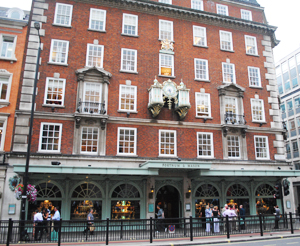
For a city packed with restaurants of all shapes and sizes catering to all sorts of tastes, this title remains apparently undisputed with Rules in Covent Garden generally agreed to be London’s oldest restaurant.

Founded in 1798 by Thomas Rule, the restaurant has only been owned by three families – the Rules, the Bell family and that of the current owner, John Mayhew, who purchased the restaurant in 1984.

Those who have dined there include literary luminaries such as HG Wells, William Makepeace Thackeray, Charles Dickens, Graham Greene (it features in his novel, The End of the Affair – only one of a number of books in which the restaurant makes an appearance), John Le Carre, and poet John Betjeman, actors including Clark Gable, Harrison Ford, Paul Newman and Joan Collins, politicians including Michael Heseltine, John Prescott and William Hague, and even royalty – Edward VII, when Prince of Wales, was known to meet his mistress Lillie Langtry here.

Originally opened as an ‘oyster bar’, the restaurant at 35 Maiden Lane is these days known for its game dishes.

For more information, see www.rules.co.uk.

Where’s London’s oldest…red telephone box?

An iconic symbol of Britishness, these days the red telephone boxes found throughout the city may well have more use as a prop in tourist’s photos than for actually making phone calls. But where’s the oldest?

Nestled under the gateway into the Royal Academy of the Arts in Piccadilly sits a rather non-descript looking red telephone box.

Created in 1924, it is actually a prototype of the red phone boxes that later became ubiquitous across the country.

The phone box prototype was designed by Sir Giles Gilbert Scott, one of three architects who were asked to create designs for the boxes after the Post Office’s initial designs were apparently rejected.

Scott’s successful design is the only one of the three to survive and while it’s made of wood, the later boxes were made of cast iron and painted red for visibility.

Where’s London’s oldest…pub?

There’s a number of contenders for this controversial title and a number of different ways of looking at the question. So, rather than take sides, we’ll just canvas a few of them.

Our initial contenders are:

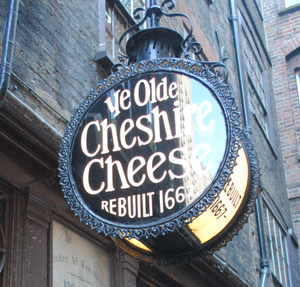
• Ye Olde Cheshire Cheese (145 Fleet Street, the City). Built in 1667 after the Great Fire of London, the current building replaced one previously on the site. The cellar is apparently 13th century and forms part of the remains of an old monastery on the site. Dr Samuel Johnson, who lived just around the corner while creating his famous dictionary, was a regular here and the pub is also said to have been frequented by writers Mark Twain, Alfred, Lord Tennyson, and Sir Arthur Conan Doyle, creator of Sherlock Holmes.

The Spaniards Inn (Spaniard’s Road, Hampstead). Located on the edge of Hampstead Heath, the Spaniard’s Inn dates from around 1585. The story goes that it was named after the Spanish ambassador to the court of James I who lived here for a time (another version says it was two Spanish brothers who first converted the building into a pub in the 1700s). Other historical figures associated with the inn include the highwayman Dick Turpin (some say he was born here while others say he used to wait here while watching for vulnerable coaches to pass by), the poets Byron and Keats and the painter Sir Joshua Reynolds – who apparently visited, and Charles Dickens who mentioned the inn in the Pickwick Papers (it also gets a mention in Bram Stoker’s Dracula).

• The Lamb and Flag (33 Rose Street, Covent Garden). The building has been occupied since Tudor times but it’s only been a licensed premises since 1623. The pub, certainly the oldest still standing in Covent Garden, was previously associated with prize fighting and was apparently once called the Bucket of Blood. The poet John Dryden is said to have been involved in a fight here.

The George Inn (77 Borough High Street, Borough). Located on the south side of London Bridge, the George Inn is a rare surviving galleried coaching inn. Now owned and leased by the National Trust, the current building dates from 1676 after the previous inn was destroyed by fire. The inn is mentioned in Dickens’ Little Dorrit and the author himself was apparently a regular visitor.

UPDATE: It seems we left one of the list which is certainly worth mentioning –  The Prospect of Whitby in Wapping (57 Wapping Wall). There’s been a tavern on this site on the bank of the Thames since 1520 and during its early days it became known the ‘Devil’s Tavern’ due to its rather dodgy clientele, alleged to have included smugglers, prostitutes and thieves as well as more famous people such as diarist Samuel Pepys, the notorious Judge Jeffreys, known as the ‘Hanging Judge’, and much later, Charles Dickens. Later destroyed by fire, it was rebuilt and given the new name, The Prospect of Whitby, after a ship that moored nearby. The building now incorporates a ship’s mast.

Where’s London’s oldest…cinema?

The oldest purpose built and continuously operated cinema in London is believed to be the Phoenix in East Finchley, north London. Built in 1910, it opened in 1912 and has known several incarnations including as the East Finchley Picturedrome, the Coliseum, the Rex and the Phoenix. It was one of the first theatres in the UK to introduce pictures with sound (it did so in 1929). The theatre, which has appeared in several movies including The End Of The Affair, recently reopened following a £1.1 million restoration. There’s a touring exhibition of the cinema’s history (follow this link to find out where you can see it). Other contenders for the oldest cinema in London include the Electric Cinema in Portobello Road, Notting Hill, which opened in 1911.