This Week in London – Beryl Gilroy at the British Library; Milligan statue acquired; and, ‘Play in the Pandemic’…

Beryl Gilroy © The Estate of Beryl Gilroy

The archive of writer, teacher and ethno-psychotherapist Beryl Gilroy has been acquired by the British Library. Highlights from the archive, which includes working drafts for published and unpublished novels, letters with publishers and literary agents and ‘born-digital’ material, is at the centre of the free Celebrating Beryl Gilroy display which opened in the Treasures Gallery earlier this month. Gilroy, who was born in Guyana (then British Guiana) and who immigrated to Britain in 1952, became the first black head teacher in London in 1969 and wrote a number of acclaimed children’s books to better reflect the lives of her pupils. Her works – which explore the lives of families, particularly of women and children, the impact of 20th century migration and societal change that came as a result – also included number of novels, a collection of poems, non-fiction writing and a 1976 memoir, Black Teacher. The free display can be seen until 26th June. For more, see www.bl.uk.

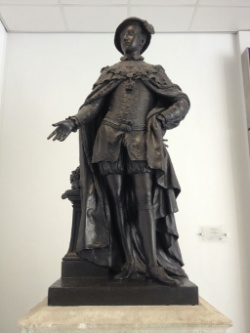
A controversial bronze statue of merchant and slave trader Robert Milligan which formerly stood on West India Quay outside the Museum of London Docklands is joining the museum’s collection. The statue was removed in June, 2020, following a petition signed by over 4,000 people called for it to be removed from public view. Its acquisition by the museum follows a public consultation conducted in partnership with the Tower Hamlets Council and landowners Canal & River Trust, which concluded that the statue should be housed in a museum where it can be fully contextualised. “Over the last 15 years, the museum has been working with academics, community leaders and activists to tell the story of London’s involvement in the transatlantic slave trade, and give voice to its legacy,” said a museum spokesman. “The West India Docks, championed by Milligan using wealth from the slave trade, are a visible reminder of how this history has shaped our city. It is right and important that we acknowledge this in the statue’s story. We will now take time to consult with the local community to decide how best to take this forward as part of our collection.” The statue will be held in storage whilst the museum consults further with local communities about how best to present it.

TY® Toy Collection with IV drips, masks and in hospital This eight-year-old child’s toy collection reflected many real-life pandemic experiences, such as wearing masks, getting vaccinated and hospital treatments.Submitted by Fei Victor Lim 2020-21, Singapore © The Play Observatory. PICTURE: Play In The Pandemic, curated by Young V&A, from 23 March 2022, playinthepandemic.play-observatory.com

• The impact of the global coronavirus pandemic on children’s play is the subject of an online exhibition launched by Young V&A and its partners UCL and the University of Sheffield this week. Play In The Pandemic features some of the 100 submissions sent in from around the globe in answer to a call-out from The Play Observatory research project for people to submit their experiences of play – everything from music videos to children’s artworks and films made by parents showing their children splashing in puddles – alongside objects from the Young V&A’s collection. The exhibition, which takes the form of an unfolding origami house, also features a series of activities – ranging from how to make your own origami house to creating dens and window boxes for people to get involved. Head to the Play Observatory website.

Send all items to exploringlondon@gmail.com.

Famous Londoners – Hannah Dadds…

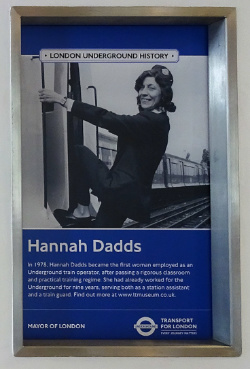
Hannah Dadds, seen in a London Underground poster in 2016. PICTURE: Kake (licensed under CC-BY-NC_SA 2.0)

As the first female driver on London’s Tube, Hannah Dadds broke new ground for working women.

Born on 16th October, 1941, Dadds grew up in the Forest Gate area of Newham. She left school when just 15 and worked in various jobs – including as a shop assistant and at the Bryant and May match factory – before in 1969 joining the London Underground to work as a “railwoman” at the Upton Park Underground Station, earning just over £13 a week.

Dadds went on to become a ticket collector at Tower Hill station and in 1976 became a train guard.

Following the passing of the 1975 the Sex Discrimination Act which opened up new jobs to women, in October, 1978, Dadds completed a seven week training course and, amid considerable fanfare, became the first female train driver on the Tube, driving her first train out of the Acton Depot to Ealing Broadway.

Initially assigned to the District line, she would go on to also drive trains on the Bakerloo and Jubilee lines. Dadds was also sometimes was paired with her sister, Edna, who joined the Underground after her sister and worked as a guard (they became the first all-female crew on the Underground).

Dadds, who retired in 1993, subsequently split her time between London and Spain. She died in 2011.

A plaque commemorating Dadds’ pioneering efforts was unveiled at Upton Park station in May, 2019, with her family and friends in attendance.

10 historic stairways in London – 9. ‘Two Princes Staircase’, Tower of London… 

The White Tower with external staircase – they’re not the stairs we’re talking about, a remnant of them is located in the niche you can see about half way up the external staircase. PICTURE: Amy-Leigh Barnard/Unsplash.

A truncated staircase – really just a few steps – located near the entrance to the White Tower is famous – or perhaps infamous is a better word – for its connection with the so-called ‘Princes in the Tower’ – the 12-year-old King Edward V and his nine-year-old brother, Richard, Duke of York, who disappeared after entering the Tower of London in the late 15th century.

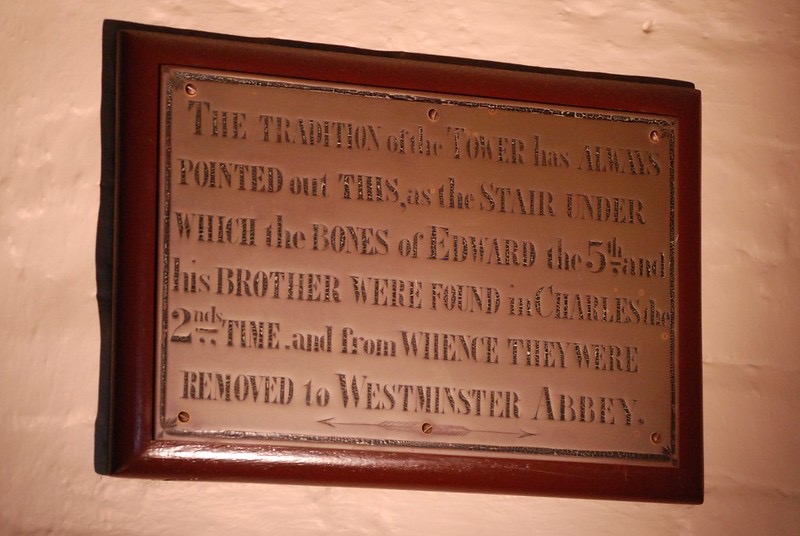
While the princes are believed to have been held in the Bloody Tower, their connection with the staircase, which is located in a doorway niche halfway up the main outer stairway into the White Tower, dates to 1674.

King Charles II had ordered the demolition of what was left of the royal palace to the south of the White Tower and during those works a wooden chest containing two skeletons was discovered beneath the foundations of a staircase which had led up to St John’s Chapel.

Many have subsequently believed the skeletons to be those of the two princes.

A plaque located near the staircase remnant at the Tower of London. PICTURE: Ian McKellar (licensed under CC BY-SA 2.0)

The princes had been taken to the tower in April, 1483, following the death of their father, King Edward IV, on the 9th of that month. Their uncle, Richard, Duke of Gloucester (and the Lord Protector of his nephews), had done so, ostensibly for their protection, while Edward’s coronation was initially scheduled for June.

The last recorded reference to them being in the tower dates from 16th June when they were seen “shooting [arrows] and playing in the garden of the Tower sundry times”.

There has since been much debate over their fate with many believing Richard, who in July of that year was crowned King Richard III, had them murdered to ensure his own ascension to the throne.

The two skeletons found almost 200 years later were put on display for several years following their discovery before King Charles II ordered that they be placed in an urn and reburied in the Henry VII Chapel in Westminster Abbey. In 1933, they were disinterred and forensically examined by LE Tannery and W Wright who concluded they were the skeletons of two boys, aged 10 and 13. They were subsequently reinterred and have remained buried since. They have never been tested for DNA.

Historic Royal Palaces Chief Curator Lucy Worsley and special guests will look at the question of whether the urn should be opened and the bones tested using modern forensic methods in an online event on 16th March at 7pm. Follow this link to register for this event.

WHERE: Tower of London (nearest Tube station Tower Hill); WHEN: 9am to 4.30pm (last admission), Tuesday to Saturday, 10am to 4.30pm (last admission) Sunday to Monday; COST: £29.90 adults; £14.90 children 5 to 15; £24 concessions (family tickets available; discounts for online purchases/memberships); WEBSITE: www.hrp.org.uk/toweroflondon/.

LondonLife: Trafalgar Square fountain by night…

PICTURE: Matthew Browne/Unsplash

One of two fountains in Trafalgar Square, this one commemorates Admiral of the Fleet, Earl Beatty, and unveiled by the Duke of Gloucester along with its counterpart commemorating Admoral Earl Jellicoe in 1948. Busts of both admirals can be see in the north wall. The fountain’s bronze sculpture and its counterpart were designed by Sir Charles Wheeler.

Where’s London’s oldest…public Holocaust memorial?

PICTURE: Matt Brown (licensed under CC BY 2.0)

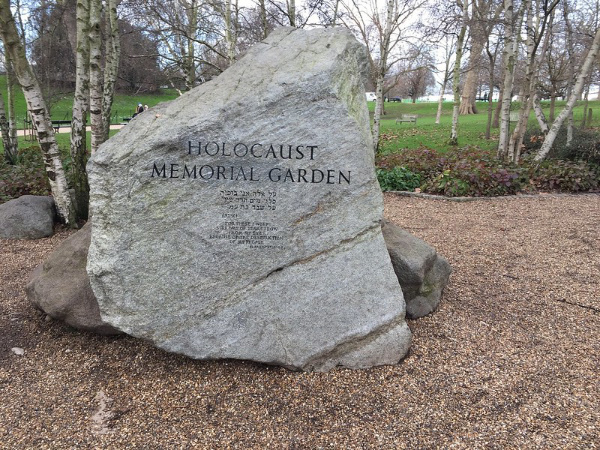
Amid controversy over plans for a new Holocaust memorial in London and the marking of Holocaust Memorial Day this week, we thought it would be a good time to take a look at where the oldest public memorial to the victims of the Holocaust in London, which actually isn’t that old, is located.

Unveiled in 1983 in Hyde Park at site just to the east of the Serpentine, it consists of a grouping of boulders surrounded by white-trunked birch trees. Designed by Richard Seifert and Derek Lovejoy and Partners, the largest of the boulders is inscribed with a text, in Hebrew and English, from the Biblical Book of Lamentations. It reads: “For these I weep. Streams of tears flow from my eyes because of the destruction of my people.”

The Holocaust Memorial Garden, which was actually the first such memorial dedicated to the victims of the Holocaust in Britain, was erected by the Board of British Jews.

Plans for a new memorial to the victims of the Holocaust – to be located in Victoria Tower Gardens, just to the south of the Houses of Parliament – were approved by the government in the middle of last year following a controversial public inquiry. But a High Court judge subsequently granted the London Historic Parks And Gardens Trust permission to appeal that decision.

Treasures of London – Bas-relief of Charles Dickens (and some famous friends)…

PICTURE: Eden, Janine and Jim (licensed under CC BY 2.0).

Christmas is fast arriving so we went in search of some related monuments in London and found one depicting two famous characters from an iconic Yuletide text.

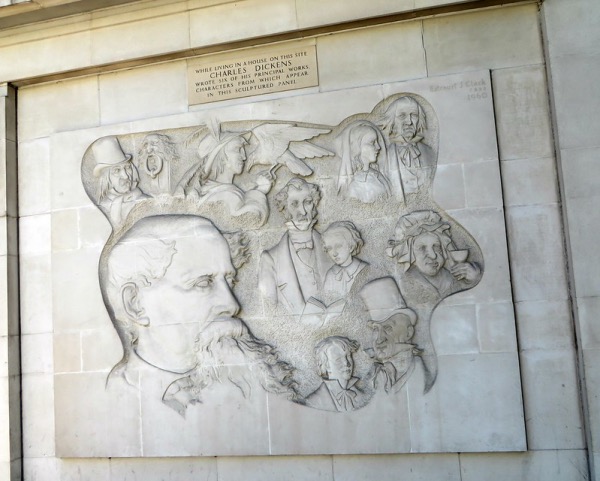
Located on the site of a house where 19th century writer Charles Dickens wrote six of his famous books, including A Christmas Carol, is a stone relief featuring several characters from them including Scrooge and Marley’s Ghost (represented as a door knocker in the top left).

Dickens lived at the property at what was then 1 Devonshire Terrace, Marylebone, between 1839 and 1851. It was demolished in the late 1950s and replaced with an office block upon which was incorporated the stone relief.

The bas-relief is the work of Estcourt J “Jim” Clack and features a large portrait of Dickens as well as the characters who, alongside the characters from A Christmas Carol.

They apparently include Barnaby Rudge with his raven ‘Grip’ (from the book of the same name), Little Nell and Granddad (The Old Curiosity Shop), Dombey and his daughter Florence (Dombey and Son), Sairey Gamp (Martin Chuzzlewit), David Copperfield and Wikins Micawber (David Copperfield).

Correction: The name of Barnaby Rudge’s raven has been corrected.

Treasures of London – Traitor’s Gate…

PICTURES: David Adams

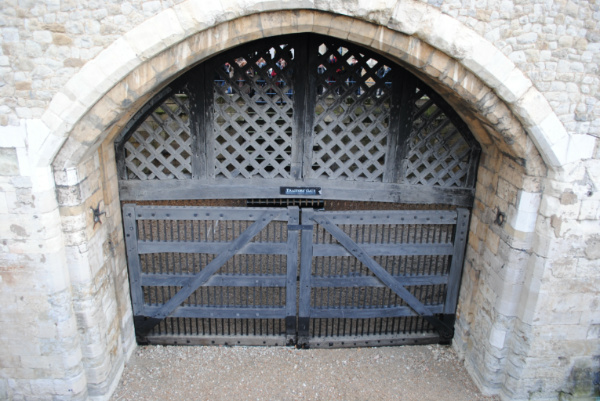
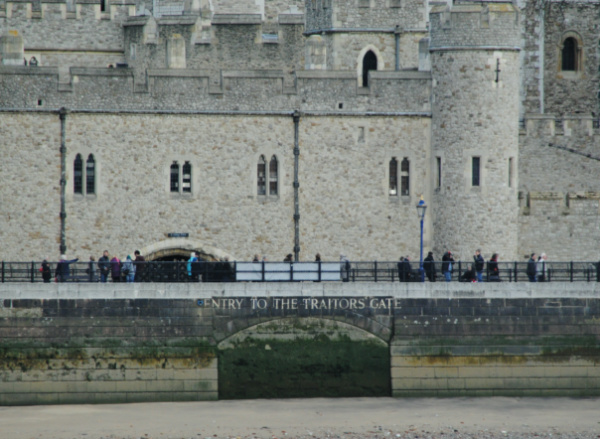
Built by King Edward I in the 13th century as a water gate to provide access from the Tower of London to the River Thames, the name ‘Traitor’s Gate’ came to be applied to this portal in Tudor times in relation to those accused of treason who were brought into the tower under its arch.

The double gateway is part of St Thomas’s Tower, which was designed by a Master James of St George, and behind it is a pool which was used to feed water to a cistern on the roof of the White Tower. While the gate was originally built to give access directly to the river, Traitor’s Gate now sits behind a wharf which runs along the river bank (and where can be seen the bricked up entrance says ‘Entry to the Traitor’s Gate’ – this was bricked up in the 19th century when embankment works were carried out)

Sir Thomas More, Sir Walter Raleigh and even the future Queen Elizabeth I (when a princess) were among those who were brought in by barge through the Traitor’s Gate (their journey would have led them under London Bridge where the heads of executed prisoners were on display). Whether Henry VIII’s disgraced Queen Anne Boleyn entered the tower through the gate remains a matter of some dispute.

10 London memorials to foreign leaders – A recap…

Before we move on to our next Wednesday special series, here’s a recap

1. Abraham Lincoln…

2. Jawaharlal Nehru…

3. Simón Bolívar…

4. Charles de Gaulle…

5. Prince Henry the Navigator…

6. Nelson Mandela…

7. Mahatma Gandhi…

8. General Don José de San Martín…

9. Władysław Sikorski…

10. Skanderbeg…

10 London memorials commemorating foreign leaders – 10. Skanderbeg…

Des Blenkinsopp / An Albanian Hero (licensed under CC BY-SA 2.0)

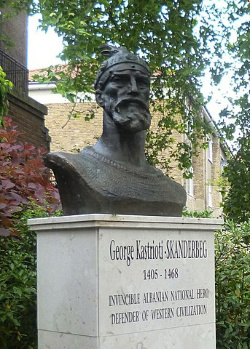
Unveiled just nine years ago, this bust in Bayswater commemorates George Kastrioti Skanderbeg, a 15th century Albanian lord who led a rebellion against the Ottoman Empire (and who later became a central figure of inspiration in the Albanian National Awakening of the 19th century).

Located on the corner of Inverness Terrace and Porchester Gardens, the bronze bust was created by Kreshnik Xhiku.

An inscription on the front reads “George Kastrioti Skanderbeg, 1405 – 1468, invincible Albanian national hero, defender of western civilization.”

It was unveiled on the 100th anniversary of Albanian independence on 28th November, 2012, with Westminster City Councillor Robert Davis and  Albanian Charge d’affaires, Mal Berisha, in attendance.

The bust was installed as part of Westminster’s City of Sculpture initiative.

10 London memorials commemorating foreign leaders – 9. Władysław Sikorski…

PICTURE: Chmee2 (licensed under CC BY-SA 3.0)
PICTURE: Ethan Doyle White (licensed under CC BY-SA 4.0)

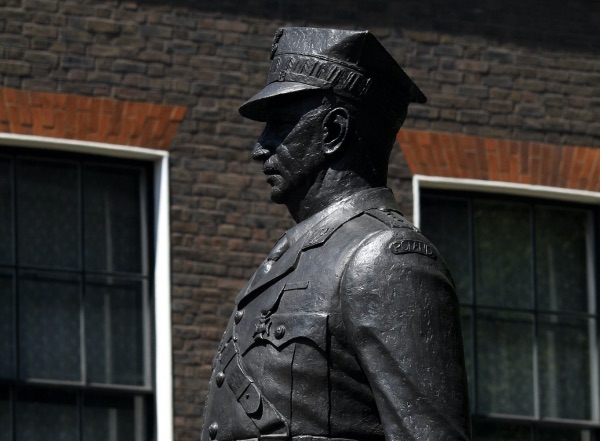
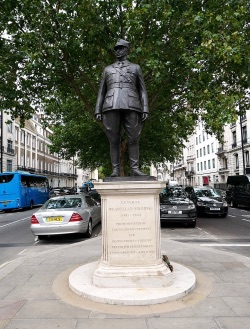
This statue in Portland Place in Marylebone commemorates wartime Polish Prime Minister and military leader (and British ally) Władysław Sikorski (1881-1943).

Larger than lifesize, the bronze statue depicts Sikorski in military uniform standing on a white stone plinth. It is the work of late British artist Faith Winter (also the sculptor of a controversial statue of Air Chief Marshal Sir Arthur Harris outside the RAF church on the Strand).

Funded by public subscription, this statue of Sikorski was erected on 24th September, 2000, and unveiled by the Duke of Kent. It stands near the Polish Embassy on a traffic island near the intersection with Weymouth Street.

There’s inscriptions on each face of the plinth which commemorate Sikorski as well as the “Soldiers, Seamen and Airmen of the Polish Armed Forces and the Resistance Movement” between 1939 – 1945. The east face inscription commemorates Polish involvement in World War II through a listing of battles.

Sikorski is also commemorated with a plaque adorning the Rubens Hotel in Buckingham Palace Road which served as his headquarters between 1940 until his death in an air crash in Gibraltar in 1943 (where there is another memorial to him).

10 London memorials commemorating foreign leaders – 8. General Don José de San Martín..

PICTURE: Peter O’Connor/licensed under CC BY-SA 2.0)

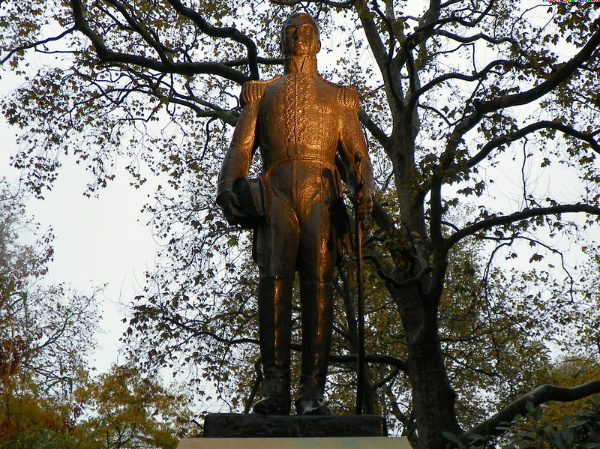
Another of the many statues in Belgrave Square and surrounds, this statue depicts a giant of South American history.

Don José de San Martín was an Argentine general who was instrumental in the continent struggle for independence from the Spanish Empire and is regarded as a hero in Argentina, Chile and Peru.

The bronze statue, the work of Juan Carlos Ferraro, was cast in Buenos Aires in 1993 and unveiled in the northern corner of the square’s gardens by the Duke of Edinburgh in 1994 in the presence of dignitaries including Senator Eduardo Menem of Argentina, Lord Mayor of Westminster Angela Hooper, UK Foreign Secretary Douglas Hurd and Argentine Ambassador Mario Campora. It was erected by the Argentine-British community in Argentina and is dedicated to the people of London.

San Martín is depicted standing in military uniform on top of a heavy plinth. It’s inscribed on the front with the words “General Don José de San Martín, 1778-1850, founder of the Argentine independence, he also gave freedom to Chile and Peru.” There are also some further inscriptions referring to its creation and one on the right side of the plinth saying “His name represents democracy justice and liberty”.

A plaque was added on the ground in front of the statue to mark the 150th anniversary of San Martin’s death – 17th August, 2000.

It’s not the only memorial to San Martín in London – there’s also a Blue Plaque, erected by the London County Council in 1953, at 23 Park Road in Marylebone (San Martín stayed here for a few months in 1824).

Where’s London’s oldest…flyover?

PICTURE: Teseum (licensed under CC BY-SA 2.0)

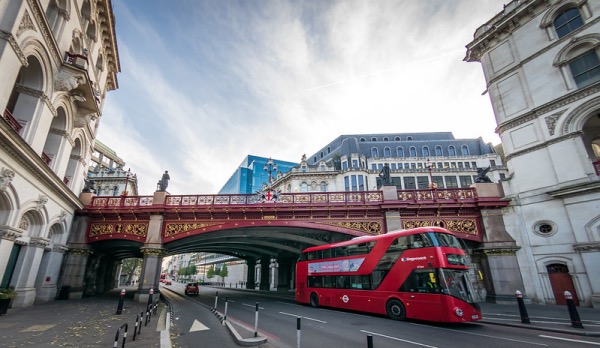
The oldest flyover in central London was actually built well before the first automobile.

Spanning the Fleet River valley, it was built between 1863 and 1869 and, spanning Farringdon Street below (which follows the line of the Fleet (now beneath the ground), it linked the City of London with Holborn (or more specifically Holborn with Newgate Street).

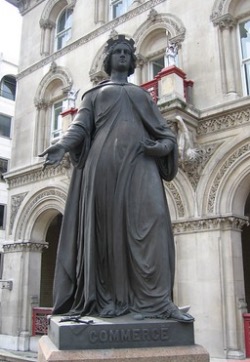
Statue of commerce on the flyover. PICTURE: steve_w (licensed under CC BY-NC-ND 2.0)

The flyover was designed by City of London surveyor William Heywood. It was part of a number of improvements designed to create better access to the City from the West End.

A number of old buildings and indeed some entire streets had to be demolished before construction could begin and thousands of bodies buried in St Andrew Holborn’s northern churchyard had to be relocated.

Made of cast iron, the flyover is about 1400 feet (425 metres) long and 80 foot (24 metres) wide and features three spans – the largest in the middle – supported on granite pillars.

Pavilions containing stairs allowing pedestrians to move between levels were built at either end on both sides of the roadway (the two northern buildings are both replacements – the previous versions were demolished after being damaged during the Blitz and have been replaced in more recent years).

The decorations include a series of four bronze statues featuring Agriculture and Commerce on the south side (the work of Henry Bursill) and Fine Arts and Science on the north side (the work of firm Farmer & Brindley).

There are also statues of winged lions and globe lamps (the current lamps are replicas with the originals thought to have been destroyed during the Blitz) as well as well as the City of London’s coat-of-arms and dragons.

The buildings containing the stairs, meanwhile, each feature a statue of a famous medieval Londoner on the facade – merchant Sir Thomas Gresham (1519-1579), engineer Sir Hugh Myddelton (1560-1631), and Mayors Sir William Walworth (d.1385) and Henry Fitz Ailwin (1135-1212).

The viaduct was opened by Queen Victoria on 6th November, 1869. It was listed as Grade II in 1972.

10 London memorials commemorating foreign leaders – 7. Mahatma Gandhi…

PICTURE: Alvesgaspar (licensed under CC BY-SA 4.0)

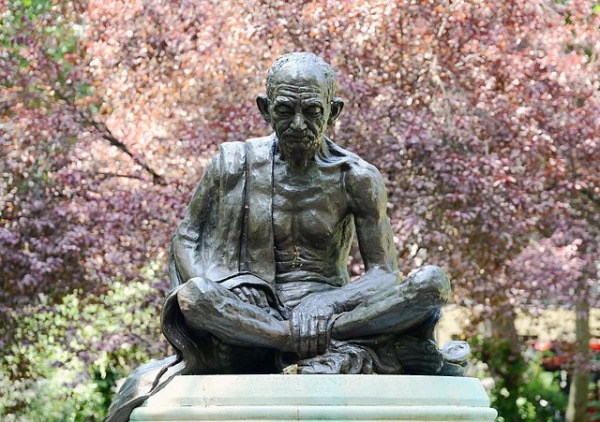
There’s a couple of statues commemorating Mahatma Gandhi in London with the most recent one was unveiled in Parliament Square in 2015.

But this week we head Bloomsbury where we find an older one in the centre of the gardens in Tavistock Square.

The work of Fredda Brilliant, it was unveiled by then Prime Minister Harold Wilson in May, 1968. Also present was the first High Commissioner of India to the UK after independence, VK Krishna Menon, and the then-current High Commissioner of India to the United Kingdom, Shanti Swaroop Dhavan.

Menon apparently chose the location for the statue – Gandhi had studied at the nearby University College London between 1888 and 1891.

Gandhi, who was assassinated in 1948 after having playing an instrumental role in the push for India’s independence, is depicted sitting in a cross-legged in the lotus position wearing a loincloth with a shawl over his right shoulder. The statue sits atop a rounded Portland stone plinth.

The memorial was erected by the Mahatma Gandhi Memorial Committee, with the support of the India League. It was Grade II-listed in 1974.

A further plaque was added beneath the statue in 1996 commemorating the 125th anniversary of the birth of Gandhi.

10 London memorials commemorating foreign leaders – 6. Nelson Mandela…

Back to Parliament Square this week where we look at a bronze statue of anti-apartheid activist and former President of South Africa, Nelson Mandela.

PICTURE: Prioryman (licensed under CC BY-SA 4.0)

Unveiled on 29th August, 2007, this larger-than-life statue is the work of English sculpture Ian Walters (he completed a clay sculpture of the Parliament Square statue before his death in 2006 but sadly didn’t live to see it cast in bronze in London.)

The statue was proposed by South African journalist and anti-apartheid activist Donald Woods but after his death in 2001, the fundraising effort, officially launched in 2003, was led by his wife Wendy and Sir Richard Attenborough.

It depicts Mandela standing on a low plinth with his arms outstretched as though making a speech. He is shown wearing a flowery shirt.

It was originally proposed the statue be located outside of the South African High Commission in Trafalgar Square but after planning approval was refused, the alternative site of Parliament Square was eventually decided upon.

The unveiling in the south-west corner of the square was attended by Mandela himself along with his wife Graça Machel and then Mayor of London Ken Livingstone while then PM Gordon Brown did the official duties.

Interestingly it’s not the only work of Walters depicting Mandela – he was also the sculptor behind the bust of Mandela which stands outside Royal Festival Hall in South Bank.

It’s also not the only South African who has a statue in Parliament Square – there’s also one of Jan Smuts, twice Prime Minister of the Union of South Africa in the early 20th century (in fact Mandela recalled at the unveiling that he and his friend Oliver Tambo, who went on to become president of the ANC, had once joked about seeing the statue of a Black man one day erected in the square – Tambo never lived to see it, but Mandela, at age 89, did).

10 London memorials commemorating foreign leaders – 5. Prince Henry the Navigator…

Prince Henry the Navigator. PICTURE: David Adams

We go back to Belgrave Square this week to its westernmost corner where there is a bronze statue of 15th century Portuguese aristocrat and explorer, Prince Henry the Navigator.

Prince Henry (1394-1460) was the son of King John I of Portugal and Philippa, the daughter of English nobleman John of Gaunt and sister of King Henry IV.

As well as being appointed the Governor of the Algarve in 1419, Henry became famous for his scientific and exploratory endeavours – he was instrumental in opening the navigational route to India (although his nickname “The Navigator” apparently was applied to him until centuries later5)

The statue, which has the prince wearing robes seated on a rocky outcrop with a rolled map in his hand, is attributed to Simoes de Almeida (who died in 1950) and it’s been claimed it was made as far back as 1915. There is a duplicate of the statue located in the US – at Fall River, Massachusetts – but this is credited to the sculptor, Aristide Berto Cianfarani.

While it’s origins remain somewhat unclear, we do know the statue was unveiled by the President of Portugal in February, 2002, with the Duke of Westminster present.

There are some verses from Portuguese poet Fernando Pessoa on the side of the plinth.

10 London memorials to foreign leaders…4. Charles de Gaulle…

PICTURE: Metro Centric (licensed under CC BY 2.0)

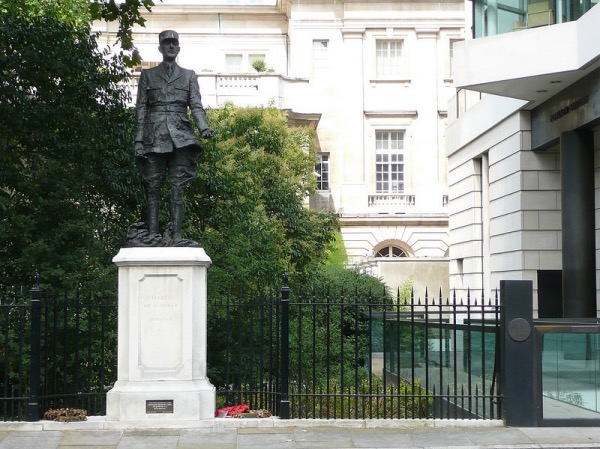
Unveiled in the early 1990s, this statue of the French leader Charles de Gaulle (1890-1970) is located in St James’s, close to the headquarters where de Gaulle headed the government-in-exile following the fall of France in 1940.

The life-sized statue is the work of sculptor Angela Conner and architect Bernard Wiehahn and was erected in Carlton Gardens following a campaign by Lady Soames, daughter of Winston Churchill. De Gaulle is depicted standing in the uniform of a General de Brigade.

The was unveiled by Queen Elizabeth, The Queen Mother, in June 1993. Nearby are an English Heritage Blue Plaque as well as another plaque, both commemorating the location of the headquarters.

A commemorative ceremony takes place each year at the statue organised by the French Embassy.

De Gaulle flew to England in June, 1940, and was subsequently recognised by Britain as the leader of the Free French. He established his headquarter at 4 Carlton Gardens on 22nd July that year, initially living at the Connaught Hotel and, from 1942 to 1944, in Hampstead. He returned to France following the D-Day invasion in 1944.

Lost London – The Maharajah’s Fountain…

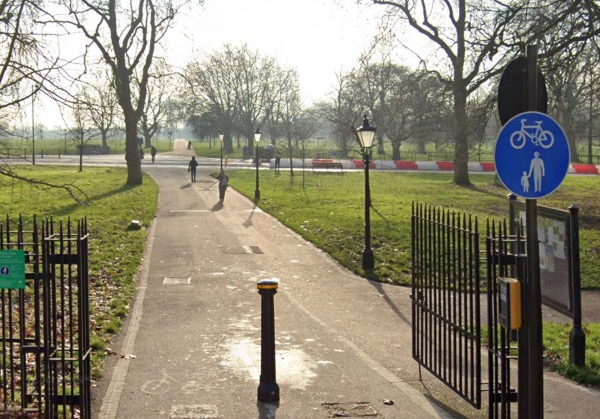
Former site of The Maharajah’s Fountain, looking into Hyde Park from Bayswater Road (you can see the plaque to the left of the path). PICTURE: Google Maps.

Once located in Hyde Park, this drinking fountain was a gift from Maharajah Meerza Vijiaram Gajapati Raj Manea Sooltan Bahadoor of Vijianagram (a small princely state once located in what is now the Indian state of Andhra Pradesh).

Installed in 1867 by the Metropolitan Drinking Fountain and Cattle Trough Association, the towering structure in the neo-Gothic style was apparently designed by the architect Robert Keirle (also the designer of the Readymoney Fountain in The Regent’s Park).

It was installed close to the park’s north-east corner (between North Carriage Drive and Bayswater Road, not far west of Marble Arch).

The fountain was eventually removed in 1964 (apparently due to the prohibitive cost of repairing it). A plaque these days marks its location.

10 London memorials to foreign leaders…3. Simón Bolívar…

PICTURE: Rept0n1x (licensed under CC BY-SA 1.0/image cropped)
PICTURE: Another Believer (licensed under CC BY-SA 4.0)

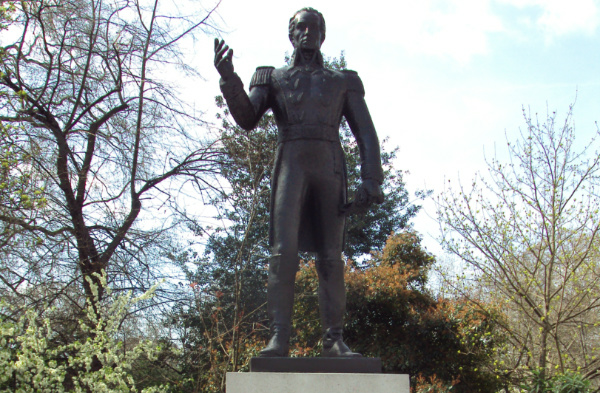
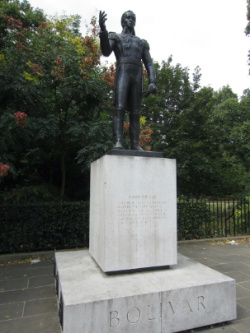
One of a cluster of statues depicting foreign leaders around Belgravia Square (thanks to the presence of so many foreign embassies in the area), this work depicting Simón Bolívar, a towering figure in the early 19th century liberation of South America from colonial powers, was erected in 1974.

The bronze, by Hugo Daini, shows Bolívar standing as though about to make a speech

The inscription describes Bolívar as the liberator of Venezuela, Colombia, Ecuador, Peru, and Panama and the founder of Bolivia and also mentions the details of his birth – Caracas, Venezuela, 24th July, 1783 – and death – Santa Maria, Colombia, 17th December, 1830.

It is accompanied by a quote on the side of the pedestal, featuring words attributed to Bolívar: “I am convinced that England alone is capable of protecting the world’s precious rights as she is great, glorious and wise”.

The statue was erected by the aforementioned nations (the coats-of-arms of which are on the plinth) and unveiled in by James Callaghan, then Foreign Secretary (and later PM).

10 London memorials to foreign leaders…2. Jawaharlal Nehru…

PICTURE: Ham (licensed under CC BY-SA 3.0/Image cropped)

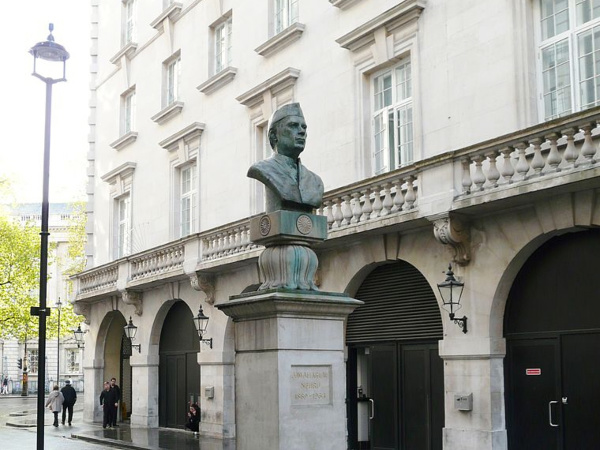
Located on the west side of India House – location of the High Commission of India – is a bust of Jawaharlal Nehru, the first Prime Minister of independent India.

The bust, which stands in India Place between Aldwych and The Strand, is the work of Latika Katt and stands on a granite plinth. It was unveiled in 1990 by the High Commissioner of India LM Singhvi and the Mayor of London.

In 2009, the bronze bust was temporarily dislodged from the plinth but was subsequently returned to its home.

10 London memorials to foreign leaders…1. Abraham Lincoln…

PICTURE: JR P (licensed under CC BY-NC 2.0)

Standing on the edge of Parliament Square opposite the UK’s home of government, this statue of the 16th US President was erected to mark the friendship between Britain and the United States of America.

The statue was proposed by the American Committee for the Celebration of the Hundredth Anniversary of Peace Among English Speaking Peoples to commemorate the centenary of the end of conflict between the two nations in 1915.

But World War I broke out and so it wasn’t until July, 1920 that this statue, a replica of a statue Auguste Saint-Gauden made for the city of Chicago and now Grade II-listed in its own right, was formally presented to then UK Prime Minister David Lloyd George by the US Ambassador and subsequently unveiled by Prince Arthur, the Duke of Connaught.

The 12 foot high, larger than life, monument – which includes a granite plinth – depicts Lincoln wearing a frock coat standing in front of his Grecian chair and about to give a speech. The original was completed in 1887 and was unveiled in Chicago’s Lincoln Park with Abraham Lincoln II, grandson of the President, in attendance as well as a crowd of some 10,000.

Interestingly, the UK wasn’t the only nation given a copy of the statue – a replica was also given to Mexico in 1964 and now stands in the Parque Lincoln in Mexico City.

There is also a replica at Lincoln’s tomb in Springfield, Illinois and in 2016, a newly cast replica of the statue was installed at the Saint-Gaudens National Historic Site – the former home and studio of the sculptor – in Cornish, New Hampshire. There are also numerous smaller replicas including a bust which is sometimes displayed in the Oval Office in the White House.