A cache of papers and items found in Vincent Van Gogh’s former south London home – and dating from 1873-74, the period he lodged there – have shed new light on his time in the city. The papers, which include insurance documents, a small pamphlet of prayers and hymns, and scraps of paper painted with watercolour flowers (probably not the work of Van Gogh), were found under the floorboards and between the attic timbers of the house at 87 Hackford Road in Stockwell. They were discovered during a renovation of the early Victorian terraced house in which Van Gogh lived in while working as an assistant for an art dealer in Covent Garden. During the period he stayed at the house, it has been suggested that the Dutch artist fell in love with Eugénie Loyer, the 19-year-old daughter of his landlord (although his love was apparently not reciprocated). He also apparently became devoutly Christian during his time there (perhaps explaining the prayer pamphlet). The home’s current owners Jian Wang, a former professional violinist who originally hails from China, and his wife Alice Childs have reportedly been renovating the property in order to use it as a base for visiting Chinese artists in collaboration with the nearby San Mei Gallery. For more on the house, see www.vangoghhouse.co.uk. A near life-size photograph of the facade of the Hackford Road house forms part of Tate Britain’s upcoming display The EY Exhibition: Van Gogh in Britain which opens later this month (more on that shortly). PICTURE: An English Heritage Blue Plaque adorning the house (Spudgun67 – licensed under CC BY 2.0).
News
This Week in London – “Spain’s Impressionist” at the National Gallery; and, London stories, told on a poster…
• The first major UK exhibition of the work of “Spain’s Impressionist”, Joaquín Sorolla y Bastida (1863-1923), opens at the National Gallery on Monday. Sorolla: Spanish Master of Light – the first UK retrospective of the artist’s work since 1908 when he mounted an exhibition in London’s Grafton Galleries, spans seven rooms in the Sainsbury Wing and features more than 60 works including portraits and scenes of Spanish life as well as the landscapes, garden views and beach scenes for which he is most renowned. Highlights include his first great success, Another Marguerite! (1892 – pictured), The Return from Fishing (1894), Sewing the Sail (1896), Sad Inheritance! (1899), a portrait of the American painter Ralph Clarkson (1911) and Female Nude (1902) – both of which were responses to the work of Velázquez, large scale preparatory studies from 1912 for Vision of Spain, and sizeable canvases painted out of doors such as Strolling along the Seashore (1909) and The Siesta (1911). The exhibition, which runs until 7th July, is organised in partnership with the National Gallery of Ireland and the Museo Sorolla, Madrid. Admission charge applies. For more, see www.nationalgallery.org.uk. PICTURE: Joaquín Sorolla y Bastida, ¡Otra Margarita! (Another Marguerite!), 1892. Oil on canvas, Mildred Lane Kemper Art Museum, Washington University in St Louis. Gift of Charles Nagel, Sr, 1894.
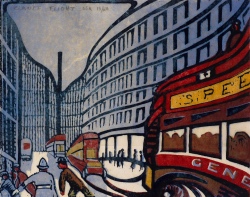
• On Now – The Poster Prize for Illustration 2019 – London Stories. One hundred illustrations depicting an aspect of London – in a current or historical, real or fictional state – and capturing a familiar or lesser-known narrative in a single image are on show at the London Transport Museum. The images were selected by a panel of judges and visitors have the chance to vote for their favourite poster with the winning illustration to be announced in June (it will then become a permanent part of the museum’s collection). Runs until 14th July. There’s a series of talks accompanying the display including ‘Bus Fare: Stories of the London Bus’ open 21st March. Admission charges apply. For more, see www.ltmuseum.co.uk/whats-on/exhibitions.
Send all items for inclusion to exploringlondon@gmail.com.
LondonLife – Queen posts her first Instagram image from the Science Museum..
Queen Elizabeth II posted her first Instagram photo while visiting the Science Museum in South Kensington last Thursday in a promotion for its exhibition on computers. Under the account @theroyalfamily, the Queen posted two images of a letter at the museum which comes from the Royal Archives. It was written to Prince Albert and Queen Victoria by Charles Babbage and in it, the 19th century inventor and mathematician spoke of his invention of an “Analytical Machine” upon which the first computer programs were written by Ada Lovelace, daughter of Lord Byron. Having explained the origins of the letter, the Queen added: “Today, I had the pleasure of learning about children’s computer coding initiatives and it seems fitting to me that I publish this Instagram post, at the Science Museum which has long championed technology, innovation and inspired the next generation of inventors. Elizabeth R.” The Royal Family’s Instagram account has some 4.9 million followers. For more on the Science Museum, see www.sciencemuseum.org.uk.
This Week in London – Princess Eugenie’s wedding dress on show; Dorothea Manning; and, the impact of photographic reproductions explored…
• The wedding dress and tiara worn by Princess Eugenie at her wedding in October last year has gone on display in a new exhibition at Windsor Castle, just to the west of London. A Royal Wedding: HRH Princess Eugenie and Mr Jack Brooksbank also features groom Jack Brooksbank’s morning suit and the maid-of-honour outfit worn by Princess Beatrice of York. But the star is the wedding dress, designed by Peter Pilotto and Christopher De Vos, which features fabric interwoven with symbols including the White Rose of York. The exhibition also includes the Greville Emerald Kokoshnik Tiara, lent by Queen Elizabeth II and on public display for the first time, Princess Eugenie’s diamond and emerald drop earrings – a wedding gift from the groom, a replica of the bridal bouquet, and the Zac Posen-designed evening gown worn by the princess for the reception. The display can be seen as part of visits to Windsor Castle until 22nd April. Admission charge applies. For more see www.rct.uk. PICTURE: Royal Collection Trust / © All Rights Reserved.
• The work of pioneering artist Dorothea Manning is the subject of a new exhibition at the Tate Modern on South Bank. Opened last week, Dorothea Tanning is organised in collaboration with the Museo Nacional Centro de Arte Reina Sofía in Madrid and is the first large scale exhibition of her work for 25 years. It brings together some 100 works, a third of which are being shown in the UK for the first time, including ballet designs, stuffed textile sculptures, installations and large scale pieces. Highlights include the self-portrait Birthday (1942), Children’s Games (1942), Insomnias (1953), Etreinte (1969),Tango Lives (1970) and the room-sized installation Chambre 202, Hôtel du Pavot (1970-73). Runs until 9th June. Admission charge applies. For more see www.tate.org.uk.
• A new exhibition on the impact photographic reproduction had on illustrative art at the end of the 19th century has opened at the Heath Robinson Museum in Pinner. The Beardsley Generation looks at how a new generation of artists versed in process engraving replaced the craft wood engravers of the past and how the new technology led to an expansion in the production of illustrated books and periodicals. The work of Aubrey Beardsley, Charles Ricketts, Laurence Housman and the Robinson brothers will be on display in the form of original drawings, books and periodicals drawn from public and private collections. Runs until 19th May. Admission charge applies. For more, see www.heathrobinsonmuseum.org.
Send all items for inclusion to exploringlondon@gmail.com.
This Week in London – Artist Louis-Léopold Boilly’s unseen works; the ‘Renaissance Nude’ at the RA; and, a day about women at the National Army Museum…
• One of the first ever exhibitions devoted to the work of French Revolution-era artist Louis-Léopold Boilly (1761-1845) opens at The National Gallery on Trafalgar Square today. Boilly: Scenes of Parisian Life features at its heart 18 paintings from private British collection the Ramsay Manor Foundation which have never been displayed or published before. They include early works like Two Young Women Kissing (1790-94), urban vistas like The Poor Cat (1832), The Barrel Game (c1828), and A Carnival Scene (1832), and portraiture like Portrait of the Comtesse François de Sainte-Aldegonde (c1800-05), and Portrait of a Lawyer (early 19th century). Also on display is The Meeting of Artists in Isabey’s Studio (1798, now held in the Musée du Louvre), the painting which, depicting the greatest artists of his generation, rocketed him to fame, and the National Gallery’s own Girl at a Window (Boilly was apparently the first to use the phrase “trompe l’oeil” to describe illusionistic paintings that “deceived the eye” by creating the illusion that depicted objects exist in three dimensions and this work gives the illusion that, though it’s oil on canvas, its a print in a mount). Though born in Lille, Boilly spent six decades in Paris from 1785 onwards and was an eyewitness to events including the French Revolution of 1789, the Terror, the rise and fall of Napoleon, and the restoration of the French monarchy. The free display can be seen in Room 1 until 19th May and admission is free. For more, see www.nationalgallery.org.uk. PICTURE: Louis-Léopold Boilly, ‘The Barrel Game’ (about 1828/oil on canvas/37.8 × 46.8 cm – The Ramsbury Manor Foundation) Photo © courtesy the Trustees.
• The ‘Renaissance Nude’ and how it inspired some of the world’s most renowned masterpieces is the subject of a new exhibition opening at the Royal Academy in Piccadilly on Sunday. The display features about 90 works in a variety of media from across Europe with artists including Lucas Cranach the Elder, Albrecht Dürer, Jan Gossaert, Michelangelo, Raphael and Leonardo da Vinci all represented. It will look at developments that led to the nude holding a pivotal place in art between 1400 and 1530 and is organised around five main themes: ‘The Nude and Christian Art’, ‘Humanism and the Expansion of Secular Themes’, ‘Artistic Theory and Practice’, ‘Beyond the Ideal Nude’ and ‘Personalising the Nude’. Highlights include Titian’s Venus Rising from the Sea (‘Venus Anadyomene’) (c 1520), Agnolo Bronzino’s Saint Sebastian (c1533), Dürer’s engraving Adam and Eve (1504), Cranach’s A Faun and His Family with a Slain Lion (c1526) and Gossaert’s Hercules and Deianira (1517). Can be seen in the Sackler Wing of Galleries until 2nd June. Admission charge applies. For more, see www.royalacademy.org.uk.
• How women have helped shaped the British Army will be the subject of a special day featuring theatrical performances, live music and discussion at the National Army Museum in Chelsea this Saturday (2nd March). The day, which is the first of new series of Saturday events at the museum and this month is being held in recognition of Women’s History Month, will feature a theatrical performance by Dr Kate Vigurs of History’s Maid telling the story of Mother Ross who in 1693 disguised herself as a man so she could join the army and find her husband who had gone missing while at war. There’s also a panel of five women – serving soldiers, veterans and army wives – who will share their stories as well as musical performances by the Military Wives Choirs, the chance to engage with re-enactors, gallery tours and object handling opportunities all centred around women in the army. Runs from 10am to 4.30pm and is free. For more, see www.nam.ac.uk/whats-on/women-and-army.
Send all items for inclusion to exploringlondon@gmail.com.
This Week in London – City of London’s biggest rooftop viewing platform opens; Rembrandt at the British Museum; and, Franz West at the Tate…
• The City of London’s largest rooftop viewing space – The Garden at 120 – has opened atop the newly opened Fen Court office building in Fenchurch Street. The viewing platform – located 15 storeys above the street – offers 360 degree views of the City and features a pergola planted with fruit trees and Italian wisteria, a water feature and coffee hut. Entry is free and access is between 10am and 6.30pm weekdays until 31st March (5pm on weekends) and between 10am and 9pm from 1st April to 30th September. For more, see www.thegardenat120.com. PICTURE: diamond geezer (licensed under CC-BY-NC-ND 2.0)
• Rembrandt’s drawing and prints are the subject of a new free exhibition at the British Museum. Marking 350 years since the death of Rembrandt van Rijn in 1669, Rembrandt: thinking on paper features more than 60 of the Dutch artist’s works ranging from quick sketches to fully realised compositions with subject matter including self-portraits, landscapes and Biblical scenes. Works include Young woman sleeping (Hendrickje Stoffels?) (c1654), his printing plate for Reclining female nude (1658), the pen-and-ink Sketches of an old man and child (c1639-40), Self-portrait, bareheaded, bust in frontal view (1629), Self-portrait drawing at a window (1648), the Raising of Lazarus (c1632) and his late, large drypoints the Three Crosses (1653) and Ecce Homo (1655). Runs until 4th August in Room 90. Entry is free. For more, see www.britishmuseum.org.
• The first posthumous retrospective of the work of Franz West (1947-2012) ever staged in the UK has opened at the Tate Modern. Franz West spans the artist’s career over four decades and includes examples from his series of early abstract small sculptures like Passstücke (Adaptives), furniture work first displayed in the artist’s pivotal 1989 exhibition at the Haus Lange Museum, as well as later, large-scale installations such as Auditorium (1992) and Epiphany on Chairs (2011). The artist’s works in papier-mâché – Legitimate Sculptures – are also featured and there’s a room devoted to Redundanz (1986), a three-part ensemble accompanied by text that stresses “the difference between language and art as ways of understanding the world”. The display finishes with an array of West’s dramatic aluminum works and a collection of maquettes for the artist’s outdoor sculptures, five of which are installed in the South Landscape. Runs until 2nd June. Admission charge applies. For more, see www.tate.org.uk.
Send all items for inclusion to exploringlondon@gmail.com.
LondonLife – Orchids at Kew…
The 24th annual Kew Orchid Festival is underway in west London with displays inspired by the flora and fauna of Colombia. For more, see www.kew.org. PICTURES: Above – Orchid stems (Ines Stuart Davidson); Below – A jaguar prowls among the orchids (photo by Jeff Eden); The Legend of El Dorado in a yellow orchid display (Jeff Eden); A sloth in a “carnival of animals” (Jeff Eden); and, Vanda orchids in a display representing the rainbow river, Cano Cristales (Jeff Eden). All pictures courtesy of Kew Gardens.
This Week in London – Experience Colombia at Kew; Norwegian landscapes at Dulwich; and, shining a spotlight on London’s disadvantaged children…
• The flowers of Colombia are at the heart of this year’s Kew Orchid Festival which kicked off in west London late last week. Featuring what’s promised to be “dazzling displays” inspired by Colombia’s fauna and flora – the country boasts some 4,270 species of orchids alone, the 24th annual festival includes music, food, crafts and, of course, coffee. More than 5,700 orchids – including the Flor de Mayo – feature in the display in the Princess of Wales Conservatory with visitors led through a series of zones that evoke the sights, smells and sounds of Colombia. The central display is a “carnival of animals’ which depicts a toucan in flight, a hanging sloth and swimming turtle – all made of orchids, bromeliads and other tropical plants. There’s also a cascade of colourful hanging vandas representing the “rainbow river” – the Cano Cristales, an enchanted forest with life-sized jaguars, and, a golden floating display featuring yellow orchids depicting the legend of El Dorado. Meanwhile, the glasshouse film room features Bogota-style street art murals by Colombian multidisciplinary artist, Vanessa Moncayo González. The festival runs until 10th March. Admission charges apply. For more, see www.kew.org.
• The works of Harald Sohlberg, one of the great masters of landscape painting in the history of Norwegian art, are on show at Dulwich Picture Gallery in the first ever exhibition of his works outside of Norway. Marking the 150th anniversary of the artist’s birth, Harald Sohlberg: Painting Norway boasts more than 90 works revealing the role of colour and symbolism in his art as well as his passion for Nordic landscapes. Spanning the period from 1889 when he was starting out as a 20-year-old through to 1935, the last year of his life, the works include the ‘national painting of Norway’ – Winter Night in the Mountains (1914) which took some 14 years to complete (pictured), as well as Fisherman’s Cottage (1906), Summer Night (1899), Sun Gleam (1894) and Street in Røros in Winter (1903). Runs until 2nd June. Admission charge applies. Accompanying the exhibition is a new sculptural installation in the gallery’s mausoleum by Bristol-based artist Mariele Neudecker – And Then the World Changed Colour: Breathing Yellow. For more see www.dulwichpicturegallery.org.uk. PICTURE: Harald Sohlberg, ‘Winter Night in the Mountains’, 1914, The National Museum of Art, Architecture and Design, Norway.
• A new photographic exhibition documenting the living conditions of London’s most disadvantaged children has opened at the Foundling Museum in Bloomsbury. Being run in partnership with The Childhood Trust, Bedrooms of London features images of sleeping spaces by Katie Wilson and they are shown alongside stories collected by Isabella Walker which bring into sharp focus the consequences of London’s social housing shortage. The display builds on the history of the Foundling Hospital, providing a glimpse into what life is like for the 700,000 London children currently living below the poverty line. It can be seen until 5th May. Admission charge applies. For more, see www.foundlingmuseum.org.uk.
Send all items for inclusion to exploringlondon@gmail.com.
LondonLife – Chinese New Year celebrations…
Chinese or Lunar New Year celebrations in London – the largest outside Asia – were held at various West End sites including Chinatown, on Sunday to welcome in the Year of the Pig.
PICTURES: Garry Knight (licensed under CC BY 2.0)
LondonLife – Snow day at ZSL London Zoo…
ZSL London Zoo recently experienced its first “snow day” for 2019. Pictured are Kiri the Kune Kune pig (above) and (below), Humboldt penguins and Asian short-clawed otters. Fun, apparently, was had by all! For more, see www.zsl.org. ALL PICTURES: © ZSL London Zoo.
This Week in London – Dior at the V&A, and, Don McCullin at the Tate…
• The UK’s largest ever exhibition focusing on fashion designer Christian Dior and his work opens at the V&A on Saturday. Christian Dior: Designer of Dreams spans his career and legacy from 1947 – the year he hosted his first UK fashion show at the Savoy Hotel in London, to the present day. Based on an exhibition shown at the Musée des Arts Décoratifs in Paris, it will also include a section on the world renowned designer’s fascination with British culture. The more than 500 objects on show – revealed in 11 sections – include more than 200 rare haute couture garments as well as accessories, photography, film, perfume and make-up, illustrations, magazines and personal possessions. Alongside gowns worn by the likes of Princess Margaret, Margot Fonteyn and Jennifer Lawrence, highlights include the iconic Bar Suit, given to the V&A by the House of Dior in 1960. Runs until 14th July in The Sainsbury Gallery. Admission charge applies. For more, see www.vam.ac.uk. PICTURE: © Adrien Dirand (V&A).
• The work of Sir Don McCullin – regarded as one of Britain’s greatest living photographers and perhaps best known as a photojournalist and war correspondent – is the subject of a new show opening at Tate Britain next Tuesday. Don McCullin features more than 250 photographs dating from the 1950s – when he started documenting the community in his native Finsbury Park – to 2017, when he visited Syria to document the destruction undertaken by the so-called Islamic State. Among the iconic photographs on show are The Guvnors, a portrait of a notorious local gang in Finsbury Park which launched his career as a photojournalist in 1958, Shell-shocked US Marine, The Battle of Hue (1968), Starving Twenty Four Year Old Mother with Child, Biafra (1968), Northern Ireland, The Bogside, Londonderry (1971), and The theatre on the Roman city of Palmyra, partly destroyed by Islamic State fighters (2017). Also on show are photographs depicting the changing social conditions in the UK, landscapes and still lifes as well as the photographer’s magazine spreads, contact sheets, McCullin’s helmet and the Nikon camera which took a bullet for him in Cambodia. Runs until 6th May. Admission charge applies. For more, see www.tate.org.uk.
Send all items for inclusion to exploringlondon@gmail.com.
LondonLife – A look inside The India Club…
The rich and tapestried history of The India Club forms the heart of a new exhibition by the National Trust which opens at the Strand-based club this week. A Home Away from Home: The India Club is an audio-based exhibition – featuring interviews with everyone from former staff, freedom fighters, BBC reporters, artists and writers – and highlights the club’s history and its ongoing significance among the British South-Asian community. Borne out of the Indian League which had campaigned for India’s independence, the club was founded in 1951 under the leadership of Krishna Menon, the first High Commissioner to India, with founding members including Jawaharlal Nehru, India’s first Prime Minister, and Lady Mountbatten. Originally located at 41 Craven Street, it moved to 143 Strand, the premises of the Hotel Strand Continental, in 1964. The club, site of what was one of the UK’s first Indian restaurants, remains an important hub for a range of Anglo-Indian organisations and the community of journalists, writers, artists, academics and students who regularly meet in the premises. The exhibition comes as more than 26,000 people have signed a petition to prevent the club’s redevelopment as part of plans to refurbish the building in which its located. Opening tomorrow and running until 1st March, the display is being accompanied by a programme of supper clubs, artist talks, screenings and conversations. The exhibition is free but ticketed. For more, see
www.nationaltrust.org.uk/features/a-home-away-from-home-the-india-club.
PICTURES: Top – Enjoying the new exhibition in The India Club (courtesy of National Trust); Below – The India Club sign (courtesy of Jake Tilson); the restaurant in The India Club (courtesy of The India Club); the Strand Continental Hotel in which the club is located (courtesy of Jake Tilson).
Found London – Matthew Flinders’ remains found…
The remains of Captain Matthew Flinders, a Royal Navy explorer who led the first circumnavigation of Australia and is credited with popularising the name the country now bears, have been found by archaeologists working on the HS2 rail project in Euston. While the general area in which he was buried – the former St James’s burial ground – has long been known, archaeologists were able to narrow down the location of his grave among the 40,000 on the site thanks to a lead breast plate placed on top of his coffin upon which, conveniently, his name was written. The HS2 project will see a high speed rail link constructed between London and Birmingham and as part of the preparations for the project, the largest archaeological dig ever to take place in the UK is underway on the site of what will be the London terminus. Flinders was buried in St James’s burial ground in 1814 but when Euston station expanded westward into the burial ground in 1840s, his headstone was removed and the location of his grave thought lost (despite a persistent myth that he was buried under Platform 15). There is already a statue of Captain Flinders at Euston Station – unveiled on the bicentenary of his death in 2014 (originally at Australia House), it depicts both Flinders, busy charting Australia’s coastline, and his cat, Trim. There is now talk of a memorial marking the site of the grave.
This Week in London – Recalling Sir Joseph Bazalgette; Pierre Bonnard retrospective; and Bill Viola meets Michelangelo…
• A plan of the Deptford Pumping Station signed by Sir Joseph Bazalgette is going on display at the City of London Heritage Gallery on Saturday to mark 200 years since the Victorian engineer’s birth. Other items in the new display include the Shakespeare Deed – only one of six documents to bear the signature of William Shakespeare, and one of the City of London’s earliest charters – granted by King Richard I in 1197. Admission to the gallery, located in the Guildhall Art Gallery, is free. Runs until 16th May. For more, follow this link.
• The first major retrospective of French painter Pierre Bonnard in 20 years has kicked off at the Tate Modern on South Bank. The CC Land Exhibition, Pierre Bonnard: The Colour of Memory, features about 100 of his most celebrated works from public and private collections spanning the period from 1912 to his death in 1947. Bonnard, like his friend Henri Matisse, had a profound impact on modern painting and went on to influence the likes of Mark Rothko and Patrick Heron. Works on show include Dining Room in the Country (1913), The Lane at Vernonnet (1912-14), Coffee (1915), Summer (1917), Piazza del Popolo, Rome (1922), Nude in an interior (c1935), and Studio with Mimosa (1939-46). Runs to 6th May; admission charge applies. For more, see http://www.tate.org.uk. PICTURE: Pierre Bonnard (1867–1947), Coffee (Le Café), 1915, Oil paint on canvas (via Tate Modern)
• The work of pioneering video artist Bill Viola has been brought together with drawings buy Michelangelo in a new exhibition opening at the Royal Academy on Saturday. Bill Viola/Michelangelo features 12 major video installations by Viola, an honorary Royal Academician, which span the period 1977 to 2013 as well as 15 works by Michelangelo including 14 highly finished drawings as well as the Academy’s Taddei Tondo. It proposes a “dialogue” between the two artists with Viola, who first encountered Michelangelo’s works in the 1970s in Florence, considered an heir to the long tradition of spiritual and affective art which uses emotion to connect viewers with the subject depicted. Runs until 31st March. Admission charge applies. For more, see www.royalacademy.org.uk.
Send all items for inclusion to exploringlondon@gmail.com.
This Week in London – VAULT returns to Waterloo, and, ‘Making Music’ at the Barbican…
• London’s largest arts festival, VAULT, kicks off next Wednesday in Waterloo with more than 400 shows on offer. Taking place across a range of venues including the main festival hub, The Vaults below Waterloo Station, as well as pop-ups in shipping containers, caravans and escape rooms and the festival’s new space for immersive events – Unit 9, highlights of the seventh festival include the Belarus Free Theatre’s production of the immersive Ukrainian folk opera Counting Sheep, the Lucy Jane Atkinson-directed play Vespertilio, and the comedy of Ciarán Dowd – winner of “best newcomer” at the Edinburgh Comedy Awards. There’s also a twilight program – featuring the VAULT Comedy Showcase – from 10pm on Thursdays and Fridays and a series of Lates including Launch Party: Hype Time featuring the eight-piece New Orleans band Brass Funkeys, blues band Slow Mojo and special guest DJs including Hazel Marimba. The festival runs from 23rd January to 17th March, from Wednesdays to Sundays (times vary). For a full programme of events and tickets, head to vaultfestival.com. PICTURE: VAULT Festival’s 2019 “class photo” (courtesy of VAULT)
• The joy found in communities making music together is explored in a new exhibition which opened at the Barbican Music Library in the City of London this week. Making Music Together: A celebration of leisure-time music in the UK shows how 13,000 leisure-time groups gather to play and perform a wide range of music – from jazz and folk to classical and barbershop – in locations ranging from houses and garages to halls, theatres and fields across the country. The exhibition, held in conjunction with Making Music – the UK’s largest organisation for leisure-time music, will feature posters, films and quotes by contributing Making Music member groups as well as specially commissioned portraits of leisure-time musicians. Runs until 23rd March. Free admission. For more, see www.barbican.org.uk/your-visit/general-info/library.
Send all emails for inclusion to exploringlondon@gmail.com.
LondonLife – Georgian ice house (re)discovered…
An 18th century ice house has been (re)discovered beneath the streets of Marylebone during a residential development project known as Regent’s Crescent. The subterranean red brick ice house – which measures 7.5 metres wide and 9.5 metres deep and was built in the 1780s – was used by pioneering ice-merchant William Leftwich during the 1820s to bring high quality ice to wealthy households and service the trend to serve frozen treats to guests as well as supply increasing demand from food retailers and medical institutions. Leftwich, seeing a niche for clean, quality ice (ice sourced from local canals and lakes during winter was often dirty), shipped ice collected in Norway’s frozen lakes and then transported it into London via Regent’s Canal. Now listed as a scheduled monument by Historic England, the egg-shaped ice house was rediscovered by MOLA archaeologists who were working on the site on behalf of property developer Great Marlborough Estates. It will now be incorporated into the gardens of Regent’s Crescent which have been newly designed by Kim Wilkie as part of the £500 million development project. The Grade I-listed crescent was originally designed by John Nash (of Buckingham Palace and Brighton Pavilion fame) and built in 1819. The houses were destroyed during the Blitz and replica properties were built in the 1960s. But the ice house, an entrance tunnel and ante-chamber all survived the bombing and remain in what MOLA has called “excellent condition”. It is anticipated that the ice house chamber will be open to public viewing via a special corridor during archaeological and architectural festivals.
PICTURES: Top – Buildings archaeologists from MOLA record the interior of the ice house/A MOLA archaeologist brushes the near perfect exterior of the ice house exposed during excavation in 2015 (Images© MOLA).
This Week in London – Good grief, Charlie Brown!; Captain Cook and the Pacific; and the Kindertransport remembered…
• Eighty original comic strips hand-drawn by Charles M Schulz, of Peanuts fame, are on show at Somerset House on the Strand along with many of his personal effects and interactive installations in an exhibition marking the 70th anniversary of the creation of iconic character Charlie Brown. Good Grief, Charlie Brown! Celebrating Snoopy and the Enduring Power of Peanuts looks at the impact of the comics on the cultural landscape, from 1950 to now, and, alongside works by Schultz, features responses to them by 20 figures from the worlds of art, fashion and music. The comic strips are showcased in their original state and size – complete with inky thumbprints and correction marks – and sit alongside vintage Peanuts products and publications as well as correspondence between Schultz and people such as Billie Jean King and Hillary Rodham (now Clinton). Along with interactive displays including a real-life re-imagination of Lucy’s Psychiatric Help booth, light boxes where people can learn to draw the Peanuts characters and a Snoopy Cinema, here are also three large-scale lights installations illuminating the entrance to the exhibition. This landmark exhibition can be seen until 3rd March. Admission charge applies. For more, see www.somerset.org.uk.
• Newly acquired contemporary artworks by Pacific Island artists are at the centre of an exhibition re-examining the relationship between Captain James Cook and the peoples of the Pacific Ocean which is running at the British Museum. Reimagining Captain Cook: Pacific Perspectives also features historic artefacts including Cook’s personal possessions and the British Museum’s oldest example of a Hawaiian shirt (pictured). Among the 14 contemporary artworks are eight specially acquired for the exhibition and all are in some way a response to Cook’s voyages to places including Australia, New Zealand, New Caledonia, Hawaii, Vanuatu and Tahiti. They include Maori artist Steve Gibbs’ Name Changer – an attempt to restore awareness of the traditional Maori names for the region around Gisborne in New Zealand, and a work by the Aboriginal photographer and artist Michael Cook, Civilised #12, which reflects on the legacy of William Dampier, the first Briton to visit Australia (before Cook). The display can be seen in Room 91 until 4th August. Admission is free. For more, see www.britishmuseum.org. PICTURE: ‘Hawaiian’ style vintage cotton shirt, decorated with designs from drawings done on Captain Cook’s voyages, Hawaii, 1970-1980. © Image The Trustees of the British Museum.
• An exhibition marking the 80th anniversary of the Kindertransport is running at the Jewish Museum London in Camden. Remembering the Kindertransport: 80 Years On tells the story of how in 1938-39, the British Government allowed 10,000 Jewish and other ‘non-Aryan’ children from Nazi-occupied Europe to come to Britain in a rescue operation which became known as the ‘Kindertransport’. It features the children, now in their 80s and 90s, telling their stories on film as well as personal objects and artefacts they brought with them from their homelands. Also on show is a photographic exhibition – Still in Our Hands: Kinder Life Portraits – featuring archival photographs and portraits of former Kindertransportees and another – My Home and Me – which, held in partnership with the British Red Cross, explores the journey of young refugees arriving in Britain today. The exhibition, which is being accompanied by a series of events, runs until 10th February. Admission is free. For more, see www.jewishmuseum.org.uk/kindertransport.
Send all items for inclusion to exploringlondon@gmail.com.
This Week in London – ‘The Favourite’ costumes at Kensington; contemporary portraiture; and, Artemisia Gentileschi’s self portrait…
• Costumes from a new film about Queen Anne, The Favourite, have gone on show at Kensington Palace where the Queen once lived. The film, directed by Yorgos Lanthimos, explores the relationships and power struggles between the Queen (played by Olivia Coleman) and two of her closest female attendants – Lady Sarah Churchill (Rachel Weisz) and Lady Churchill’s impoverished cousin turned chambermaid, Abigail (Emma Stone). The costumes have been designed by three-time Oscar winner Sandy Powell who worked with Fox Searchlight Pictures and Historic Royal Palaces in creating the display in the Queen’s Gallery, once used by Queen Anne and her husband for exercise when the weather was bad. The display can be seen until 8th February. Admission charge applies. The Favourite opens in the UK and Ireland on 1st January. For more, see www.hrp.org.uk/kensington-palace/. PICTURE: © Historic Royal Palaces/Michael Bowles
• Previously unseen portraits of Amy Winehouse and Sir Kenneth Branagh and newly acquired portraits of explorer Sir Rannulph Fiennes, astronaut Tim Peake and British Museum director Neil MacGregor have gone on show at the National Portrait Gallery. The portraits, which also include photographs from the Duke and Duchess of Sussex’s wedding in May this year, form part of a major new display of the gallery’s contemporary collection which features works produced from the year 2000 until today. Sitting alongside the collection is a new exhibition of works by artist Njideka Akunyili Crosby from her series The Beautyful Ones – comprised of portraits of Nigerian youth, including some members of her own family. Admission is free and The Beautyful Ones display can be seen until 3rd February. For more. see www.npg.org.uk.
• A recently discovered rare self portrait of Artemisia Gentileschi, the most celebrated female artist of the Italian Baroque, has gone on show at the National Gallery. Self Portrait as Saint Catherine of Alexandria (1615-17), which was acquired by the gallery in July, 2017, can be seen in the Central Hall of the gallery after going through a five month conversation and restoration process which was documented in a series of short films shared on social media via #NGArtemisia. In March, the painting will leave the gallery on a “pop-up” tour of unexpected venues across the UK. A major exhibition of Gentileschi’s work is planned at the National Gallery in 2020. Admission to see the painting is free. For more, see www.nationalgallery.org.uk.
Send all items for inclusion to exploringlondon@gmail.com.
LondonLife – It’s Christmas!…
Trafalgar Square bedecked for Christmas with its famous Norwegian tree. PICTURE: Ben Pipe Photography via London Partners.
This Week in London – Cast Court reopens at V&A; ‘Visionaries’ at Guildhall; and ‘Cats on the Page’…
• The V&A has reopened the second of its two Cast Courts following a redevelopment which has seen the addition of a new interpretation gallery, new exhibits and the restoration of historic original features. The West Court, now renamed the Ruddock Family Cast Court, has been returned to its historic past with original 19th century floors and wall colours and the Central Gallery, now renamed the Chitra Normal Sethia Gallery, features a new exhibition exploring the history, significance and contemporary relevance of the casts on display. Among the new exhibits are a scaled down digital reproduction of the arch of Palmyra destroyed by the so-called Islamic State in 2015 while one of the key existing exhibits, a 35 metre high cast of Trajan’s Column (displayed in two parts – see picture) has had its base permanently opened so visitors can gain an internal perspective. The reopening follows that of the Weston Cast Court in 2014 and completes a project which was begun in 2011. The Cast Courts were first opened in 1873, then known as the Architecture Courts, and house a collection of casts of some of the world’s most inspiring objects including everything from Michelangelo’s David to 16th-century tombs by Peter Vischer in Nuremberg and the Pórtico de la Gloria from the Cathedral of Santiago de Compostela. They are the only public galleries in the South Kensington institution to display the same collection of objects as when they first opened. Entry to the Cast Courts is free. For more, see www.vam.ac.uk. PICTURE: © Victoria and Albert Museum, London.
• Works by Edward Burns-Jones, Dante Gabriel Rossetti, John Everett Millais and Grayson Perry are among those on show as part of a new exhibition at the City of London Corporation’s Guildhall Art Gallery. Visions and Visionaries – a collaboration between the Guildhall Art Gallery, The Sir Denis Mahon Charitable Trust, Flat Time House, and the Bologna-based Association Age of Future, highlights some of the key figures who defined the ‘Visionary’ idea of art and laid the foundations for a later generation of avant-garde artists. Among the works on show are Sir John Gilbert’s depiction of two knights ambushed by fairies in a moon-lit forest, Marcello Pecchioli’s Alien Priest, and John Latham’s experimental screen print, NO IT, 1967 as well as Sir John Gilbert’s The Enchanted Forest, Burne-Jones’ St Agnes and St Dorothy; and a series of 25 drawings by Blake to illustrate two poems by Thomas Gray, The Bard and The Fatal Sisters. Admission is free. Runs until 28th April. For more, follow this link.
• On Now: Cats on the Page. Featuring original illustrations of Mog by Judith Kerr, Beatrix Potter’s Kitty-in-Boots as imagined by Quentin Blake and two illustrations by Axel Scheffler for TS Eliot’s Old Possum’s Book of Practical Cats, this exhibition at the British Library is a celebration of literary felines and their creators. Objects on show include Lewis Carroll’s own copy of the exceptionally rare 1893 (third) edition of Through the Looking-Glass and what Alice found there (in which the author expresses frustration with the printing including a comment on an illustration of Alice’s kitten), an 1879 letter by Edward Lear in which he included doodles of himself and his cat Foss, a 16th century pamphlet on witchcraft with a woodcut image accompanying the description of a black cat or familiar belonging to ‘Mother Devell’, and a letter written by TS Eliot to Alison, daughter of his friend Geoffrey Tandy, which contains a draft of his poem Mungojerrie and Rumpelteazer as well as Alison’s reply which includes drawings of the two cats. Coinciding with the 80th anniversary year of the original publication of Old Possum’s Book of Practical Cats, the free exhibition is being accompanied by a programme of events and can be seen until 17th March. For more, see www.bl.uk/events/cats-on-the-page.
Send all items to exploringlondon@gmail.com