Around London – Giant screens for the Royal Wedding; Graham Greene plaque; and, getting down and dirty at the Wellcome Collection…

• The Royal Wedding will be broadcast live on giant screens at Trafalgar Square and Hyde Park under plans announced by the Department for Media, Culture & Sport, the Mayor of London and The Royal Parks. The live coverage will be free to watch from 7am on 29th April and guests are advised to get there early. A “celebration wheel” has also been set up in Hyde Park – fees apply. See www.london.gov.uk/royalwedding.

• A blue plaque has been unveiled at the house where novelist Graham Greene wrote Brighton Rock. Greene, who died in 1991, lived at 14 Clapham Common North Side in London from 1935 to 1940 and while here wrote several works – these also included the Cannes’ winning collaboration with Carol Reed, The Third Man, and The Power and the Glory – before he joined the forerunner to intellgience service MI6 in 1941. Graham moved out of the house at Clapham Common after it was hit by a bomb in October 1940 (the Queen Anne-style property has since been rebuilt). No-one was in the house at the time – Greene’s wife Vivien and his children had been evacuated to Sussex while Greene himself was staying in Bloomsbury with his lover Dorothy Glover when the bomb hit. The English Heritage plaque was unveiled by Greene’s daughter, Caroline Bourget.

• On Now: Dirt, the Filthy Reality of Everyday Life. Get down amongst it at the Wellcome Collection where they’re running an innovative exhibition on dirt and humanity’s at times desperate efforts to keep it under control. The exhibition features 200 artefacts including visual art, scientific artefacts, film and literature with highlights including the earliest sketches of bacteria, John Snow’s ‘ghost map’ showing the spread of cholera in London in the 1850s, and a bejewelled broom. The exhibition features six different locations – from a street in Victorian London to a New York landfill site in 2030 – from where to begin the exhibition. Runs until 31st August. See www.wellcomecollection.org.

LondonLife – The Olympic countdown…

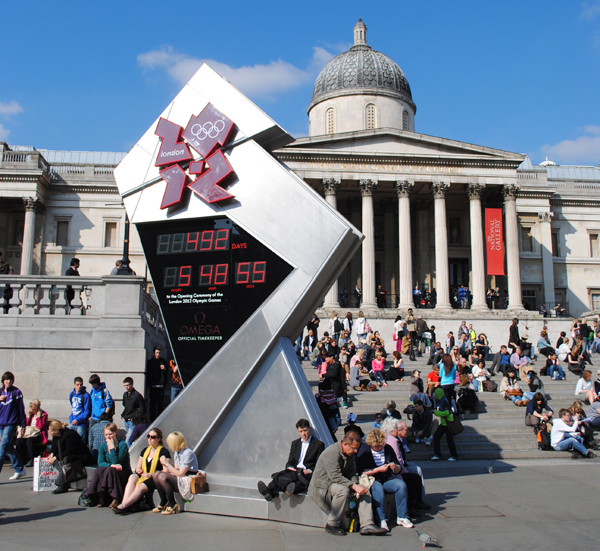
OK, it’s had some teething issues (stopping less than 24 hours after it was launched was one; being daubed with paint another). But the countdown to next year’s Olympics on the official 6.5 metre high clock located in Trafalgar Square continues unabated. The clock was unveiled in mid-March, 500 days before the start of the Games.

Keats’ love letter to be returned home; a royal wedding Oyster; youngest Spitfire pilot honored; and, The Cult of Beauty at the V&A

A love letter Romantic poet John Keats wrote to his beloved Fanny Brown will be returned to the house in which it was written. Keats wrote the letter in 1820 while living next door to her at Wentworth House in Hampstead, north London – his home from 1818 to 1820 and the setting that inspired some of his most memorable poetry including Ode to a Nightingale. The City of London Corporation, who manage the house – now a museum known as Keats House, recently purchased the letter with the support of the Heritage Lottery Fund for £80,000. They say it will now be returned to the house and displayed there. In the letter Keats wrote: “I shall Kiss your name and mine where your Lips have been – Lips! why should a poor prisoner as I am talk about such things.” He said his consolation was “in the certainty of your affection”. See www.keatshouse.cityoflondon.gov.uk.

Amid the host of souvenirs and trinkets up for sale in the lead-up to the wedding of Prince William and Catherine Middleton comes news of a unusual offering from Transport for London – a limited edition royal wedding Oyster card. The card, which will go on sale in the week leading up to the ceremony, features a portrait of the couple and their wedding date – 29th April, 2011. More than 750,000 of the cards will be offered for sale. The move is not without precedent – in 1981, a unique ticket was produced for the marriage of Prince Charles and Lady Diana.

• Squadron Leader Geoffrey Wellum, the youngest Spitfire pilot to take part in the Battle of Britain, was granted the Freedom of the City of London at a ceremony at Guildhall last week. Wellum was just 18-years-old when he joined the RAF in August 1939. Serving in a frontline squadron, he flew many combat missions including dogfights during the Battle of Britain and was subsequently awarded the Distinguished Flying Cross.

• On Now: The Cult of Beauty: The Aesthetic Movement 1860-1900 at the Victoria & Albert Museum in . Said to be the “most comprehensive” exhibition ever staged on the Aesthetic Movement in Britain, it brings together masterpieces in painting as well as sculpture, design, furniture, architecture, fashion and literature of the era and explores some of the key personalities  involved in the movement – from William Morris and Frederic Leighton through to James McNeil Whistler, Dante Gabriel Rossetti, Edward Burne-Jones and Oscar Wilde. Organised in collaboration with the Fine Arts Museums of San Francisco, the exhibition runs until 17th July. Tickets are £12 (concessions available). See www.vam.ac.uk.

LondonLife – The Oxford and Cambridge Boat Race

PICTURE: Oxford celebrate their win. Source: Getty Images

Last weekend saw the running of the 157th Oxford and Cambridge Boat Race from Putney to Mortlake on the River Thames in London. Oxford this year added to its tally with a victory which now has the running scores as 80 Cambridge, 76 Oxford.

The origins of the race go back a friendship between two men who’d met at the prestigious Harrow School – Charles Merivale and Charles Wordsworth (incidentally, the nephew of the poet William Wordsworth). Merivale went on to attend Cambridge and Wordsworth, Oxford. The first race was organised after Cambridge challenged Oxford.

The first race, said to have been watched by 20,000 people, was held at Henley on Thames, Oxfordshire, in 1829 after Cambridge sent a challenge to Oxford (Oxford won after a restart). It was such a success that the townfolk decided to organise an annual regatta – the Henley Royal Regatta – but the race itself moved to London with the second event held in 1836.

Initially Westminster was the chosen location but growing crowds led it to be moved again in 1845 – this time what was then the village of Putney, about six miles upstream. It became an annual event in 1856 and has run every year ever since, with the exception of the war years.

The races have featured several sinkings (including 1912 when both boats sank), a win in a blizzard (1952), and a “dead heat” (1877 – although some controversy surrounds how close it was – in any event it was almost repeated in 2003 when Oxford won by just one foot).

Sponsored by Xchanging, the race – in which Oxford traditionally wear dark blue and Cambridge light blue with both teams known as “Blues” – is now watched by some 250,000 people who crowd along the river’s bank as well as millions around the world. Among the traditions which have continued are that it’s the loser of the previous year’s race who challenges the victor to the next race.

For more about the race, see www.theboatrace.org or visit the River & Rowing Museum at Henley on Thames.

Around London – Apsley House’s State Dining Room reopens; St Pancras Renaissance Hotel restored; Sir Basil Spence honored; and, your chance to lift Tower Bridge…

The State Dining Room at Apsley House, the Duke of Wellington’s former London residence, reopened to the public last weekend after a make-over. The revitalisation works included repairing and cleaning the ceiling and chandelier as well as the Portuguese silver centre piece, which was presented to Wellington by the Portuguese Council of Regency to commemorate his victories over Napoleon in the Peninsular War. The house, which bears the landmark address of Number One London, was given to the nation in 1947 by the 7th Duke of Wellington, whose family continues to occupy private rooms in the premises. See www.english-heritage.org.uk/daysout/properties/apsley-house/.

Seventy-six years after it last hosted a guest, the former Midland Grand Hotel at London’s St Pancras station reopened its doors quietly earlier this month following a 10 year, £150 million restoration project. The Grade I-listed Victorian Gothic building, designed by Sir George Gilbert Scott (he also designed the Albert Memorial), originally opened in 1873. It closed in 1935 but was saved from demolition in the 1960s after a campaign led by poet laureate Sir John Betjeman. Among the highlights of the recent project is the restoration of the Sir George Gilbert Scott suite to look like it did in the Victorian era. The hotel, rebranded the St Pancras Renaissance Hotel,  will be officially opened on 5th May, exactly 138 years after it first opened. See www.marriott.com/hotels/travel/lonpr-st-pancras-renaissance-london-hotel/.

Architect Sir Basil Spence (1907-1976) has been honored with an English Heritage blue plaque outside his former home and office in Islington. The architect, best known for his redesign of Coventry Cathedral after it was bombed by the Luftwaffe during World War II, lived and worked at 1 Canonbury Place from 1956 until the mid-1960s. He and his family then moved next door while he continued to use the property as his offices (it remained in use as architectural offices long after his death). Other commissions for which Sir Basil is known include Kensington and Chelsea Town Hall, the controversial Knightsbridge Barracks and the Swiss Cottage Library. Internationally, his works included the unusual ‘beehive’ extension to the Parliament Building in Wellington, New Zealand.

• Now On: Your chance to lift the two 1,100 tonne bascules at Tower Bridge. The City of London Corporation this week launched their annual competition to find a “guest bridge driver”. Enter by going to Tower Bridge’s website (www.towerbridge.co.uk) and answering a question about the bridge or the Square Mile. The winner will be drawn next month and as well as using the controls to lift and lower the bridge, will receive a commemorative certificate in the control cabin, a tour of the Tower Bridge Exhibition and the chance to visit the underground bascule chamber and fifth-level turrets, neither of which are normally open to the public. They’ll also be presented with a bottle of champagne.

Around London – Happy St Patrick’s Day; 18th century workhouse saved; David Gestetner honored; and, Watteau’s drawings…

• First-up, we’d like to wish you all a happy St Patrick’s Day! And if you missed the St Patrick’s Day Parade and free festival in London last Sunday, don’t worry, there’s still plenty of Irish cheer on the city streets with the London Eye and Battersea Power Station both turning green to mark the occasion while the green beer is flowing at the city’s many Irish pubs.

The building some believe served as a model for the workhouse in Charles Dickens’ novel Oliver Twist has been saved from demolition with a Grade II listing. Completed in 1778, the Covent Garden Workhouse in Cleveland Street became the workhouse of The Strand Poor Law Union in 1836 and was later used as an infirmary before more recently serving as the outpatients department of the Middlesex Hospital. The workhouse is believed to the most well preserved of the three surviving 18th century workhouses in London. Announcing the listing this week, John Penrose, Minister for Heritage and Tourism, said that while it is unknown whether or not the building was the inspiration for the workhouse featured in Oliver Twist, “we know that it is the sole survivor of the workhouses  that were operating in the capital when Dickens wrote his famous novel and that as a young man he lived just nine doors along from it”. Simon Thurley, chief executive of English Heritage, said the listing also recognised the association between the workhouse and Dr Joseph Rogers, whose direct experience of the workhouse when working as Chief Medical Officer led him to launch important reforms of the system of healthcare provision for the poor.

David Gestetner, a key player in the development of office copying technology, has been commemorated with a blue plaque outside his former residence at 124 Highbury New Park in Islington. The Hungarian-born Gestetner lived at the property for 41 years until his death in 1939. The plaque was unveiled on Tuesday by two of his great grand-children.

On Now: Watteau: The Drawings. The first retrospective exhibition of the drawings of French artist Jean-Antoine Watteau opened last Saturday at the Royal Academy of Arts. Watteau is known for inventing the genre of fetes galantes (small pictures of social gatherings of elegant people in parkland settings) and for his mastery of the ‘three chalks’ or trois crayons technique using red, black and white. The exhibition features more than 80 works on paper. There is an admission charge. Runs until 5th June. See http://www.royalacademy.org.uk for more information.

Around London – Transport depot open day; Brixton Windmill to reopen; and, St Pancras’ Olympic Rings

The London Transport Museum Depot’s ‘Open Weekend’ kicks off on Saturday. The weekend of events at the depot in Gunnersbury Lane, Acton, will feature model railways, the chance to ride the Acton Miniature Railway – on either a replica 1938 tube train or a Metropolitan steam train – as well as heritage buses, and talks by author and broadcaster Christian Wolmar on his books Engines of War and Subterranean Railway. There will also be events specifically for children. The depot is home to more than 370,000 objects including road and rail vehicles, posters and artwork, and ticket machines. Events run from 11am to 5pm (last entry 4pm). There is an admission charge. For more information, see www.ltmuseum.co.uk/whats-on/museum-depot/events

Brixton Windmill, the only surviving windmill in inner London, will be open to the public from 2nd May after a major restoration project. The Grade II* listed building, located in Windmill Gardens in Brixton, south-east London, was built in 1816 and was owned by the Ashby family until it ceased production in 1934. It was purchased by the London County Council in 1957 but had since fallen into disrepair. The restoration project, which kicked off in October last year, was partly funded by a £397,700 Heritage Lottery Fund grant obtained by Friends of Windmill Gardens and Lambeth Council. It is envisaged that interpretation materials will be installed and a programme of educational activities run at the site – including growing wheat and mixing flour – after the completion of the restoration work. See www.brixtonwindmill.org for more information.

Giant Olympic Rings were unveiled at St Pancras International earlier this month. The 20 metre wide and nine metre high rings, which have been suspended from the station’s roof, weigh 2,300 kilograms and are made from aluminium. Built in Hertfordshire over four weeks, they took seven nights to install. They’re the first in a series of Olympic Rings that will appear around the city in the lead-up to the 2012 Games. The Olympics was last held in London in 1948.

Around London – Burial place of Bunyan, Defoe and Blake gets Grade I listing; Kew Gardens joins Streetview; and, Afghan treasures on show…

The London burial place of writers John Bunyan and Daniel Defoe and artist and poet William Blake has been recognised as one of the city’s most significant historic landscapes with a Grade I listing on the national Register of Parks and Gardens. The news, which was announced last month, also sees 75 tombs located within Bunhill Fields Cemetery individually listed. Bunhill, located between City Road and Bunhill Row, is one of 106 registered cemeteries in London (and now one of only seven Grade I listed cemeteries). It was established in 1660 and, thanks to its not being associated with Anglican place of worship, is viewed as the “pre-eminent graveyard for Nonconformists in England” . About 123,000 burials took place in its four acres before it was closed in 1869. The oldest monument is that of theologian Theophilus Gale, who died in 1678. As well as the tombs of Buynan, Defoe and Blake, others listed on the register include that of Dame Mary Page, who died in 1728 and whose tomb inscription talks of her stoicism in the face of 240 gallons of water being taken out of her prior to her death, and Joseph Denison, a banker who died in 1806 and was one of England’s wealthiest commoners at the time. The listing was made by the Department of Culture, Media and Sport following advice from English Heritage. For more on Bunhill Fields, follow this link

Kew Gardens has joined Google Streetview, meaning it’s now possible to navigate your way around the gardens from the comfort of your own home. More than 26 kilometres of paths and the interiors of some of the garden’s glasshouses – including the Palm House and the Temperate House – can now be seen on Streetview which offers 360 degree views. Professor Stephen Hopper, director at Kew, says the new technology is “bound to encourage people to visit us and experience Kew for themselves”. Follow this link to see the gardens on Streetview.

• On Now: Afghanistan’s heritage is on display in a newly opened exhibition at the British Museum. Afghanistan: Crossroads of the Ancient World showcases more than 200 objects from the National Museum of Afghanistan as well as some items from the British Museum and includes sculptures, ivory inlays once attached to furniture, Roman glassware and Egyptian stone tableware, and inlaid gold ornaments once worn by the area’s “nomadic elite”. The objects were found between 1937 and 1978 and were preserved thanks to officials who kept them out of harm’s way during the Soviet and Taliban eras. The museum announced this week that they would be joined by carved ivory fragments that were stolen from Afghanistan’s national museum in the early 1990s and only recently presented to the British Museum by a benefactor with the idea that they will eventually be returned to Kabul. The exhibition runs until 3rd July. There is an admission charge. For more information, see www.britishmuseum.org.

Around London – Sir John Soane’s private apartments to be restored; Highland cattle to return to Richmond; and two new photographic exhibitions…

• An appeal has been launched to raise the final £500,000 of a £7 million project to restore Sir John Soane’s private apartments in his former home overlooking Lincoln’s Inn Fields in Holborn. Phase one of the three year restoration project, Opening up the Soane, is expected to be complete by late 2012 with the entire project – which will see all of the rooms open to the public – to be completed by 2o14. The eight rooms being restored in the project, all of which are located on the second floor of No. 13 Lincoln’s Inn Fields – one of three adjoining properties Soane owned , include the architect’s bedroom, bathroom, oratory and book passage as well as Mrs Soane’s morning room and a room containing Soane’s architectural models. The building  already contains the Sir John Soane Museum which features an eclectic and at time outright strange mix of artefacts Soane, designer of the Bank of England (although it has since been substantially altered), collected during his lifetime. For more information, see www.soane.org.

Highland cattle will return to Richmond Park in autumn to help create patches of bare ground for wildflowers to grow after the success of a recent grazing trial. Richmond Park has the most extensive area of natural grassland in London and the type of grassland – known as ‘acid grassland’ – is a nationally rare habitat. Richmond Park is already home to 650 red and fallow deer. For more information, see www.royalparks.org.uk.

On Now – A new exhibition of street photography in London has just opened at the Museum of London. London Street Photography showcases 200 candid images of everyday life in the city with images ranging from sepia-toned scenes of horse-drawn cabs captured by tripod mounted cameras through to the use of digital cameras in snapping images of 21st century residents. Among the 59 photographers whose work is on display is that of Paul Martin, who pioneered the idea of candid street photography in London in the early 1890s, freelance photojournalist Henry Grant who photographed London’s streets in the Fifties and Sixties, and Stephen McLaren, known for his contemporary “quirky and colorful” street images. Entry is free. The exhibition runs until 4th September. For more information, see www.museumoflondon.org.uk.

On Now – The first major exhibition in 30 years of the work of EO Hoppe has opened at the National Portrait Gallery. Hoppe, who lived from 1878 to 1972, is considered one of the most important photographers of the early 20th century and is described as the “prototypical celebrity photographer”, shooting among others Margot Fonteyn, George Bernard Shaw, King George V, David Lloyd George and Ezra Pound. He also published the Book of Fair Women – photographs of women he believed to be the most beautiful of earth – in 1922 and in the Twenties and Thirties increasinly spent time outside the studio photographing street life. Hoppe Portraits: Society, Studio and Street runs until 30th May. For more information, see www.npg.org.uk.

Around London – A clowning Sunday, and Sir William Ramsay honored…

Clowns turned out en masse for the annual clown service held in honour of the ‘father of modern clowning’, Joseph Grimaldi, at Holy Trinity Church in Dalston last weekend. The London-born clown, who lived from 1778 to 1837, is became widely known for his pantomine performances and is believed to have been the first ‘white face’ clown. He has been honored at a “clown service”, held on the first Sunday in February, since the mid-1940s. It was originally held at St James’ Church, Islington – where Grimaldi was buried – but was moved after the church was demolished. His grave is preserved in a memorial garden on the site.

• Sir William Ramsay, the Nobel Prize-winning chemist credited with discovering the noble gases, has been commemorated with a blue plaque at his former home in Notting Hill. The Glasgow-born Ramsay moved to London in 1887 when appointed chair of chemistry at University College London and it was while living at 12 Arundel Gardens, Notting Hill, that he discovered the five noble gases. Ramsay lived at the property until 1902. He died in 1916. English Heritage unveiled  the plaque on Wednesday.

Around London – Year of the Rabbit celebrations; virtual art galleries; and, to the moon and back on ‘Boris bikes’

London will celebrate Chinese New Year this Sunday as it once again hosts the largest celebrations outside of Asia attracting some 250,000 people from around the globe. The event programme, which celebrates 2011 as the Year of the Rabbit, kicks off at 11am on the main stage in Trafalgar Square with firecrackers at noon, a Lion and Dragon performance at 1.10pm and dance and song during the afternoon culminating in a finale just before 6pm. There will also be a stage in Shaftesbury Avenue with performances throughout the day. Roads in the area will be closed for the event.

You no longer have to be in London to walk through the galleries of the Tate Britain or the National Gallery. Both institutions are among 17 around the world taking part in the Google Art Project which allows web surfers to virtually “walk” around the museum using the organisation’s Street View technology and turn 360 degrees to view the artworks in situ on the walls. The project also allows viewers to look through images of more than 1,000 artworks and, in addition, each institution has selected one artwork which then captured in “super high resolution” and then placed on line (Hans Holbein’s The Ambassadors‘ for the National Gallery, Chris Ofili’s No Woman, No Cry for the Tate). See www.googleartproject.com for more.

Cyclists have ridden the distance to the moon and back 13 times – 10 million kilometres – since the launch of Mayor Boris Johnson’s cycle scheme. Transport for London released figures this week showing riders have made more than 2.5 million journeys on the “Boris bikes” since the scheme was launched six months ago. The TfL has announced plans to expand the Barclays Cycle Hire scheme to new areas of east London including all of the Borough of Tower Hamlets, North Shoreditch, Bethnal Green, Bow, Canary Wharf, Mile End and Poplar by spring 2012. Almost 110,000 people are now signed up to the scheme. www.tfl.gov.uk.

The youngest Spitfire pilot in the Battle of Britain is to be granted the Freedom of the City of London in a special ceremony next month. Squadron Leader Geoffrey Wellum was awarded the Distinguished Flying Cross for his service in a front line squadron during the battle.

Around London – New fourth plinth sculptures announced; Australian Season at British Museum; and Kenwood House shows off gardens…

• Sculptures of a child on a rocking horse and a giant blue cockerel will occupy Trafalgar Square’s fourth plinth in 2012 and 2013 respectively, it was announced late last week. The Mayor of London, Boris Johnson, described the artworks as “witty and enigmatic creations”. The first proposed first sculpture, correctly titled Powerless Structures, Fig. 101, is the creation of Elmgreen & Dragset while the second, Hahn/Cock, is that of Katharina Fritsch. The plinth is currently occupied by Yinka Shonibare’s Nelson’s Ship in a Bottle. See www.fourthplinth.co.uk.

The British Museum has announced it will be holding a series of exhibitions and events focusing on Australia later this year. Highlights of Australian Season will include Australia Landscape: Kew at the British Museum (21st April to 16th October), an exhibition of prints and drawings dating from the ‘Angry Penguin’ school of the 1940s through to the rise of Aboriginal printmaking (Out of Australia: prints and drawings from Sidney Nolan to Rover Thomas, from 26th May to 11th September), and an exhibition focusing on indigenous Australian baskets (Baskets and belong: Indigenous Australian histories, 26th May to 29th August). See www.britishmuseum.org.

On Now: Kenwood House in Hampstead is hosting a new exhibition, The Gardens of English Heritage. The exhibition, which is based on the publication of the same name, features stunning images of some of the UK’s most impressive gardens.Runs until 3rd April. For more information, see www.english-heritage.org.uk/daysout/properties/kenwood-house/

Around London – Composer Herbert Howells honored; London Eye’s new name; and, the Natural History Museum’s new gallery…

Composer and teacher Herbert Howells has been commemorated with a blue plaque on his former home in Barnes, south west London. Known for composing “recognisably English” works, Howells is considered by man to be the last of the great English Romantic composers and is particularly remembered for this contributions to the Anglican liturgy. According to English Heritage, Howells lived at the house at 3 Beverley Close from 1946 until a few weeks before he died in 1983. For more on Howells, see www.howellstrust.org.uk.

The London Eye is to have a name change. Having started life as the Millennium Wheel (while still under construction), it was officially named the British Airways London Eye when it first opened in March 2000 and later renamed the Merlin Entertainments London Eye when the BA naming deal expired. Following a new deal, the wheel will be known as the EDF Energy London Eye from the end of this month.

On Now – The Natural History Museum’s new Images of Nature gallery opens tomorrow. The new permanent gallery showcases the museum’s collection of natural history artworks and includes works by bird illustrator, John Gerrard Keulemans, and botanical artist, Georg Ehret as well as a range of more modern-day creations such as a 3D scan of a shark’s head. The gallery also boasts a temporary annual exhibition with the first, a rotating collection of Chinese watercolors, featuring works by 19th century amateur naturalist John Reeves as well as contemporary works by the museum’s Shanghai-based artist-in-residence. Entry is free. See www.nhm.ac.uk.

Around London – City’s history goes online; London’s oldest structure discovered?; and, my, how prices have changed…

• Four hundred years of London’s history is being put online as part of a new project on the City of Westminster’s website. The council is publishing a new picture depicting a different historical event from the city’s tumultuous history every day throughout 2011 under its A date with history project. The images, taken from the council’s archives, include photographs, engravings and sketchings. They include a black and white photo of queues of people waiting on Vauxhall Bridge to pay their final respects to King George V lying in state at Westminster Hall after his death on 20th January, 1936, another photograph showing the King and Queen with PM Winston Churchill inspecting damage to Buckingham Palace’s swimming pool following a raid during the Blitz in September, 1940, a hand-colored print depicting the execution of King Charles I on 30th January, 1649, and an engraving showing a comet passing by the spire of St Martin in the Field in 1744. It is the first time the images have been made freely available online. To see the images, head to www.westminster.gov.uk/archives/day-by-day.

What could be London’s oldest structure has been unearthed on the Thames foreshore. Six timber piles up to 0.3 metres in diameter have been discovered only metres from the MI6 headquarters in Vauxhall, part of what archaeologists believe is part of a prehistoric structure which stood on the river bank more than 6,000 years ago during the Mesolithic period when the river was lower. The find, made by a Thames Discovery Programme team, is only 600 metres away from a Bronze Age timber bridge or jetty dating from 1,500 BC which was discovered in 1993. The piles may be able to be seen from Vauxhall bridge during low tides between 10.25am on 22nd January and 11.15am on 23rd January.

Homes in London were purchased for an average price of £14,000 back in 1910, according to land tax valuations documents released online this week. Ancestry.co.uk has placed the London, England Land Tax Valuations 1910 – compiled as part of David Lloyd George’s 1910 Finance Act, known as the Domesday Survey – online to help people discover more about the financial situations of their ancestors. The documents put the value of the Bank of England at £110,000, the Old Bailey at £6,600, and Mansion House at a more impressive £992,000. The average value of property on Fleet Street was £25,000 (compared with £1.2 million today) while in Cannon Street, the average value was £20,000 (£2.2 million) and in Chancery Lane, the average value was just £11,000 (£1.1 million).

Around London – Dulwich celebrates 200 years, and Tube life captured on lens…

The Dulwich Picture Gallery  in south London is celebrating its bicentenary this year and to celebrate it’s holding a day of celebrations on Sunday (9th January). The gallery was founded in 1811 when art dealer Sir Francis Bourgeois bequeathed his collection of old masters for the “inspection of the public”. Interestingly, Sir Francis and his colleague Noel Desenfans had assembled the collection at the behest of the Polish King, Stanislaus Augustus, but when Poland was annexed by Russia and the king forced into exile, the two dealers were left with the goods. Sunday’s programme of events includes music, falconry displays and a family costume workshop as well as fireworks. For more information, see www.dulwichpicturegallery.org.uk.

Artist Belinda Dawley had captured life on the Underground with a series of photographs of people riding the escalators. Called, appropriately enough, Escalators, the work features portraits of travellers on 14 different escalators. To see the image, head to www.belindalawley.com.

Around London – New Year’s Eve fireworks; New Year’s Day Parade; and remembering the Blitz…

A British pyrotechnic company, Kimbolton Fireworks, will be used for the first time in the creation of the Mayor of London’s fireworks display at the London Eye on New Year’s Eve. And in another first, the firework display will be accompanied by music. The mayor’s office have warned that viewing areas for the fireworks fill up early (and will be closed when full) and have suggested that families with young children may consider attending a fireworks display closer to home. For more information, including a detailed viewing area plan, see www.london.gov.uk/get-involved/festivals/newyearseve/at-fireworks.

London’s New Year’s Day parade celebrates it’s 25th anniversary when it kicks off at 11.45am on New Year’s Day. The parade route starts outside the Ritz Hotel in Piccadilly and runs down Lower Regent Street and along Pall Mall and Cockspur Street into Trafalgar Square before heading down Whitehall and into Parliament Square where it concludes at 3pm. The parade will involve some 10,000 people representing 20 different countries. More than half a million people are expected to line the route. For more information, see www.londonparade.co.uk.

Firefighters have laid wreaths at the Firefighters’ Memorial outside St Paul’s Cathedral in commemoration of the 70th anniversary of one of the worst nights of the Blitz. More than 160 people were killed on the night of 29th December, 1940, in what became known as the ‘Second Great Fire of London’. While large parts of the city were destroyed in the German attack, St Paul’s was spared a similar fate thanks to the actions of specialist firefighters assigned to the building. The night was immortalised by Daily Mail photographer Herbert Mason in what is now an iconic photograph of the Blitz showing the great dome of St Paul’s wreathed in smoke.

Around London – 100 years since the Siege of Sidney Street;

It’s 100 years since the Siege of Sidney Street and the Houndsditch Murders and to mark the occasion, the Museum of London Docklands opens a special exhibition this Saturday.

The murders took place on 16th December, 1910, when a group of Latvian revolutionaries attempted to break into a jeweller’s shop in Houndsditch. Three City of London policemen were killed and two more disabled for life in the gunfight which broke out.

Two weeks later, on 3rd January, 1911, the Siege of Sidney Street began when more than 200 armed police and a detachment of Scots Guards besieged a home at 100 Sidney Street in Stepney where two of the Houndsditch gang were believed to be hiding.

The exhibition, which has been put together in partnership with the Jewish East End Celebration Society, features objects from the trial of suspected gang members as well as never-before-seen objects including guns taken from the crime scene and safe-breaking equipment. The overcoat Winston Churchill wore on the day of the siege – he attended in his capacity as Home Secretary – will also be on display.

London Under Siege: Churchill and the Anarchists, 1911, runs from 18th December to April 2011. Entry is free. For more information, see www.museumindocklands.org.uk.

• Meanwhile a plaque was unveiled today on the site in Cutler Street where three policemen – Sergeant Robert Bentley, 36, Sergeant Charles Tucker, 46, and PC Walter Choat, 34 – were killed during the gunfight with the gang. Two other policemen were disabled for life and a fireman, Superintendent Charles Pearson, later died after he entered the Sidney Street property which had been gutted by fire. A plaque will be unveiled in his honor on 6th January.

Around London – Imperial War Museum’s WWI revamp; St Paul’s Christmas broadcasts; House Mill to be restored; Henry III’s rolls online; and, Winter Wonderland in Hyde Park

The Imperial War Museum has unveiled plans for a major rebuilding project at its Lambeth headquarters to culminate with the 100th anniversary of the start of World War I in 2014. Under a £71 million proposal, the size of the existing World War I galleries will be doubled and a new atrium will be created with further works – including a new sunken entrance – to be completed by 2019. The museum moved to its Lambeth location, formerly the Bethlem Royal Hospital, in 1936. Prince William is fronting the first £29 million appeal for funds. Meanwhile plans have reportedly been mooted to have the decommissioned aircraft carrier, the HMS Ark Royal, brought to London where it would be permanently moored in the Thames as a tourist attraction akin to the HMS Belfast.

St Paul’s Cathedral has announced it will provide live outdoor broadcasts of its three most popular Christmas services for the first time to allow those who can fit in the cathedral to participate. A 25 metre screen will be set up in Paternoster Square, next to the cathedral, where ‘A Celebration of Christmas’ will be screen on 16th December at 6.30pm along with Christmas Carol services on the 23rd and 24th December at 4pm. See www.stpauls.co.uk.

An historic 18th century mill in East London will undergo restoration after the granting of a £248,000 lottery grant. House Mill, which dates from 1776, is believed to be the largest tidal mill still in existence anywhere in the world. Built across the River Lea, the mill was used for flour-making and for a distillery located next door on Three Mills Island in Bow. The project, which is being managed by the River Lea Tidal Mill Trust, involves the restoration of the mill as well as the adjoining Miller’s House and the creation of a visitor’s centre. The trust says it has also been given the “green light” for a further £2.65 million Heritage Lottery Fund grant. See http://housemill.org.uk.

A three year project has made documents drawn up for King Henry III in the 13th century available on the internet for the first time. Project partners Canterbury Christ Church University, King’s College London, and the National Archives in Kew have translated and digitised the king’s ‘fine rolls’, written to record money and favours owed to the king. The rolls consist of 56 parchments – one for each year of his reign which started in 1216 and ended in 1272 – and contain as many as 40,000 entries amounting to some two million words. Some of the parchments, the originals of which are held at the National Archives, measure up to three metres in length. See www.finerollshenry3.org.uk.

On now: Winter Wonderland in Hyde Park. Christmas festivity on a vast scale, Winter Wonderland includes the city’s largest open air ice rink, circus acts, a giant observation wheel, rides and eating places including the igloo-style E:Cube and the Spiegel Saloon. For more information see www.hydeparkwinterwonderland.com.

Around London – Skating at a palace or a tower?; British Military Tournament; and, new blue plaques

Christmas is looming and snow and ice have been besieging London. But there’s plenty you can do to keep warm, including visiting one of the many ice skating venues about the city. Among those with a particularly historic location are rinks at Hampton Court (located against the backdrop of the palace’s west front, it’s open until 9th January – see website for ticket prices and times), in the moat of the Tower of London (also open until 9th January, see website for ticket prices and times), and at Somerset House (open until 23rd January, see website for ticket prices and times).

The British Military Tournament 2010 will be held at Earl’s Court this weekend. The programme features 500 troops, 145 horses, military bands, the field gun run and will include a re-enactment of a combat incident in Afghanistan involving recently returned troops. Presented by ABF The Soldiers’ Charity, with performances on both Saturday and Sunday. For more information – including booking information, see www.britishmilitarytournament.com.

New blue plaques have been unveiled in London marking the former homes of speed daredevils Sir Malcolm Campbell and his son Donald, and ground-breaking photographer Bill Brandt. The plaque for the Campbells, who between them set 10 land speed records and 11 water speed records, is located at Canbury School in Kingston-upon-Thames – Sir Malcolm moved here in 1919, married to Dorothy Whittall the following year, and, Donald was born here in 1921. The family moved in 1922 to Surrey. The plaque for German-born Brandt, meanwhile, was unveiled at 4 Airlie Gardens in Campden Hill. He lived here with his second wife Marjorie Beckett from 1958 and family members still live in the home. Some of his nudes were taken inside. For more information, visit www.english-heritage.org.uk.

Around London – New VC gallery at Imperial War Museum; Roman remains unearthed at Syon Park; and, High Society at the Wellcome Collection…

An exhibition containing the world’s largest collection of Victoria Crosses has opened at the Imperial War Museum, housed in what is the museum’s first new major permanent gallery for 10 years. The Extraordinary Heroes exhibition – housed in the Lord Ashcroft Gallery – contains his Lordship’s collection of 162 Victoria Crosses, awarded for parts played in wars stretching from the Crimean to the Falklands, displayed alongside the 48 Victoria Crosses and 31 George Crosses already held by the museum. As well as the awards, the new gallery will display many objects for the first time, including a badly damaged backpack worn by Lance Corporal Matt Croucher when he leapt on a grenade during action in Afghanistan in 2008 to save the lives of his fellow soldiers (he survived as well), and the diving suit worn by Acting Leading Seaman James Magennis who won a VC for his role in placing limpet mines in the Johore Straits in World War II. The gallery was paid for with a £5 million donation from Lord Ashcroft. Admission is free. For more information, see www.iwm.org.uk.

The remains of a Roman settlement have been unearthed at historic home, Syon Park, in London’s west. Archaeological experts from the Museum of London have already removed around 11,500 pieces of pottery, jewellery and about 100 coins from the site on the Syon Park estate. Syon Park, the home of the Duke of Northumberland, sits on the northern bank of the Thames, opposite Kew Gardens. The site was excavated in 2008 in preparing for the construction of a new luxury hotel there. Some of the artefacts will go on display at the new hotel, the London Syon Park, A Waldorf Astoria Hotel, which will open early next year. The settlement, which includes a Roman road and burials, was discovered only half a metre below ground level. For more information on the property, see www.syonpark.co.uk.

Now on: From an early morning coffee in European cities to chewing betel nut in Asia, the Wellcome Collection’s major winter exhibition, High Society, traces the role mind-altering drugs have played in history and culture. The display includes more than 200 exhibits, from an 11th century manuscript written by monks in Suffolk detailing poppy remedies, to a 17th century account by Captain Thomas Bowrey describing his crew’s experiments with the cannabis drink bhang, and an account of NASA’s experiments with intoxicated spiders. Admission is free. The exhibition runs until 27th February. For more information, see www.wellcomecollection.org.