
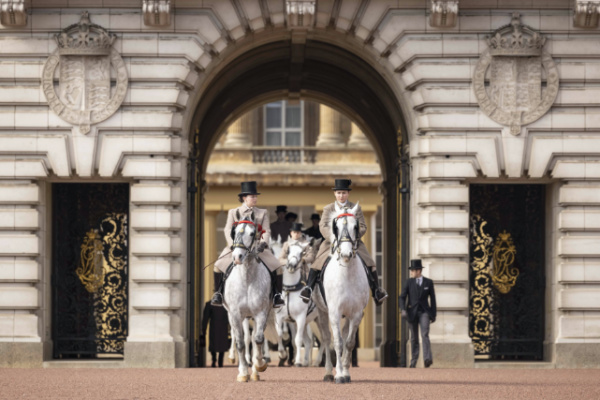
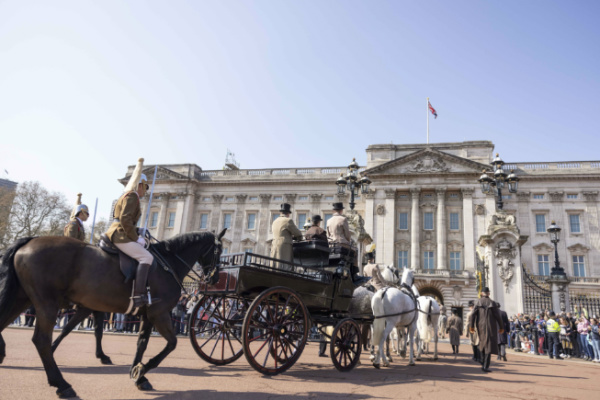
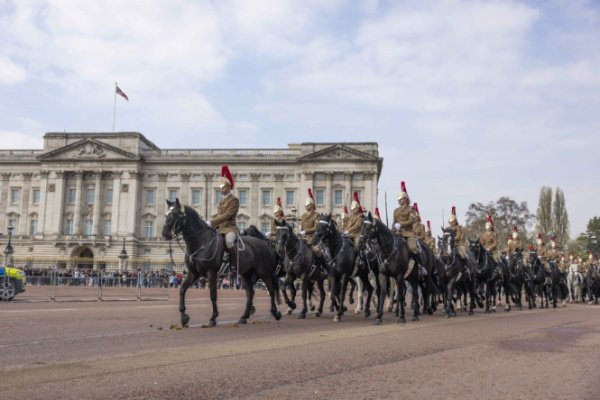
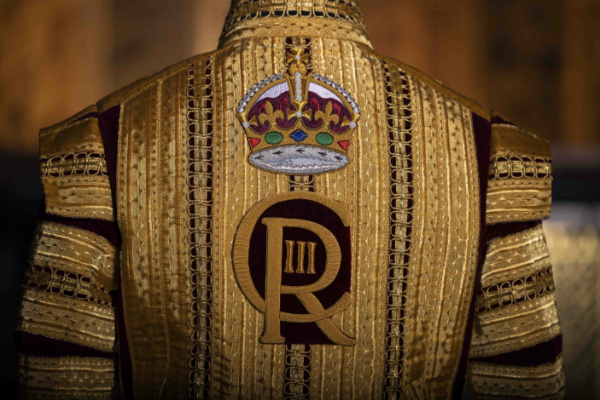
The Gold State Coach will feature in the Coronation Procession of King Charles III (though, interestingly, not for both journeys), it was announced earlier this week so we thought we’d take a more detailed look at it.
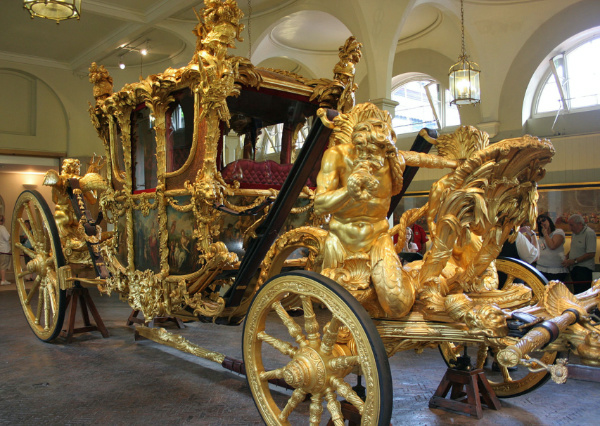
The coach – which was last seen publicly during Queen Elizabeth II’s Platinum Jubilee in June, 2022 – was built for King George III to travel to the State Opening of Parliament in 1762.
Designed by Sir William Chambers, it was built in the London workshops of coach maker Samuel Butler and cost more than £7,500 at the time.
The coach weighs some four tonnes and is 28 foot long and 12 feet high. The coach is made of giltwood – a thin layer of gold leaf over wood – and features sculptures by Sir Joseph Wilton including three cherubs on the roof (representing England, Ireland and Scotland) and four tritons (a display of imperial power) above the wheels. The coach is also decorated with painted panels depicting Roman gods and goddesses by artist Giovanni Battista Ciprian.
Inside the coach is lined with velvet and satin.
The coach is pulled by a team of eight horses wearing a Red Morocco leather harness. At the coronation it will be pulled by Windsor Greys and due to its age and weight, will only move at walking pace.
The coach has been used in every coronation since that of King William IV and was also used for the State Opening of Parliament by Kings George III, George IV and William IV as well as Queen Victoria (up until Prince Albert’s death).
The coach is, however, not said to be the most comfortable ride – Queen Elizabeth II is known to have said so while King William IV described travelling in the coach as like being on a ship “in a rough sea”. So it will only be used for the return, post-Coronation, journey from Westminster Abbey to Buckingham Palace.
For the outward journey – from Buckingham Palace to Westminster Abbey – the King and Queen Consort Camilla will travel in the more comfortable – and Australian-made – Diamond Jubilee State Coach (unlike the Gold State Coach, it comes with air-conditioning, modern suspension and electric windows).
Both coaches are usually housed in the Royal Mews at Buckingham Palace.
On Coronation Day, the Gold State Coach will transport the newly crowned King and Queen Consort on a shorter route than that of Queen Elizabeth II on her Coronation Day – just 1.3 miles compared to the late Queen’s five mile route back to the palace. Leaving Westminster Abbey, it will travel down Whitehall and pass under Admiralty Arch before travelling down The Mall to Buckingham Palace.
WHERE: The Royal Mews, Buckingham Palace (nearest Tube stations are Victoria, Green Park, St James’s Park and Hyde Park Corner); WHEN: 10am to 5pm (check website for closure dates around the coronation); COST: £15 adults/£10 young person (aged 18-24)/£9 child (aged five to 17); WEBSITE: www.rct.uk/visit/the-royal-mews-buckingham-palace
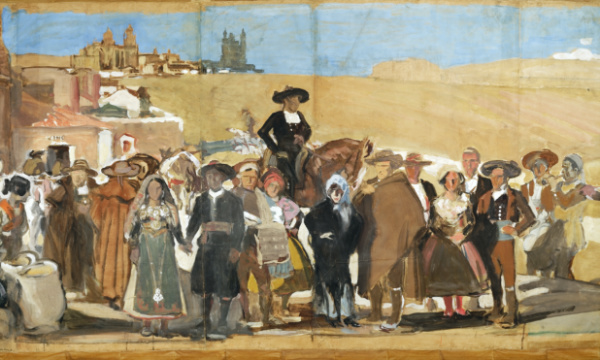
• The collection of the Hispanic Society Museum & Library in New York is being celebrated in a new exhibition opening at the Royal Academy of Arts. Opening Saturday, Spain and the Hispanic World: Treasures from the Hispanic Society Museum & Library features more than 150 works from the collection – founded in 1904 by Archer M Huntington – which range from paintings and sculptures to jewellery, maps and illuminated manuscripts. Highlights include Francisco de Goya’s painting The Duchess of Alba (1797), Pedro de Mena’s reliquary bust, Saint Acisclus (c1680), earthenware bowls from the Bell Beaker culture (c2400-1900 BC), Celtiberian jewellery from the Palencia Hoard (c150-72 BC), and Hispano-Islamic silk textiles including the Alhambra Silk (c1400). There’s also a beautifully illuminated Hebrew Bible (after 1450-97), an exceptionally rare Black Book of Hours (c1458), and, Giovanni Vespucci’s celebrated world map from 1526. The exhibition runs until 10th April. Admission charge applies. For more, see www.royalacademy.org.uk.
• The Lunar New Year is being celebrated in Greenwich this Saturday with a series of events at the National Maritime Museum. Activities range from Mahjong workshops to seeing a traditional lion dance, lantern making, a tea ceremony demonstration and, of course, the chance to find out about the items in the museum’s collection with Asian connections. For more, see www.rmg.co.uk/whats-on/national-maritime-museum/lunar-new-year.
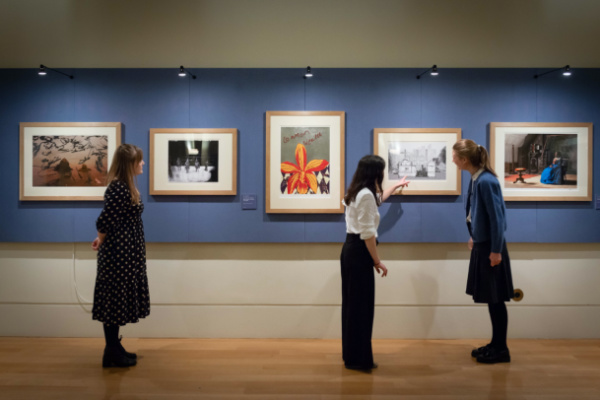
• Twenty contemporary artworks gifted by the Royal Academy of Arts to Queen Elizabeth II ar on display at The Queen’s Gallery in Buckingham Palace. The works on paper – created by Royal Academicians elected in the past decade – were presented to the Queen to mark her Platinum Jubilee in 2022. They include Wolfgang Tillmans’ Regina – a photograph taken during Queen Elizabeth II’s Golden Jubilee celebrations in 2002 depicting the Queen in the Gold State Coach passing along Fleet Street, Yinka Shonibare’s Common Wealth – a digital print of an orchid against a collage of platinum leaf and Dutch wax printed fabric, and Sir Isaac Julien’s Lady of the Lake – a fictionalised portrait of the American abolitionist Anna Murray Douglass as well as a digital print of Thomas Heatherwick’s design for the Tree of Trees project. This 21-foot sculpture incorporates 350 saplings and was erected outside Buckingham Palace as part of The Queen’s Green Canopy and was illuminated during a special Platinum Jubilee ceremony on 2nd June last year. The works can be seen until 26th February. Admission charge applies. For more, see www.rct.uk.
Send all items for inclusion to exploringlondon@gmail.com.
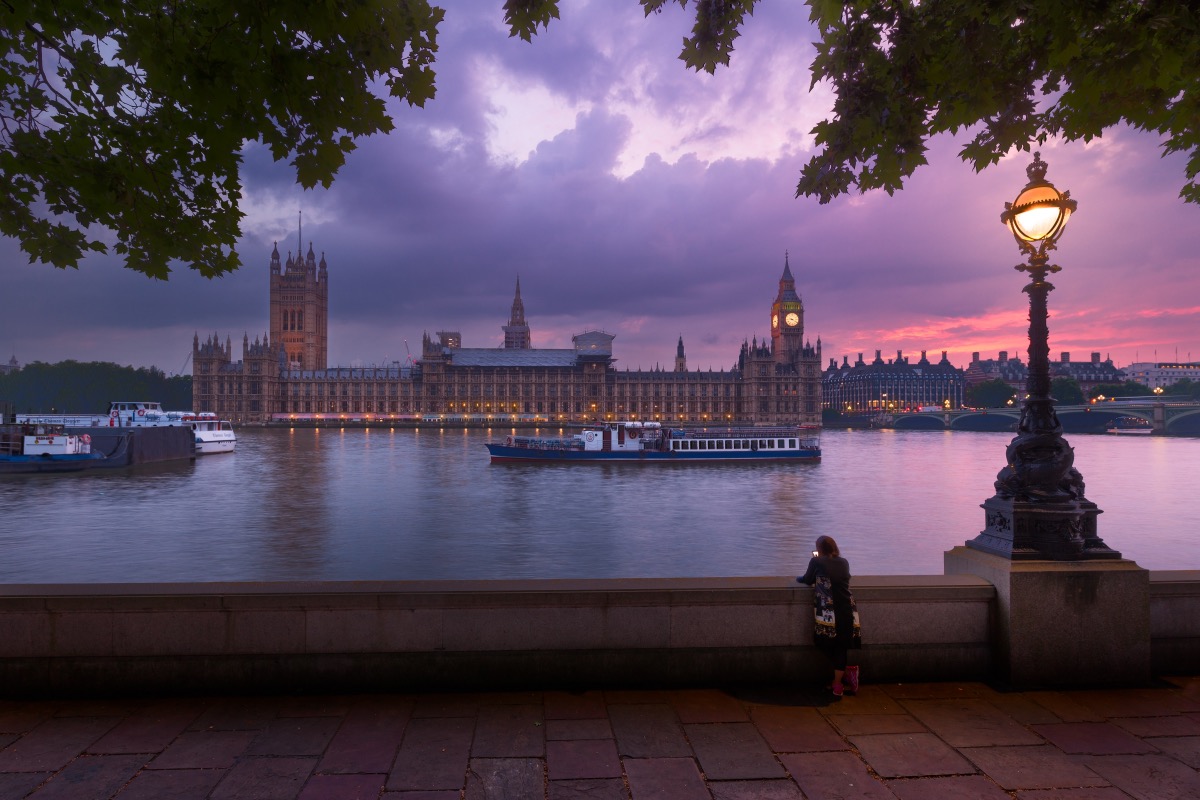
Rishi Sunak was appointed as the nation’s third Prime Minister in less than two months today following Liz Truss announcement she would resign on Friday. Sunak visited King Charles III at Buckingham Palace after Truss visited earlier to officially resign.
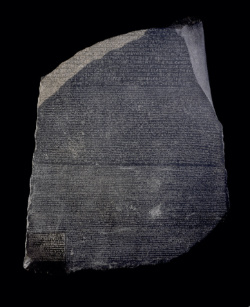
• Marking 200 years since French Egyptologist Jean-Francois Champollion (1790-1832) was able to decipher hieroglyphs using the Rosetta Stone, a new exhibition opening at the British Museum explores how the stone and other inscriptions and objects helped scholars unlock one of the world’s oldest civilisations. Hieroglyphs: unlocking ancient Egypt centres on the Rosetta Stone but also features more than 240 other objects, many of which are shown for the first time. Alongside the Rosetta Stone itself, highlights include: “the Enchanted Basin”, a large black granite sarcophagus from about 600 BCE which is covered with hieroglyphs and images of gods; the richly illustrated, more than 3000-year-old Book of the Dead papyrus of Queen Nedjmet which measures more than four metres long; and the mummy bandage of Aberuait, a souvenir from one of the earliest ‘mummy unwrapping events’ in the 1600s where attendees each received a piece of the linen, preferably inscribed with hieroglyphs. There’s also the personal notes of key figures in the race to decipher hieroglyphs including those of Champollion which come from the Bibliothèque nationale de France as well as those of England’s Thomas Young (1773 – 1829) from the British Library. The exhibition can be seen in the Sainsbury Exhibition Gallery until 19th February. Admission charge applies. For more, see britishmuseum.org/hieroglyphs.
• King Charles III will be crowned at Westminster Abbey on 6th May next year, Buckingham Palace has announced this week. The Queen Consort, Camilla, will be crowned alongside him in the first such coronation since 12th May, 1937, when King George VI and Queen Elizabeth were crowned in the abbey. The ceremony, which will be conducted by the Archbishop of Canterbury, will, according to the palace, “reflect the monarch’s role today and look towards the future, while being rooted in longstanding traditions and pageantry”. King Charles III is expected to sign a Proclamation formally declaring the coronation date at a meeting of the Privy Council later this year. The first documented coronation at Westminster Abbey was that of King William the Conqueror on 25th December, 1066, and there have been 37 since, the most recent being that of Queen Elizabeth II on 2nd June, 1953.
• A new dark comedy, The Admiral’s Revenge, has opened in The Admiral’s House in the Old Royal Naval College, Greenwich. The play, set in 1797, features sea shanties, puppetry and follows a crew of shipmates in the wake of the ill-fated Battle of Tenerife. Audiences have the chance to explore the Admiral’s House before the show and enjoy a complimentary rum cocktail. Runs until 12th November. For ticket prices, head to https://ornc.org/whats-on/1797-the-mariners-revenge/.
• A new exhibition exploring Charles Dickens’ interest in the paranormal has opened at the Charles Dickens Museum in Bloomsbury. To Be Read At Dusk: Dickens, Ghosts and the Supernatural explores Dickens’ famous ghost stories, including A Christmas Carol, and reveals his influence on the genre. Highlights include a copy of The Chimes which Dickens gifted to fellow author Hans Christian Anderson, original John Leech sketches of Dickens’ ghosts of the past, present and future and original tickets and playbills relating to the author’s public performances of his ghost stories. The display will also look into Dickens’ own views on the supernatural as a fascinated sceptic and includes correspondence in which he was asking about the location of a supposedly haunted house. Runs until 5th March. Admission charge applies. For more, see https://dickensmuseum.com/blogs/all-events/to-be-read-at-dusk-dickens-ghosts-and-the-supernatural.
Send all items to exploringlondon@gmail.com
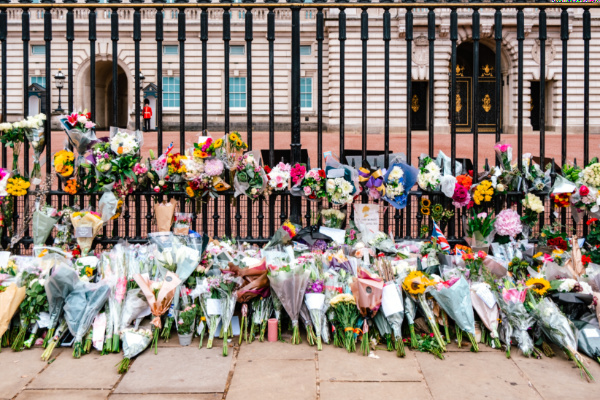
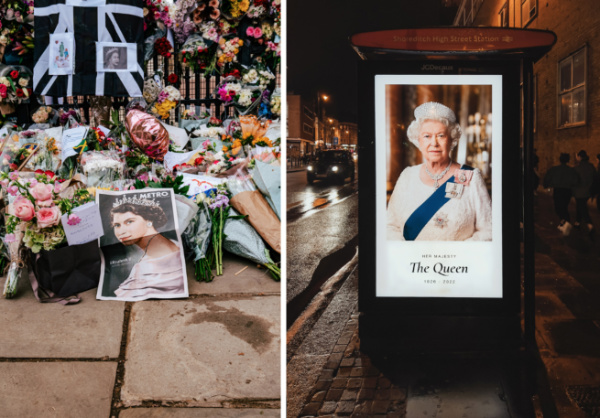
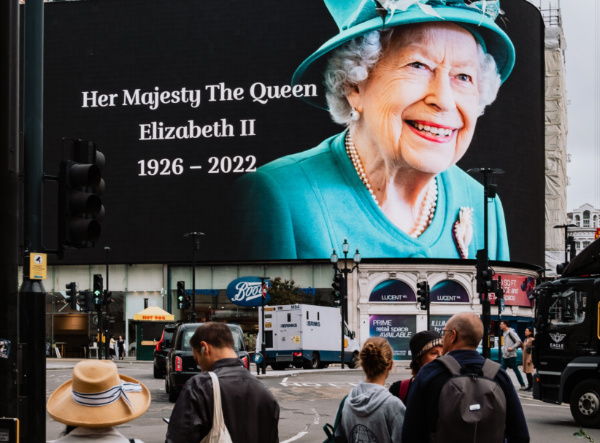
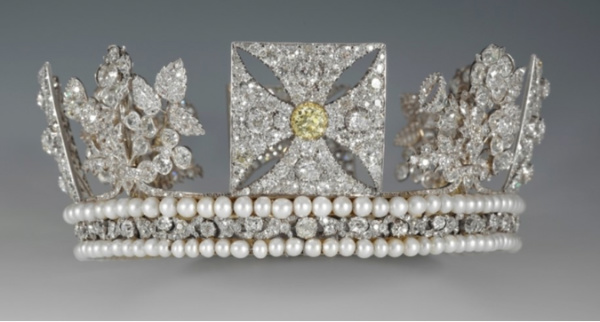
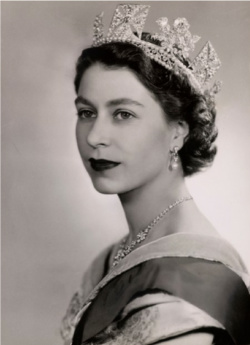
• Key items of Queen Elizabeth II’s jewellery including the Diamond Diadem and the Delhi Durbar necklace go on display in Buckingham Palace’s State Rooms from tomorrow as part of the palace’s Summer Opening. Created for the coronation of King George IV in 1821, the Diamond Diadem is set with 1,333 brilliant-cut diamonds, some of which are set in the form of a rose, a thistle and two shamrocks, the national emblems of England, Scotland and Ireland. The diadem, which was inherited by Queen Victoria in 1837 and passed down to the current Queen, will be displayed alongside the official portraits of the Queen taken by photographer Dorothy Wilding just weeks after the Accession (the portraits were later were used as the basis of the Queen’s image on postage stamps from 1953 until 1971, as well as providing the official portrait of Her Majesty sent to every British embassy throughout the world). The Delhi Durbar necklace, meanwhile, incorporates nine emeralds originally owned by Queen Mary’s grandmother, the Duchess of Cambridge, as well as an 8.8 carat diamond pendant cut from the Cullinan diamond – the largest diamond ever found. It was made for Queen Mary as part of a suite of jewellery created for the Delhi Durbar in 1911. The Queen inherited the necklace in 1953 and wore it in a portrait sitting for Dorothy Wilding in 1956 – thought to have been their last sitting together before Wilding’s retirement in 1958. The jewellery, a special display to mark the Platinum Jubilee, can be seen at the Summer Opening of the State Rooms at Buckingham Palace, the first time the palace has been open to the public in three years, until 2nd October. Admission charge applies. For more, see www.rct.uk.
• An exhibition exploring how design can enhance our experience of ageing has opened at the Design Museum. The Future of Aging includes a selection of prototypes, sketches and research from projects that are being developed by Design Age Institute and its partners. They include a self-balancing, two-wheeled personal electric vehicle known as ‘The Centaur’, a hands-free cargo-carrying robot called Gita, and a digital ‘audioscape’ app that uses the sound of birdsong to engage visitors with their hearing health. The free display also includes a long-term participatory project that explores opportunities for an intergenerational garden at the museum and two new film commissions which showcase stories and experiences of later life. Runs until 25th September. For more, see https://designmuseum.org/exhibitions/the-future-of-ageing.
• On Now: Painting ‘A Bridge with a View’. Until the end of August, English artist Melissa Scott-Miller is painting the views she spies from Tower Bridge’s West Walkway. Visitors are able to observe her at work and take part in related public workshops and family activities. Admission charge applies. For more including the dates for activities, see www.towerbridge.org.uk/see-bridge-view.
Send items to exploringlondon@gmail.com
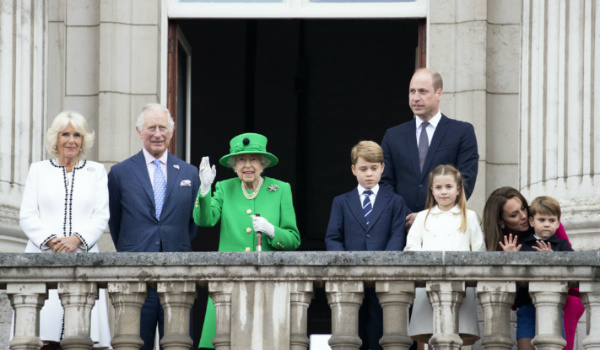
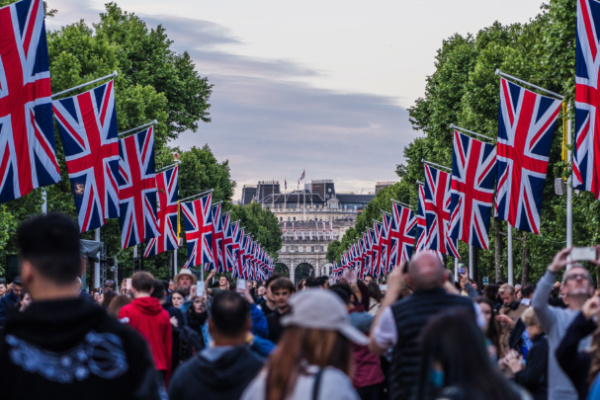
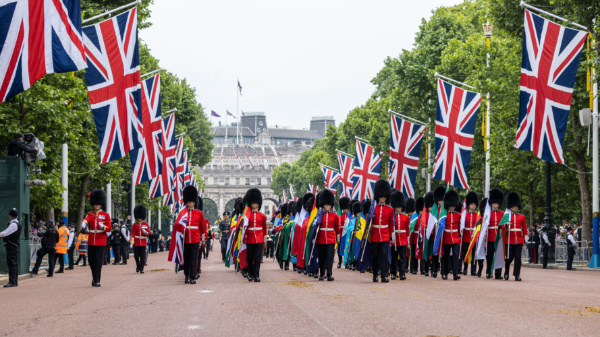
Four days of celebration were held from Thursday to Sunday to mark Queen Elizabeth II’s Platinum Jubilee. Here’s a short selection of images from the events…
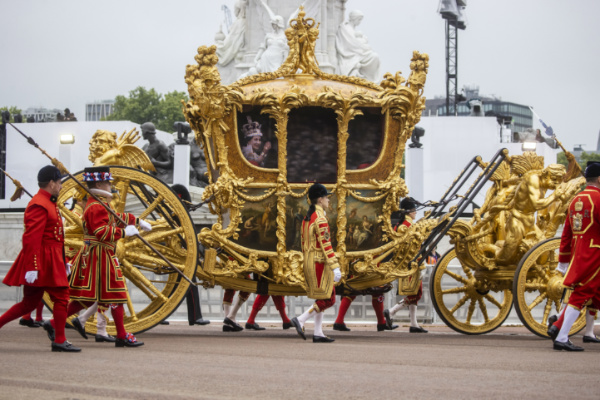
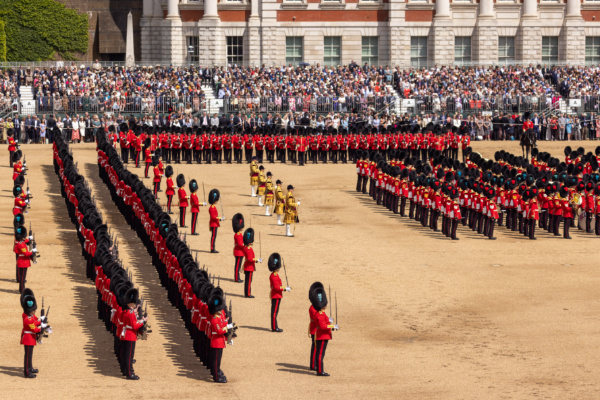
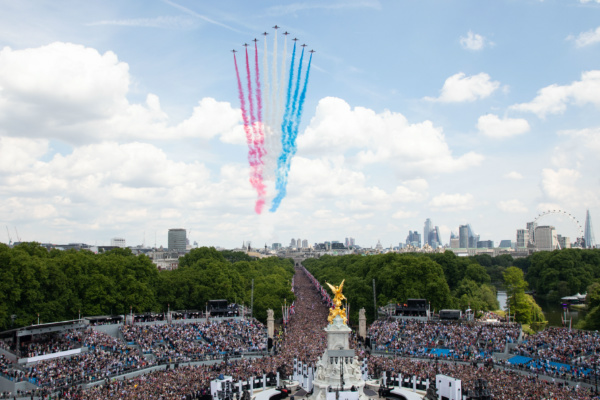
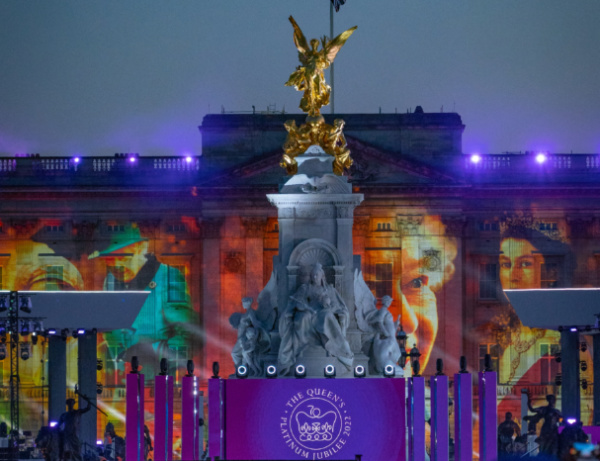
There are numerous royal palaces in London but which are royal residences?
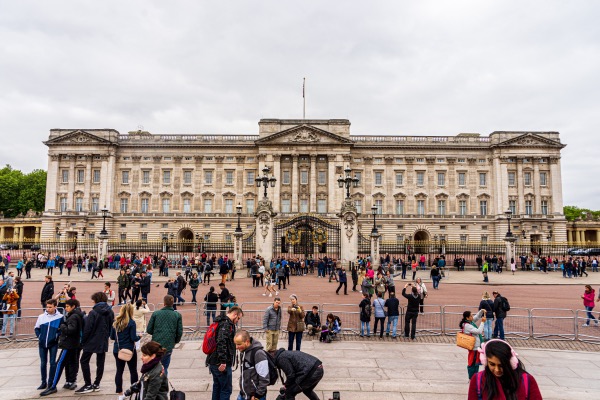
Foremost is Buckingham Palace, the official residence and office of the monarch – Queen Elizabeth II – in London. The palace – acquired for the Crown by King George III in 1761, converted to a palace by King George IV and first lived in by Queen Victoria – is also used for State ceremonies and for official entertaining.
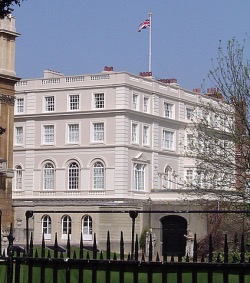
Other royal residences include Clarence House which is the official London residence of Prince Charles and Camilla, Duchess of Cornwall.
The property was built between 1825 and 1827 to the designs of John Nash for Prince William Henry, Duke of Clarence (hence the name).
It was the home of Queen Elizabeth, the Queen Mother, between 1953 and her death in 2002, and was also temporarily the home of the then-Princess Elizabeth and Prince Philip following their marriage in 1947.
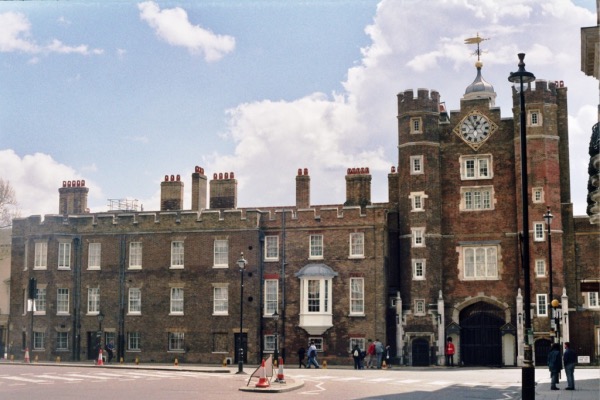
St James’s Palace, which was largely built by King Henry VIII and served as the residence of numerous monarchs until King William IV, also remains the home of several members of the Royal Family – including Princess Anne and Princess Alexandra – and their household offices.
The State Apartments are sometimes used for entertaining during in-coming State Visits, as well as for other ceremonial and formal occasions. Its history means diplomats are still accredited to the Court of St James.
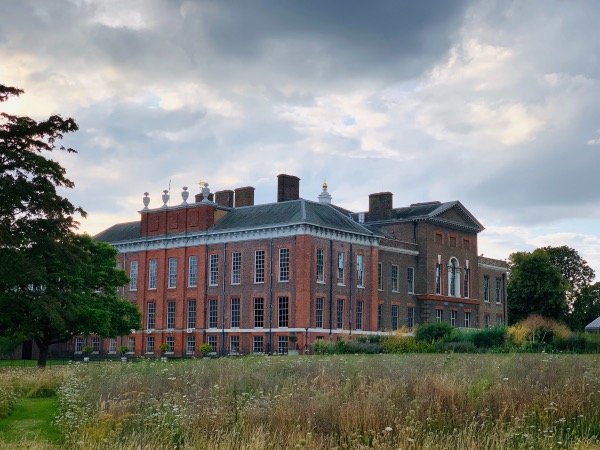
Kensington Palace – childhood home of Queen Victoria and favoured residence of monarchs from King William III to King George II – is these days the official London residence of Prince William and Katherine, the Duchess of Cambridge.
It also contains the London residences and offices of the Duke and Duchess of Gloucester, the Duke and Duchess of Kent and Prince and Princess Michael of Kent.
While Hampton Court Palace, the Tower of London, Kew Palace and the remnant of the Palace of Whitehall known as the Banqueting House are all royal palaces, they ceased being used regularly for royal court purposes in the 18th century and are now in the care of Historic Royal Palaces (along with parts of Kensington Palace).
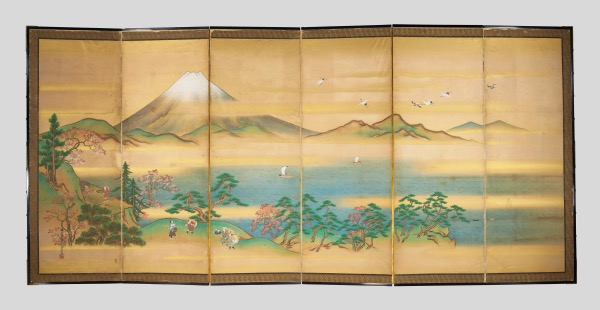
• A first-of-its-kind exhibition featuring the Royal Collection’s Japanese works of art opens at the Queen’s Gallery, Buckingham Palace, tomorrow. Japan: Courts and Culture, features more than 150 works including rare porcelain, samurai armour, woodcut prints, embroidered screens and a range of diplomatic gifts sent during the reigns of monarchs ranging from King James I to Queen Elizabeth II. Among the highlights are a pair of folding screens sent to Queen Victoria in 1860 from the Japanese Shōgun Tokugawa Iemochi which will go on public display for the first time since they arrived at the British court 162 years ago. The screen paintings, which depict the changing seasons, were not thought to have survived but in recent years research has revealed the two screens were the work of Itaya Hiroharu, one of the artists likely to have worked on Queen Victoria’s gifts. Also included in gift was a set of lacquer furniture, spears inlaid with glittering mother of pearl, and swords made by leading court swordsmiths – all of which will also be on display. Admission charge applies. Runs until 26 February, 2023. For more, see www.rct.uk.
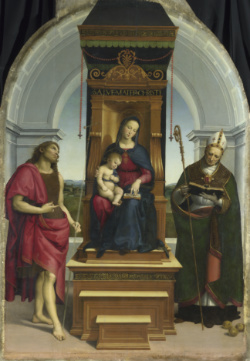
• Marking the 500th anniversary of the death of Raphael, one of the first-ever exhibitions to explore the complete career of this giant of the Italian Renaissance opens at The National Gallery on Saturday. The Credit Suisse Exhibition: Raphael, which was supposed to be held in 2020 and was delayed due to the coronavirus pandemic, features more than 90 exhibits. They include a rare gathering of Raphael’s paintings of the Virgin and Child including Ansidei Madonna (The Virgin and Child with Saint John the Baptist and Saint Nicholas of Bari) (1505), two bronze roundels – The Incredulity of Saint Thomas and The Descent into Limbo – from Santa Maria della Pace which have never previously exhibited outside Italy and which are attributed to Cesarino Rossetti after designs by Raphael, and a room devoted to Raphael’s frescoes for Pope Julius II’s private apartments. There are also several of his original print designs, an survey of ancient Rome he undertook for Pope Leo X, tapestry designs including Saint Paul Preaching at Athens (workshop of, or on behalf of, Pieter van Aelst, active about 1490–1533, after design by Raphael, about 1517–19), and portraiture from his final years including Portrait of Lorenzo de’ Medici (1518) and Portrait of Baldassare Castiglione (1519). Admission charge applies. Runs until 31st July. For more, see www.nationalgallery.org.uk/exhibitions/the-credit-suisse-exhibition-raphael.
• The British Library’s Food Season kicks off today with almost two months of online and in-person events inspired by the cookbooks, recipes and culinary stories in the collection. Highlights include chef Ainsley Harriott talking about his life and career with food-writer Melissa Thompson, food-writer Maunika Gowardan celebrating India’s breadth of food cultures with chefs and food-writers including Ravinder Bhogal, Romy Gill, Kavi Thakrar and Farokh Talati, chef and broadcaster Andi Oliver discussing Jessica B Harris’ 50- year career examining the history and meaning of food for the African diaspora, and psychologist Kimberley Wilson chairing a discussion about the food prisoners are fed inside British correctional institutions and if it impacts rehabilitation. Now in its fifth year, the 2022 Food Season is supported by KitchenAid. For the full programme of events, head to www.bl.uk/events/food-season.
• Textile designer Enid Marx – famous for her seat fabric designs on the London Underground – has been honoured with an English Heritage Blue Plaque. The plaque was unveiled this week at her former home at 39 Thornhill Road where she lived and worked for more than 30 years. Marx, who shared the house with her partner, Margaret Lambert, and friends Eleanor Breuning and Grace Lambert (Breuning continues to live at the house today), had a purpose-built studio in the back garden which remains in similar condition to when she left it almost 25 years ago. Alongside her work for the London Underground, Marx also is known for her design of postage stamps marking the start of Queen Elizabeth II’s reign in 1953. For more, see www.english-heritage.org.uk/visit/blue-plaques/.
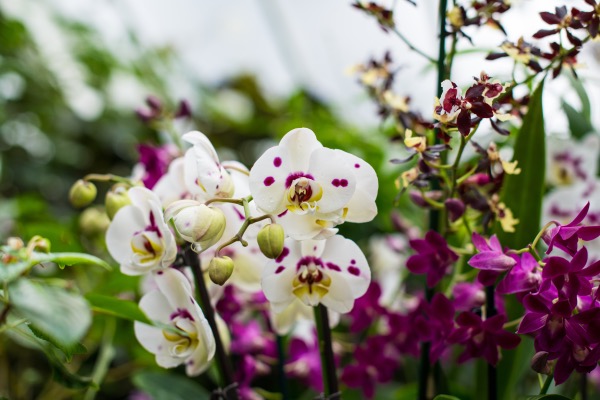
• Biodiversity hotspot Costa Rica is the focus of this year’s Orchid Festival which opens at Kew Gardens on Saturday. The festival, which returns for the first time in two years, sees a recreation of the verdant landscape of the Caribbean island nation in the Princess of Wales Conservatory – including the creation of monkeys, sea turtles, toads and hummingbirds in plant form – with a central display in the glasshouse pond of vibrant orchids and bromeliads. Meanwhile, the International Garden Photographer of the Year exhibition is also opening in Kew’s Arboretum and features a selection of images from across categories including ‘Beautiful Gardens’, ‘The Beauty of Plants’ and ‘The World of Fungi’ as well as winner of the ‘Captured at Kew’ special award. Both can be seen until 6th March. Admission charge applies. For more, see www.kew.org.
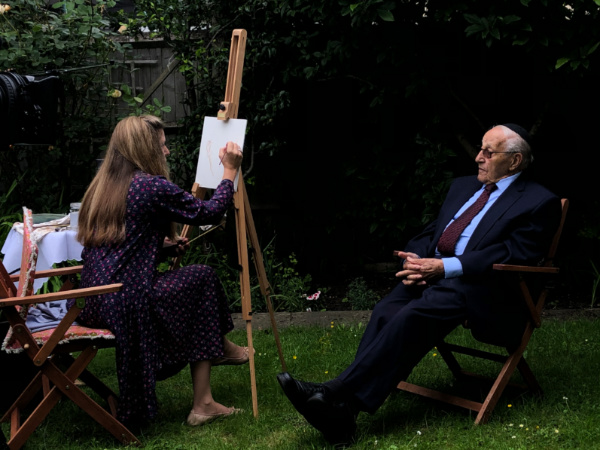
• A series of portraits depicting Holocaust survivors has gone on show at The Queen’s Gallery in Buckingham Palace. The seven works in Seven Portraits: Surviving the Holocaust were commissioned by Prince Charles in his role as patron of Holocaust Memorial Day which was marked last week. The exhibition can be seen at The Queen’s Gallery until 13th February. Admission charge applies. For more on Holocaust Memorial Day, see www.hmd.org.uk. For more on The Queen’s Gallery, head to www.rct.uk/visit/the-queens-gallery-buckingham-palace.
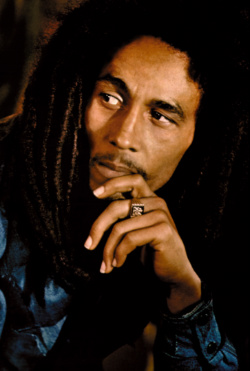
• Music icon Bob Marley is the subject of an exhibition which opened at the Saatchi Gallery this week. Bob Marley: One Love Experience features hitherto unseen photographs of Marley as well as memorabilia, giant art installations and multi-sensory experiences as visitors are led through a series of rooms including the ‘One Love Music Room’, the ‘One Love Forest’ and the ‘Soul Shakedown Studio’. The exhibition runs until 17th April. Admission charges apply. For more, see www.bobmarleyexp.com.
Send items for inclusion to exploringlondon@gmail.com.

Buckingham Palace is among the sites across London which will be hosting events to mark Queen Elizabeth II’s Platinum Jubilee this June. The Queen’s 70th year on the throne will be marked with four days of celebrations across the June bank holiday weekend which will include the Queen’s Birthday Parade (known as Trooping the Colour), the lighting of Platinum Jubilee Beacons – including the principal beacon at Buckingham Palace, a Service of Thanksgiving at St Paul’s Cathedral, the ‘Platinum Party at the Palace’ – a celebration concert in the gardens of Buckingham Palace, The Big Jubilee Lunch in communities across the city, and a special Platinum Jubilee Pageant, part of which will see a moving river of flags rippling down The Mall. For more information, head to www.royal.uk/platinum-jubilee-central-weekend.
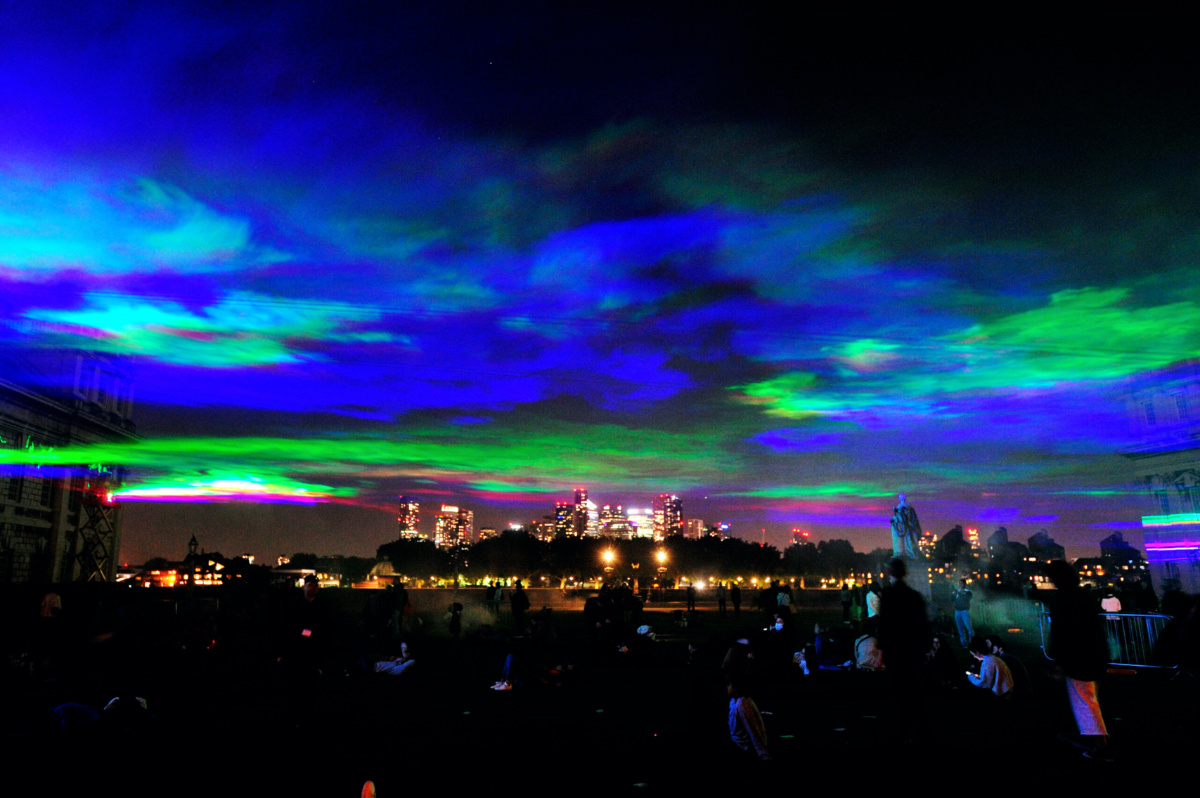
• A dazzling light show inspired by the Northern Lights – one of the seven natural wonders of the world – can be seen in the Guildhall Yard this December. Borealis – which can be seen between 11th and 22nd December – is the work of artist Dan Acher and is one of a number of light displays which is illuminating London this winter as part of Mayor Sadiq Khan’s ‘Winter Lights’ campaign. Others include an animal-themed display bringing to life the beasts that once lived at the Tower of London, an outdoor programme of installations and video art projections illuminating the Southbank Centre’s site, the ‘Illuminated River’ display lighting up nine of London’s bridges in what is be the longest public art project in the world, and a free Canary Wharf ‘Winter Lights Spectacular’ in January which will feature 20 new light commissions by some of the most innovative artists across the globe. In Grosvenor Square, Mayfair, thousands of illuminated white roses will form an ‘Ever After Garden’ designed by fashion designer Anya Hindmarch while traditional favourites like the Hyde Park Winter Wonderland as well as winter markets and ice rinks at locations like the Natural History Museum and Somerset House are also once again returning to the city. London’s red buses are an easy way to see the Christmas lights this year with routes 12, 94, 98, 139 and 390 all travelling through Oxford Circus. Free tickets to Borealis can be booked at www.visitlondon.com/Borealis while, for more on the best bus routes, see https://londonblog.tfl.gov.uk/festive-bus-routes/. For more information on all the light shows and events (some of which are already underway), see visitlondon.com .
• Costumes worn by then Princess Elizabeth and her sister Princess Margaret in wartime-era pantomimes are at the heart of a new display at Windsor Castle this Christmas. The princesses spent much of their time at Windsor during World War II – away from the Blitz in London – and, between 1941 and 1944, they performed in and helped to stage a series of pantomimes to raise money for the Royal Household Wool Fund which supplied knitting wool to make comforters for soldiers fighting at the front. Six of the costumes they wore have been brought together for the first time and are being displayed in the castle’s Waterloo Chamber where the pantos were originally performed. The costumes on show were worn in the last two pantos – Aladdin, which was performed in 1943, and Old Mother Red Riding Boots which was performed in 1944. Also on show are 16 large scale pictures of fairy-tale characters that were pasted around the walls to create the space for the performances. Visitors to Windsor this Christmas will also see State Apartments decorated for the festive season and a 20 foot high Christmas tree in St George’s Hall. The Semi-State Rooms, created for King George IV and now used for official entertaining, are also now open to visitors. The costumes can be seen until 31st January. Admission charges apply. For more on the Christmas activities at Windsor, including a ‘Mary, Queen of Scots at Christmas Family Activity Day’ on 18th December, see www.rct.uk/whatson/. Meanwhile, Buckingham Palace is offering guided tours of the State Rooms over winter with special family guided tours available for the first time. The tours run until 30th January. Admission charge applies. For more on the guided tours, head here and for more on the family tours, head here.
• The ancient Greeks’ pursuit of knowledge is the subject of a new exhibition which has opened at the Science Museum in South Kensington. Ancient Greeks: Science and Wisdom takes visitors on a journey in which they will sail the perilous seas with a statue of Hermes that was discovered on a shipwreck off the island of Antikythera, experience the lost music of the aulos instrument through interactive displays and an exclusive video that reimagines its ancient sounds, and gaze at the starry cosmos through ancient Greek eyes via a beautiful and rare silver globe depicting the known constellations and a Byzantine sundial-calendar – the second oldest known geared mechanism in the world. The free display can be seen until 5th June. Tickets are required – to book head to sciencemuseum.org.uk/ancient-greeks.
Send all items for inclusion to exploringlondon@gmail.com.
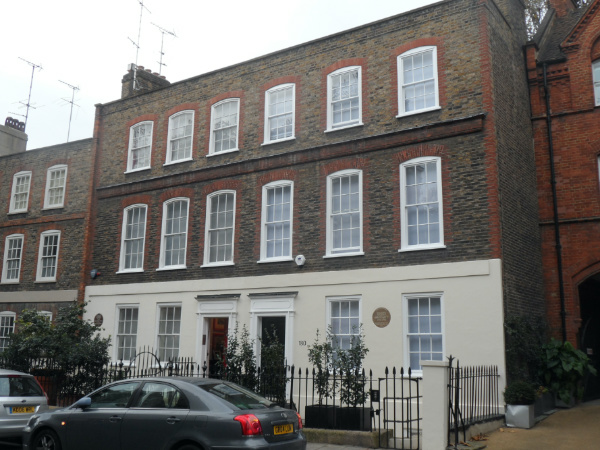
Think of Austrian composer Wolfgang Amadeus Mozart and chances are it isn’t London which immediately comes to mind. But it was in a home in Belgravia that the then-precocious eight-year-old composed his first symphony.
Mozart, his father Leopold, mother Anna Maria and his elder sister Maria Anna spent almost a year-and-a-half in London, between April, 1764, and July, 1765, as part of a European grand tour. Having initially taken lodgings above a barber’s shop in Cecil Court in Soho, they moved to the more rural setting of 180 Ebury Street, then known as Five Fields Row, in August so his father could recover from a serious illness which apparently developed after he caught a cold.
Mozart and his sister were both child prodigies and during their London sojourner performed in various London theatres and for King George III and Queen Charlotte at Buckingham Palace on several occasions. But, with his father now needing quiet, they were forbidden to play instruments in the house and so, according to his sister’s writings, in order to keep himself busy it was there that he composed his “first symphony for all the instruments of the orchestra, especially for trumpets and kettledrums”.
While the work she was referring to is now lost, Mozart did go on to compose the symphony that is now seen as his first at the same time. Known as K.16 in E flat major, it was first performed at the Haymarket Little Theatre in February, 1765.
Leopold did recover and so the family moved back to Soho – lodging at 20 Frith Street to be précise – in September, 1764. It was there that Mozart met the youngest son of Johann Sebastian Bach, Johann Christian, who was to be a key influence on his musical style. They left the property – and brought their time in England to an end in July, 1765, amid waning public interest in their performances (they gone from performing for the Royal Family to entertaining pub patrons). The family continued with their European tour before eventually returning to their home town of Salzburg (Mozart later settled in Vienna where he died at the young age of 35).
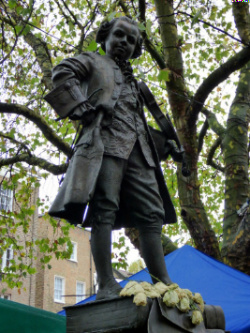
Mozart’s time at the Ebury Street residence (and the composition he wrote there) is commemorated with an English Heritage Blue Plaque (albeit this one is brown) which was erected by the then London County Council in 1939. Following damage in the war, it was reinstated in 1951. There’s also a statue commemorating Wolfgang Amadeus Mozart in nearby Orange Square. Designed by Philip Jackson, it was erected in 1994.
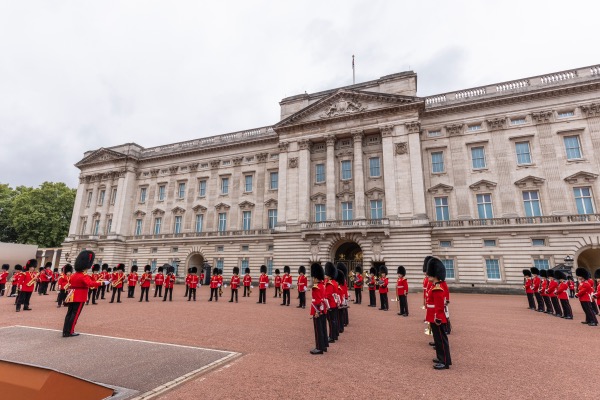
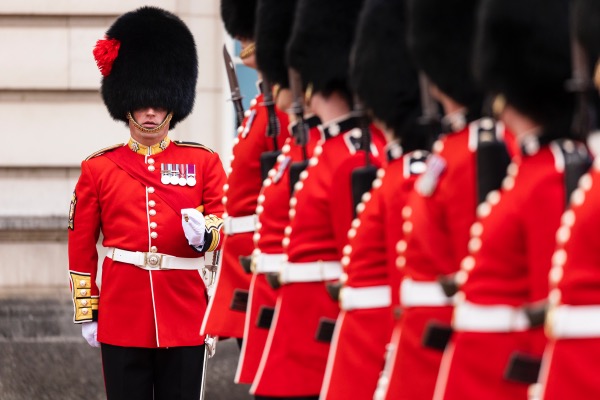
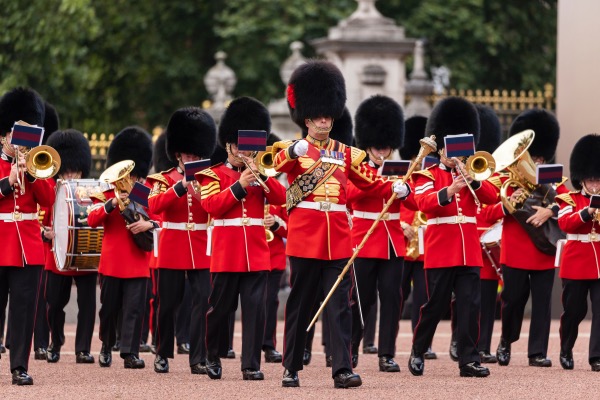
The full Changing of the Guard ceremony returned to Buckingham Palace, St James’s Palace and the Tower of London on Monday after the longest pause in its taking place since World War II. The ceremony, usually a popular tourist drawcard, had been absent from London since March last year due to the COVID-19 pandemic. The return to the ceremonial duty was carried out by the Number 3 Company from 1st Battalion Coldstream Guards based in Windsor, accompanied by the Band of The Coldstream Guards. PICTURES: Sergeant Donald C Todd, RLC (UK MOD © Crown copyright 2021/published under the MOD News Licence).
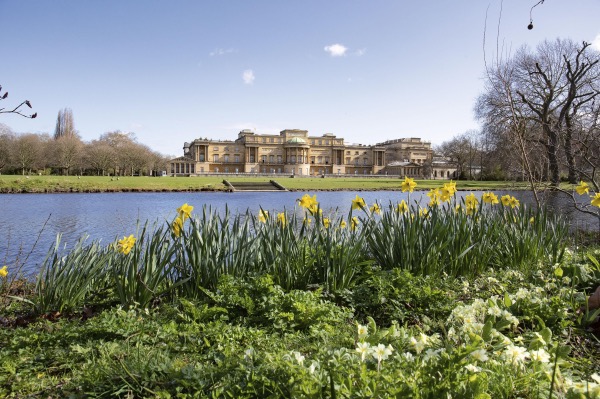
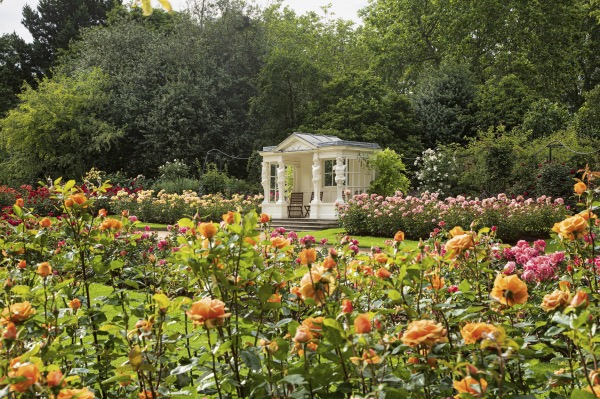
The historic 39 acre garden at Buckingham Palace opened to the public for the first time last Friday as part of the palace’s summer opening. Visitors can follow a route that takes in the 156-metre Herbaceous Border, plane trees which were planted by and named for Queen Victoria and Prince Albert, and views of the island and its beehives across the 3.5-acre lake. There’s also the opportunity to enjoy a picnic on the lawns and guided tours of the south-west of the garden with features including the Rose Garden, summer house and wildflower meadow. The current landscape dates back to the 1820s when King George IV turned Buckingham House into a place. It features more than 1,000 trees, the National Collection of Mulberry Trees (mulberry trees were first planted by King James I in 1608), 320 different wildflowers and grasses, and, since 2008, five beehives. The Queen traditionally hosts three garden parties in the gardens annually which are each attended by 8,000 guests, who consume around 27,000 cups of tea, 20,000 sandwiches and 20,000 slices of cake. The gardens are open until 19th September. Admission charge applies. For more, see www.rct.uk.

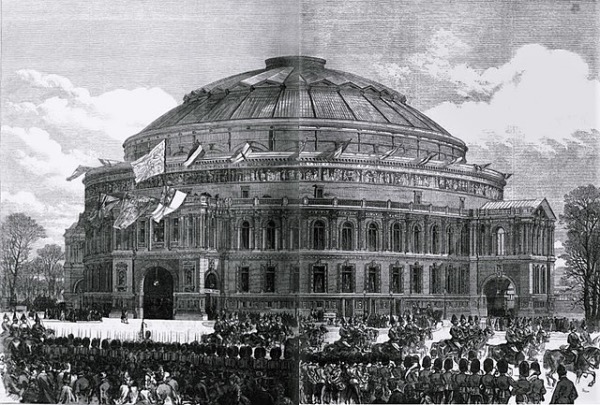
Next week sees the Royal Albert Hall’s 150th anniversary concert taking place, one of a number of events to mark the anniversary of the hall’s opening.
This spectacular building in South Kensington was officially opened on 29th March, 1871, as The Royal Albert Hall of Arts and Sciences (the opening was actually brought forward from 1st May – 20th anniversary of the opening of the Great Exhibition – at the request of Queen Victoria).
The Queen had laid the foundation stone in 1867 and the work on the building, the creation of which was partly funded by profits from the Great Exhibition of 1851, was complete by the end of 1870 (at least its structure – much of the interior decoration was apparently added later).
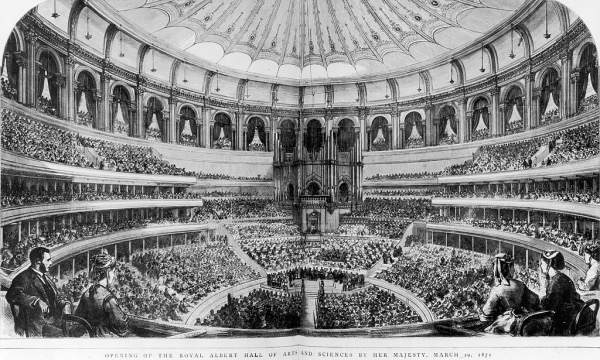
Queen Victoria and members of the Royal Family left Buckingham Palace in a line of state carriages for the event at noon escorted by the Royal Horse Guards Blue. Large crowds lined the route of her passage and a guard of honour composed of the Grenadiers stood opposite the entrance.
On arriving, the Queen was met by the Edward, the Prince of Wales (the future King Edward VII), members of the building committee and some of those who has served as commissioners of the Great Exhibition of 1851.
The Queen processed to a dais inside the building’ auditorium where some 8,000 dignitaries and invited guests waited in the audience. But she was apparently too overcome by memories of her late husband – Prince Albert, after whom the building as named – to give a speech. So it was the Prince who did so, although the Queen did reportedly add her own comments, saying according to an account in The Guardian: “I cannot but express my great admiration for this beautiful building, and my earnest wishes for its complete success.”
A battery of artillery performed a salute in nearby Hyde Park after which the Queen and Royal Family took their seats in the Royal Box to watch the musical program that followed. The Queen then returned to Buckingham Palace.
Interestingly, the first concert at the hall, held to test acoustics, actually took place month earlier on 25th February for an audience of some 7,000 people made up of those who had worked on the building and their families as well as officials and various invited members of the public.
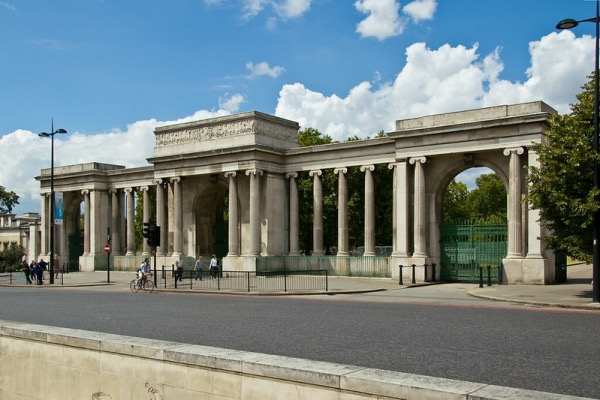
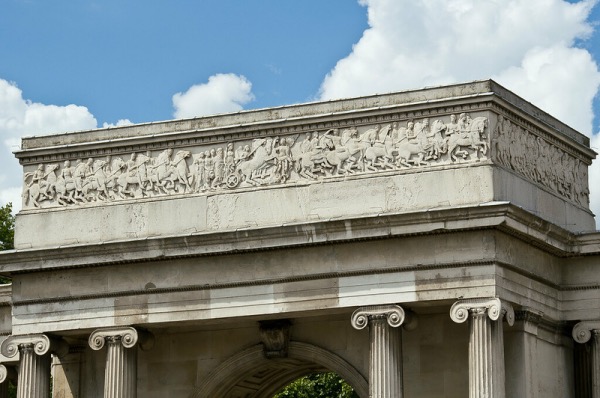
This ornate triple stone entrance in the south-east corner of Hyde Park (better known as Hyde Park Corner), was designed by Decimus Burton when he was just 25-years-old.
Made of Portland stone, the gate, also known as the ‘Apsley Gate’ (after the nearby home of the Duke of Wellington) or the ‘Hyde Park Screen’, was installed in the late 1820s and replaced a former tollgate.
Several designs were proposed in the late 18th century but it was only after work started to transform Buckingham Palace from a home into the grand building we know today that Burton, who was already working on designing a series of gates, lodges and railings around Hyde Park for the Office of Woods and Forests, was asked to design the screen alongside plans for a grand memorial arch to serve as an entrance to Green Park which would be located opposite.
Burton’s designs for the Hyde Park gateway were approved by none other than King George IV and it now stands true to his original design. Decorative elements in the gate include scroll-topped columns and friezes by John Henning which were copied from the Elgin Marbles. Burton also designed the classical-style lodge house just inside the gates.
Burton’s initial plans for the Green Park arch, however, were deemed not to be grand enough – after all, this would be one of the approaches to Buckingham Palace – and so he produced a second design which is now largely embodied in what became the Wellington Arch.
While the Hyde Park gateway originally stood in line with Wellington Arch, traffic management matters saw the latter moved to its current position in the 1880s, putting it out of alignment with the gateway.
• A social reformer, a former slave turned campaigner and the “people’s princess” are among six women who will be commemorated with new English Heritage Blue Plaques this year. The first of the new plaques – dedicated to crystallographer and peace campaigner Kathleen Lonsdale – was unveiled last week at the home in Seven Kings, Redbridge, where she lived from 1911 to 1927 during her early days at UCL and the Royal Institute. Lonsdale went on to carry out ground-breaking work on crystal structures and played what’s described as a “fundamental role” in progressing x-ray crystallography. Other plaques will commemorate social reformer Caroline Norton, designer Jean Muir, former slave and campaigner Ellen Craft, barrister Helena Normanton, and, Diana, Princess of Wales. For more on English Heritage’s Blue Plaques, see www.english-heritage.org.uk/visit/blue-plaques/.

• The garden at Buckingham Palace will open to the public this summer, allowing visitors to explore the 39 acre grounds on a self-guided tour for the first time. The route will encompass the 156-metre herbaceous border, plane trees planted by Queen Victoria and Prince Albert, and take in views of the garden’s 3.5 acre lake and island with its beehives. Visitors will also have the chance to enjoy a picnic on the lawns and explore the south-west of the garden – which includes the Rose Garden, summer house and wildflower meadow – on guided tours. Meantime, during April and May enthusiasts are able to enjoy the garden in springtime on guided tours. And for those unable to make it in person, a series of digital talks, A Warden’s Welcome, which explore Buckingham Palace, Windsor Castle and the Palace of Holyroodhouse kick off online next Wednesday. Charges apply for all – for more information and tickets, see www.rct.uk.
Send all items for inclusion to exploringlondon@gmail.com.
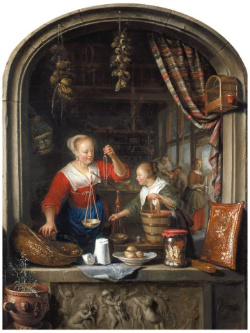
• World renowned artworks from Buckingham Palace’s Picture Gallery go on show at the Queen’s Gallery from tomorrow. Masterpieces from Buckingham Palace features 65 works by the likes of Titian, Rembrandt, Rubens, Vermeer, Van Dyck and Canaletto and, unlike in the tours of the State Rooms, visitors to the Queen’s Gallery will face the chance to enjoy the works close-up. The paintings on show include Johannes Vermeer’s The Music Lesson (early 1660s), Sir Peter Paul Rubens Milkmaids with Cattle in a Landscape, (c1617–18), Rembrandt’s The Shipbuilder and his Wife (1633), Canaletto’s The Bacino di San Marco on Ascension Day (c1733–4), Titian’s Madonna and Child in a Landscape with Tobias and the Angel (c1537) and Gerrit Dou’s The Grocer’s Shop (1672). The exhibition runs until January 2022. Advance booking is essential and admission charge applies. For more, see www.rct.uk.
• The Museum of London is seeking to record the dreams of Londoners during the coronavirus pandemic in a new project with the Museum of Dreams at Western University in Canada. Guardians of Sleep represents the first time dreams as raw encounters and personal testimonies will be collected by a museum. Londoners are being asked to register their interest to take part by 15th January with conversations with members of the Dreams network – an international team of trained scholars from the psychosocial community, slated to be held over Zoom in February. Contributions will be considered for acquisition by the Museum of London as part of its ‘Collecting COVID’ project. To volunteer to participate in the study, or to find out more details, members of the public should contact info@museumofdreams.org.
• Abdus Salam, a Nobel Prize-winning theoretical physicist, has been honoured with a Blue Plaque at his former property in Putney. The red brick Edwardian house was the Pakistani scientist’s London base from 1957 until his death in 1996. It features a study where Salam would write while listening to long-playing records of Quranic verses and music by composers ranging from Strauss to Gilbert and Sullivan. Salam’s work on electroweak theory contributed to the discovery of the Higgs boson particle – the ‘God particle’ which gives everything mass, and he was also involved in improving the status of science in developing countries.The unveiling comes as English Heritage issues a call for the public to nominate more notable scientists from history for its Blue Plaque scheme in London with only around 15 per cent of the 950 plus blue plaques across the capital dedicated to scientists. For more, see www.english-heritage.org.uk/visit/blue-plaques/.
• A self-portrait series by late Gambian-British artist Khadija Saye can be seen at the British Library’s entrance hall from today. Khadija Saye: in this space we breathe features nine silk-screen prints and demonstrates Saye’s deep concern with “how trauma is embodied in the black experience” as well as her Gambian heritage and mixed-faith background. Saye, who died in 2017, photographed herself with cultural, religious and spiritual objects of significance both to her Christian mother and Muslim father and in African traditions of spirituality. The free display is on show until 2nd May. For more, see www.bl.uk.
Send all items for inclusion to exploringlondon@gmail.com.
 Exploring London