Around London – The Tower hosts Royal Beasts; take a ride on a 1938 tube train; Lambeth Palace Library celebrates the King James Bible; and, see model cathedrals at Sir John Soane’s house…

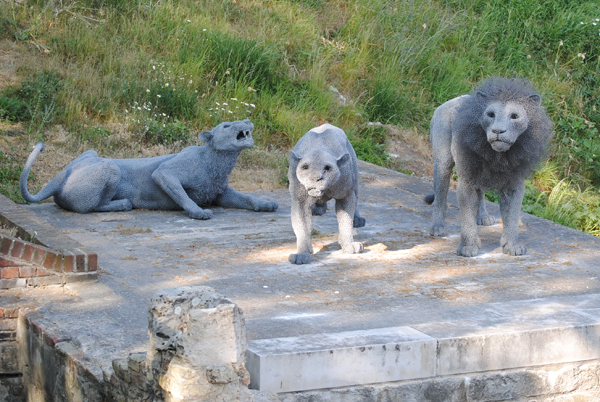
• The history of the Royal Menagerie is the focus of a new exhibition on now at the Tower of London. Royal Beasts explores the history of the Tower menagerie which, founded during the reign of King John in the early 1200s, remained there for more than 600 years. Among the animals were lions (the first record of which dates from 1210), a grizzly bear (a gift from the Hudson Bay Company to King George III), elephants, tigers, ostriches and kangaroos. Highlights of the exhibition include modern animal sculptures by artist Kendra Haste and interactive sensory displays. The recently restored north wall walk and the never before opened Brick Tower will host some of the displays, including sights, sounds and smells of some of the animals. See www.hrp.org.uk/TowerofLondon.

A 1938 tube train will run along the western end of the Piccadilly Line this Sunday (that’s Father’s Day in case you’ve forgotten) as part of the London Transport Museum’s Heritage Vehicles on the Move 2011 programme. Leaving Northfields, the train will travel to High Street Kensington via Earl’s Court (crossing from the Piccadilly to the District Line in a move not normally experienced by the general public) before heading back down the District Line to Acton Town where it will change back onto the Piccadilly Line. The train will then undertake the “fishhook move”, visiting Heathrow Terminal 4 before going to Terminals 1,2,3 and 5. The entire journey is expected to last about two hours. Tickets, which can be purchased at the museum ticket desk or by calling 020 7565 7298, will need to be collected at Northfields Station. For more, see www.ltmuseum.co.uk/whats-on/events/vehicles-on-the-move.

• Lambeth Palace Library is celebrating the 400th anniversary of the King James Bible with a new exhibition. The exhibits include a 1611 edition of the Bible as well as Medieval Bible translations, landmark editions of the Bible which drew on the textual scholarship of the Renaissance and Reformation and early printed vernacular versions. Runs until 29th July. Admission is by pre-booking only. For information on buying tickets and more, see www.lambethpalacelibrary.org/content/2011exhibition.

On Now: Time is running out to see Sir Herbert Oakley’s collection of 27 models of European and English cathedrals at the Sir John Soane Museum. The models were made in the 1850s by William Gorringe, who was a modelmaker by appointment to Queen Victoria. Runs until 25th June. For more, see www.soane.org/exhibitions/

King James I’s London – 7. The Gunpowder Plot

One of the most significant events during the early year of King James I’s reign was the discovery of the Gunpowder Plot.

The plot, which involved a group of Catholic conspirators including Robert Catesby and  Guido ‘Guy’ Fawkes (you can read more about Fawkes in our earlier entry on Bonfire Night), centred on a plan to blow up the House of Lords in Westminster Palace during the State Opening of Parliament in November 1605, thus killing the king (who had aggrieved Catholics in a public denunciation at the Hampton Court Conference in 1604; it should also be noted that he was already aware of several other failed Catholic plots to kill him) and, presumably, many MPs and Lords.

It is believed they intended replacing James with his daughter, Princess Elizabeth, whom they hoped could be made more amendable to Catholic worship.

But such a plot was hard to keep mum and an anonymous tip-off to Lord Monteagle, a Catholic, not to attend the event, led authorities to eventually uncover the plot in a basement storeroom below the House of Lords where, at around midnight on 4th November, they found Fawkes guarding the 36 barrels of gunpowder.

Fawkes was sentenced to be hung, drawn and quartered – a sentence never fully carried out after he leapt off the scaffold and broke his neck – and the other plotters, who had fled from London soon after the discovery, were either killed during subsequent arrest attempts, imprisoned or executed.

So happy was King James I – that he had Act of Parliament passed which made the 5th November a day of thanksgiving – it remained in force until 1859. Celebrations of the plot’s foiling continue every year on Bonfire Night.

But what were some of the significant places in the event? The cellar where Fawkes was arrested no longer exists – it was destroyed during a fire in 1834.

The conspirators who had been arrested were subsequently taken to the Tower of London where King James I authorised the torture of at least Fawkes and perhaps others among the conspirators. Fawkes capitulated quickly and signed two confessions (which are now in The National Archives). Another of the conspirators, Francis Tresham, died of natural causes while in the Tower.

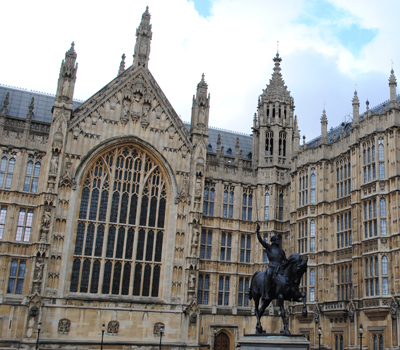
The eight surviving conspirators went on trial at Westminster Hall – still part of the Houses of Parliament complex today; the end of the hall is visible in the above picture – in late January 1606 and were all condemned to death for treason.

Four of them were executed on 30th January in St Paul’s Churchyard outside St Paul’s Cathedral while the remaining four including Fawkes were executed the next day outside Westminster Hall in Old Palace Yard. The heads of Catesby and Thomas Percy, both of whom had been killed during a shoot-out in Staffordshire, were set up outside the Houses of Parliament.

Arrests – and in some cases executions – of others believed to be associated with the plot continued in the following months.

Another place of note in the story of the Gunpowder Plot is Syon Park in the city’s west, now the London home of the Duke of Northumberland. The aforementioned Thomas Percy was a cousin of the then Earl of Northumberland, Henry Percy, and apparently dined with the Catholic earl at the house on the night of 4th November, before the plot was uncovered.

That association subsequently led to the earl’s arrest and he was confined to the Tower for the next 15 years on the order of the king.

LondonLife – Beating the Bounds at All Hallows

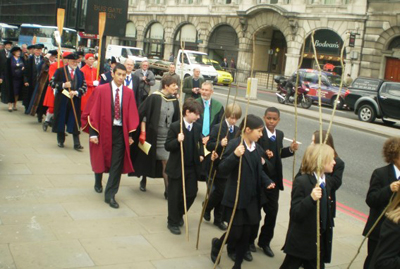
Thursday is Ascension Day and, at All Hallows by the Tower in the City, that means conducting the ancient ceremony of Beating the Bounds.

The origins of the custom go back to medieval times when parishes annually reaffirmed their boundaries by undertaking a procession during which each parish boundary marker was beaten with wands while praying for protection and blessings.

At All Hallows, the beating party consists of students from Dunstan College in Catford (these students have an association with the church of St Dunstan-in-the-East which is now part of the parish of All Hallows) along with parish clergy and the masters of livery companies associated with the parish and Thames waterboatmen. (Pictured right is last year’s procession).

Highlights of the procession at All Hallows include the beating of the parish’s southern marker – this is located in the middle of the Thames and must be reached by boat – and the mock ‘confrontation’ which occurs between the beating party and the Governor and Yeoman Warders of the Tower of London.

The ‘confrontation’ relates to the fact that the parish and the tower share a boundary – this was apparently a common cause of dispute in the Middle Ages and led, in 1698, to a ‘battle’ between the people of the parish and those of the tower. The ceremony is followed by attendance at a festal evensong at the church.

For more, see www.ahbtt.org.uk/history/beating-the-bounds/

PICTURE: Courtesy of All Hallows by the Tower.

Around London – See museums after hours; the White Tower is white again; and, foundation stone for Bomber Command is laid…

• The annual Museums at Night event returns to London (and Britain) this weekend with hundreds of museums and galleries across the country opening their doors for special after hours events. Among those places in London taking part is the Churchill War Rooms, which is hosting a 1940s evening on Friday night, the London Canal Museum which is hosting”candle-lit tours, atmospheric lighting, and exhibits of art and film in dark places”, and the Petrie Museum of Egyptian Archaeology which is hosting a double hill of Hammer films and a “Gothic Egypt” trail. Other institutions taking part include the Sir John Soane Museum, the National Gallery, the Bank of England Museum, and Orleans House Gallery in Twickenham.  For more information about what’s on see www.museumsatnight.org.uk

King William the Conqueror celebrated at the Tower of London this week following the completion of a £2 million, three year project to clean the White Tower. First built shortly after the Norman Conquest of 1066, the tower had become blackened by pollution but has now been restored to its original color. For more information on visiting the Tower, see www.hrp.org.uk/toweroflondon/.

A foundation stone has reportedly been laid for a Bomber Command Memorial in Green Park. The memorial, which is due to be completed for the Queen’s Jubilee celebrations in 2012, will be constructed of Portland stone and will feature a nine foot tall statue of a bomber command aircrew. Bomber Command lost more than 55,000 airmen during World War II. The foundation stone was laid by the Duke of Gloucester. Supporters of the monument’s construction have included former Bee Gee Robin Gibb, Sir Michael Beetham, Marshal of the RAF, and  The Daily Telegraph newspaper which is running an appeal to help raise funds for the memorial.

Curious London Memorials – 7. Tower Hill scaffold memorial

Nestled on Tower Hill, somewhat overshadowed by the monumental memorial to the merchant naval casualities of World War I and II nearby, lay a series of plaques commemorating more than 125 people who were executed there.

The plaques, which stand on the site of the former scaffold, list the names of some of the most prominent who died there including Simon of Sudbury, Archbishop of Canterbury, who was beheaded by an angry mob during the Peasant’s Revolt in 1381, John Fisher, the Bishop of Rochester, and former chancellor Sir Thomas More – both of whom were executed in 1535 on the orders of King Henry VIII, and Thomas Cromwell, another chancellor who fell foul of King Henry VIII and was executed in 1540.

Later executions include William Laud, another Archbishop of Canterbury who was executed in 1645, James, Duke of Monmouth, the illegitimate son of King Charles II who was executed in 1685, and Simon Fraser, Lord Lovat, who became the last man to be executed there in 1747 (and the last man in England to be beheaded) after his capture following the Battle of Culloden in Scotland.

An inscription at the site reads that the memorial was created to “commemorate the tragic history and in many cases the martyrdom of those who for the sake of their faith, country or ideals staked their lives and lost”.

It’s worth noting that contrary to popular belief only 10 people were ever executed on Tower Green inside the Tower of London including two of King Henry VIII’s queens – Anne Boelyn (1536) and Catherine Howard (1542) – as well as the tragically young Lady Jane Grey, queen for only nine days before she was beheaded in 1554, and three Black Watch soldiers who were shot in 1743 after being charged with mutiny.

Happy Valentine’s Day!

It’s Valentine’s Day, so we’re pausing from our usual updates to give you a couple of interesting historical titbits…

• The first recorded written Valentine’s Day card is generally attributed to Charles, the Duke of Orleans, who wrote it to his wife while imprisoned in the Tower of London following King Henry V’s defeat of the French at the Battle of Agincourt in 1415;

• Geoffrey Chaucer, author of 1382 text Parlement of Foules – a poem written in honor of King Richard II’s engagement to Anne of Bohemia which is generally attributed with first linking St Valentine’s Day and romantic love, was born in and lived in London (although it should be noted that many don’t believe Chaucer was referring to 14th February in his reference but to another day associated with a different St Valentine).

PICTURE: Andrew C. (www.sxc.hu)

Treasures of London – The Crown Jewels

No series on the treasures of London would be complete without a mention of the Crown Jewels, housed – except when being used – under tight security in the same place they’ve been since the early 1300s – the Tower of London.

The jewels, which are described as a ‘working collection’, include the coronation regalia and feature some 23,578 gems  – the Imperial State Crown alone boasts 2,868 diamonds, 273 pearls, 17 sapphires, 11 emeralds and five rubies.

The regalia itself is made up of the crowns of the sovereigns, consorts and Princes of Wales as well as sceptres, orbs, rings, swords, spurs, bracelets, robes, and the oldest piece, a 12th century anointing spoon.

It and three steel coronation swords are the only pieces to survive the destruction of all the pre-Civil War regalia in 1649-50, carried out at the behest of Oliver Cromwell following the execution of King Charles I (many of the earlier crown jewels, dating from the Anglo-Saxon period, had already been replaced in the early 13th century after items were lost while being taken across The Wash during the reign of King John in 1216).

Following Cromwell’s destruction, new regalia was made on the orders of King Charles II. Modelled on that of his father, it was used in the king’s coronation on 23rd April, 1661, and cost more than £12,000.

Today, St Edward’s Crown – with which the sovereign is crowned by the Archbishop of Canterbury – is the principal piece of the regalia. Other items include the Sovereign’s Sceptre, topped with 530 carat First Star of Africa – the largest flawless cut diamond in the world, Queen Victoria’s small diamond crown, and the Imperial Crown of India. There is also a crown made for Queen Elizabeth, the Queen Mother, for her 1937 coronation which features the famous Koh-i-Nur (‘Mountain of Light’) diamond.

Until 1303, the Crown Jewels had been housed at Westminster Abbey. Following a successful robbery that year, however (after which most items were recovered), they were moved to the Tower.

The most famous attempt to steal the Crown Jewels was made by an Irishman, Colonel Thomas Blood, in 1671. He and his gang had arranged to see the jewels (this could be done for a fee) but when they arrived, used a mallet to knock out the jewel keeper before stabbing him.

Colonel Blood had hidden King Charles II’s crown under his cloak, squashing its arches of in the process, while his companion Robert Perot had stuck the coronation orb down his breeches and Blood’s son was in the process of sawing the sceptre in half when the keeper’s son returned unexpectedly and raised the alarm.

Arrested, Blood got off rather lightly – King Charles II decided, apparently for some unknown reason, to pardon him. Security around the jewels, however, was tightened – iron bars were used instead of wooden ones and people were thenceforth forbidden from handling the jewels.

The Crown Jewels are now housed in the Jewel House at the Tower, built in 1967 in the west wing of the Waterloo Barracks, and guarded by the Yeomen Warders.

WHERE: Tower of London (nearest tube station Tower Hill); WHEN: 9am to 4.30pm, Tuesday to Saturday, 10am to 4.30pm Sunday to Monday (until 28th February); COST: £18.70 adults; £10.45 children under 15; £15.95 concessions; £51.70 for a family (prices, which include a voluntary donation, are valid until 28th February); WEBSITE: www.hrp.org.uk/toweroflondon/. For more on the Crown Jewels, see www.royal.gov.uk/MonarchUK/Symbols/TheCrownJewels.aspx or the Royal Collection website, http://bit.ly/i9FM3
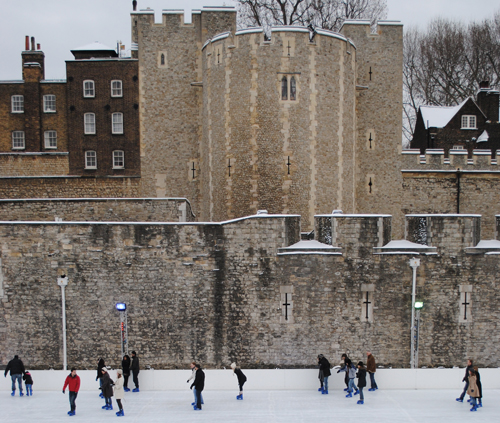
LondonLife – Ice skating at the Tower

Skaters take to the ice in the moat of the Tower of London. The rink, one of many about London, is open until 10th January, 2011. For more information, see www.toweroflondonicerink.com.

Where’s London’s oldest…surviving building?

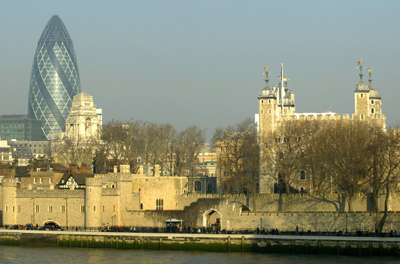
The oldest intact building in London is generally believed to be the White Tower, which stands in the heart of the Tower of London.

Construction on the White Tower (which stands to the right in the picture) was started on the orders of William the Conqueror some time prior to 1070 and was completed by 1100. The newly appointed Bishop of Rochester, Gundulf, was placed in charge of the project which used stone imported from Normandy (much of this was replaced in later centuries).

Built as a towering stronghold and fortress for the English kings, the walls of the tower at 15 feet (4.5 metres) thick and 90 feet (27 metres) high. It was later enclosed by a curtain wall and moat, taking the shape of the Tower of London as we now know it by about 1350.

The White Tower, also known as the Great Tower, has been the scene of many dramatic events in British history – from the deposition of Richard II in 1399 to the disappearance (and possible murder) or the Princes in the Tower – Edward V and his brother Richard, Duke of York, around 1483 (two skeletons, which some believed to be theirs, were unearthed here in 1674).

The White Tower, which is now part of a World Heritage Site, contains the splendid 11th century Chapel of St John the Evangelist. While three of the turrets at the corners of the tower are square, the fourth – the north-east turret, is round and once contained the first royal observatory.

The onion-shaped domes and weathervanes on the turrets were added in the 1520s.

These days the tower contains an exhibition of royal armour – including that worn by King Henry VIII – as well as exhibits on the tower’s history.

WHERE: Tower of London (nearest tube station is Tower Hill); WHEN: Tuesday to Saturday 9am to 4.30pm; Sunday to Monday 10pm to 4.30pm (closing times are 5.30pm between March and October); COST £18.70 an adult/£15.95 concessions/£10.45 a child (children under five free)/£51.70 for a family of two adults and up to six children; WEBSITE: www.hrp.org.uk/TowerOfLondon/

PICTURE: Stephen Pond/Historic Royal Palaces

Around London – Skating at a palace or a tower?; British Military Tournament; and, new blue plaques

Christmas is looming and snow and ice have been besieging London. But there’s plenty you can do to keep warm, including visiting one of the many ice skating venues about the city. Among those with a particularly historic location are rinks at Hampton Court (located against the backdrop of the palace’s west front, it’s open until 9th January – see website for ticket prices and times), in the moat of the Tower of London (also open until 9th January, see website for ticket prices and times), and at Somerset House (open until 23rd January, see website for ticket prices and times).

The British Military Tournament 2010 will be held at Earl’s Court this weekend. The programme features 500 troops, 145 horses, military bands, the field gun run and will include a re-enactment of a combat incident in Afghanistan involving recently returned troops. Presented by ABF The Soldiers’ Charity, with performances on both Saturday and Sunday. For more information – including booking information, see www.britishmilitarytournament.com.

New blue plaques have been unveiled in London marking the former homes of speed daredevils Sir Malcolm Campbell and his son Donald, and ground-breaking photographer Bill Brandt. The plaque for the Campbells, who between them set 10 land speed records and 11 water speed records, is located at Canbury School in Kingston-upon-Thames – Sir Malcolm moved here in 1919, married to Dorothy Whittall the following year, and, Donald was born here in 1921. The family moved in 1922 to Surrey. The plaque for German-born Brandt, meanwhile, was unveiled at 4 Airlie Gardens in Campden Hill. He lived here with his second wife Marjorie Beckett from 1958 and family members still live in the home. Some of his nudes were taken inside. For more information, visit www.english-heritage.org.uk.