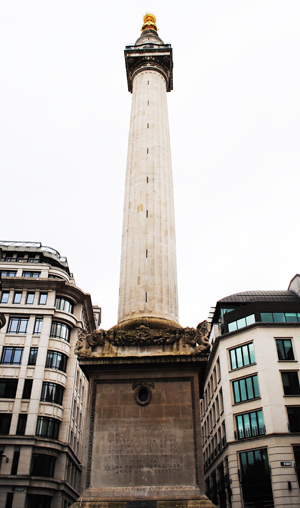
 It was a toss-up whether to include The Monument in this list but, surprisingly perhaps, there are still many visitors to London who overlook what is a unique site in the old city of London and a reminder of one of the key events which have shaped the city.
The tallest free-standing stone column in the world, it was built between 1671-77 to commemorate the Great Fire of London in 1666 and the subsequent rebuilding of the city. The fire broke out in a baker’s shop in nearby Pudding Lane on Sunday, 2nd September, 1666, and burned until the following Wednesday, destroying much of the city in the meantime (although, thankfully, there was actually little loss of life).
Sir Christopher Wren (architect of St Paul’s fame and then Surveyor-General to King Charles II) and Dr Robert Hooke (Surveyor to the City of London and Wren’s assistant) designed the memorial which is topped by a drum and copper urn from which flames are emerging and stands 61 metres above the ground and which, if toppled, reaches the point in Pudding Lane where the fire began.
A spiral stone staircase winds it way up the column’s middle to a platform where you can get come stunning views of the city (but be warned at 311 steps, it’s quite a climb, although at least since 1842 there’s been an iron railing around the platform).
The reliefs on the western side of the base shows Charles II in all his glory while inscriptions on the other three sides tell the story of the great fire (incidentally, the main inscription, was altered in 1681 to include the words “But Popish frenzy, which wrought such horrors, is not yet quenched” which were removed in 1831). The site is now owned by the City of London Corporation.
WHERE: Junction of Monument Street and Fish Street Hill (Nearest Tube station is Monument). WHEN: Daily (9.30am-5.30pm). COST: Adults £3/concessions £2/children £1. WEBSITE: www.themonument.info
 Exploring London