10 London sites to celebrate Charles Dickens – 5. Seven pubs associated with Dickens (including one he never visited)…

There hardly seems to be a pub in London which doesn’t claim some connection with the Victorian author but we thought we’d confine ourselves to five pubs with more well-established credentials…
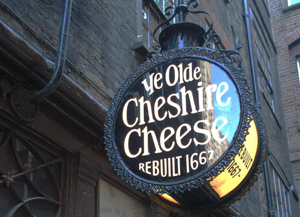
• Ye Olde Cheshire Cheese. This pub is a Fleet Street institution with parts of the current building dating back to 1667 when it was rebuilt following the Great Fire. Dickens was among numerous literary figures who frequented the premises – the pub is perhaps most famously associated with the lexicographer Dr Samuel Johnson (although there is apparently no recorded evidence he ever attended here); other literary figures who came here include Mark Twain and Sir Arthur Conan Doyle – and, according to a plaque in Wine Court, worked out of the pub for a period while producing his journal All The Year Round.

• The One Tun, Saffron Hill. Said to have been established as an ale house on its present site in 1759, the pub was rebuilt in the mid-Victorian era  and was apparently patronised by Dickens between 1833 and 1838. It’s also apparently the inspiration for the pub called The Three Cripples in Oliver Twist (The Three Cripples was actually a lodging house next door to the One Tun and didn’t sell ale). For more, see www.onetun.com
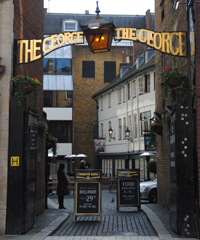
• The George Inn, Southwark. Dating from the 17th century, the George Inn in Borough High Street is the last galleried coaching inn left standing in London and is now cared for by the National Trust (and leased for use by a private company). Dickens is known to have come here when it was running as a coffee house and he mentions it in the book, Little Dorrit. For more, see     www.nationaltrust.org.uk/george-inn/.

• George & Vulture, Castle Court (near Lombard Street). Established in the 18th century on the site of an older inn, this well-hidden pub was not only frequented by Dickens but is mentioned in The Pickwick Papers more than 20 times.

• The Grapes, Limehouse. Formerly known as The Bunch of Grapes, there has been a pub on the site for almost more than 430 years. Dickens was known to be a patron here (his godfather lived in Limehouse) and mentioned the pub – renamed The Six Jolly Fellowship Porters – appears in his novel Our Mutual Friend. For more, see www.thegrapes.co.uk.
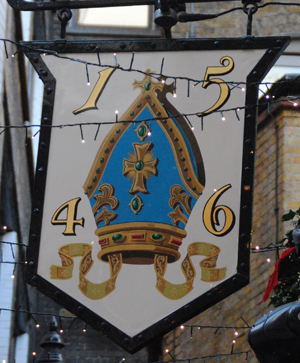
• Ye Olde Mitre, Ely Place. This pub dates from the mid 1500s by Bishop Goodrich of Ely to house his retainers and later rented out to Sir Christopher Hatton (it still houses the remains of a cherry tree which Sir Christopher is said to have danced around during a May Day celebration with none other than the future Queen Elizabeth I). Dickens (and the ubiquitous Dr Johnson) are both said to have drunk here.

• And lastly, The Dickens Inn in St Katharine Docks. It’s worth noting up front that Charles Dickens had nothing to do with this pub – dating back to at least 1800, it was once a warehouse and is thought to have been used to either house tea or play a role in a local brewing operation – but it was his great grandson, Cedric Charles Dickens, who formally opened the pub in 1976, apparently declaring, “My great grandfather would have loved this inn”. For more, see www.dickensinn.co.uk.

This list is by no means comprehensive – we’d love to hear from you if you know of any other pubs Dickens frequented…

Famous Londoners – Sarah Siddons

The most acclaimed tragic actress of the 18th and early 19th centuries, Sarah Siddons is best remembered for her iconic role as Shakespeare’s Lady Macbeth.

Born in 1755 into the theatrical Kemble family (her father was an actor and theatre manager and many of her 11 younger siblings, including John Philip Kemble, also went on to be actors) in Brecon, Wales, Siddons first began appearing with Kemble’s company while still at school. Still only a young teenager, she also began a romance with one of the company’s actors, William Siddons.

The liaison was discouraged by her parents (as was the idea of her acting) and in 1770 she was sent into service with a family in Warwick. She had kept up correspondence with Siddons, however, and, after her parents withdrew their opposition to the match, they were married on 26th November, 1773.

The couple rejoined Kemble’s company initially but were soon working for another, Chamberlain and Crump, and it was while doing so in the spa town of Cheltenham that Siddons’ abilities came to the notice of famed actor, playwright and theatre manager David Garrick.

Invited to London, her initial foray into acting there, however, fell flat and, following a short-lived season at Drury Lane Theatre which resulted in her services no longer being required (it is believed the fact she had two very young children at the time, having only just given birth to the second, didn’t help her performances), Siddons instead headed to the country and worked in places like York, Manchester and Bath, rebuilding her somewhat battered reputation.

It proved a successful move for when she was invited back to London in 1782, her now not just restored but blossoming reputation preceded her. To much acclaim she performed in the title role in David Garrick’s play, Isabella, or, the Fatal Marriage.

It was to be the first of many high profile roles – the most famous of which was to play Lady Macbeth – and Siddons soon rose to become the most sought-after actress in the city, a position which allowed her to mix among the elite of society (among her friends were counted lexicographer Dr Samuel Johnson and philosopher Edmund Burke and she even appeared before King George III and Queen Charlotte). Venerated as a “cultural icon”, her star continued to climb in the 1780s and it was in 1783-84 that she sat for a portrait, The Tragic Muse, by Sir Joshua Reynolds (pictured).

Her personal life, meantime, was another matter and in 1804, Siddons and her husband – who had increasingly spent time apart during the preceding years, formally separated (William died in Bath four years later). She had also experienced the deaths of many of her children – in fact, only two of her seven children were to outlive her.

Siddons retired from the stage in 1812 – her final moving performance was, you guessed it, as Lady Macbeth – but continued to appear on special occasions until 1819.

She died in June, 1831, and, following a huge funeral, was buried at St Mary’s Cemetery at Paddington Green. There is a statue of her at the grave. Siddons is among those actresses currently featured in the National Portrait Gallery exhibition The First Actresses – Nell Gwyn to Sarah Siddons. The exhibition runs until 8th January (an admission charge applies). For more information visit www.npg.org.uk.

For further reading – Robyn Asleson’s A Passion for Performance: Sarah Siddons and Her Portraitists

PICTURE: Sarah Siddons as the Tragic Muse by the Studio of Sir Joshua Reynolds, 1784  © National Portrait Gallery, London

10 small (and fascinating) museums in London…1. Museum of the Order of St John

This is the first in our new special series looking at 10 of the best of London’s small museums. We’re not including houses once lived in by famous people (that will be the subject of a later series), but rather those museums which contain some of the city’s most eclectic collections yet still tend to fly a little under the radar when it comes to the crowds…

First up, we take a look at the Museum of the Order of St John. The museum – which was reopened in late 2010 following a £3.7 million redevelopment – is located in St John’s Gate in Clerkenwell (pictured), the Tudor era gatehouse of the order’s once substantial London priory.

Told inside is the story of the order, from its founding in the 12th century as the Order of the Hospital of St John of Jerusalem with the aim of caring for sick pilgrims who had travelled to the Holy Land through to its later role as a military order and its Middle Ages moves – following the capture of Palestine by Muslim forces in 1291 – to Cyprus, then Rhodes, and eventually Malta, along with its current work through the charitable foundation of St John Ambulance.

Exhibits include weapons and armour, paintings and illuminated manuscripts (such as the Rhodes Missal of 1504), coins, furnishings, ceramics, silverware and textiles. There is also a 16th or 17th century bust of Jean de la Valette, Grand Master of the Knights Hospitaller from 1557 to 1568 and famed for leading the order to victory in the Great Siege of Malta in 1565 (he is remembered still in the name of the island nation’s capital, Valletta).

As well as the gatehouse (which, following the Dissolution, was used for various purposes including being the childhood home of 18th century artist William Hogarth and, at another time, housing a printing press used by famed lexicographer Dr Samuel Johnson), the museum’s assets also encompass the 12th century crypt under what was once the priory church (it’s located just to the north across Clerkenwell Road). It’s well worth a visit for the stunning 16th century tomb effigies alone.

WHERE: The Museum of the Order of St John, St John’s Gate, St John’s Lane, Clerkenwell (nearest Tube stations is Farringdon); WHEN: 10am to 5pm, Monday to Saturday (tours are held at 11am and 2.30pm on Tuesday, Friday and Saturday); COST: Free (a small donation for guided tours); WEBSITE: www.museumstjohn.org.uk.

Famous Londoners: Samuel Johnson

The man behind what is perhaps the most famous quote about London – “When a man is tired of London, he is tired of life” – Samuel Johnson was a noted writer, critic and raconteur of the 18th century whose work included a then unparalleled English language dictionary.

Often simply referred to as “Dr Johnson”, Johnson was also the subject of one of the most famous biographies ever written – that of his friend James Boswell’s aptly named Life of Samuel Johnson.

Born in 1709 in Lichfield, Staffordshire (the home is now a museum), Johnson – who often struggled with poor health and depression – was the son of a bookseller who managed to help fund his brief time at Pembroke College in Oxford before lack of funds meant he had to leave without a degree (he was later awarded an honorary degree).

He worked with his father and as a tutor before eventually, in 1737, heading to London with his friend and former pupil, actor David Garrick, and there worked for the rest of his life as a writer producing works including magazine articles and essays, poetry, sermons, and biographies.

In 1746, he was commissioned to produce the dictionary and rented  a property at 17 Gough Square, not far from Fleet Street, where he would spend the nine years working in it. Published in 1755, the dictionary was a remarkable work which not only won him acclaim ever since but also resulted in King George III granting Johnson a modest pension for the rest of his life (he had previously been arrested for debt).

The Gough Square house is these days open to the public and includes an exhibition on Johnson’s life, particularly with regard to his time there (there’s a statue of his cat Hodge in the square itself). Other sites which Johnson is known to have frequented include Ye Olde Cheshire Cheese in Fleet Street, the Anchor Inn in Bankside, the Theatre Royal Covent Garden (now the Royal Opera House) in Bow Street where the Beefsteak Club met, and St John’s Gate in Clerkenwell where he once had an office.

Johnson married an older widow, Elizabeth Porter, in 1735, but she died in 1752 and it was following her death that Francis Barber, a former Jamaican slave, moved in as his servant, eventually becoming Johnson’s heir.

Johnson’s friends included some of the great luminaries of the time, including artist Joshua Reynolds, philosopher Edmund Burke, poet Oliver Goldsmith, and, of course, Boswell.

Following a series of illnesses, Johnson died in 1784 and was buried in Westminster Abbey. The 300th anniversary of his death was marked with a series of events last year including a re-enactment of the walk Johnson and Garrick made from Lichfield to London.

Dr Johnson’s House (17 Gough Square, nearest tube is Temple, Holborn or Chancery Lane) is open Monday to Saturday, 11am-5.30pm (5pm from October to April). Entry costs £4.50 an adult, £3.50 for concessions, £1.50 for children and family tickets are available for £10. For more information, see www.drjohnsonshouse.org.