Once a significant estate on the northern outskirts of London, the palace of the Bishops of Ely was used for some 500 years as their London residence.
William Shakespeare
London pub signs – The Shakespeare’s Head, Soho…
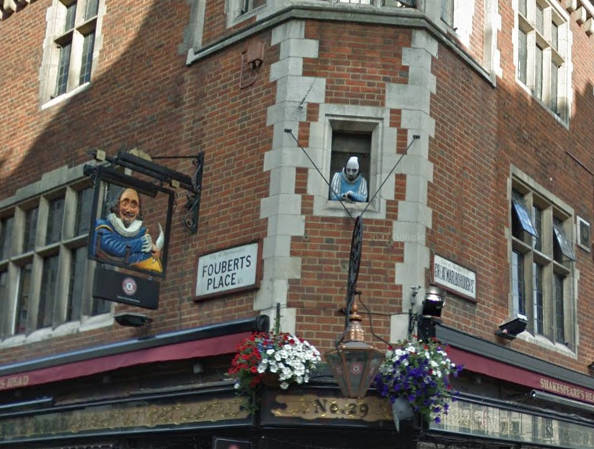
Located at the northern end of Carnaby Street, this Soho pub features a life-sized bust of the Bard looking out of a first floor window at the people passing by in the street below.
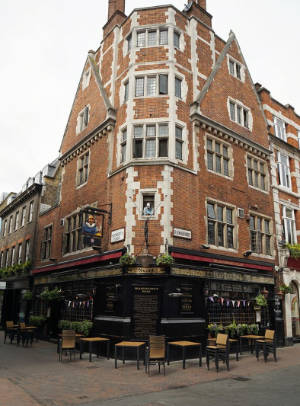
According to the pub’s signage, it was first constructed in 1735 and owned by Thomas and John Shakespeare, who were said to be distant relatives of William (and, if indeed they were the owners, no doubt keen to capitalise on his fame).
The current, rather ornate, building, designed in a faux-Tudor style, reportedly dates from the late 19th century.
As well as the bust, which features a missing hand due to damage from a bomb in World War II, the pub sign features an image of Shakespeare with his quill poised.
The pub, now part of the Greene King chain, is located on the corner of Fouberts Place and Carnaby Street (although its address is 29 Great Marlborough Street – it has a street sign for this on its facade – we’ll try and find out some more about why this is so). For more, see www.greeneking.co.uk/pubs/greater-london/shakespeares-head.
This Week in London – ‘Spies, Lies and Deception’ at IWM London; the printing of Shakespeare’s plays; and, Georgian illuminations at the Sir John Soane’s Museum…
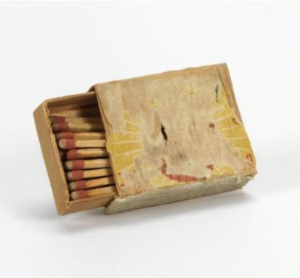
secret messages used during World War II. © IWM (EPH 178)
• A free exhibition exploring the “tricks, tools and elaborate plots that make up the secret world of spying and deception” has opened at IWM London. Spies, Lies and Deception features more than 150 objects including gadgets, official documents, art and newly digitised film and photography. Highlights include Operation Mincemeat mastermind Ewen Montagu’s private papers relating to the World War II plot – which fooled German High Command about the location of the next major Allied assault by planting a dead body with fake military documents off the Spanish coast – along with an oar from the submarine’s dinghy which deposited the body. There is also a box of matches with a match specially adapted for writing secret messages (pictured), footprint overshoes made by SOE (Special Operations Executive) in South-East Asia during World War II to disguise the wearer’s real footprints, and papier-mâché heads used to deceive snipers in World War I trenches. The exhibits also detail the work of the World War I Postal Censorships department – which examined letters sent to foreign locations including testing letters for invisible ink and tell the story of SOE operative Noor Inayat Khan – the first female wireless operator sent by SOE into Occupied France, she successfully transmitted messages to London for four months before being betrayed, captured and executed. There’s also a newly commissioned interview with Eliot Higgins, founder of Bellingcat, an international collective of researchers who used open source data to uncover the real identities of those responsible for the Salisbury Novichok poisonings in 2018, along with a photo album of double agent Kim Philby in Siberia after he escaped to the Soviet Union following his discovery in 1963. The free display can be seen until 14th April next year. For more, see iwm.org.uk/events/spies-lies-and-deception.
• A exhibition looking at the history of printing William Shakespeare’s plays has opened at the Guildhall Library. Folio 400: Shakespeare in Print covers everything from the printing of the small ‘Quartos’ of the late 16th century to the reworking of the text in the 18th century and the rediscovery of original texts in the 19th century. Running in parallel is a display at the City of London Heritage Gallery at Guildhall Art Gallery which features the library’s copy of the First Folio, widely regarded as one of the finest and most complete. Entry is free. Runs until 30th January. For more, see www.cityoflondon.gov.uk/things-to-do/history-and-heritage/guildhall-library.
• An exhibition centring on the spectacular light illuminations of the Georgian period has opened at Sir John Soane’s Museum. Georgian Illuminations celebrates the light shows of the period and the impressive and the elaborate temporary architectural structures created for them, often designed by leading architects and artists, including Sir John Soane. It features newly discovered linen transparencies, which were back-lit in Georgian windows as patriotic decoration during the Napoleonic Wars, as well as a contemporary work by light artist Nayan Kulkarni light artist which sees the facade of the museum at Lincoln’s Inn Fields illuminated each night from dusk until about 11pm. A series of events accompanies the exhibition. Runs until 7th January, 2024. Entry is free. For more, see www.soane.org/exhibitions/georgian-illuminations,
Send all items to exploringlondon@gmail.com for inclusion.
This Week in London – Georgian fashion; Shakespeare’s First Folio; what’s new at the British Museum…
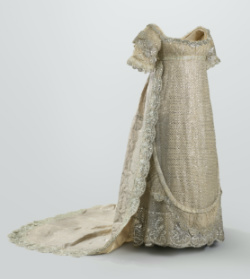
Princess Charlotte of Wales, 1816. PICTURE: Royal Collection Trust/© His Majesty King Charles III 2023
• The only royal wedding dress that survives from the Georgian period – the silk embroidered bridal gown of Princess Charlotte of Wales, daughter of King George IV – is one of the star sights at a new exhibition at The Queen’s Gallery, Buckingham Palace. Style and Society: Dressing the Georgians features more than 200 works from the Royal Collection including rare surviving examples of clothing and accessories as well as artworks by artists such as Gainsborough, Zoffany and Hogarth. Other highlights include a portrait of the wedding ceremony of George IV and Princess Caroline of Brunswick by John Graham – on display for the first time – as well as the original silver and gold dress samples supplied for the bride and other royal guests. There’s also a Thomas Gainsborough,’ depicting’s full-length portrait of Queen Charlotte wearing a magnificent court gown, a preserved gown of similar style worn at Queen Charlotte’s court in the 1760, and life-size coronation portraits of George III and Queen Charlotte by Allan Ramsay. Other items include a 1782 portrait of Prince Octavius, the 13th child of George III and Queen Charlotte, by Benjamin West in which the three-year-old wears a a style of dress known as a ‘skeleton suit’, jewellery including diamond rings given to Queen Charlotte on her wedding day and a bracelet with nine lockets – one with a miniature of the left eye of Princess Charlotte of Wales, and accessories such as a silver-gilt travelling toilet service acquired by the future George IV as a gift for his private secretary at a cost of £300. The exhibition can be seen until 8th October. Admission charges apply. For more, see www.rct.uk.
• One of the finest copies of Shakespeare’s First Folio goes on display at the City of London’s Guildhall Library for just one day on Monday, 24th April, as part of the celebrations surrounding the 400th anniversary of its publication. The document will be on display between 10.30am to 3.30pm with a 10-minute introductory talk given on the hour throughout the day. Two small and original copies (‘Quartos’) of Henry IV Part One and Othello will also be on display, next to a replica copy of the First Folio that visitors can look through. The First Folio brought together 36 plays in one volume and was published in an edition of around 750 copies on 8th November, 1623 – seven years after Shakespeare’s death. It is now regarded as one of the most valuable books in the literary world. For more, see www.cityoflondon.gov.uk/things-to-do/history-and-heritage/guildhall-library.
• Prints and drawings acquired by the British Museum over the past five years have gone on show in Room 90. New acquisitions: Paul Bril to Wendy Red Star features works ranging from an early 17th-century study for a fresco by the Flemish artist Paul Bril to 19th century drawings by Dante Gabriel Rossetti, 2019 prints by the Apsáalooke (Crow) artist Wendy Red Star and Cornelia Parker’s From H to B and back again – made during with the COVID-19 pandemic. Can be seen until 10th September. Admission is free. For more, see britishmuseum.org/exhibitions/new-acquisitions-paul-bril-wendy-red-star.
Send all items for inclusion to exploringlondon@gmail.com.
This Week in London – Shakespeare’s First Folio; Charles Dickens and fog; and, Berthe Morisot at Dulwich…
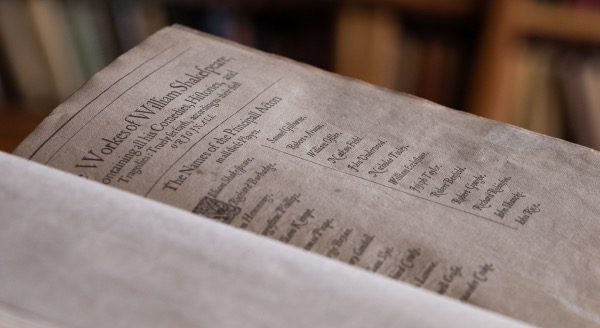
• Shakespeare’s First Folio goes on display at the National Maritime Museum in Greenwich from tomorrow. The display is part of a national celebration of the 400th anniversary of the folio’s publication. Shakespeare’s First Folio was published in 1623, seven years after the playwright’s death. Some 235 copies are known to survive with 50 remaining in the UK. The version on display – the Dulwich College Folio, which includes the Comedies and Histories (but lack the Tragedies), is believed to have been acquired by the college in 1686 from the estate of William Cartwright, a bookseller and actor who performed with the King’s Company and is known to have played Brabantio in Othello and Falstaff in Henry IV Part I and Part II. The two volumes feature handwritten notes, ink and water stains, and burn holes, suggesting they were well-used before the college acquired them. The Tempest and the Thames can be seen until 24th September. Admission is free. For more, see www.rmg.co.uk/folio-400.
• London’s fog and its reflection in Charles Dickens’ writings are the subject of a new exhibition opening at the Charles Dickens Museum in Bloomsbury. A Great and Dirty City: Dickens and the London Fog explores how the fog affected Dickens’ work, his health and that of his family, and how London has endeavoured to mitigate the problem of air pollution over the past couple of centuries. Among the items on display are the hearthstone Dickens laid in front of the fireplace in the Drawing Room, the fire poker from Dickens’ dining room at Gad’s Hill Place (his home from 1856 until his death in 1870), original first edition parts of Dickens’ ‘foggiest’ novel Bleak House, an original pen and wash illustration by Frederick Barnard depicting Martin Chuzzlewit, Mary Graham, and Mark Tapley, and, a letter from Dickens to his sister-in-law Helen Dickens in which he writes about his brother Alfred’s “inflammation in the region of the lungs” which is dated on 16th July, 1860 – just 11 days before Alfred’s death. Runs until 22nd October. Admission charge applies. For more, see https://dickensmuseum.com.
• Forty of Impressionist painter Berthe Morisot’s works have been brought together for a new exhibition at the Dulwich Picture Gallery. Berthe Morisot: Shaping Impressionism, which opens tomorrow, is the first major UK exhibition of the renowned Impressionist since 1950 and features many works never seen before. Highlights include Eugène Manet on the Isle of Wight (1875) – painted while Morisot was on honeymoon in England, Self-Portrait (1885) – which will appear alongside Jean-Honoré Fragonard’s Young Woman (c.1769) from Dulwich Picture Gallery’s collection, Apollo revealing his divinity to the shepherdess Issé, after François Boucher (1892), In the Apple Tree (1890) and Julie Manet with her Greyhound Laerte (1893). Runs until 10th September. Admission charge applies. For more, see www.dulwichpicturegallery.org.uk.
Send all items to exploringlondon@gmail.com.
10 London hills – 5. Primrose Hill…

Standing in a park located just to the north of Regent’s Park in the city’s inner north-west, Primrose Hill stands 63 metres above sea level and, like Parliament Hill, provides panoramic views of the city skyline.
The hill, which features one of six protected views in London, was once part of a chase (unenclosed hunting land) owned by King Henry VIII and was Crown property until 1842 when it became part of a public park through an Act of Parliament.
The name has been in use for at least 500 years and is thought to refer to the flowers that grew here profusely (which it means it can’t have been named for Archibald Primrose, Prime Minister between 1894 and 1895).
The hill forms part of one of Mother Shipton’s “prophecies” – she apparently proclaimed that when London surrounded the hill, its streets would run with blood.
It was for a time known as Greenberry Hill after three labourers – Robert Green, Henry Berry and Lawrence Hill – were found guilty of the murder of magistrate Sir Edmund Berry Godfrey (he had heard Titus Oates’ evidence in the so-called Popish Plot). Sir Edmund was found impaled on his own sword on the hill in October, 1678 – convicted of his murder the three men were hanged on its summit in 1679 (they were later exonerated and the death of Sir Edmund remains something of a mystery).
The hill, which has also apparently been known as Battle Hill, was also the location where the poet and antiquarian Iolo Morganwg (Edward Williams) founded the Gorsedd, a community of Welsh bards, on 21st June in 1792.
In 1838, a railway tunnel under the hill was completed by the North Western Railway – it was the first in London and connected Chalk Farm and Swiss Cottage. In the 1840s, a proposal to create a cemetery here was put to Parliament but never went ahead. There were also plans to develop the entire hill as a housing estate but nothing came of it.
On top of the hill is York stone edging with an inscription by William Blake: “I have conversed with the spiritual sun. I saw him on Primrose Hill.” There’s also the remains of an anti-aircraft battery from World War II.
On the hill’s slope, meanwhile, is a tree planted in 1964 to mark the 400th anniversary of Shakespeare’s birth (it replaced once planted 100 years earlier in honour of the Bard’s 300th).
Primrose Hill gives its name to part of the surrounding area, which remains a sought-after residential district.
For details on when to visit, head to www.royalparks.org.uk/parks/the-regents-park/things-to-see-and-do/primrose-hill.
Famous Londoners – William Marshal (part II)…
We published part I of this two-part article last week. Part II follows…
Marshal had made his name as a knight and, was still in the retinue of Henry, the Young King, heir of Kind Henry II, when he again rebelled against his father (and brother, the future King Richard I).
This was despite a brief rift with the Young King following an accusation that Marshal had slept with Henry’s wife Marguerite (the truth of which remains something of a mystery). Despite their falling out, William and Henry had repaired their relationship to at some degree when, still in rebellion against his father, on 7th June, 1183, the Young King died of dysentery at just the age of 28.
 In a dying wish, Henry had asked William to fulfil his vow to go on crusade to the Holy Land. This Marshal duly did, undertaking a pilgrimage to Jerusalem and spending two years in the Middle East before returning to England at around the end of 1185.
On his return, he entered the household of King Henry II and was on campaign with him in France in 1189 when the King died at the age of 56.
Marshal’s allegiance was now with his son and heir, King Richard I, the “Lionheart”. He subsequently confirmed his father’s permission for Marshal to marry his ward, the wealthy heiress the 16-year-old Isabel of Clare which Marshal, now 42, quickly did, returning to London to claim his bride who was then living at the Tower of London. It’s believed they may have married on the steps of St Paul’s.
Somewhat controversially, when Richard I set off on the Third Crusade, Marshal remained behind in England, appointed as co-justiciar to govern in the king’s absence. Thanks to his marriage, Marshal was now a major landholder with his base at Striguil Castle (now Chepstow) in the Welsh Marches and he assembled a household befitting of his status. In 1190 his wife Isabel gave birth to a son, ‘Young’ William.
Marshal managed to successfully navigate the dangerous politics of the time as, in the absence of King Richard, his younger brother John manoeuvred to gain power and, following news that Richard had been captured on the way home from the Holy Land and was now imprisoned in Austria, went so far as to open ally himself with the French King Philip Augustus.
Richard was finally released for the exorbitant ransom of 150,000 silver marks and when he arrived back in England, Marshal returned to his side, joining the King as he dealt with the fallout, both in England and France, from John’s treachery (John, meanwhile, was back in his brother’s camp, having begged his forgiveness).
His kingdom largely restored, Richard died in April 1199 after being struck with a crossbow bolt while campaigning in Limousin. Following his death, Marshal supported John’s claim to the throne over his ill-fated nephew Arthur and at John’s coronation he was rewarded by being named, thanks again to his marriage, the Earl of Pembroke – the title of earl being the highest among the English aristocracy.
Pembroke in southern Wales now became his base but following John’s coronation Marshal spent considerable time fighting for the King on the Continent in an ultimately unsuccessful campaign that ended with the English largely driven from France. When Marshal then tried to keep his lands in Normandy by swearing an oath to King Philip, not surprisingly he fell from John’s favour.
Marshal then turned his attention to his own lands in Wales and in Ireland which he visited several times to assert his claim by marriage to the lordship of Leinster. But he again crossed John when he visited in early 1207 without the King’s permission and when John summoned Marshal back to England to answer for his impudence, his lands in Leinster were attacked by the King’s men. John’s efforts to seize Marshal’s Irish domains, however, failed and the King was eventually forced to back down, leaving Marshal to strengthen his position in Ireland.
John and Marshal’s relationship deteriorated even further in 1210 after Marshal was summoned to Dublin to answer for his role in supporting William Briouze, a one-time favourite of the King who had dramatically fallen out him (and who eventually died in exile in 1211 while his wife and eldest son were starved to death in Windsor Castle on John’s orders).
Despite the fact Briouze’s had apparently been on his lands in Ireland for 20 days after they’d fled England to escape the wrathful King, Marshal managed to come out relatively unscathed by the affair – but he was forced to relinquish a castle and place some of his most trusted knights and eldest sons in the King’s custody.
By 1212, however, Marshal was back in royal favour – his sons were freed the following year – and in 1213 he led his forces in support of King John who was facing revolt in England and a possible invasion from France (Marshal subsequently remained in England to guard against attack from the Welsh while the King was in France).
In 1215, Marshal was involved in the creation of the Magna Carta – his name was the first the English lords to appear on the document – and some have even suggested he was one of its principal architects (although this may be overstating his role).
He remained loyal to John in the subsequent strife but he was in Gloucester when King John died in 1216.
Marshal subsequently supported the claim of King John’s son, King Henry III, to the throne and, named as a ‘guardian of the realm’ (a role which was essentially that of a regent), he played an instrumental part in taking back the kingdom for Henry, including successfully leading the royalist forces against a French and rebel force on 20th May, 1217, at Lincoln – a battle which brought about a quick resolution to the ongoing war.
Marshal spent the next couple of years working to restore the King’s rule but in early 1219, at the age of 72, fell ill and retreated to his manor house at Caversham.
He died around noon on 14th May. His body was taken to London via Reading and after a vigil and Mass at Westminster Abbey, he was interred in the Temple Church.
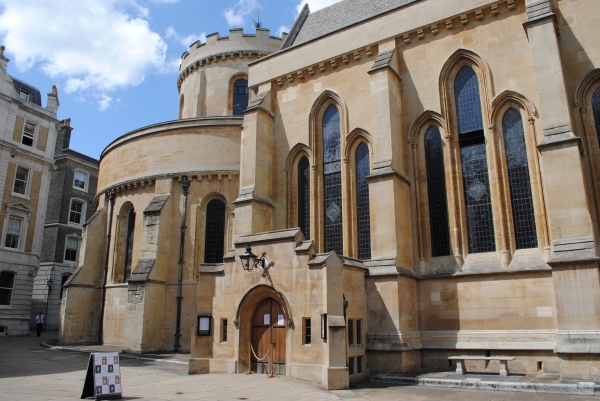
Marshal’s place of burial was due to an agreement he had made with the Templars back in the 1180s in which he agreed to enter their order before his death in exchange for the gift of a manor. The master of the Templars in England, Aimery of St Maur, had apparently travelled to Caversham before his death to perform the rite.
Marshal’s wife Isabel died the following year and sadly, while he had five sons, the Marshals gradually faded from history, the lack of male heirs in the family eventually leading to the break-up of the family lands.
A towering figure of his age – seen by many as the epitome of what a knight should be, Marshal’s story – despite a minor mention as Pembroke in Shakespeare’s King John – has largely been forgotten. But his influence on the world in which he lived – and hence the shaping of our world today – was significant.
With thanks to Thomas Asbridge’s The Greatest Knight: The Remarkable Life of William Marshal, the Power Behind Five English Thrones…
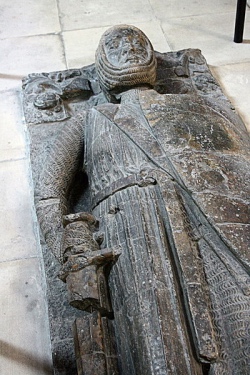
PICTURES: Top – An effigy believed to be that of William Marshal in the Temple Church, London (Michael Wal – licensed under CC BY-SA 2.0). Lower – The Temple Church in London in which William Marshall was buried. PICTURE: David Adams
London Pub Signs – The Sir John Oldcastle…
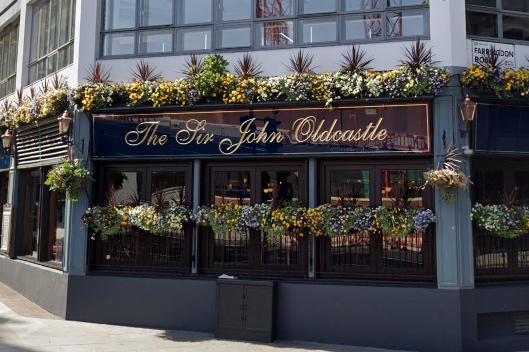
This Farringdon pub is named after a previous tavern which stood in what had been the grounds of Sir John Oldcastle’s nearby mansion and dated back at least to the mid 17th century.
Sir John, thought to have been the model for the Shakespearean character Sir John Falstaff, was a leader of the Lollards in the late 14th and early 15th centuries.
A trusted friend of Henry, Prince of Wales (later King Henry V), he accompanied the Prince on a military expedition to France 1411 but on returning to England was accused of heresy for his Lollard beliefs and eventually prosecuted.
Imprisoned in the Tower of London, Oldcastle escaped and launched a rebellion against the King but after the rebellion was put down was forced to live in hiding until he was eventually, in 1417, captured and subsequently executed in London.
Housed in a modern building, the pub at 29-35 Farringdon Road, which has a wealth of historical information about the area adorning its walls, is part of the Wetherspoons chain. For more, see www.jdwetherspoon.com/pubs/all-pubs/england/london/the-sir-john-oldcastle-farringdon.
LondonLife – Four London sites heritage listed in 2019…
We’ve entered a new year but before we leave 2019 completely behind, here’s quick look at four sites in London that were put on the National Heritage List for England last year…
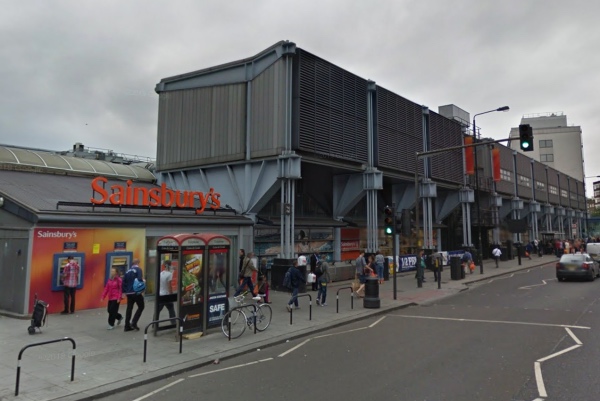
1. Sainsbury Supermarket, Camden Town. Listed at Grade II, it was the first purpose-built supermarket to be placed on the National Heritage List. The store was built in 1986-88 as part of Grand Union Complex designed by architectural practice Nicholas Grimshaw & Partners.
2. The Curtain Playhouse, Shoreditch. A scheduled monument, the theatre dates from about 1577 and hosted performances of Romeo and Juliet during Shakespeare’s lifetime, as well as Ben Jonson’s Every Man in His Humour with Shakespeare himself listed as a performer. Archaeological investigations in the years from 2011-16 revealed parts of the stage as well as the wings, galleries and yards and 17th century structures which showed the later use of the site as tenement housing.
3. Nursemaid’s Tunnel, Regent’s Park. Grade II listed, this is one of the earliest surviving pedestrian subways in London. It was built under New Road (now Marylebone Road) – linking Park Crescent with gardens in Park Square – in 1821 after residents campaigned for its construction due to the dangers of navigating the busy road (especially for children being taken to the playground by their nursemaids).
4. Cabman’s Shelter, corner Northumberland Avenue and Embankment Place. Grade II-listed, this still-in-use shelter was built in 1915 on the orders of the Cabmen’s Shelter Fund. It was based on Maximilian Clarke’s original design of 1882 and is one of just 13 examples to survive in London.
PICTURE: Google Maps.
LondonLife – Shakespeare at home?
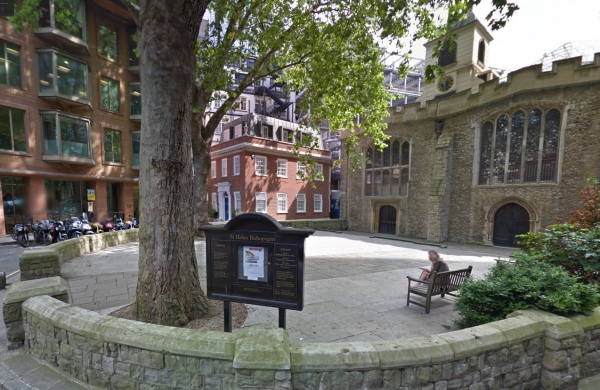
A theatre historian believes he has discovered where William Shakespeare lived while he was writing some of his most famous works including Romeo and Juliet and A Midsummer Night’s Dream. While it has long been known the playwright lived close to the site of Liverpool Street station in the late 1590s, Geoffrey Marsh says an examination of official records has pinpointed the location as being on the site of what is now an office block at 35 Great St Helen’s, only a stone’s throw from The Gherkin. The BBC reports that Marsh, who is also the director of the V&A’s department of theatre and performance, found Shakespeare was a tenant of the Company of Leatherworkers and most likely lived among dwellings overlooking the churchyard of St Helen’s Bishopsgate, pictured above. PICTURE: Via Google maps
This Week in London – Van Gogh and Britain; miniature Elizabethan portraits; and, ‘Jews, Money, Myth’…
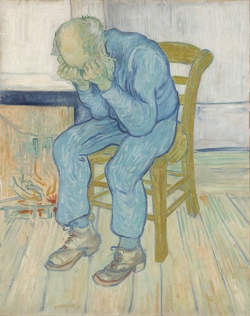 • The first exhibition to examine the work of Dutch artist Vincent van Gogh through his relationship with Britain has opened at Tate Britain this week. Van Gogh and Britain includes more than 40 works by the artist including L’Arlésienne (1890), Starry Night on the Rhone (1888), and Sunflowers (1888). The exhibition will also feature later works by Van Gogh including two he painted while in the Saint-Paul asylum – At Eternity’s Gate (1890 – pictured) and Prisoners Exercising (1890). The exhibition shows how Van Gogh, who lived in London between 1873 and 1876 working as a trainee art dealer, responded to works by artists like John Constable and John Everett Millais and his love of British writers like William Shakespeare, Christina Rossetti and, particularly, Charles Dickens (L’Arlésienne features one of Dickens’ favourite books in the foreground). The show runs until 11th August and is being accompanied by a series of talks and other events. Admission charge applies. For more, see www.tate.org.uk. PICTURE: Vincent van Gogh (1853 –1890), ‘Sorrowing old man (‘At Eternity’s Gate’)’ (1890), Collection Kröller-Müller Museum, Otterlo
• On Now – Elizabethan Treasures: Miniatures by Hilliard and Oliver. This exhibition at the National Portrait Gallery – which is focused on the work of Nicholas Hilliard (1547-1619) and Isaac Oliver (c1565-1617) – is the first major display of Tudor and Jacobean portrait miniatures to be held in the UK for more than 35 years and includes new discoveries as well as portraits on public display for the first time. A large section of the exhibition is devoted to portraits of Queen Elizabeth I as well as King James I, his wife Anne of Denmark and his three children – Henry, Elizabeth and Charles (later King Charles II). There are also miniatures of famous figures like Sir Walter Ralegh, Sir Francis Drake and a little known portrait of Shakespeare’s patron, the Earl of Southampton. Other highlights include a previously unknown portrait by Hilliard of King Henri III of France. Runs until 19th May. Admission charge applies. For more, see www.npg.org.uk.
• A major exhibition exploring the role of money in Jewish life has opened at the Jewish Museum London in Camden Town. Jews, Money, Myth looks at the “ideas, myths and stereotypes” that link money and Jews over two millennia. It features art works such as Rembrandt’s Judas Returning the Thirty Pieces of Silver as well as new commissions by Jeremy Deller and Doug Fishbone along with film, literature and cultural emphemera ranging from board games and cartoons to costumes and figurines. There are a series of related events. For more, see www.jewishmuseum.org.uk.
Send all items for inclusion to exploringlondon@gmail.com.
This Week in London – Recalling Sir Joseph Bazalgette; Pierre Bonnard retrospective; and Bill Viola meets Michelangelo…
• A plan of the Deptford Pumping Station signed by Sir Joseph Bazalgette is going on display at the City of London Heritage Gallery on Saturday to mark 200 years since the Victorian engineer’s birth. Other items in the new display include the Shakespeare Deed – only one of six documents to bear the signature of William Shakespeare, and one of the City of London’s earliest charters – granted by King Richard I in 1197. Admission to the gallery, located in the Guildhall Art Gallery, is free. Runs until 16th May. For more, follow this link.
 • The first major retrospective of French painter Pierre Bonnard in 20 years has kicked off at the Tate Modern on South Bank. The CC Land Exhibition, Pierre Bonnard: The Colour of Memory, features about 100 of his most celebrated works from public and private collections spanning the period from 1912 to his death in 1947. Bonnard, like his friend Henri Matisse, had a profound impact on modern painting and went on to influence the likes of Mark Rothko and Patrick Heron. Works on show include Dining Room in the Country (1913), The Lane at Vernonnet (1912-14), Coffee (1915), Summer (1917), Piazza del Popolo, Rome (1922), Nude in an interior (c1935), and Studio with Mimosa (1939-46). Runs to 6th May; admission charge applies. For more, see http://www.tate.org.uk. PICTURE: Pierre Bonnard (1867–1947), Coffee (Le Café), 1915, Oil paint on canvas (via Tate Modern)
• The work of pioneering video artist Bill Viola has been brought together with drawings buy Michelangelo in a new exhibition opening at the Royal Academy on Saturday. Bill Viola/Michelangelo features 12 major video installations by Viola, an honorary Royal Academician, which span the period 1977 to 2013 as well as 15 works by Michelangelo including 14 highly finished drawings as well as the Academy’s Taddei Tondo. It proposes a “dialogue” between the two artists with Viola, who first encountered Michelangelo’s works in the 1970s in Florence, considered an heir to the long tradition of spiritual and affective art which uses emotion to connect viewers with the subject depicted. Runs until 31st March. Admission charge applies. For more, see www.royalacademy.org.uk.
Send all items for inclusion to exploringlondon@gmail.com.
London Pub Signs – The Crosse Keys…
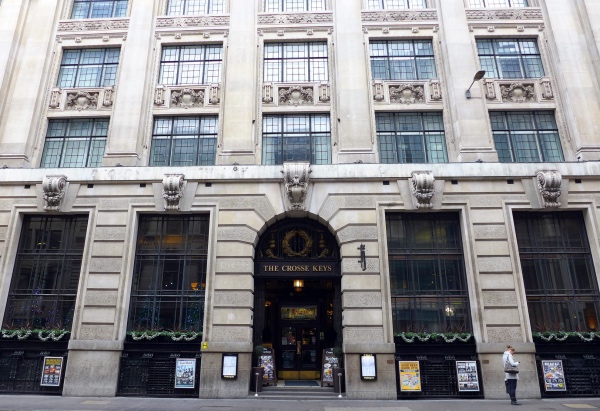
This City of London pub – a sizeable establishment to say the least, takes its name from a building that no longer exists.
Located at 9 Gracechurch Street, The Crosse Keys is located in a former purpose-built bank – that of the Hong Kong and Shanghai Banking Corporation. Designed by W Campbell Jones, the Grade II-listed building opened in 1913 and featured the largest banking floor in the City at the time.
The bank moved out in the latter part of the 20th century and JD Wetherspoon moved in, opening it as The Crosse Keys and keeping much of the original opulent interior, including marble pillars and fireplaces and a magnificent glass dome above the stairwell.
Oh, and the name? That comes from The Crosskeys Inn, a famous coaching inn which once stood on the site and took its name from the keys of heaven, held by St Peter (the crossed keys form part of the Holy See’s coat of arms).
The origins of the inn go back to before the Great Fire of London in 1666 (the inn’s yard also served as a playhouse during the Elizabethan era – the Lord Chamberlain’s Men, of which Shakespeare himself was a member, were said to be among those who performed here).
It was destroyed in the Great Fire, rebuilt and burnt down again in 1734. Rebuilt again, by the late 1800s, it had become a well known coaching inn, said to cater for some 40 or more coaches a day.
There’s a City of London blue plaque marking the site and inside, plenty of historical facts and figures in a series of prints on the walls.
For more, see www.jdwetherspoon.com/pubs/all-pubs/england/london/the-crosse-keys-city-of-london.
PICTURE: The rather grand facade of The Crosse Keys (Ewan Munro; licensed under CC BY-SA 3.0)
Lost London – Poet’s Fountain…
This rather large fountain once stood in Mayfair as a tribute to literary greats Geoffrey Chaucer, William Shakespeare and John Milton.
Designed by Thomas Thorneycroft (and apparently funded from wealth of a lady who died intestate but who had apparently always advocated for the location of a fountain on the site), the fountain stood on the centre of what is now a roundabout at the intersection of Old Park Lane and Hamilton Place.
Unveiled in July, 1875, it featured the three poets standing on various sides of a central pillar (Shakespeare taking pride of place looking towards Hyde Park). Below them sat three muses and above them, on top of a central column, stood a figure representing fame, blowing a trumpet.
The fountain, and survived until World War II during which it sustained damaged. It was dismantled in 1948 and only the figure of ‘Fame’ is believed to have survived.
This Week in London – Queen Elizabeth I’s letters; ‘used and abused’ books; Sir Mark Rylance at Westminster Abbey…
 • Forty-three letters written by Queen Elizabeth I and her senior advisors concerning the imprisonment of Mary, Queen of Scots, have been donated to the British Library. Many of the 43 letters were written to Sir Ralph Sadler, who held the Scottish Queen in custody at Tutbury Castle in Staffordshire between 1584-85 prior to her execution in 1587. Four of the letters are signed by Queen Elizabeth I and others are written in the hand of Chief Minister Lord Burghley and Secretary of State, Sir Francis Walsingham. The collection has been on loan to the library for a number of years but has now been gifted by the industrialist and philanthropist Mark Pigott to the American Trust for the British Library. The library plans to digitise the letters and make them available on its Digitised Manuscripts website.
• The alteration of books through customisation, decoration or disguise is the subject of a new exhibition opening at the Guildhall Library on Monday. Books: Used and Abused shows how some books have been used as notepads or expanding files while others have become containers. A free ‘book surgery’ advice session will be held at the library on 22nd February for people to learn about their own ‘used and abused’ books and how to repair them. Runs until 9th March. Entry is free (booking required for the free advice session). For more, head here.
• Sir Mark Rylance will bring the words of Shakespeare to life in six special performances at Westminster Abbey this April. All Places that the Eye of Heaven Visits will feature a cast of 23 actors from Shakespeare’s Globe performing extracts from some of the Bard’s most famous plays and poetry. The performances will occur over 26th to 28th April. Tickets go on sale on 29th January via the Shakespeare’s Globe box office.
Send all items for inclusion to exploringlondon@gmail.com.
10 sites of significance in Jane Austen’s London…10. A final memorial…
 Jane Austen died in Winchester, Hampshire, on 18th July, 1817, at the age of just 41. She was buried in the city’s cathedral but a small tablet was unveiled in Westminster Abbey to mark her death 150 years later.
Located in Poets’ Corner in the abbey’s south transept, the small tablet was erected on 17th December, 1967, by the Jane Austen Society. Made of polished Roman stone, it simply bears her name and year of birth – 1775 – and year of death.
The tablet was placed on the lefthand side of the (much larger) memorial to William Shakespeare and below that of lexicographer Samuel Johnson.
This is the final in our series on Jane Austen’s London – we’ll be starting a new series shortly.
WHERE: Westminster Abbey (nearest Tube station is Westminster and St James’s Park); WHEN: Various – check website; COST: £22 adults/£17 concessions/£9 chirldren (6-16)/five and under free (check website for more options); WEBSITE: www.westminster-abbey.org
PICTURE: Carcharoth (Commons)/CC BY-SA 3.0 (image cropped)
This Week in London – Royal Gifts at Buckingham Palace; celebrating life on London’s stages; and, Kew Gardens’ summer fun…
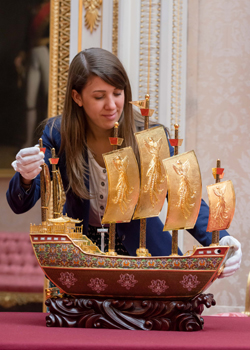 • The exchanging of gifts on Queen Elizabeth II’s official engagements both in the UK and overseas is the subject of a special exhibition at this year’s summer opening of the Buckingham Palace State Rooms. Displayed throughout the rooms are more than 250 objects from more than 100 countries and territories and among the gifts on show is the Vessel of Friendship (pictured), a model of a 15th century ‘treasure ship’ sailed by Chinese navigator and diplomat Zeng He which was presented to the Queen by President Xi Jinping of China during a State Visit to Buckingham Palace in October, 2015. There’s also a colourful beaded Yoruba throne presented to the Queen by the people of Nigeria in 1956, a pair of baskets woven from coconut leaves given by Queen Salote Tupou III of Tonga during a visit by the Queen and Duke of Edinburgh in 1953, and a wooden totem pole presented to the Queen during a visit to Canada in 1971. Royal Gifts can be seen at the palace from Saturday until 1st October. Admission charge applies. For more, see www.royalcollection.org.uk. PICTURE: Royal Collection Trust/© Her Majesty Queen Elizabeth II 2017.
• The lives of some of London’s most popular entertainers is the subject of a new exhibition at the London Metropolitan Archives in Clerkenwell. Life on the London Stage employs documents, prints and photographs to depict the lives of entertainers from the days of the Elizabethan theatre through to the 20th century. Among those whose lives are depicted are everyone from Edmund Keen and Dame Ellen Terry to Sir Henry Irving and Charlie Chaplin. Objects on show include documents recording the tragic life of William Shakespeare’s brother Edmund Shakespeare, Sir Laurence Olivier’s orders for bespoke boots and letters from Carry On actor Kenneth Williams to a young fan. Runs until 6th December. Admission is free. For more, see www.cityoflondon.gov.uk/lma.
• Three time British Open champion and perhaps the first ‘celebrity golfer’ Henry Cotton has been honoured with an English Heritage Blue Plaque. The plaque, which was unveiled earlier this month, is located at the golfer’s former home at 47 Crystal Palace Road in East Dulwich. Cotton lived there with his family during his early years and developed the skills that would later lead to his success in the sport. For more, see www.english-heritage.org.uk/visit/blue-plaques/.
• Head to the countryside at Kew Gardens as it hosts an ‘Insect Adventure Camp’ in its newly named ‘Natural Area’ of native woodlands this summer. The camp features bell tents, woodland houses, picnic tables and trails which will host a series of family-friendly activities including animation workshops, insect safaris and the chance to explore specimens under a microscope. Other attractions at the gardens this summer include a virtual reality climbing experience following head arborist Tony Kirkham as he scales at 150-year-old Giant Redwood, the return of the kitchen gardens, the Hive installation and the Kew Science Festival. Admission charges apply. Dates vary for different events, so head to www.kew.org for more information.
Send all items for inclusion to exploringlondon@gmail.com.
This Week in London – New insights into Canaletto’s Venice; a rare Shakespearean opportunity; and, a Green Plaque for William Henry Hudson…
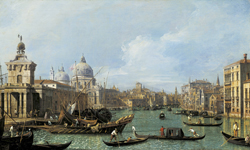 • Methods employed by world renowned 18th century Venetian painter Canaletto in creating his evocative images of the city where he lived are the subject of a new exhibition which opens at The Queen’s Gallery in Buckingham Palace tomorrow. Canaletto & the Art of Venice showcases the findings of recent research in an exhibition which focuses on the Royal Collection’s remarkable group of paintings, drawings and prints by the artist – a collection obtained by King George III in 1762 from dealer (and the then-British Consult in Venice) Joseph Smith. Royal Collection Trust conservators used infrared technology to uncover previously hidden marks on drawings, providing new insights into Canaletto’s artistic techniques and casting doubt on a long held theory that he used a camera obscure to achieve topographical accuracy in his work. The exhibition, which features more than 200 paintings, drawings and prints, displays his work alongside that of contemporary artists Sebastiano, Marco Ricci, Rosalba Carriera, Francesco Zuccarelli, Giovanni Battista Piazzetta and Pietro Longhi. Runs until 12th November. Admission charge applies. For more, see www.royalcollection.org.uk. PICTURE: Canaletto, The Grand Canal looking East from Campo San Vio towards the Bacino, c.1727-8, from a set of 12 paintings of the Grand Canal. Royal Collection Trust/© Her Majesty Queen Elizabeth II 2017
• A rare ‘First Folio’ of William Shakespeare’s work – widely regarded as one of the most perfect copies in existence – will be available for viewing before an outdoor performance of Twelfth Night next month. Five actors from acting company The Three Inch Fools will perform the comedy in the St Mary Aldermanbury’s Garden on 1st June at 7pm, the same garden where Henry Condell and John Heminges, two of the Bard’s co-partners at the Globe Theatre and the men behind the production of the First Folio in 1623, were buried. Those attending the performance will be given the chance to view the folio in the nearby Guildhall Library before the performance. Tickets to this one night only opportunity can be purchased from Eventbrite.
• Author and naturalist William Henry Hudson, whose work so inspired author Ernest Hemingway that his name was referenced in Hemingway’s first novel The Sun Also Rises, has been commemorated with a City of Westminster Green Plaque in Leinster Square, Bayswater. Born the son of British parents in Argentina, Hudson came to Westminster after leaving South America in 1874. An early support of the Royal Society for the Protection of Birds, his books on the English countryside became famous and helped foster the back to nature movement of the 1920s and 1930s.
Send all items for inclusion to exploringlondon@gmail.com.
10 of the most memorable (and historic) views of London – 2. The city skyline from Primrose Hill…
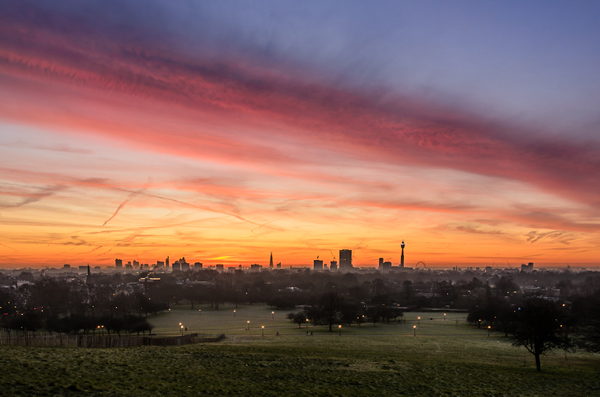
Standing some 200 feet above sea level (almost 63 metres), this rounded grassy hill, just to the north of The Regent’s Park proper, has long held a fascination for Londoners partly, at least, for the panoramic views it offers of the city skyline.
Once part of a hunting ground used by King Henry VIII, the hill – which has also been known as Battle and Greenberry Hill – was purchased in 1841 from Eton College to provide more public space for Londoners.
It has served as the site of a famous unsolved murder (that of magistrate Sir Edmund Berry Godfrey whose mysterious death, exploited by anti-Catholic plotter Titus Oates, caused considerable uproar) as well as duels, prize fights, mass gatherings and mystic happenings.
The latter have included it being the location where Edward Williams (Iolo Morganwg) first organised a gathering of druids, known as a Gorsedd of Bards, in 1792, as well as it being the subject of a prophecy by 16th century ‘soothsayer’ Mother Shipton warning that the streets would “run with blood” if the hill should become surrounded by urban sprawl.
Around the summit of the hill stands a York Stone edging feature bearing an inscription from poet William Blake – “I have conversed with the spiritual sun. I saw him on Primrose Hill” – while standing on the slope below is the famous Shakespeare’s Tree which was originally planted in 1864 to mark the 300th anniversary of the Bard’s birth (but was replaced in 1964).
The view over London is one of a number of protected views in the city (meaning you can’t build anything block it) and the trees below the summit are kept deliberately low so as not to impede sightlines.
The nearby residential district known as Primrose Hill is noted for being home to numerous famous figures including the likes of Jude Law, Kate Moss and the Gallagher brothers. It is also where the aliens in HG Well’s book, War of the Worlds, intended making their headquarters.
WHERE: Primrose Hill, The Regent’s Park (nearest tube stations are Chalk Farm, Swiss Cottage, St John’s Wood and Mornington Crescent); WHEN: Usually always; COST: free; WEBSITE: www.royalparks.org.uk/parks/the-regents-park/things-to-see-and-do/primrose-hill.
PICTURE: Mike Rolls/Flickr/CC BY-SA 2.0 (taken in 2012).
Lost London – The Mermaid Tavern…
Located on Cheapside (with entrances on Friday and Bread Streets), the Mermaid Tavern is best known for being the home of Elizabethan-era drinking club known as the Mermaid Club (and also as the Friday Street Club or even the ‘Fraternity of Sireniacal Gentlemen’).
 Founded in the early 17th century (and meeting on the first Friday of each month), its members included such literary luminaries as Ben Jonson, John Donne and Francis Beaumont.
There are also suggestions it was founded by Sir Walter Raleigh and that William Shakespeare was also a member but modern scholars have cast doubt upon both claims.
The earliest reference to the tavern, meanwhile, dates from the early 15th century.
The tavern, the location of which today corresponds to the corner of Bread and Cannon Streets, burned down in the Great Fire of London but lives on in John Keats’ poem Lines on the Mermaid Tavern.
 Exploring London